Memento Park: Budapest’s Communist Statue Graveyard
After 1989, Budapest didn't destroy its Lenins and Soviet soldiers — it moved them twenty minutes south and arranged them in a field. What's actually there, and the one honest way to get to it.
In this guide
This article contains advertising. Our booking links are routed through a partner that adds commission tracking automatically, so if you book through one we earn a commission from the provider, at no extra cost to you. It never affects what we recommend. Affiliate disclosure
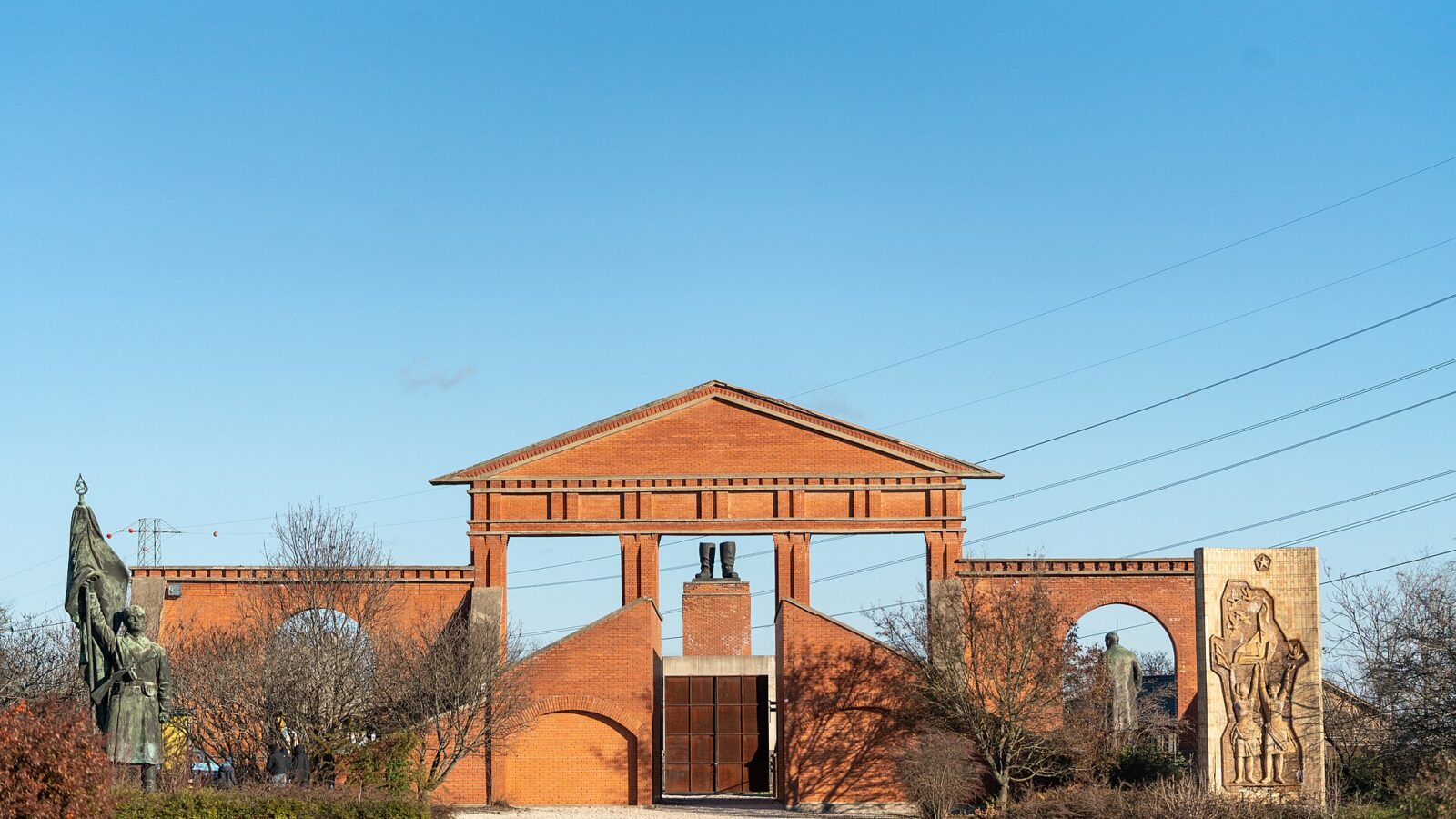
Memento Park Budapest is where the city sent everything it didn’t want looking down on it anymore. After the communist government fell in 1989, dozens of the outsized Lenins, Marxes and Soviet soldiers that had stood over Budapest’s squares for four decades came down — not smashed, not melted, but driven twenty minutes south of the city and arranged in a field behind a deliberately blank brick wall. It opened to the public in 1993 as Szoborpark, later rebranded Memento Park, and it remains one of very few places in the former Eastern Bloc that preserved this material rather than destroying it outright.
This guide covers what’s actually inside — the statues worth knowing the story behind, the recreated Stalin’s Boots monument at the entrance, the propaganda-film screening room, and the honest logistics of getting there, since this is the one major Budapest attraction with no metro option. Prices and hours were checked in September 2026.
At a glance
| What | Cost | Hours |
|---|---|---|
| Adult admission | 3,000 HUF (€7.50) | May–Oct daily 10:00–18:00; Nov–Apr daily 10:00–16:00 |
| Student | 1,800 HUF (€4.50) | Same hours |
| Child under 14 | 1,200 HUF (€3) | Same hours |
| Child under 6 | Free | Same hours |
| Direct shuttle bus from Deák tér | Included with a return ticket bought at the park’s city-centre point of sale | Departs 11:00 daily (Sat–Sun–Mon only Nov–Mar), returns 13:00 |
| Public transport | Standard BKK fare | M4 metro to Kelenföld, then bus 101B/101E (9 min) or 150 (25 min) to the Memento Park stop |
Why the statues weren’t destroyed
When Hungary’s communist government fell in 1989–90, most of the toppled regime’s statues across the former Eastern Bloc met one of two fates: destruction, or storage in some forgotten depot. Budapest took a third path. Architect Ákos Eleőd won a public competition to design a permanent home for the city’s removed monuments, and rather than treat the project as either a monument to communism or a mockery of it, he designed something closer to a museum of political theatre — the statues arranged with space and dignity, presented as historical artefacts rather than props for ridicule. Eleőd has described the park’s purpose less as being about the dictatorship these statues served, and more about the democratic process that allows a society to talk about that period openly rather than erase it. The park opened in June 1993 on a plot of land in Budapest’s XXII district, roughly ten kilometres south-west of the city centre, and has expanded its exhibits gradually since.
The site itself carries some of that intent in its architecture. The entrance building is built from unadorned brick, low and deliberately unimpressive — a conscious rejection of the monumental, propagandistic scale of the statues it introduces. Visitors buy tickets and pass through a narrow gate before the grounds open out, a sequencing Eleőd designed to echo the experience of moving through a one-party state’s bureaucracy: modest, procedural, faintly ominous, before arriving at the outsized figures the system built to tower over ordinary citizens. It’s an unusually thoughtful piece of exhibition design for what could easily have been a simple outdoor storage yard, and it’s part of why the park is taken seriously by historians and museum professionals rather than dismissed as a novelty attraction or a theme park for Cold War nostalgia.
It’s also worth being clear about what the park is not. This isn’t a memorial to victims of communism in the way Budapest’s House of Terror museum is, and it’s a different kind of stop again from a broader walking tour of communist-era Budapest that covers surviving architecture and street-level history around the city — that’s a different, considerably heavier institution housed in a former secret-police headquarters on Andrássy Avenue, documenting terror and interrogation rather than displaying public statuary. Memento Park is closer to an exercise in civic memory: what do you do, practically and symbolically, with the physical remains of an ideology a society has formally rejected but can’t pretend never happened.
What’s actually there
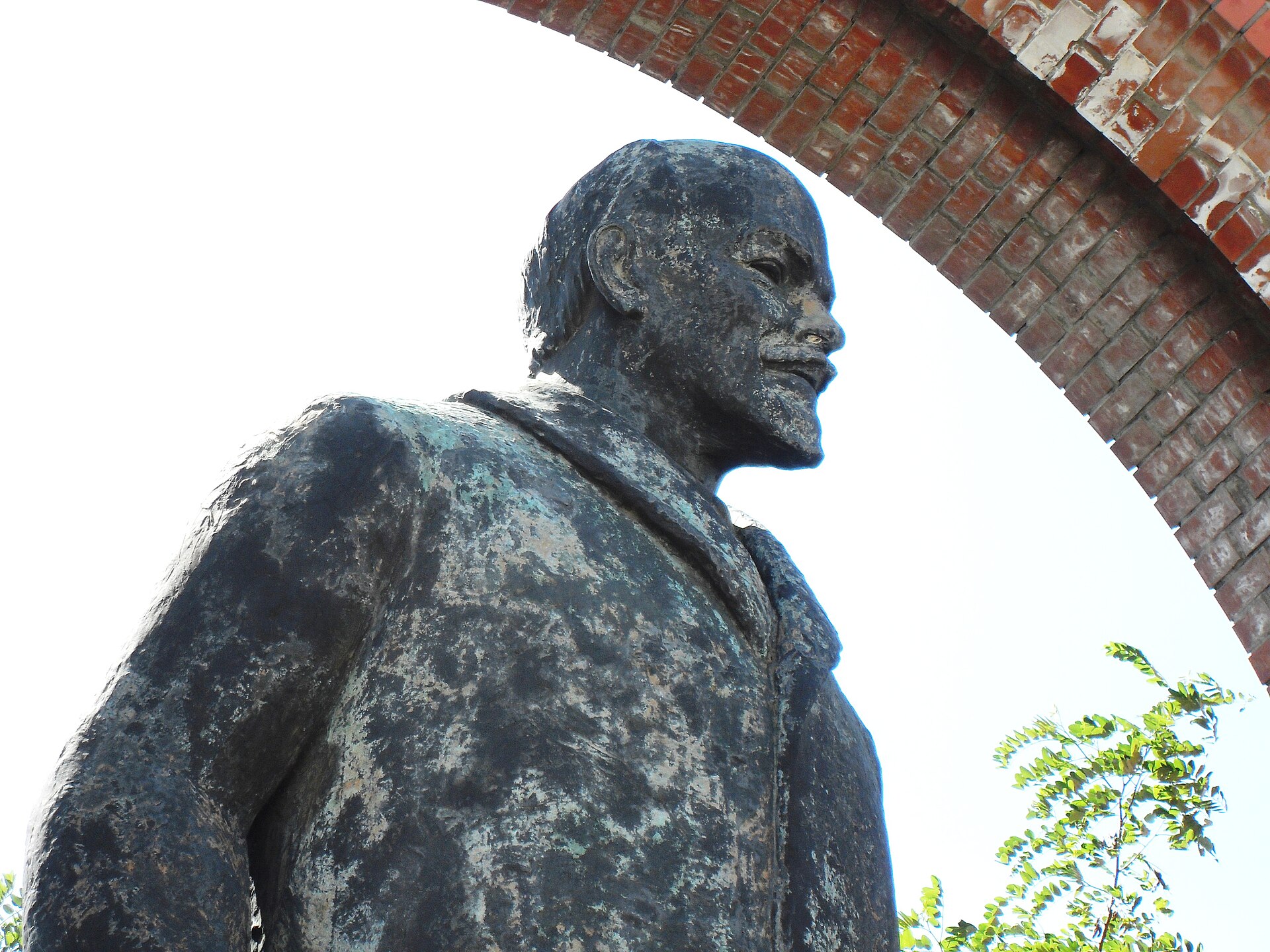
The park’s roughly forty pieces are dominated by a handful of statues most visitors will recognise even without captions: a monumental Lenin, arm raised mid-address, that once stood watch over a Budapest square; a joint Marx and Engels relief that anchored a different plaza; and multiple versions of the Soviet soldier who used to stand beside the Liberty Statue on Gellért Hill before Hungary rewrote that monument’s meaning after 1989 and relocated the soldier here. A memorial to Béla Kun, leader of Hungary’s short-lived 1919 communist republic, stands among the larger pieces — a marching crowd cast mid-stride, one of the more visually striking single works in the collection.
Beyond the household names, the collection includes a number of pieces most visitors have no prior context for: the Republic of Councils Monument, a huge striding worker-soldier figure that commemorated the 1919 revolutionary government; various Workers’ Movement memorials commissioned to mark strikes, uprisings or Party anniversaries; and a run of smaller busts of local Party officials and Soviet-Hungarian friendship monuments that once stood in front of factories, schools and municipal buildings across the city. Taken individually, many of these are unremarkable as sculpture — mass-produced civic kitsch, essentially — and that’s part of the point the park makes simply by putting so many of them side by side. Seeing a dozen near-identical heroic worker poses in one field does more to convey what public space under one-party rule actually looked like than any single statue could on its own.

Walking the grounds is less like touring a conventional sculpture garden and more like walking a designed circuit — Eleőd laid the park out in a figure-of-eight path specifically so visitors can’t see the whole collection at once from any single vantage point, forcing a statue-by-statue encounter rather than a single sweeping photograph. Information panels throughout give context on each piece: who commissioned it, where it originally stood, and roughly when it came down. Most visitors spend somewhere between 45 minutes and an hour and a half walking the full circuit, depending on how much of the signage they read.
Light and season change the visit considerably. On a clear day the open grass setting and unobstructed sky make for stronger, harder-edged photography than most of Budapest’s more enclosed indoor attractions offer — the statues were originally designed to be seen from below, dominating public squares, and photographing them from the same low angle here recreates a little of that original intimidating scale even in their new, deliberately humbled setting. In winter the grounds can feel genuinely bleak, bare trees and grey sky against grey concrete, which some visitors find adds rather than detracts from the atmosphere; in high summer, by contrast, the lack of shade makes an early visit more comfortable than an afternoon one.
Stalin’s Boots
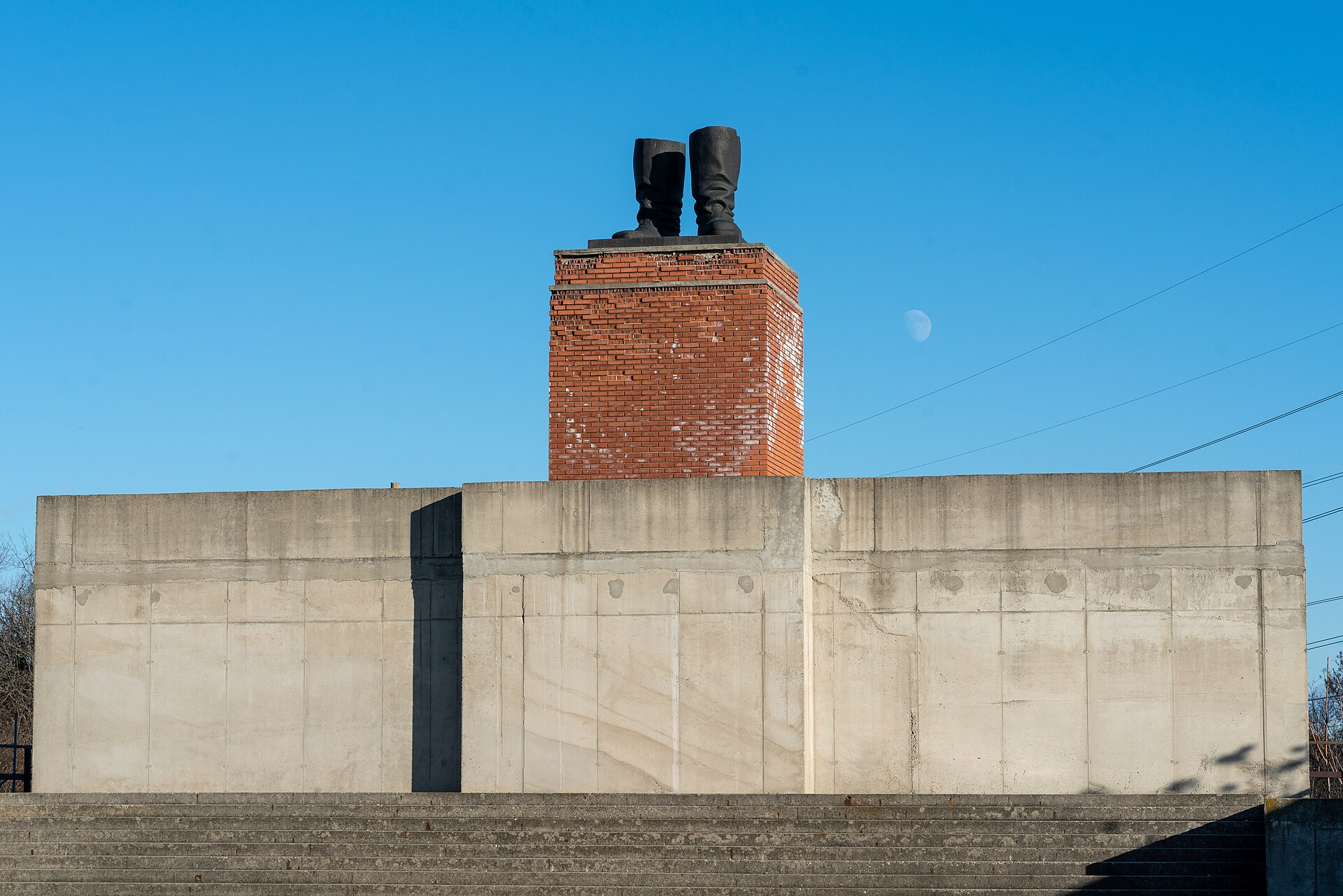
The single most photographed feature isn’t a statue at all — it’s a recreation, standing just past the entrance, of an empty pair of oversized boots on a plinth. This references one of the most vivid moments of the 1956 Hungarian Uprising: on 23 October 1956, crowds in central Budapest toppled a colossal Stalin statue that had stood on what’s now Dózsa György út, cutting the figure off at the ankles and dragging the torso through the streets while the boots remained bolted to the pedestal. The original statue was gone entirely by the time this park was built, so what stands here is a purpose-made replica of just the boots and plinth, recreating the single most famous image from that day rather than restoring a lost original.
The 1956 Uprising itself — a spontaneous, nationwide revolt against Soviet-imposed rule that began with student protests and briefly toppled the government before Soviet tanks crushed it after less than two weeks — sits at the emotional centre of a lot of what this park represents, even though most of the individual statues on display postdate 1956 and commemorate the decades of restored one-party rule that followed. The boots monument functions almost as a prologue to the rest of the collection: a reminder that the systems being memorialised elsewhere in the park were not universally accepted even at the time, and that Hungarians pulled down a Stalin statue with their bare hands and ropes a full 33 years before the regime itself finally fell.
The Trabant, the propaganda film, and the gift shop
Near the entrance building, a Trabant — the boxy, underpowered East German car that became an unofficial symbol of life behind the Iron Curtain — is usually parked as a photo prop, a smaller and more personal artefact than the statues themselves and a reliable favourite for visitors old enough to remember the model in daily use. The entrance building also runs a small cinema showing genuine secret police training films from Hungary’s communist-era State Protection Authority (ÁVH) — surveillance and interrogation training material rather than public propaganda, and one of the more genuinely unsettling parts of a visit precisely because it wasn’t made for public consumption at the time. The park’s gift shop leans into dark comedy more than the rest of the site, stocking communist-kitsch souvenirs — Lenin postcards, Soviet-style enamel pins, the odd novelty item — that visitors either find funny or a little uncomfortable depending on temperament; either reaction is roughly the point of the whole park.
Getting there
This is the one major Budapest sight not reachable by metro, and it catches out visitors who assume every attraction is a short ride from the centre. The most convenient option for a straightforward round trip is the park’s own direct shuttle bus, which departs Deák tér (where all three metro lines meet) at 11:00 daily — Saturday, Sunday and Monday only from November through March — and returns from the park at 13:00, giving a fixed two-hour window that suits the typical visit length well. Tickets for the shuttle are sold at the departure point and typically bundle the return fare with park admission at a modest discount versus buying separately.
For more flexible timing, take the M4 metro to Kelenföld vasútállomás, then transfer to bus 101B or 101E (both roughly a 9-minute ride to the Memento Park stop) or the slower but more frequent bus 150 (around 25 minutes), all covered by a standard BKK single ticket or travelcard. Driving is straightforward too if you have a car — from the M0 ring road, exit at Diósd onto road 7 and follow it roughly 5 km back towards the city; the park has on-site parking.
Whichever option you choose, build in the return journey before committing to the trip — this is genuinely on the edge of Budapest’s built-up area, closer to suburban Diósd than to anything resembling a tourist district, and there’s very little else nearby to fill time if a bus is running late. The direct shuttle’s fixed 11:00–13:00 window is the lowest-friction option precisely because it removes that uncertainty; the public-transport route via Kelenföld gives more flexibility on timing but requires slightly more attention to the return schedule, particularly outside peak daytime hours when bus frequency thins out.
Combining with the rest of communist-era Budapest
Memento Park works best as one stop in a loosely themed day rather than an isolated excursion. Paired with a morning at Gellért Hill — where the Liberty Statue’s Soviet soldier once stood before being relocated here — the two sites bookend the same historical thread from opposite ends: one still standing in its original place with a rewritten meaning, the other removed entirely and recontextualised. Visitors building a fuller picture of this period in Hungarian history often add the House of Terror museum on Andrássy Avenue, a considerably more intense stop documenting the human cost of both the fascist and communist secret-police eras, though it’s worth spacing the two out rather than visiting back to back — between Memento Park’s more detached, curatorial tone and the House of Terror’s direct confrontation with victims’ testimony, doing both in one day can be a lot.
Practical tips
Wear real shoes — the grounds are gravel paths and open grass, exposed to weather with very little shade, so a hot summer visit needs sun protection and a cold winter one needs layers. There’s a small café near the entrance for coffee and snacks, but nothing substantial; eat before or after rather than counting on the park for a proper meal. The full grounds are step-free and stroller-friendly, gravel surface aside, though wheelchair users should expect the gravel paths to be somewhat harder going than paved city-centre attractions. Because this sits well outside the usual tourist core, it pairs awkwardly with a packed single-day itinerary — treat it as its own half-day trip rather than trying to bolt it onto a morning that also covers central Pest.
The propaganda-film screening isn’t always running continuously — it plays in a loop inside the entrance building, and content can occasionally rotate between different archival reels, so don’t build a visit specifically around seeing one particular film. Signage throughout the park is bilingual Hungarian and English, and an audio guide is typically available to rent at the entrance for visitors who want more context on individual pieces than the printed panels provide; it’s a worthwhile add if English-language depth matters more to you than pace, since the printed panels are informative but relatively brief, and the audio commentary tends to go further into individual sculptors and commissioning histories than the on-site signage has room for.
The honest verdict
This is a good candidate for a slower multi-day Budapest itinerary rather than a tightly packed weekend, precisely because it’s a half-day trip outside the centre for a collection that, taken purely as sculpture, is intentionally more didactic than beautiful. But for anyone with real curiosity about how a city processes a political period it wants to remember without honouring, this is one of the more thoughtful answers to that problem anywhere in the former Eastern Bloc, and there’s nothing quite like it inside central Budapest. If your interest in communist-era Hungary is more than passing, budget the half-day and go; if it’s a mild curiosity, the free approach — walking past whatever communist-era architecture remains in the city itself — probably covers it well enough without the trip south. Either way, go in with the right expectation: this is a field of statues and information panels, not an interactive museum, and the value is almost entirely in the context and the accumulated weight of seeing so many of these figures together rather than in any single dramatic exhibit.
The statues here make most sense with the dates in mind. If you’re in Budapest around 23 October, the anniversary of the 1956 revolution, our Budapest in October guide explains what happens on the day and where the city remembers it.
Frequently asked questions
How much does Memento Park cost?
Adult admission is 3,000 HUF (€7.50), with discounts for students (1,800 HUF) and children under 14 (1,200 HUF); under-6s are free. The direct shuttle bus from Deák tér is sold separately and typically bundles a discount with admission.
How do you get to Memento Park without a car?
The simplest option is the park’s own direct shuttle bus from Deák tér, departing 11:00 daily (weekends and Mondays only November–March) and returning at 13:00. Alternatively, take the M4 metro to Kelenföld vasútállomás and transfer to bus 101B, 101E or 150, all covered by a standard BKK ticket.
What is Stalin’s Boots at Memento Park?
It’s a recreation of the pedestal left standing after crowds toppled a giant Stalin statue in central Budapest during the 1956 Uprising, cutting the figure off at the ankles. The original statue no longer exists; what’s on display is a purpose-built replica of just the boots and base, recreating that specific historical moment.
How long does a visit to Memento Park take?
Most visitors spend 45 minutes to an hour and a half walking the full circuit and reading the information panels. The direct shuttle bus’s fixed two-hour round-trip window (11:00 departure, 13:00 return) comfortably covers a typical visit.
Is Memento Park worth visiting?
If you have genuine interest in Hungary’s communist-era history and how post-1989 Budapest chose to handle its removed monuments, yes — it’s a thoughtful, unusual site with no real equivalent inside the city. If your interest is only passing, it’s a half-day commitment outside the centre that’s easy to skip without missing anything essential to a first visit.
Is Memento Park the same as the House of Terror?
No — they’re different institutions covering related but distinct ground. Memento Park is an open-air collection of removed public statuary on the city’s outskirts, presented with a curatorial, historical framing. The House of Terror, in central Budapest on Andrássy Avenue, is a museum inside a former secret-police headquarters documenting the human cost of both the fascist and communist eras through victim testimony and original interrogation spaces — a considerably more intense visit.
Photo credits
The entrance gate of Memento Park, with Stalin’s Boots visible through the columns by Paul Colin Hennig (firstdorsal.eu), CC BY-SA 4.0, via Wikimedia Commons.
Stalin’s Boots monument at Memento Park by Paul Colin Hennig (firstdorsal.eu), CC BY-SA 4.0, via Wikimedia Commons.
A Lenin statue at Memento Park by Ferran Cornellà, CC BY-SA 3.0, via Wikimedia Commons.