Gellert Hill and the Citadella: The Best View in Budapest
The Citadella reopened in spring 2026 after four years of restoration — free park, paid exhibition. What's changed, what the Liberty Statue actually commemorates now, and the honest way up a hill with no funicular.

In this guide
This article contains advertising. Our booking links are routed through a partner that adds commission tracking automatically, so if you book through one we earn a commission from the provider, at no extra cost to you. It never affects what we recommend. Affiliate disclosure
Every guidebook tells you Gellert Hill Budapest has the best view in the city, and for once the consensus is correct — but almost nobody explains what changed at the top in 2026. The Citadella, the nineteenth-century fortress crowning the hill, spent four years wrapped in scaffolding and reopened this spring as something genuinely new: a free public park with a paid exhibition inside the old fortress walls, instead of the half-abandoned, graffiti-streaked ruin visitors have been climbing up to for the last two decades.
This guide covers what’s actually up there now — the Citadella park and the ticketed Bastion of Liberty exhibition, the Liberty Statue itself, the Cave Church cut into the rock on the hill’s Danube-facing slope, and the honest logistics of getting up a 235-metre hill with no funicular. Prices and hours were checked in September 2026 against current listings; the Citadella reopening is recent enough that details are still settling, so confirm anything time-critical before you climb.
At a glance
| What | Cost | Hours |
|---|---|---|
| Citadella park, walkways, Liberty Statue plaza | Free | Open until midnight Apr–Oct; shorter in winter |
| Bastion of Liberty exhibition | ≈4,900 HUF (€12) adult | Mon–Thu, Sat–Sun 10:00–18:00; Fri 12:00–20:00 |
| Cave Church (Sziklatemplom) | Small entry fee, often ~1,000 HUF; donation-based at times | Mon–Sat roughly 09:30–19:30; Sundays for services only |
| Getting up | 500 HUF (single BKK ticket) for bus 27, or free on foot | Bus runs regular daytime hours; paths open 24/7 |
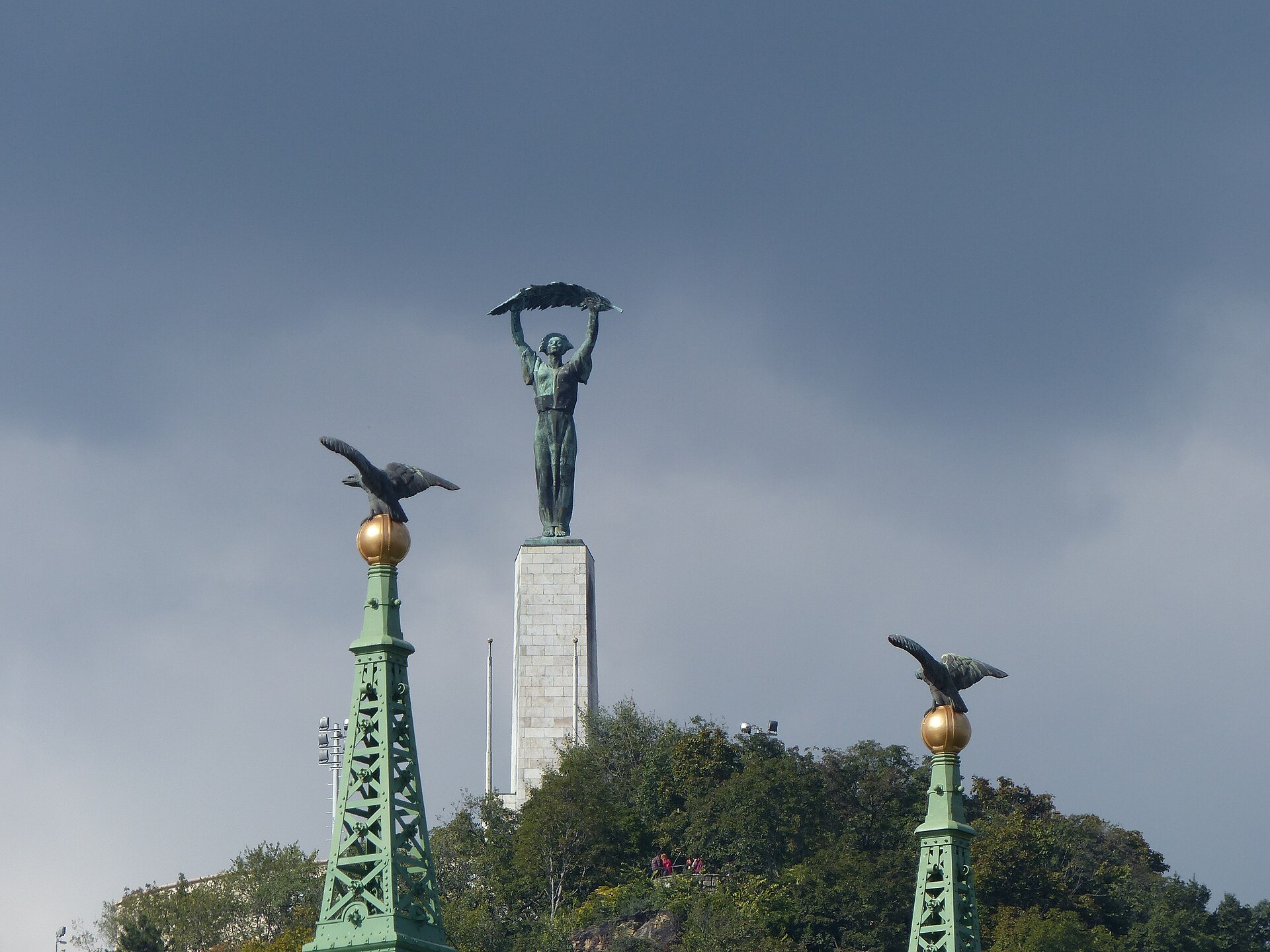
Why there’s a fortress on top of a hill in the middle of Budapest
Gellért Hill takes its name from Bishop Gerard (Gellért in Hungarian), an eleventh-century missionary who was, according to legend, martyred here by being rolled down the hillside in a spiked barrel by pagan rebels resisting Hungary’s conversion to Christianity — a grim origin story for what’s now the city’s favourite sunset spot. The hill itself is a 235-metre outcrop of dolomite rock on the Buda side, directly across the Danube from the Pest embankment, which is exactly why it ended up fortified: whoever controls this hill can put artillery on the entire city below.
The Habsburgs did precisely that. After crushing the Hungarian Revolution of 1848–49, the Austrian imperial government built the Citadella between 1850 and 1854 — not to defend Budapest from outside attack, but to intimidate it from within, with cannons that could be turned on the city itself if Hungarians rose up again. It never fired a shot in anger for that purpose, and by the time Hungary gained more autonomy within the Austro-Hungarian Empire in 1867, the fortress had already become a strategic irrelevance the city grudgingly tolerated rather than a working military position.
The Liberty Statue
The 14-metre bronze figure holding a palm branch aloft at the hill’s summit is the Liberty Statue (Szabadság-szobor), Budapest’s most visible monument and one that’s changed meaning at least twice since it went up in 1947. It was originally commissioned under Hungary’s Soviet-aligned postwar government to commemorate the Red Army’s 1945 liberation of Budapest from Nazi occupation, and for over four decades it stood alongside a bronze Soviet soldier at its base and a dedication plaque crediting the Soviet army by name.
After the fall of communism in 1989, Hungary kept the woman and her palm branch — a genuinely well-regarded piece of public sculpture on its own merits — but removed the Soviet soldier and rewrote the dedication to a more general tribute to those who sacrificed their lives for Hungary’s independence, freedom and prosperity. The soldier statue wasn’t destroyed; it now stands, mildly incongruous among the entrance gates and roadside dinosaurs, in Memento Park, the open-air collection of Budapest’s exiled communist-era monuments on the city’s southern outskirts. The 2026 Citadella restoration included conservation work on the statue itself, which had been showing its age after seven decades exposed on an unsheltered hilltop.

The Citadella: park, walls and the Bastion of Liberty
Here’s the part that catches returning visitors off guard: the Citadella closed for restoration in the early 2020s and reopened only in spring 2026, after four years of work that turned a fortress most guidebooks describe as crumbling and half-derelict into a proper public space. The distinction that matters for planning a visit is what’s free and what isn’t.
The park itself — walking paths, gardens, the plaza around the Liberty Statue, and new walkways along the top of the old fortress walls — is free and open to everyone, no ticket or booking required, and stays open until midnight from April through October, making it one of the better free late-evening viewpoints in the city. The only paid element is the Bastion of Liberty, a multi-level exhibition built into the fortress’s western tower, which runs roughly 4,900 HUF (€12) for an adult and includes access to a rooftop viewing platform the exhibition brands as the Roof Garden 360. Hours run Monday to Thursday and Saturday to Sunday, 10:00 to 18:00, with a later Friday session from 12:00 to 20:00 — useful if you want the view at golden hour without waiting for the free park’s later closing time.
Whether the Bastion of Liberty ticket is worth it depends on what you’re after. If the goal is simply the view and the atmosphere of standing on top of Budapest, the free park delivers that completely — the panorama from the fortress walls themselves is unobstructed and doesn’t need a ticket. The exhibition is worth adding if you want the history explained in depth, or if the extra elevation and vantage point of the Roof Garden 360 genuinely adds something the free walkways don’t already give you, which on a clear day is a fairly marginal difference.
Inside, the exhibition is organised across the fortress’s western tower and spans the hill’s military history from the 1850s Habsburg garrison through the upheavals of the twentieth century, including the Soviet military presence here during the Cold War years. Expect a mix of period artefacts, interpretive panels and multimedia displays rather than a dense academic museum — it’s built for a 45-minute to hour-long visit, not a half-day one, and works well paired with the free walk around the ramparts either side of it.
The fortress walls themselves are worth a slower look regardless of whether you buy a ticket: thick, low, dolomite-block ramparts built for artillery rather than aesthetics, with the restoration adding discreet modern walkways, handrails and lighting without disguising the nineteenth-century stonework underneath. It’s a more sympathetic renovation than some of Budapest’s other recently restored monuments, which occasionally lean too hard into a polished, rebuilt-from-scratch look — the Citadella still reads as a real fortress rather than a replica of one.
The Cave Church
On the hill’s Danube-facing slope, a natural cave system has been fitted out as a working chapel since 1926, when Pauline monks — Hungary’s only native religious order — converted the caves into the Sziklatemplom, or Cave Church, modelling the project loosely on the shrine at Lourdes. Its history since is one of the starker stories on this hill: in 1951, Hungary’s communist government banned the Pauline order outright, sealed the cave entrance in concrete, and imprisoned or executed several of the monks on fabricated charges. The church stayed bricked shut for nearly four decades until 1989, when the order was reinstated and the chapel reopened to the public — one of the more literal instances of a building being unsealed at the exact moment communist rule ended.
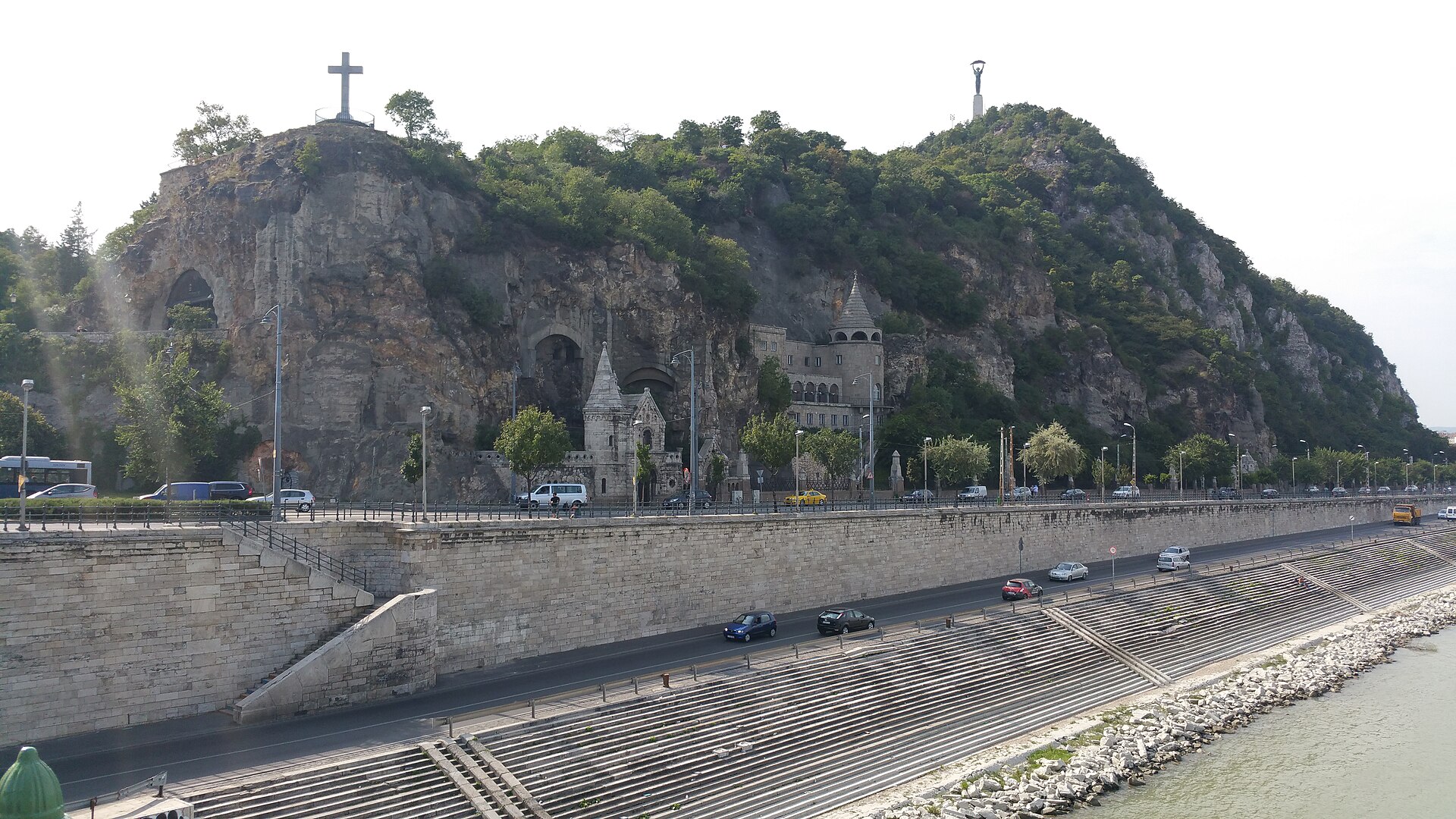
Today it functions as an active parish church with daily Mass — typically around 8:30, 17:00 and 20:00 on weekdays and Saturdays, with an additional Sunday service around 11:00 — and is open to visitors outside service times on most days, generally around 09:30 to 19:30 Monday to Saturday. On Sundays it operates primarily for worship rather than sightseeing, so plan a weekday or Saturday visit if a look inside is the priority. Admission is modest, sometimes framed as a small fixed entry fee and sometimes as a donation depending on who’s staffing the door; either way it’s a low bar for one of the more atmospheric interiors in the city, half-natural cave and half-consecrated chapel, still faintly smelling of damp stone under the incense.
Getting up the hill
Unlike Castle Hill on the other side of the Danube, Gellért Hill has no funicular, and that trips up more visitors than it should. There are three practical ways up. On foot, the most direct route climbs from near Gellért Baths or the Buda end of Elizabeth Bridge, gaining roughly 130 metres of elevation over well-maintained paths and stairs — reckon on 25 to 35 minutes at a moderate pace, longer with children or in summer heat, and wear shoes with some grip since sections are steep and occasionally uneven rock. Bus 27 runs up the hill’s southern side to a stop close to the Citadella entrance, covered by any standard BKK ticket or travelcard, and is the sensible choice if walking uphill isn’t appealing or if mobility is a concern — though even from the bus stop there’s a short walk and some steps to the summit itself. A taxi or rideshare can also get partway up via the same road bus 27 uses, though not all the way to the fortress gates.
For most visitors, the honest recommendation is to walk up — ideally starting from the Rudas Baths by Elizabeth Bridge so a hot soak is waiting for you afterwards — and take the bus back down if legs are tired, rather than the reverse. The climb rewards you with the view building gradually rather than arriving at it all at once.
Views and photography
The classic panorama looks north from the fortress walls: the Danube, Elizabeth Bridge and Liberty Bridge below, Buda Castle across the river to your left, and the Parliament building’s dome visible further along the Pest embankment. Sunset is the reliably best light, when the low sun catches the river and the city’s domes and spires face you directly rather than being backlit, and it’s also when the free park stays open latest, making a late-afternoon climb and a sunset at the top an easy, unticketed combination. Midday in summer is the least flattering light and also the hottest, shadeless climb — if you only have one time slot to plan around, avoid that one.

Practical tips
There’s little in the way of food or shade on the hill itself — a small kiosk operates near the Citadella entrance in season, but don’t count on it, and bring water in summer regardless of which route up you choose. Toilets are available near the Bastion of Liberty exhibition entrance (for ticket holders) and at a public facility close to the Citadella car park, but not scattered generously along the walking paths, so plan accordingly if you’re climbing with children. The fortress-wall walkways and much of the free park are step-free or gently ramped following the 2026 restoration, though the original walking paths up the hillside itself remain steep, uneven in places, and not realistically wheelchair-accessible; bus 27 combined with the paved approach road is the more practical route for visitors with mobility needs.
Weather matters more here than at most Budapest attractions, given how exposed the summit is — wind at the top is noticeably stronger than at street level, and the view (the entire point of the climb) is obviously compromised on a heavily overcast or foggy day. If your Budapest itinerary has any flexibility, save Gellért Hill for the clearest forecast day available rather than a fixed slot, and it’s a natural candidate for a golden-hour stop on a photography-focused day in the city.
Nearby baths
The hill’s namesake thermal bath complex, the Gellért Baths at its base on the Buda side, closed on 1 October 2025 for a renovation expected to run until around 2028 indoors and 2029 for the outdoor pools; the Gellért Baths guide has the latest. A soak is still the natural way to end a climb rather than start one — sweaty legs and a hot pool are a better pairing than the reverse — and the Rudas Baths, at the foot of the hill by Elizabeth Bridge, are open.
The honest verdict
Gellért Hill earns its reputation — this genuinely is the best panoramic view in Budapest, and as of the 2026 reopening, the Citadella at the top is a considerably better-kept space than it’s been in years. Budget an hour and a half for the round trip if you’re walking and just want the free park and the view; add another half-hour if the Bastion of Liberty exhibition interests you, and a further 20–30 minutes if you want to see the Cave Church on the way down. Whether you pay for the exhibition or not, don’t skip the walk up itself — the gradual reveal of the city as you climb is arguably better than the payoff at the top.
It’s also worth building into a wider Buda itinerary rather than treating as a stand-alone errand: pair it with Buda Castle further along the same riverbank, since both sit on the Buda side and a full day covering both hills — with a soak at the Rudas Baths in between — is a reasonable, well-paced way to see the best of this side of the river without doubling back across the Danube more than once.
The hill is at its best in October, when the woods on its slopes turn yellow and the haze of summer has gone from the view. Our guide to Budapest in October covers the rest of the city’s autumn colour and the weather to expect.
Frequently asked questions
Is Gellért Hill free to visit?
The hill itself, the walking paths, and the Citadella park including the Liberty Statue plaza and fortress-wall walkways are all free. Only the Bastion of Liberty exhibition inside the fortress charges admission, around 4,900 HUF (€12) for an adult.
Is the Citadella open in 2026?
Yes — it reopened in spring 2026 after a four-year restoration. The site is now a public park with free access, plus the ticketed Bastion of Liberty exhibition inside the old fortress. This is a significant change from how the Citadella is described in older guidebooks, which mostly cover it as a semi-derelict, largely free-roam ruin.
How do you get to the top of Gellért Hill without walking?
Bus 27, covered by any standard BKK ticket, runs up the hill’s southern side to a stop near the Citadella. There’s no funicular on Gellért Hill — that’s a feature of Castle Hill on the other side of the river, and a common point of confusion for first-time visitors.
How long does it take to walk up Gellért Hill?
From near Gellért Baths or Elizabeth Bridge, reckon 25 to 35 minutes at a moderate pace on well-maintained paths and stairs, gaining around 130 metres of elevation. Add time in summer heat or with young children.
Is the Cave Church worth visiting?
Yes, particularly if you have any interest in the more unusual chapters of Budapest’s communist-era history — it was sealed shut by the state from 1951 to 1989. It’s a short detour on the hill’s Danube-facing slope, open to visitors most days outside Sunday service times, and the half-natural, half-built interior is unlike anything else in the city.
When is the best time to visit for the view?
Sunset, when the low light faces the city directly rather than backlighting it, and when the free Citadella park stays open latest (until midnight, April to October). Avoid the middle of a summer day if possible — the climb is shadeless and the light is flatter.
Can you combine Gellért Hill with the Cave Church and a thermal bath in one visit?
Yes, and it’s a natural loop: start at Elizabeth Bridge, walk up to the Citadella and Liberty Statue, then come back down via the Cave Church on the Danube-facing slope and walk along the river to finish at the Rudas Baths. The Gellért Baths beside the Cave Church are closed for renovation until around 2028, so Rudas is the one to plan on. Budget half a day for all three unhurried, or a brisk two hours if you’re skipping the Bastion of Liberty exhibition and the baths.
Photo credits
The Liberty Statue on Gellért Hill, seen past the turul eagles of Liberty Bridge by Elekes Andor, CC BY-SA 4.0, via Wikimedia Commons.
Gellért Hill’s cliff face and the Cave Church entrance, with the Liberty Statue visible on the summit by Nettadi, CC BY-SA 3.0, via Wikimedia Commons.