Vajdahunyad Castle: Budapest’s Beautiful Architectural Fake
Built for an 1896 exhibition and never meant to last, Vajdahunyad Castle is a composite of twenty real Hungarian buildings. What's free, what's the agricultural museum inside, and the statue everyone photographs.

In this guide
- At a glance
- A building built to be a history lesson
- Walking the wings in order
- The Anonymus statue
- What’s inside: the Museum of Hungarian Agriculture
- What the exhibits actually cover
- The lake and winter skating
- Nearby in City Park
- Getting there
- Practical tips
- The honest verdict
- Frequently asked questions
- Photo credits
This article contains advertising. Our booking links are routed through a partner that adds commission tracking automatically, so if you book through one we earn a commission from the provider, at no extra cost to you. It never affects what we recommend. Affiliate disclosure
Vajdahunyad Castle looks like it should be the oldest building in Budapest — moss-streaked stone, a Gothic chapel, a Romanesque cloister, a fairy-tale tower with a green copper spire — and it is, structurally speaking, one of the youngest. The whole complex was finished in 1908, built as a deliberate architectural fiction: a composite of roughly twenty real Hungarian and Transylvanian buildings, stitched together into one structure so visitors could walk through eight centuries of Hungarian architecture without leaving City Park. It started life as a temporary exhibit made of cardboard and wood and proved so popular that Budapest rebuilt it in permanent stone rather than tear it down. That’s the whole story in miniature: a fake nobody minded staying fake for a hundred and twenty years.
This guide covers what’s real and what’s replica inside the complex, the Museum of Hungarian Agriculture that now occupies most of it, the Anonymus statue everyone photographs without knowing why, and when the lake in front freezes for skating. Prices and hours were checked in September 2026 against current museum listings.
At a glance
| What | Cost | Hours |
|---|---|---|
| Courtyards and exterior | Free, all day and night | Open 24/7 except during festivals |
| Museum of Hungarian Agriculture | 2,500 HUF (€6) adult · 1,200 HUF (€3) student/senior | Tue–Fri 10:00–16:00 (Nov–Mar) or 10:00–17:00 (Apr–Oct); Sat–Sun 10:00–17:00 year-round; closed Mon |
| Gate Tower climb | +400 HUF (€1) | Same hours as the museum |
| Nearest metro | Included in any BKK ticket | M1 (yellow line), Hősök tere or Széchenyi fürdő station |
A building built to be a history lesson
Vajdahunyad Castle was the centrepiece exhibit of the 1896 Millennium Exhibition, the same celebration that produced Heroes’ Square next door. The architect Ignác Alpár was given an unusual brief: build something that would let visitors experience the full sweep of Hungarian architectural history in one walk, from the country’s medieval beginnings through to the Baroque era. Rather than design one building, he designed a sequence of them, each wing modelled on a real structure from Hungary or historic Hungarian Transylvania (much of which fell outside Hungary’s borders after the 1920 Treaty of Trianon, which makes the castle an unintentional architectural record of buildings many visitors will otherwise never see in person).
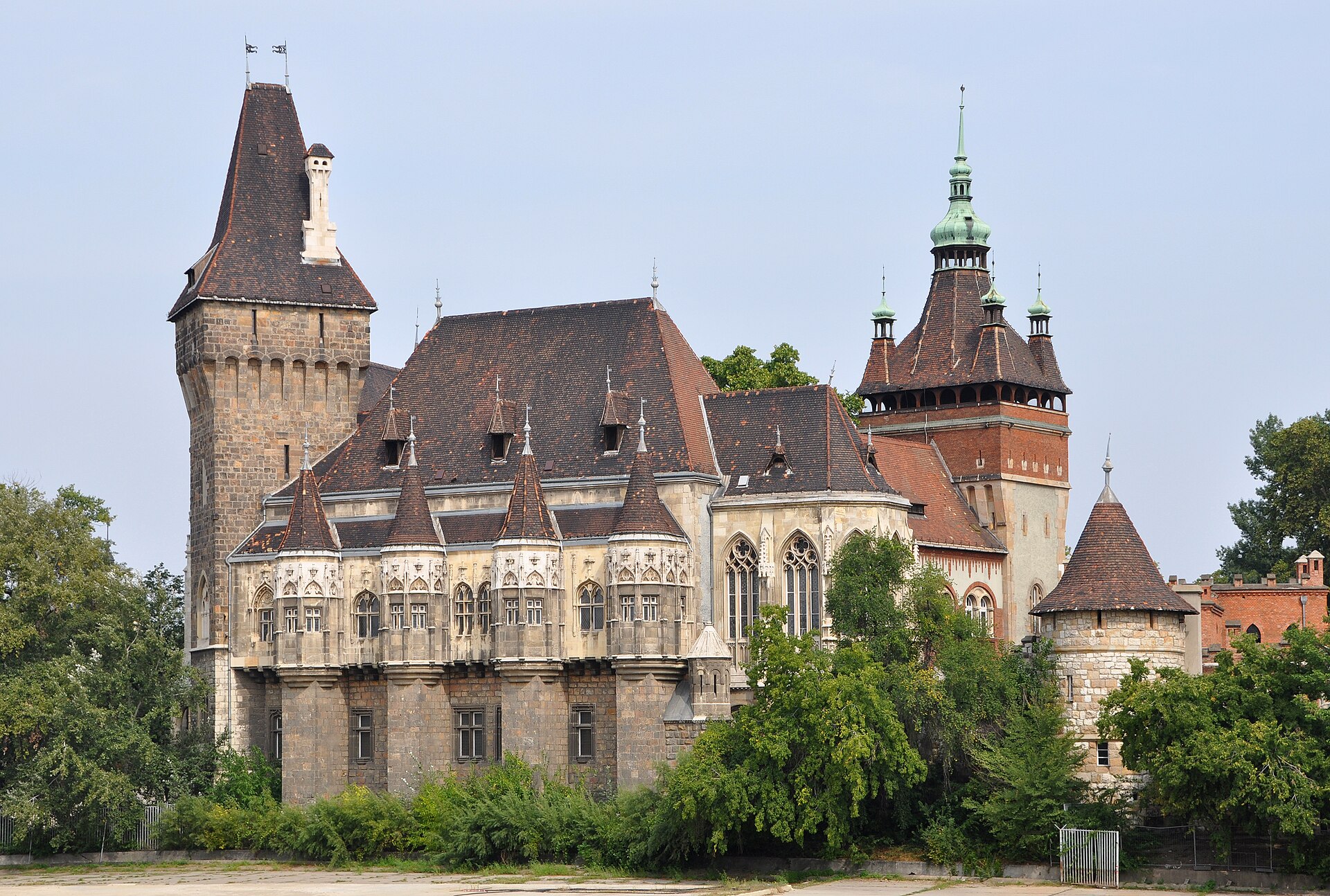
The complex moves roughly chronologically as you walk through it: a Romanesque section drawing on Ják Abbey’s famous portal, a Gothic wing modelled substantially on the real Vajdahunyad Castle in Transylvania (in what’s now Hunedoara, Romania, and the source of the whole complex’s name), and Renaissance and Baroque sections referencing palaces and manor houses from across the historic Hungarian kingdom. None of it is a literal one-to-one copy of any single building — Alpár borrowed facades, towers and details freely and reassembled them into something that reads as a coherent, if architecturally impossible, whole.
Built originally from cardboard, wood and plaster as a temporary exhibition structure meant to be demolished after 1896, it was kept standing by popular demand and rebuilt between 1904 and 1908 in permanent brick and stone on the same site — an unusually direct case of a fake becoming, materially, the real thing.
Walking the wings in order
The layout rewards a slow circuit rather than a single glance from the lakeside, since the whole point is the progression from one architectural era to the next. Entering from the Romanesque end, the earliest section draws on the cloister and carved portal style of Ják Abbey, a genuine twelfth-century church in western Hungary regarded as one of the country’s finest surviving Romanesque buildings — the version here is a partial, freestanding reconstruction rather than a full copy, but the carved stonework around the doorway is close enough to the original to give a fair sense of it without the journey out to Ják itself.
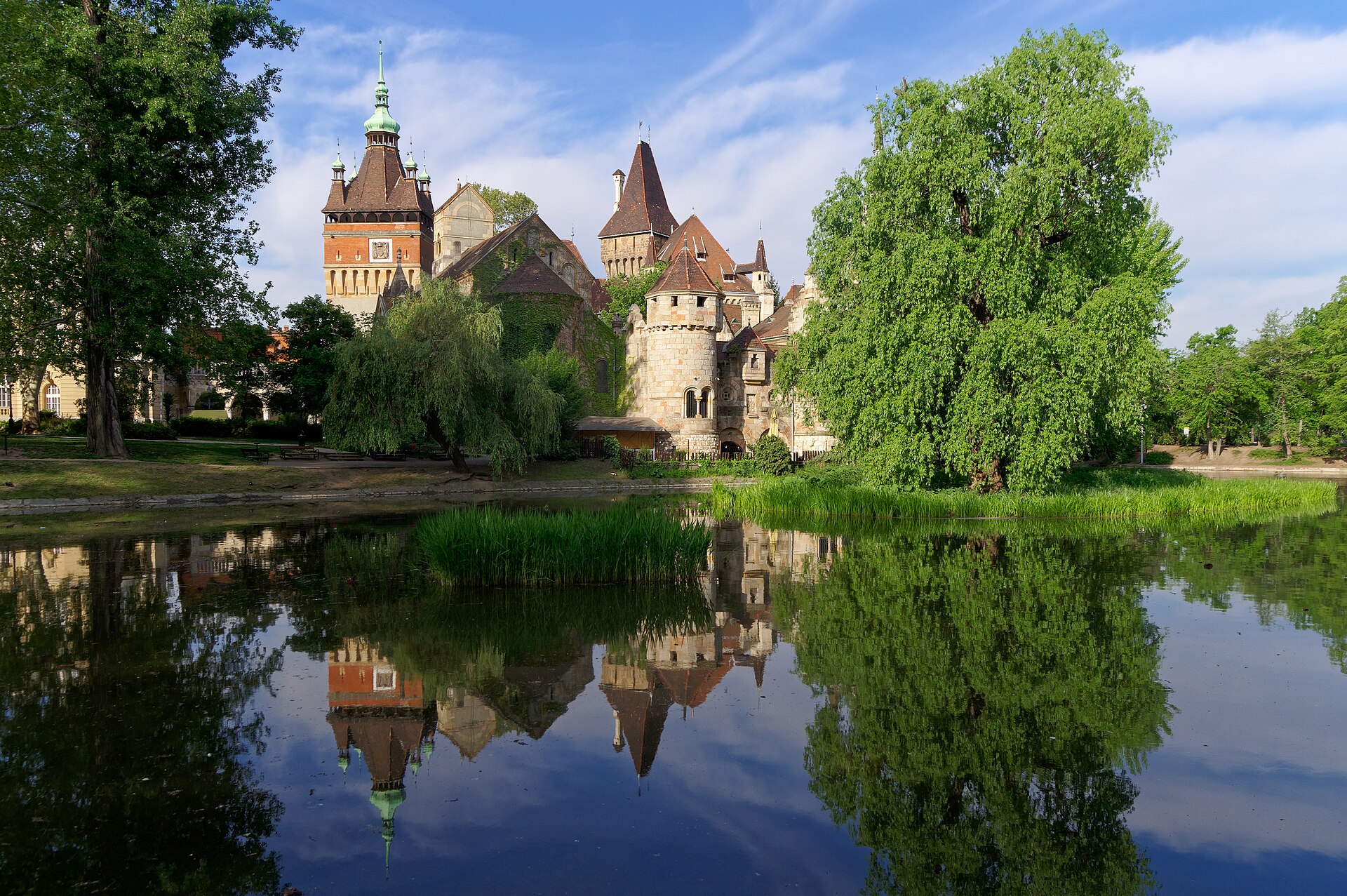
From there the complex moves into its Gothic centrepiece, the tall, turreted wing modelled on the real Vajdahunyad Castle (Hunyad Castle, or Corvin Castle) in what is now Hunedoara, Romania — one of the largest and best-preserved Gothic-Renaissance castles in Europe, built for the Hunyadi family, who produced two of medieval Hungary’s most significant rulers: János Hunyadi, the military leader who held off Ottoman advances in the mid-fifteenth century, and his son Matthias Corvinus, arguably Hungary’s most celebrated Renaissance king. This is the wing most visitors mean when they say “Vajdahunyad Castle,” and it’s also the section most photographed from across the lake, its steep roofline and corner towers giving the whole complex its fairy-tale silhouette.
Beyond it, the complex shifts into Renaissance and Baroque registers, drawing on features from various manor houses and palaces of the historic Hungarian nobility, before arriving at the more restrained courtyard that now serves as the Museum of Hungarian Agriculture’s main entrance. The transitions between styles are deliberately abrupt rather than blended — Alpár wanted each section legible as its own era, not smoothed into a single unified facade, which is part of why the building reads more like an open history textbook than a conventional palace.
The Anonymus statue
Just outside the castle’s Gothic wing sits one of Budapest’s most photographed and least explained statues: a hooded, faceless bronze figure seated with a quill in one hand and a scroll on his lap, the word ANONYMVS carved into the plinth beneath him. He represents an unidentified medieval chronicler — known to history only by the Latin signature “P. dictus magister” — who served as a notary at the court of King Béla III in the late twelfth century and wrote the Gesta Hungarorum, the earliest surviving account of the Magyar tribes’ arrival in the Carpathian Basin. His true identity was never recorded, and the hood, sculpted by Miklós Ligeti in 1903, is a literal representation of that anonymity rather than an artistic flourish.
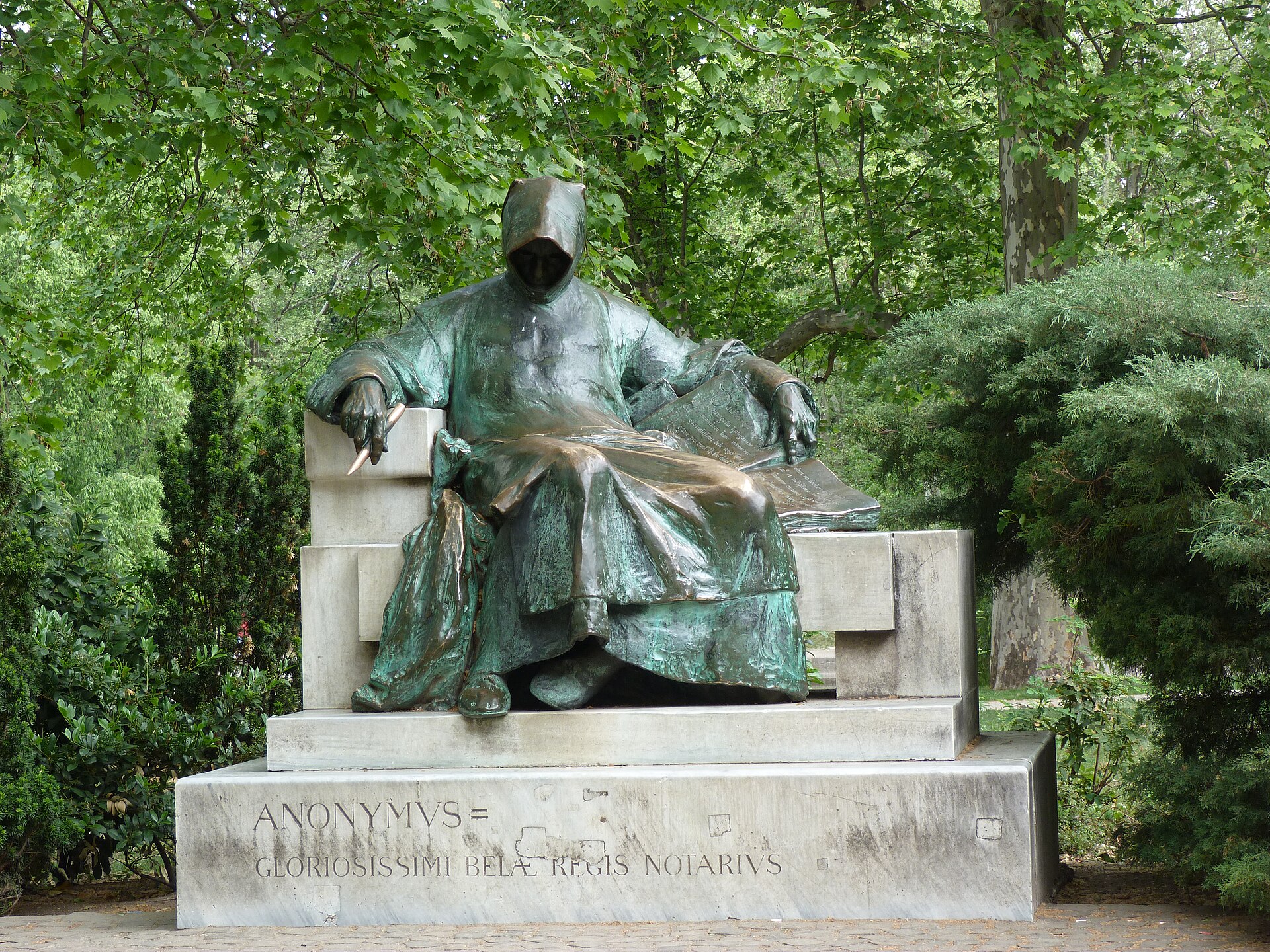
A local tradition, popular mainly with students, holds that touching the tip of the statue’s bronze pen brings writing talent or good luck on exams — you can see exactly which part of the statue this applies to from a distance, since decades of hands have rubbed that one spot to a bright polish against the surrounding dark patina. It costs nothing to join in, and it’s a nice small ritual to end a walk through a building otherwise dedicated to architecture nobody actually lived in.
What’s inside: the Museum of Hungarian Agriculture
Most of the complex today houses the Hungarian Museum of Agriculture (Magyar Mezőgazdasági Múzeum), reportedly the largest agricultural museum in Europe — a genuinely unexpected pairing of subject matter and building, though it makes more sense once you know the complex was designed from the outset as an exhibition space rather than a residence. Exhibits cover the history of Hungarian farming, viticulture, hunting, fishing and forestry, along with a significant taxidermy collection and displays on horse breeding, a subject with deep roots in Hungarian national identity going back to the Magyar tribes’ equestrian culture. It’s a denser, more old-fashioned museum experience than Budapest’s newer attractions — closer in spirit to a nineteenth-century cabinet of curiosities than a hands-on modern exhibit — which either appeals or doesn’t depending on your taste.
Admission runs 2,500 HUF (€6) for an adult and 1,200 HUF (€3) for students and seniors, with an additional 400 HUF (€1) to climb the Gate Tower, one of the complex’s tallest points, for a rooftop view back across City Park. The museum keeps shorter hours in winter (10:00–16:00 Tuesday to Friday, November through March) and longer summer hours the rest of the year (10:00–17:00), with weekends running 10:00–17:00 year-round; it’s closed Mondays, and last admission is 30 minutes before closing. Crucially, none of this applies to the courtyards and exterior of the complex, which are free to walk through at any hour, day or night, except during occasional festivals when the grounds are used for ticketed events.
What the exhibits actually cover
The Museum of Hungarian Agriculture spreads across several floors and wings of the complex, and the range is broader than the name suggests. Alongside the expected displays on crop farming, viticulture and the history of Hungarian wine regions, there’s a substantial section on hunting and forestry, complete with mounted trophies and taxidermy that will either fascinate or unsettle younger visitors — worth knowing in advance if you’re bringing children who are sensitive to that kind of display. A separate wing covers horse breeding and equestrian history, a subject with unusually deep cultural weight in Hungary given the Magyar tribes’ origins as horseback nomads from the Eurasian steppe; look out for displays connecting this history back to the mounted chieftain statues at Heroes’ Square next door. Fishing and beekeeping get smaller dedicated sections, and temporary exhibitions rotate through additional gallery space, occasionally touching on more contemporary agricultural or environmental themes.
None of this is presented with much interactivity by contemporary museum standards — expect glass cases, period tools and dense information panels rather than hands-on exhibits — which makes it a better fit for visitors with a genuine interest in the subject matter or Hungarian rural history than for a family simply looking to fill an hour. The Gate Tower climb at the end is the most universally appealing add-on regardless of interest in the exhibits themselves, since it’s the one part of the ticket that delivers a view rather than more display cases.
The lake and winter skating
The artificial lake in front of the castle serves double duty through the year: rowing boats for hire in the warmer months, and — when the ice is thick enough, roughly late November through February — one of Europe’s oldest and largest outdoor ice rinks, in operation since 1870. Full details on rink pricing and hours are covered in the Heroes’ Square and City Park guide, since the same lake and rink serve both attractions; the castle itself makes for a far more atmospheric skating backdrop than a standard municipal rink, which is a large part of its enduring popularity with both locals and visitors.
Nearby in City Park
Vajdahunyad Castle is one stop on a genuinely dense cluster of attractions rather than an isolated detour. Széchenyi Baths, Europe’s largest thermal bath complex, sits a fifteen-minute walk north along the park’s edge. Budapest Zoo and the Great Circus occupy the park’s northern corner, and Heroes’ Square with its two flanking museums bookends the park to the south. Realistically, most visitors combine the castle with at least one of these rather than treating it as a stand-alone trip, since all four sit within a fifteen-to-twenty-minute walk of each other through pleasant, mostly shaded parkland. For a longer visit, a one-day Budapest itinerary can reasonably build an entire morning around this corner of the park before moving on to the rest of the city.
Getting there
Vajdahunyad Castle sits a five-minute walk into City Park from Heroes’ Square, reached most directly via the M1 metro to Hősök tere. Alternatively, the M1’s Széchenyi fürdő station on the park’s northern edge puts you close to the castle from the other direction, useful if you’re combining the visit with Széchenyi Baths. Both approaches are flat, paved walks through the park with no significant elevation change, making this one of the more accessible of City Park’s attractions for visitors with mobility considerations, though the older interior floors inside the museum itself are less consistently step-free.
Practical tips
Photography is unrestricted and free across the entire exterior and courtyards, and this is genuinely one of the better photo locations in the city precisely because it costs nothing to spend an hour finding the right angle — the classic shot from across the lake works best in morning or late-afternoon light, when the sun catches the towers without washing out the water reflection. Inside the museum, photography rules follow the usual pattern of no flash and no tripods in most galleries; check current signage, since policies occasionally shift between temporary exhibitions.
There’s no dedicated café inside the complex itself, though City Park has several options within a few minutes’ walk, including the café at the House of Hungarian Music described in the Heroes’ Square guide. Toilets are available inside the museum for ticket holders; the nearest public facilities outside museum hours are back towards Heroes’ Square. Benches are plentiful around the lake, making this an easy, unhurried stop to combine with a packed lunch rather than a rushed ticket-and-photo visit.
If you’re visiting primarily for photographs and have no interest in the agricultural museum, plan around the free exterior alone and treat the museum as optional — there’s no need to buy a ticket just to see the building’s best angles, all of which are visible from the public paths and the lakeside promenade.
The honest verdict
The courtyards and exterior are the real draw and cost nothing — walk the full loop around the complex, find the Anonymus statue, and take in the lake view before deciding whether the museum interior is worth your time. The Museum of Hungarian Agriculture is a solid, if niche, addition if the subject genuinely interests you or if you’re visiting with children curious about farm animals and taxidermy; it’s easy to skip without missing the building’s main appeal, which is entirely architectural and entirely free to see. Budget 30–45 minutes for the exterior alone, or up to two hours if you’re adding the museum and Gate Tower climb.
The castle is at its most photogenic in late October, when the old plane trees around the lake turn gold and the leaves drift on the water. The Budapest in October guide has the other places to see the autumn colour, and when it usually peaks.
Frequently asked questions
Is Vajdahunyad Castle free to visit?
The courtyards and exterior are free at all times, day or night, except during occasional festivals. Only the Museum of Hungarian Agriculture inside charges admission — 2,500 HUF (€6) for an adult, plus 400 HUF (€1) for the Gate Tower climb.
Is Vajdahunyad Castle a real medieval castle?
No — it’s a composite built in 1896 and rebuilt permanently in 1904–1908, combining architectural elements from roughly twenty real Hungarian and Transylvanian buildings into one structure. It’s named after and partly modelled on the genuine Vajdahunyad Castle in Hunedoara, present-day Romania, but the Budapest building is a purpose-built replica, not a relocated or restored original.
What’s the story behind the Anonymus statue?
It depicts an unidentified twelfth-century royal notary who wrote the earliest surviving chronicle of Hungarian history, the Gesta Hungarorum, but never recorded his own name. The hood represents that anonymity. Visitors traditionally rub the statue’s bronze pen for luck, particularly students hoping for writing inspiration.
How long does it take to see Vajdahunyad Castle?
30–45 minutes for a walk around the free exterior and courtyards; up to two hours if you add the Museum of Hungarian Agriculture and the Gate Tower climb.
Can you ice skate at Vajdahunyad Castle?
Yes — the lake in front of the castle becomes one of Europe’s oldest outdoor ice rinks each winter, typically from late November through February, weather permitting. See the Heroes’ Square and City Park guide for current rink pricing and hours.
Is the Museum of Hungarian Agriculture worth visiting?
It depends on your interest in the subject. The exhibits on farming, viticulture, hunting and horse breeding are dense and old-fashioned in presentation rather than hands-on, which suits visitors genuinely curious about Hungarian rural history more than families looking for an interactive stop. The building’s architecture, which is free to see from outside, is the main draw for most first-time visitors.
What’s the connection between Vajdahunyad Castle and Transylvania?
The complex’s Gothic centrepiece is modelled on the real Vajdahunyad Castle (also called Hunyad or Corvin Castle) in Hunedoara, in present-day Romania — historically part of the Hungarian kingdom and the seat of the Hunyadi family, including King Matthias Corvinus. The Budapest version borrows the original’s silhouette and towers rather than reproducing it exactly.
Photo credits
Vajdahunyad Castle’s Gothic wing, with its arcaded oriel windows by Marc Ryckaert (MJJR), CC BY 3.0, via Wikimedia Commons.
Vajdahunyad Castle reflected in the lake in front of it by Jakub Hałun, CC BY-SA 4.0, via Wikimedia Commons.
The Anonymus statue at Vajdahunyad Castle by Derzsi Elekes Andor, Public domain, via Wikimedia Commons.