Keleti, Nyugati and Deli: Budapest’s Train Stations Explained
Three main stations, three different jobs. Which one handles international trains, which one gets you to Lake Balaton, and why Nyugati's glass hall traces back to the Eiffel company.
In this guide
- At a glance
- Keleti — the main international gateway
- Facilities at Keleti
- Nyugati — the Eiffel company’s Budapest project
- Facilities at Nyugati
- Déli — the gateway to Buda and the south
- Facilities at Déli
- Three eras of Hungarian railway building in one city
- Accessibility
- Which station do you actually need?
- Practical tips
- The honest verdict
- Frequently asked questions
- Photo credits
This article contains advertising. Our booking links are routed through a partner that adds commission tracking automatically, so if you book through one we earn a commission from the provider, at no extra cost to you. It never affects what we recommend. Affiliate disclosure
Three main-line termini, three different sides of the city, and enough overlapping route names that even confident travellers occasionally turn up at the wrong one with ten minutes to departure. Getting the right Budapest train station matters more here than in most European capitals, and more than the confident phrasing on most booking sites lets on, because the three don’t function as interchangeable options the way, say, several London terminals sometimes do — Keleti, Nyugati and Déli each specialise in a different slice of the network, and only one of them is usually right for any given journey.
This guide covers what each station actually serves, what’s inside, and how to tell them apart before you’re standing on the wrong platform. Facts below were checked in September 2026.
At a glance
| Station | Side | Opened | Mainly serves | Metro |
|---|---|---|---|---|
| Keleti (Eastern) | Pest | 1884 | International — Austria, Slovakia, Romania, and most long-distance domestic InterCity | M2, M4 |
| Nyugati (Western) | Pest | 1877 | Select international (Vienna, Bratislava, Prague) plus domestic and regional | M3 |
| Déli (Southern) | Buda | 1975 (current building) | Domestic — Lake Balaton, southwest Hungary, Croatia/Slovenia connections | M2 |
Keleti — the main international gateway
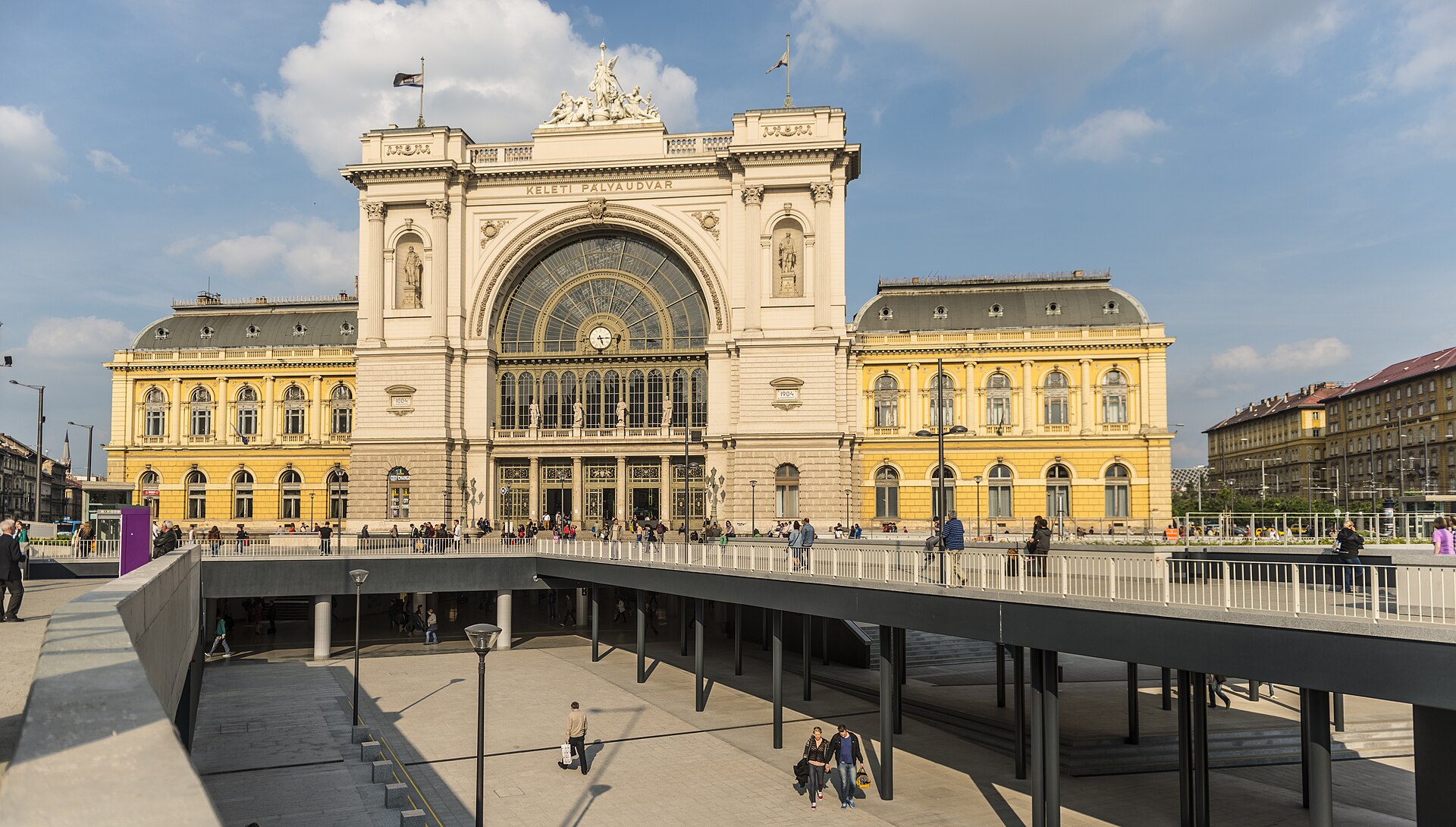
Keleti (literally “Eastern”) is Budapest’s largest and busiest station, opened in 1884 and still the primary hub for international rail travel: Railjet and InterCity services to and from Austria and beyond, day and night trains to and from Romania, and connections into Slovakia and Poland all run through its 18 platforms. If you’re arriving in or leaving Budapest by international train, there’s a strong chance it’s Keleti — this is also the departure point covered in the Budapest to Prague guide for RegioJet and České dráhy services heading north.
The building itself is grand rather than purely functional — a neo-Renaissance facade with sculptures of James Watt and George Stephenson flanking the entrance, honouring pioneers of steam power, and an interior main hall of iron and glass that held its own for over a century as one of the more imposing station spaces in Europe. Look up at the roofline and facade sculpture as you approach rather than heading straight in; most passengers moving fast to catch a connection miss the detail entirely, and it’s one of the more overlooked pieces of nineteenth-century architecture in central Pest precisely because everyone using it is usually in a hurry. The statues themselves are a small piece of nineteenth-century internationalism worth noting — a Hungarian station honouring a Scottish inventor and an English railway engineer, a reminder that railway technology moved across borders as freely then as the trains themselves eventually would. It sits on the M2 and M4 metro lines, giving it direct underground access to both the deep Soviet-era line and the newest, automated one — practically useful, and a reasonable illustration on its own of how differently Budapest’s transport infrastructure was built across different eras.
Facilities at Keleti
As Budapest’s busiest terminus, Keleti has the fullest range of passenger facilities of the three: multiple ticket halls covering both domestic MÁV-START and international operators, a reasonable spread of food options from quick coffee counters to sit-down options, currency exchange, and left-luggage services. It’s also the station most likely to feel genuinely crowded at peak times — summer mornings and early evenings on weekdays in particular — so budget extra time for navigating the concourse if you’re connecting to a tight onward journey, whether that’s a metro transfer or a flight-adjacent taxi.
Nyugati — the Eiffel company’s Budapest project
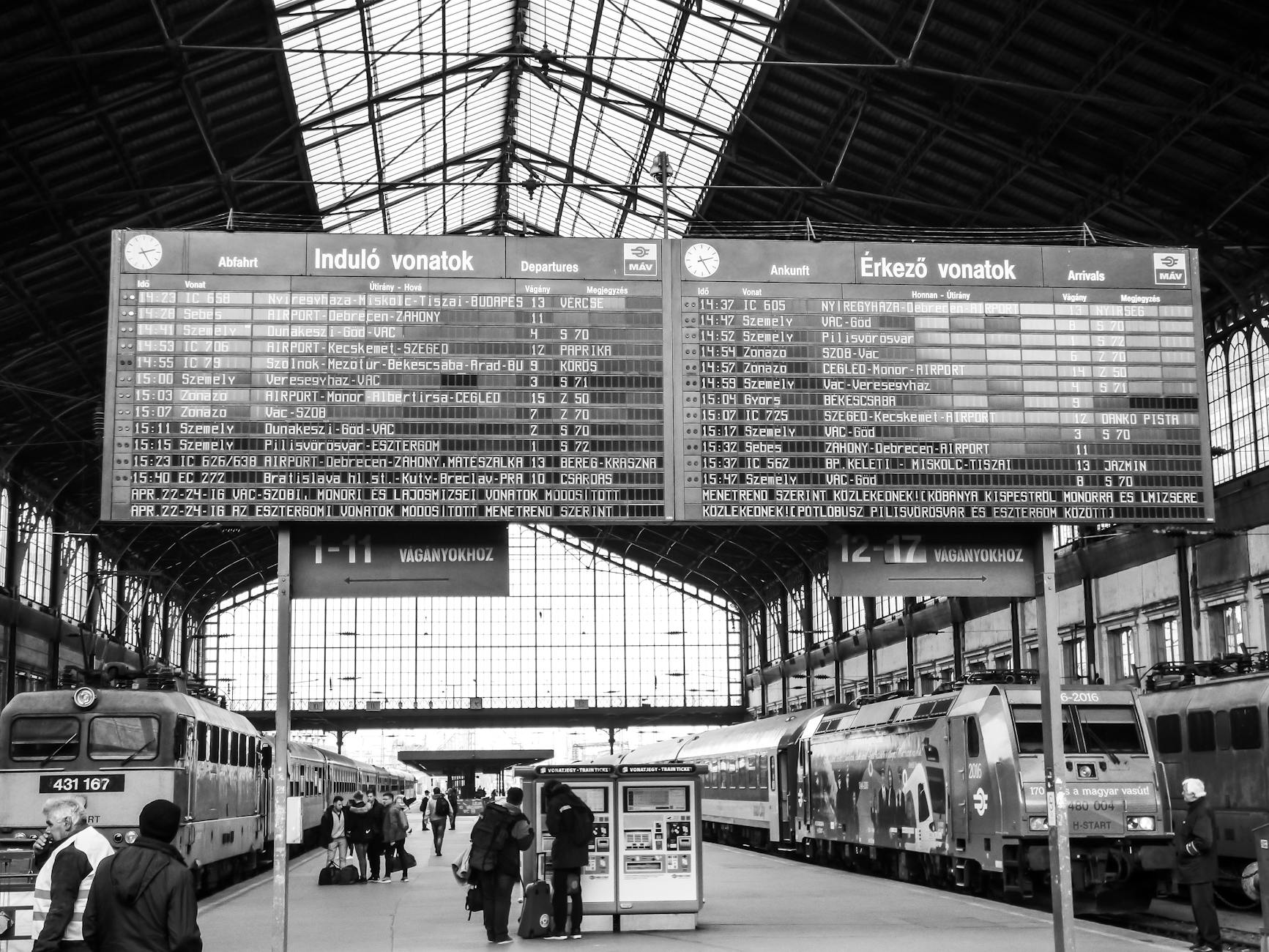
Nyugati (“Western”) opened on 28 October 1877, designed by the Austrian architect August de Serres, who worked for the engineering company of Gustave Eiffel — the same firm behind the tower in Paris a dozen years later, and the exposed iron-and-glass engineering philosophy on display at Nyugati is a direct ancestor of that later, more famous structure. The station’s main hall runs 146 metres, purpose-built so every carriage on a train could be reached from under a single covered platform roof, and it survived serious damage in the Second World War before a full structural renovation in the late 1970s brought the hall back to something close to its original form.
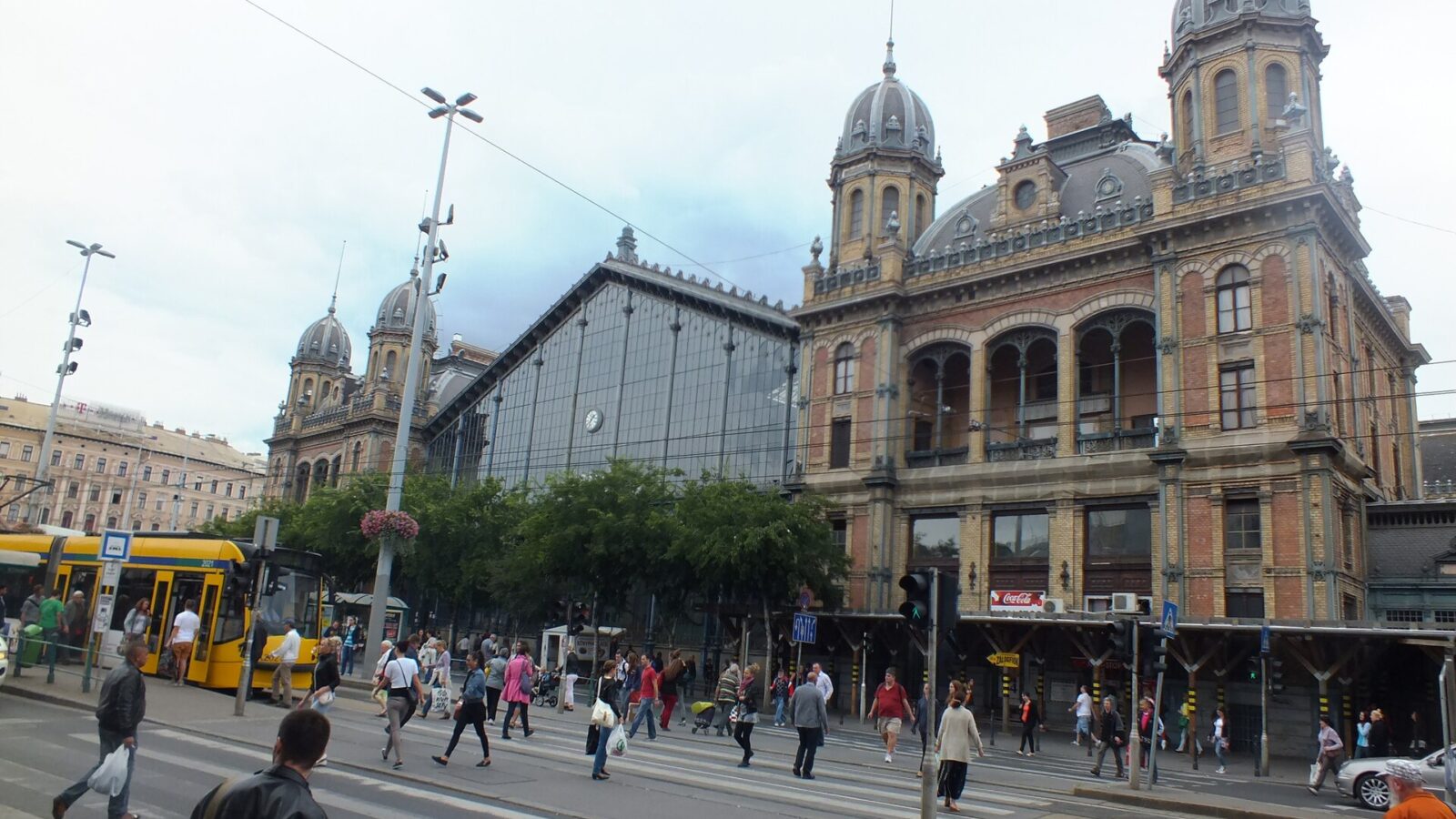
Today Nyugati handles a mix of domestic and regional services plus select international routes, including trains to Vienna, Bratislava and Prague alongside some European night-train connections — a smaller international slice than Keleti carries, but a meaningful one, so double-check your specific booking rather than assuming Keleti by default — the split isn’t arbitrary, but it also isn’t intuitive from outside the network, and getting it wrong on a tight connection is exactly the kind of mistake this guide exists to prevent. A major renewal project for the station and its surrounding area was awarded to the architecture firm Grimshaw following an international design competition, aiming to preserve the historic Eiffel-era hall while increasing capacity and improving the station’s connection to the surrounding city — worth knowing about if a future visit coincides with construction, though no confirmed completion date had been set as of when this was checked. The station sits directly on the M3 metro line and on Budapest’s Grand Boulevard (Nagykörút), making it an easy landmark to navigate by even without going near a platform.
Facilities at Nyugati
Nyugati’s concourse has a notably different feel from Keleti’s — somewhat calmer, with a large supermarket occupying part of the historic hall alongside the usual mix of ticket counters, cafés and newsagents. The building’s dual identity as both a working terminus and a well-known city landmark means it draws a share of visitors who aren’t travelling anywhere at all, simply stopping to look at the glasswork; if you’re one of them, the best vantage point is from the square directly outside rather than inside the working concourse, where lingering near the platforms understandably draws less patience from station staff.
Déli — the gateway to Buda and the south
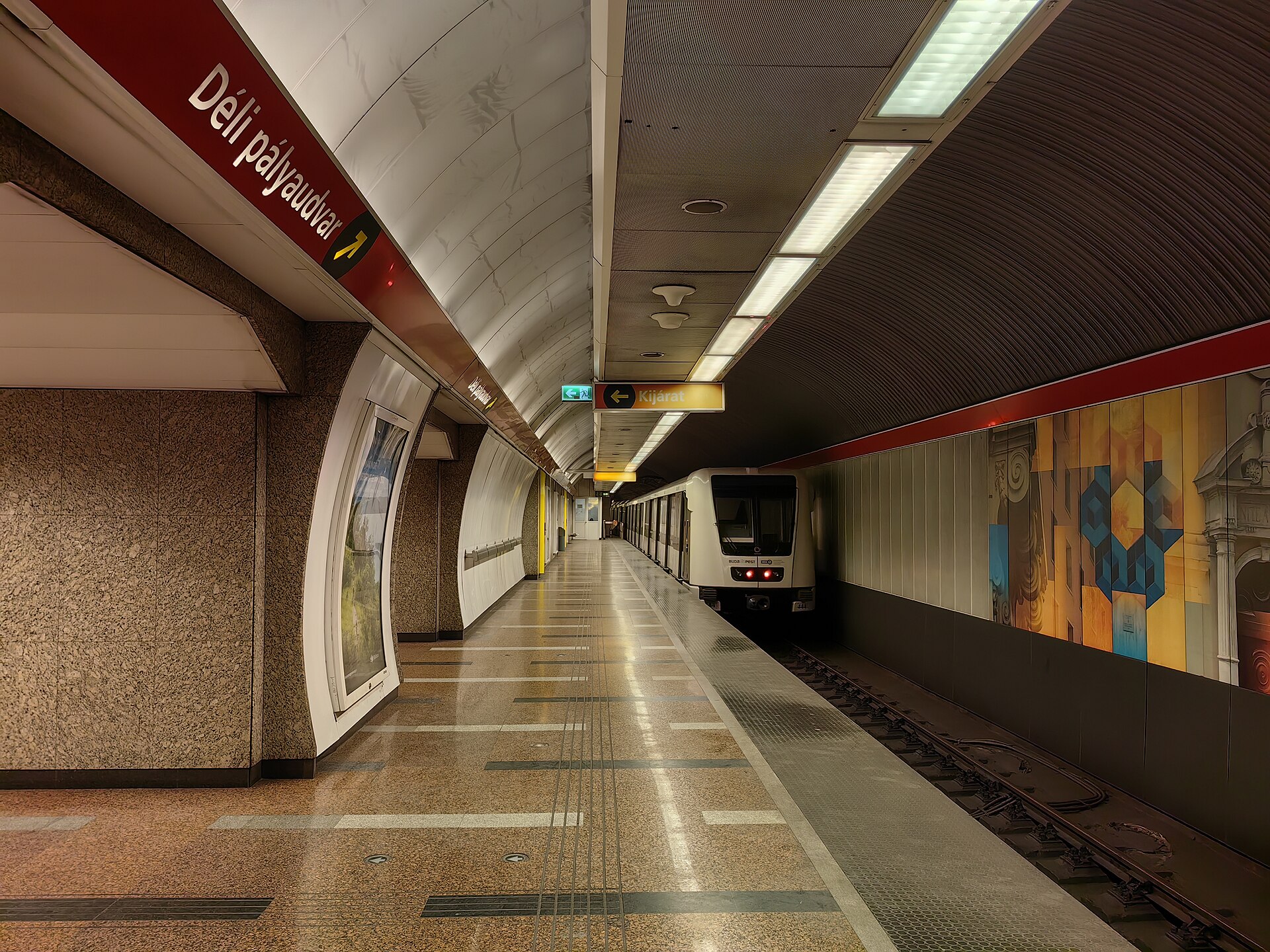
Déli (“Southern”) is the odd one out architecturally: where Keleti and Nyugati are nineteenth-century showpieces, Déli is a Communist-era concrete-and-glass structure completed in 1975, replacing an original 1861 station — itself the first main railway station built in Hungary — that was heavily damaged in the Second World War. It sits on the Buda side of the city, integrated directly with the M2 metro station of the same name, and its architecture reads as a genuine example of 1970s Eastern Bloc civic design rather than a restoration of something older.
Functionally, Déli is Hungary’s gateway to Lake Balaton and the southwest: MÁV runs direct InterCity and regional services to Siófok, Balatonföldvár and Fonyód on the lake’s southern shore, departing every 30 to 60 minutes through the summer season when Balaton traffic peaks, plus onward connections toward Croatia and Slovenia. If your trip includes a Balaton day out, the Lake Balaton day-trip guide covers which of these towns are worth the ride, and Déli is very likely where that journey starts and ends.
Facilities at Déli
Déli is smaller and more straightforwardly functional than the other two — a compact concourse with ticket machines, a handful of food and coffee kiosks, and direct escalator access down to the M2 platform below. It lacks the architectural drama of Keleti or Nyugati, but it’s also generally the easiest of the three to navigate quickly, with clearer, less crowded sightlines between the entrance, the ticket area and the platforms. Its position on the Buda side, away from the Pest city centre most visitors base themselves in, means it’s worth building a little extra travel time into your plans to actually reach it, particularly if you’re coming from a hotel well outside the centre.
Three eras of Hungarian railway building in one city
Taken together, the three stations trace a rough history of Hungarian rail infrastructure across a century and a half. Déli’s predecessor, opened in 1861 as Buda állomás, was the country’s very first main railway station — a fact easy to miss given the current building dates only to 1975, but it means the site itself has been a railway gateway for longer than either of the other two. Nyugati, opened in 1877, and Keleti, opened in 1884, both belong to the grand era of nineteenth-century Hungarian railway expansion under the Austro-Hungarian Empire, built as much to project the confidence and prosperity of a rapidly industrialising Budapest as to move passengers efficiently — which is exactly why both remain architecturally striking in a way few purely functional transport buildings from any era manage.
The gap between Nyugati and Déli’s current buildings — glass-and-iron Victorian engineering versus 1970s poured concrete — is also a fairly blunt illustration of what happened to Hungarian public architecture in between: war damage, decades of more austere Communist-era rebuilding priorities, and only in recent years a return to ambitious, heritage-conscious redevelopment, visible in projects like the Nyugati renewal competition described above.
Accessibility
All three stations have step-free routes between street level and platforms, though the ease of that access varies — Déli’s more compact, purpose-built 1970s layout tends to be the most straightforwardly navigable for wheelchair users and travellers with heavy luggage, while Keleti and Nyugati’s older buildings mix original nineteenth-century circulation with later, sometimes awkwardly grafted-on lifts and ramps. If accessibility is a significant concern for your journey, contacting MÁV-START or your specific train operator ahead of travel to confirm platform-level assistance is worth the extra step, particularly for Keleti given how much larger and busier its concourse is than the other two.
Which station do you actually need?
The simplest rule: check your ticket rather than guessing by destination alone, since routing occasionally shifts between stations for the same city depending on the specific service and operator. As a general pattern, though — international trains toward Austria, Romania or most of Central Europe usually mean Keleti; Vienna, Bratislava or Prague services sometimes run from Nyugati instead, so verify rather than assume; and anything toward Lake Balaton or southwestern Hungary almost always means Déli. None of the three stations are within easy walking distance of each other, so confirming your departure station the night before, not the morning of, is worth the two minutes it takes.
Practical tips
All three stations have left-luggage facilities, though hours and exact locations shift periodically — ask at an information desk on arrival rather than relying on an old blog post’s directions. Ticket offices, MÁV-START self-service machines and international booking desks (RegioJet, in particular, maintains a visible presence at Keleti) are concentrated in or near the main halls at all three stations, so a first stop at an information point on arrival is rarely wasted time even if you already hold a ticket, simply to confirm your platform and any last-minute schedule changes. As with any major European terminus, stay alert to your belongings in crowded concourses and platforms, particularly around Keleti, which sees the heaviest tourist and long-distance passenger footfall of the three — ordinary situational awareness is enough, nothing more than you’d apply at a busy station anywhere else. The usual station-adjacent scams found across major European cities — unofficial “helpers” offering to carry bags for an unexpected fee, unlicensed taxi touts approaching before you’ve reached the official rank, overly persistent offers of accommodation — show up occasionally at Keleti in particular given its tourist and international-arrival volume; politely declining and heading for clearly marked official services (ticket windows, licensed taxi ranks, metro entrances) handles all of them.
All three stations connect to the wider city via the metro lines listed above, plus extensive tram and bus routes — see the getting around Budapest guide for fares if you haven’t already sorted out a travelcard. None of the three require a special approach to reach; they’re simply worth knowing apart before you need one specifically.
Taxi ranks and rideshare pickup points operate outside all three, clearly marked and generally easy to find near the main entrance rather than tucked away — useful with heavy luggage or a late-night arrival when the metro has stopped running for the day. Hotel proximity is also worth weighing when booking accommodation if you know which station your trip will use most: staying within easy reach of Keleti makes sense for a trip built around international rail travel, while a Buda-side hotel pairs more naturally with a Déli-anchored Balaton itinerary. Neither consideration should override a good location for the rest of your trip, but it’s a reasonable tiebreaker if two otherwise similar hotels are on the table and your itinerary already has a station-heavy day built into it.
The honest verdict
Keleti and Nyugati are worth a look even if you’re not catching a train from either — genuine nineteenth-century engineering landmarks in daily use rather than museum pieces, and Nyugati’s Eiffel-company pedigree in particular is a detail most visitors walking past on the Grand Boulevard never learn. Déli won’t win any beauty contests, but it does its job as the practical, efficient route to Lake Balaton that most Budapest-based day-trippers end up using at least once. Know which one your ticket actually names before you leave your hotel, and the rest of using Budapest’s rail network is straightforward. If your trip involves more than one of the three — say, arriving into Keleti from Vienna and later taking a Balaton day trip from Déli — treat them as genuinely separate destinations on your mental map of the city rather than variations on the same stop, since conflating them is the single most common way visitors end up standing in the wrong queue with a departure clock running down.
Keleti is also where most trips to Austria begin. The hourly Railjets to Vienna start here and call at Kelenföld on the way out of the city, while the cheaper RegioJets leave from Déli instead, which catches out a surprising number of people. Our Vienna train guide covers the fares, the seats and which of the three stations suits your hotel.
The international night trains are where checking your ticket matters most. The sleeper to Poland, for example, carries carriages bound for different cities that are divided during the night. The Budapest to Krakow night train guide explains how to find the right carriage and what to expect on board.
Nyugati is also, for now, the starting point for the rail route to Serbia: InterCity trains to Szeged connect with a cross-border train to Subotica and the new high-speed line to Belgrade. Our Budapest to Belgrade guide covers that route, and what changes when the direct trains from Keleti begin.
Frequently asked questions
Which Budapest train station do I need for international trains?
Keleti handles the largest share of international services — Austria, Romania, Slovakia, Poland and beyond. Nyugati also runs some international routes, including to Vienna, Bratislava and Prague. Always check your specific ticket rather than assuming, since routing varies by operator and service.
Which station do I need for Lake Balaton?
Déli, on the Buda side. MÁV runs direct InterCity and regional trains from Déli to the southern shore towns of Siófok, Balatonföldvár and Fonyód, with frequent summer departures.
Is Nyugati station really connected to the Eiffel Tower’s designers?
Yes, indirectly — Nyugati’s architect, August de Serres, worked for the engineering company of Gustave Eiffel, and the station’s exposed iron-and-glass hall, completed in 1877, shares the same structural philosophy Eiffel’s firm became world-famous for a dozen years later in Paris.
Can I walk between Keleti, Nyugati and Déli?
Not practically — they sit on different sides of the city (Déli in Buda, Keleti and Nyugati in Pest) and are several kilometres apart. Use the metro: M2 and M4 for Keleti, M3 for Nyugati, M2 for Déli.
Do Budapest’s train stations have left luggage?
Yes, all three have left-luggage facilities, though hours and exact locations shift periodically — check at an information desk on arrival rather than relying on outdated directions.
Which is the oldest Budapest train station?
By building, Nyugati (1877) predates Keleti (1884). By site, Déli’s location has the longest railway history of the three, dating to 1861, though its current building was completed in 1975 after the original was destroyed in the Second World War.
Are Budapest’s train stations safe?
Generally yes, with ordinary big-city caution — stay aware of belongings in crowded concourses, and decline unofficial “help” with luggage or unlicensed taxi offers, which occasionally target tourists at Keleti given its international-arrival traffic. None of the three present risks beyond what you’d expect at any major European terminus.
Photo credits
The iron-and-glass facade of Nyugati station with a tram passing in front by Orrling, CC BY-SA 3.0, via Wikimedia Commons.
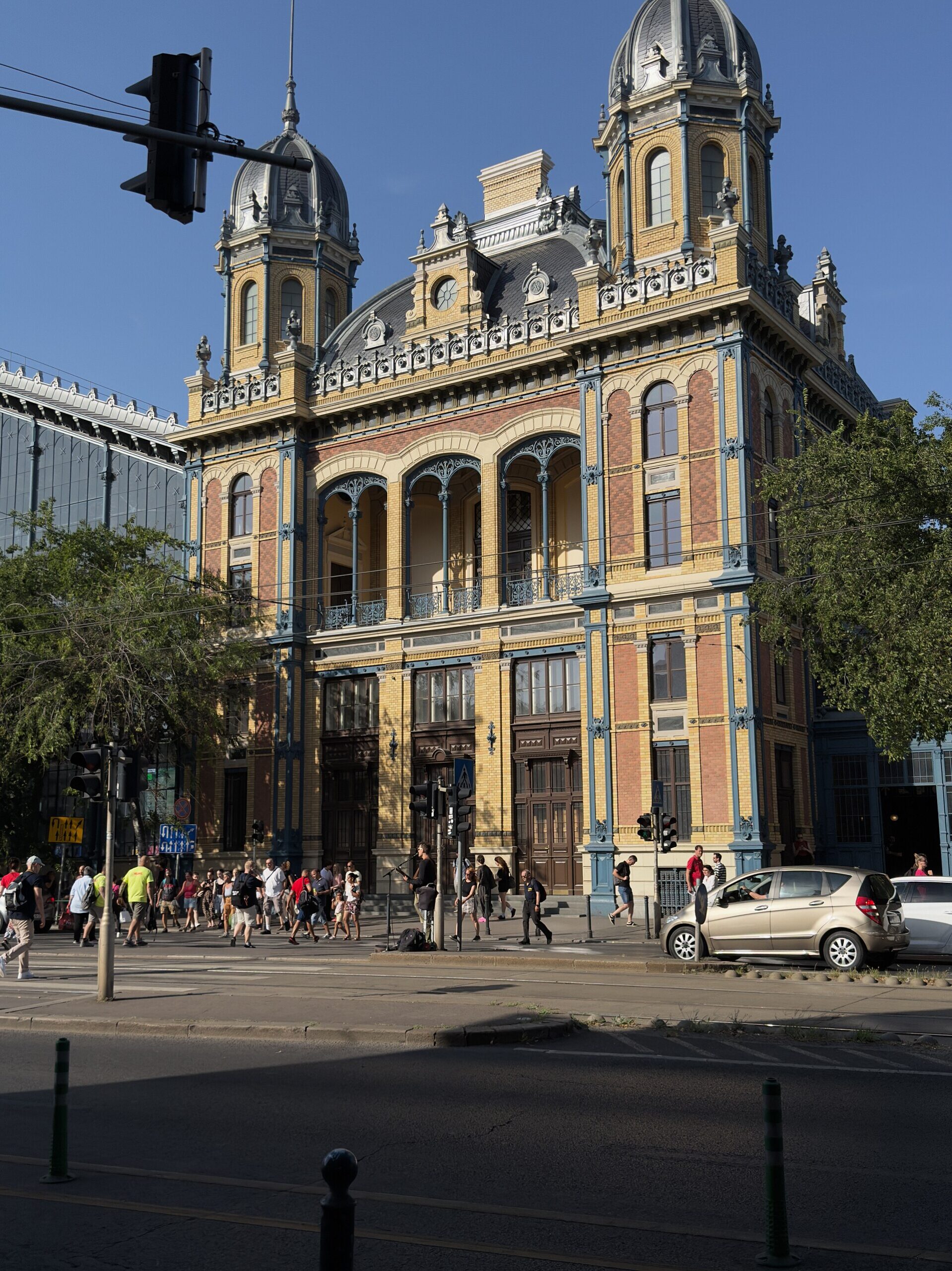
An ornate corner pavilion of the Nyugati station complex by Mike is Michi, CC BY-SA 4.0, via Wikimedia Commons.
The M2 metro platform at Déli pályaudvar by Random photos 1989, CC BY-SA 4.0, via Wikimedia Commons.