The Budapest Metro: All Four Lines, Decoded
M1's 1896 wooden carriages are still running. M4 has no driver at all. A line-by-line guide to what each of Budapest's four metro lines actually feels like to ride.
In this guide
- At a glance
- M1 — the yellow line: a museum piece that’s still in service
- M2 — the red line: deep, fast, and under the river
- M3 — the blue line: the workhorse, freshly renovated
- M4 — the green line: automated and architecturally distinct
- A fifth line that never quite happened
- Riding tips and etiquette
- Practical tips
- The honest verdict
- Frequently asked questions
- Photo credits
This article contains advertising. Our booking links are routed through a partner that adds commission tracking automatically, so if you book through one we earn a commission from the provider, at no extra cost to you. It never affects what we recommend. Affiliate disclosure
Four lines, one letter and a colour each, and remarkably little overlap in character between them — that’s the whole shape of the Budapest metro. Ride the yellow line and you’re in wooden-floored carriages barely wider than a tram, built in 1896. Change onto the green line two stops later and you’re standing under a rippling mosaic ceiling in a station that opened in 2014 with no driver at the front of the train at all. Few metro systems anywhere pack that much contrast into four lines and fifty-two stations.
This guide goes line by line: what M1, M2, M3 and M4 actually feel like to ride, which stations are worth a look for their own sake, and how they connect. For what to actually buy and how validation works, the Budapest public transport guide covers tickets, passes and the BudapestGO app in full — this one stays focused on the four lines themselves.
At a glance
| Line | Colour | Opened | Route | Character |
|---|---|---|---|---|
| M1 | Yellow | 1896 | Vörösmarty tér ↔ Mexikói út | Original, shallow, small historic carriages |
| M2 | Red | 1970 | Déli pályaudvar ↔ Örs vezér tere | Deep Soviet-era line, crosses under the Danube |
| M3 | Blue | 1976 | Újpest-Központ ↔ Kőbánya-Kispest | Longest line, fully renovated with new trains |
| M4 | Green | 2014 | Kelenföld vasútállomás ↔ Keleti pályaudvar | Newest, fully automated, striking architecture |
M1 — the yellow line: a museum piece that’s still in service
The M1 opened on 2 May 1896, built for Hungary’s Millennium celebrations, and holds the distinction of being the first electrified underground railway on continental Europe — only London’s Underground is older anywhere in the world. It runs the length of Andrássy Avenue from Vörösmarty tér in the city centre out to Mexikói út, stopping at Hősök tere and Széchenyi fürdő along the way, and the whole line and its original stations were declared a UNESCO World Heritage Site as part of the wider Andrássy Avenue listing.
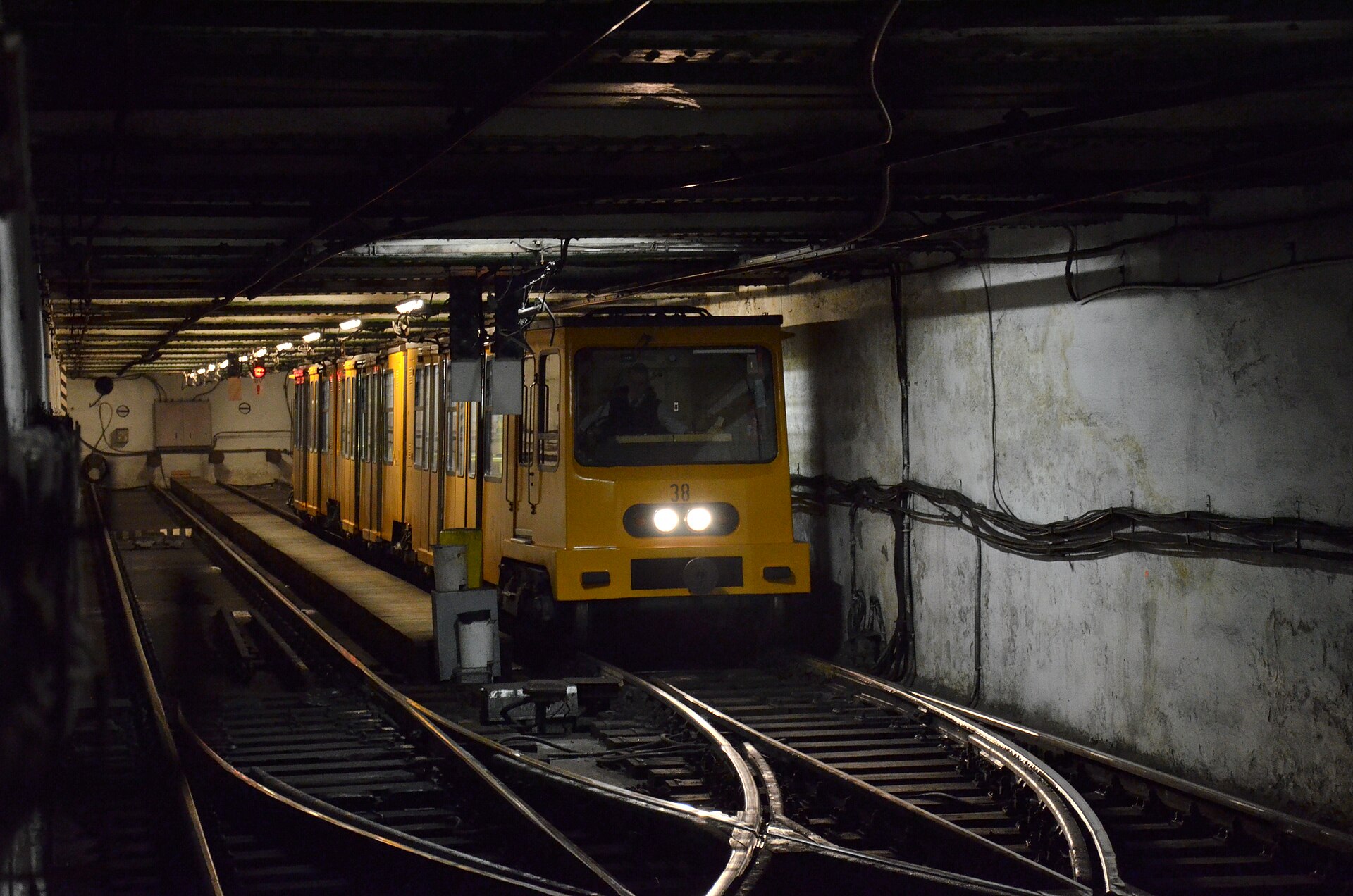
What makes the M1 worth riding for its own sake, not just as transport, is how little it’s been modernised. The line sits just a few metres below street level — shallow enough that some stations are reached by a short staircase rather than an escalator — and the small, yellow, wood-panelled carriages feel closer to a heritage tramway than a modern metro. It’s the line to take if you want the Andrássy Avenue sights (the Opera House, Heroes’ Square, the House of Terror) without walking the whole boulevard, and it’s also, simply, worth a ride as a piece of working transport history that most cities converted or replaced a century ago.
The line opened as the Franz Josef Underground Electric Railway, with Emperor Franz Joseph I himself among its first passengers, and has been known at various points since as the Millennium Underground — a nod to the Millennium celebrations it was built for — before settling into its current low-key “M1” designation on modern maps and signage. Its eleven stations are compact enough that riding the whole line end to end takes barely 20 minutes, and several of the original station pavilions at street level — small, ornate kiosk-like structures — survive largely unchanged from 1896, worth a glance even if you’re not getting on a train there. Vörösmarty tér’s pavilion in particular sits right at the top of the line on the square of the same name, and makes an easy landmark to navigate by even before you’ve worked out the rest of the system.
M2 — the red line: deep, fast, and under the river
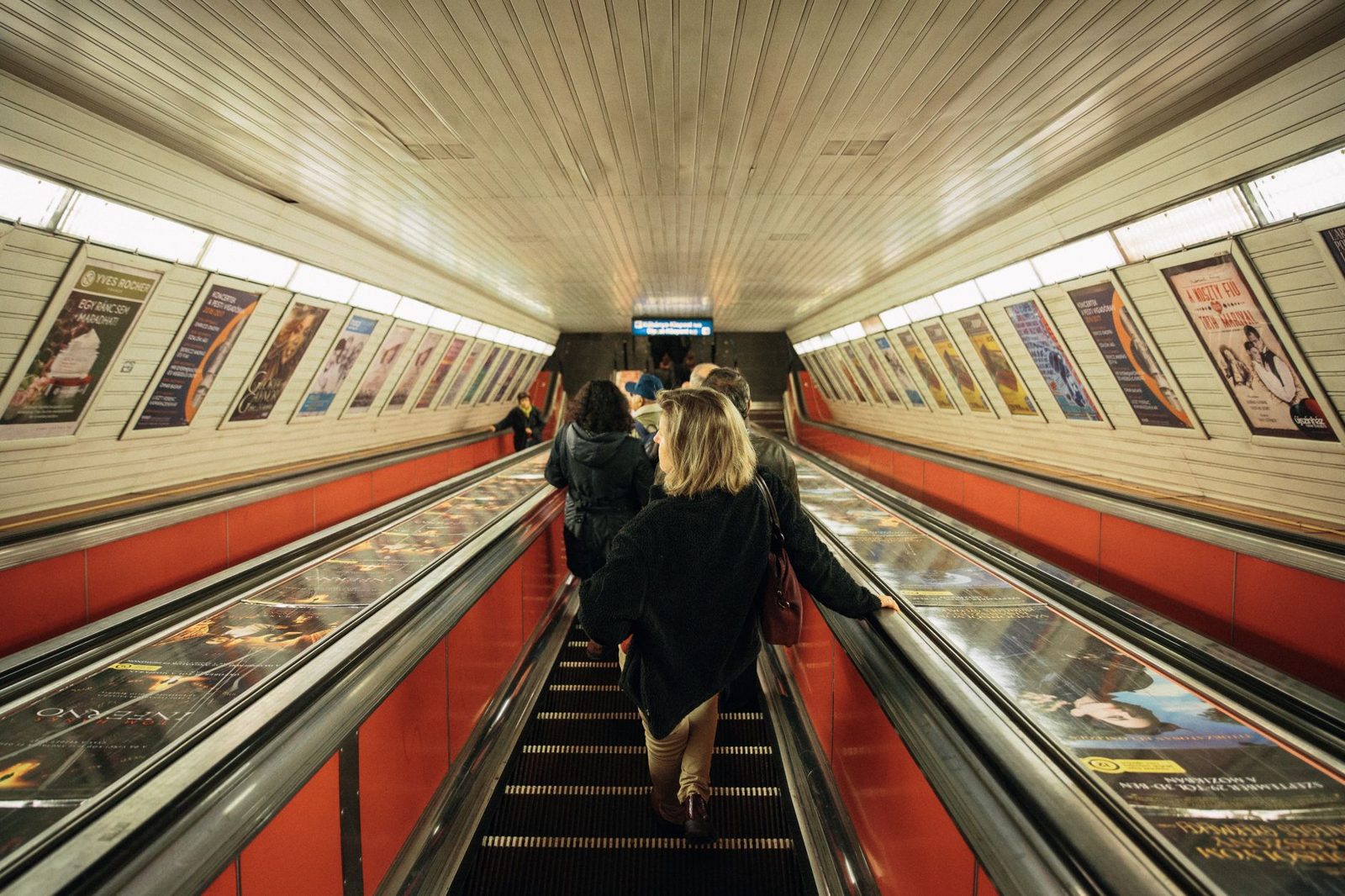
The M2 opened in 1970, decades into the Soviet era, and it shows in the engineering: this is a deep-bore line, reached by long escalators rather than stairs, built to double as a civil-defence shelter as much as a transit line, a design philosophy common to Eastern Bloc metro systems of the period. It runs from Déli pályaudvar on the Buda side to Örs vezér tere in Pest, crossing beneath the Danube between Batthyány tér and Kossuth Lajos tér — one of the more dramatic underground river crossings you’ll do without noticing you’re doing it.
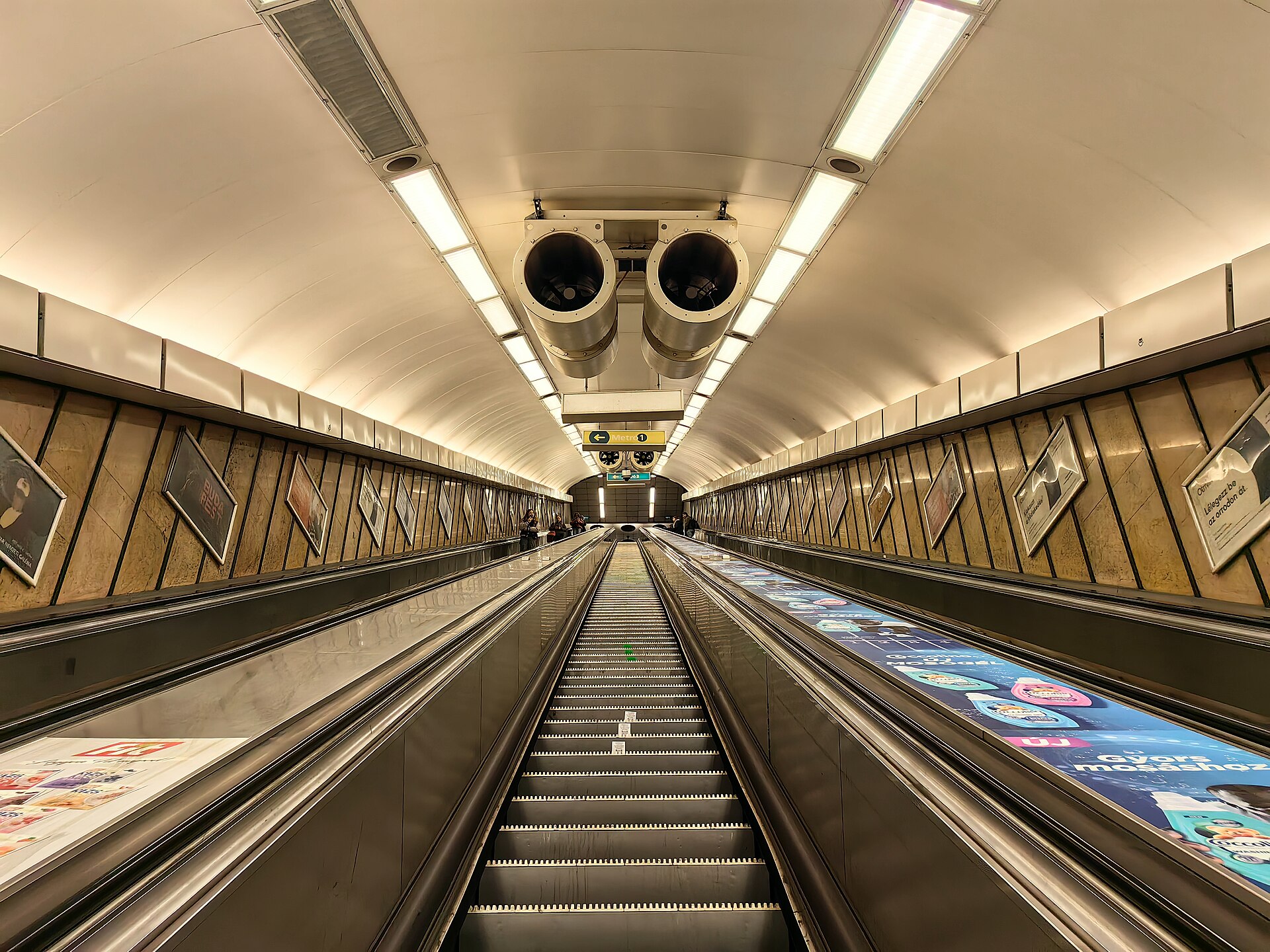
Deák Ferenc tér, where all three of M1, M2 and M3 meet, is the system’s central interchange and worth pausing in briefly even if you’re just passing through — three eras of Budapest metro construction stacked more or less on top of each other. The M2 underwent a major reconstruction between 2004 and 2008, with new rolling stock arriving in 2010 and entering full service in 2012, so despite the line’s age the trains themselves are considerably newer than the tunnels they run through.
The M2’s stations carry a distinct visual identity of their own, built in the heavier, more monumental Soviet civic style of the era — marble and stone finishes, deep coffered ceilings, and a general sense of permanence that contrasts sharply with the M1’s delicate ironwork. Kossuth Lajos tér, serving the Hungarian Parliament building directly above, was rebuilt as part of a wider square renovation and is worth a brief look if you’re already visiting Parliament, since the station entrance integrates directly into the redesigned public square rather than sitting as a separate structure.
M3 — the blue line: the workhorse, freshly renovated
The M3 is the system’s longest line at 16.5 km and 20 stations, running north to south from Újpest-Központ through the city centre to Kőbánya-Kispest, and it’s carried the heaviest passenger load of any line for most of its history simply by virtue of covering the most ground. It opened in stages from 1976 through 1990, and for decades ran on Soviet-built rolling stock that had aged into a byword for Budapest transport’s rougher edges — worn interiors, temperamental air conditioning, the kind of train regular commuters complained about and visitors mostly didn’t notice.
That changed with a comprehensive renovation completed in stages through the late 2010s and early 2020s: new Alstom Metropolis trains replaced the old Soviet stock, and station infrastructure was overhauled to match, closing the gap with the newer M4 considerably. If your mental picture of the M3 is still the old rattling trains from a pre-2020 trip report, it’s worth updating — this is now one of the more comfortable lines to ride rather than the one regular users used to grumble about.
The M3’s route also happens to cover some of the most useful stops for visitors staying outside the immediate centre: Nyugati pályaudvar (one of Budapest’s three main train stations, alongside a striking nineteenth-century iron-and-glass train shed designed with input from the Eiffel company), Deák Ferenc tér for the central interchange, and Kálvin tér for the connection onward to M4. Its northern and southern ends, by contrast, run through residential districts most visitors never see, which makes the line a reasonable window into ordinary Budapest life if you ride it further than your own stop requires — worth a short out-and-back ride for anyone curious what the city looks like once you’re past the postcard districts.
M4 — the green line: automated and architecturally distinct
The newest line, opened in 2014, runs from Kelenföld vasútállomás on the Buda side to Keleti pályaudvar in Pest, crossing the Danube along the way, and it’s fully automated — driverless trains under Siemens-supplied control systems, one of the first metro lines in Central and Eastern Europe built this way. The absence of a driver’s cab at the front means an unobstructed view down the tunnel from the very front of the leading carriage, a small novelty that regular metro riders from cities with older systems tend to notice immediately.
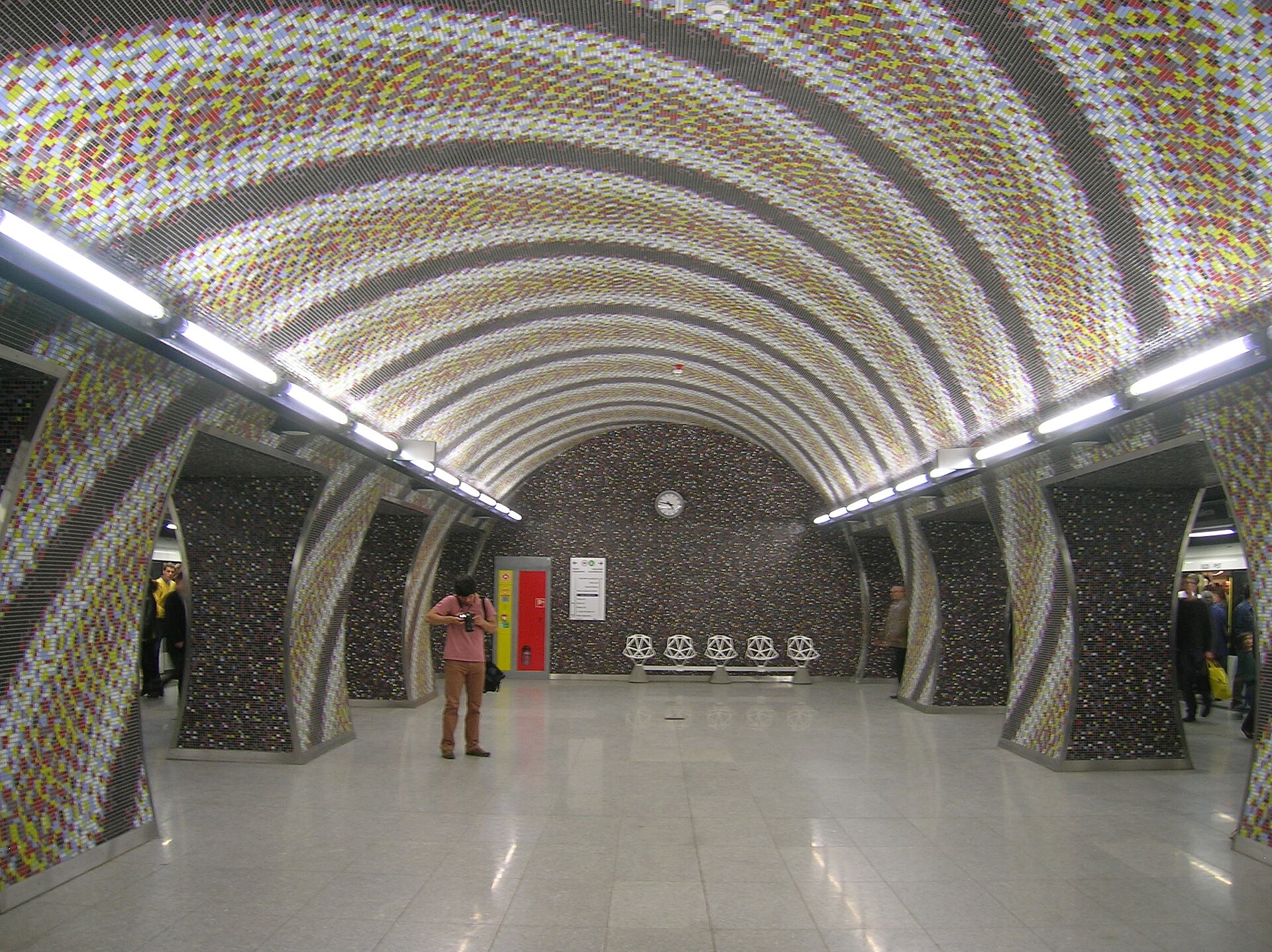
The M4’s stations are the line’s real signature: each was designed with its own distinct identity by a different architectural team, using exposed concrete, monumental open spaces and, where possible, natural light channelled down from street level onto the platforms. Szent Gellért tér is the standout — a rippling, wave-like mosaic of thousands of tiles by artist Tamás Komoróczky covering the entire vaulted ceiling and walls, built to evoke light reflecting on the Danube directly above. Fővám tér and Rákóczi tér are also worth a look if you’re riding this line anyway; none of the other three lines pursued station architecture as a deliberate, individual design statement the way M4 did.
The technical numbers behind the automation are genuinely impressive for a system this size: the Siemens-supplied control system can run up to 30 trains an hour on the line, carrying up to roughly 20,100 passengers per direction per hour at full capacity — figures that put it comfortably in line with much larger, older metro systems despite M4 being the newest and shortest of Budapest’s four lines at just 7.34 km. Depths vary considerably station to station, from around 14.5 metres down to over 31 metres at the deepest points, a consequence of threading the line beneath existing infrastructure — older metro tunnels, building foundations, the Danube itself — rather than any single consistent design depth.
A fifth line that never quite happened
Budapest has discussed a fifth metro line, running roughly north-south through parts of the city the existing four don’t cover well, on and off for decades, with various proposed routes surfacing and stalling at the planning stage rather than reaching construction. Nothing currently under construction should change the four-line map for visitors any time soon, but it’s worth knowing the conversation exists if you come across an older map or forum thread speculating about an “M5” — as of 2026, it remains a long-term planning idea rather than a project with a firm timeline, and the practical system to plan a visit around is still the four lines covered here. If a fifth line does eventually move from proposal to construction, expect it to take the better part of a decade from groundbreaking to opening, in line with how long M4 itself took from approval to its 2014 debut.
Riding tips and etiquette
Stand on the right on escalators, particularly the long ones on M2 and M4, and walk on the left if you’re in a hurry — this is followed reasonably consistently and standing on the wrong side during a busy commuter period draws the same mild irritation it would in London or Moscow. Doors close briskly and without much warning chime on some rolling stock, so don’t count on a long grace period once the doors start moving — treat a closing door the way you would anywhere else in Europe and simply wait for the next train rather than forcing your way through. Priority seating near the ends of each carriage is marked and genuinely expected to be given up for elderly, pregnant or disabled passengers; it’s a stronger social norm here than in some Western European cities, and visibly ignoring it draws more open disapproval than it might elsewhere.
Deák Ferenc tér is the only station where three lines meet (M1, M2, M3), making it the system’s de facto hub and the station you’ll most likely pass through even on a route that doesn’t strictly require it. Kálvin tér connects M3 and M4; Keleti pályaudvar connects M2 and M4 alongside the mainline railway station of the same name; Örs vezér tere links M2 with several tram lines heading further out into Pest. None of the four lines currently intersect more than once with any other, so a typical cross-city journey involves at most one change, which keeps the system considerably easier to navigate mentally than networks with more tangled interchange patterns.
Practical tips
Trains run roughly every 2 to 4 minutes at peak times on all four lines and somewhat less frequently late evening and on weekends, with the full system operating from around 04:30 to past 23:00. All four lines are covered by the same ticket and pass system as buses and trams — validate before you descend to the platform rather than on board, since Budapest’s metro entry gates and validators sit at street level or on the concourse, not inside the train. Step-free access varies significantly by line and station: the M4 was built accessible throughout, the M2 and M3 have step-free access at most but not all stations following their respective renovations, and the M1’s shallow, historic stations are the most likely to require stairs — check the specific station you need rather than assuming, particularly if travelling with a wheelchair, a pushchair or heavy luggage.
Fare inspectors in plain clothes or light vests check tickets regularly at platform level and occasionally on trains, and they do check tourists as readily as locals — an unvalidated or missing ticket results in an on-the-spot fine with no leniency for “I didn’t realise,” so validate before descending to the platform every time rather than assuming a quick trip doesn’t need one — inspectors are just as likely to check a one-stop hop as a cross-city journey, and “I was only going one station” carries no more weight with them than it would with any transit inspector anywhere else. Photography is unrestricted throughout the system for personal use, including on platforms and inside stations, which is exactly why Szent Gellért tér has become such a well-documented stop — tripods and anything resembling commercial equipment are a greyer area and best cleared with station staff if you’re planning more than a phone snapshot. Early morning, before the platforms fill with commuters, is the easiest window for a clean shot of Szent Gellért tér without other passengers in frame.
The honest verdict
All four lines are worth knowing simply for getting around, but two are worth riding on their own merits: the M1 for its sheer age and character, and the M4 for Szent Gellért tér’s mosaic ceiling alone. If your itinerary already has you crossing the city, routing through one of those two rather than the fastest option is a small, free detour into two very different eras of how Budapest thought about public transport.
For a visitor with limited time, the practical order of priority runs: use whichever line gets you where you’re going first, but if a choice exists between two roughly equal routes, pick the one that takes you through Deák Ferenc tér, Kossuth Lajos tér or Szent Gellért tér rather than a purely functional interchange. None of the four lines require a special ticket or a detour worth planning a whole afternoon around — the appeal here is opportunistic rather than a destination in its own right, which is exactly what makes it easy to fold into a normal day of sightseeing rather than something you have to schedule separately.
The metro stops running at around 11pm, and after that the night buses and the all-night 6 tram take over. If they don’t go your way, a cab is the fallback: the Budapest taxi guide explains the fixed tariff, how Bolt works here, and what a ride across town should cost.
Above ground, the trams do much of the work the metro doesn’t, and a few of them are worth riding for the view alone. The Budapest tram guide covers the 2 along the river, the 4 and 6 round the Grand Boulevard and the 47 and 49 over the Liberty Bridge, with the ticket rules that apply to all of them.
Frequently asked questions
How many metro lines does Budapest have?
Four: M1 (yellow, 1896), M2 (red, 1970), M3 (blue, 1976) and M4 (green, 2014), covering 39.4 km and 52 stations between them.
Is the Budapest M1 line really the oldest in continental Europe?
Yes — it opened on 2 May 1896 and was the first electrified underground railway built on mainland Europe, second in the world only to the London Underground. The line and its original stations are part of a UNESCO World Heritage listing alongside Andrássy Avenue above it.
Which Budapest metro line is driverless?
The M4 (green line), opened in 2014, runs fully automated trains with no driver, one of the first metro lines built this way in Central and Eastern Europe.
What ticket do I need for the Budapest metro?
The same tickets and passes used across the whole BKK network — single tickets, transfer tickets, and 24-hour or longer travelcards. See the Budapest public transport guide for current prices and how validation works.
Which metro station connects the most lines?
Deák Ferenc tér, where M1, M2 and M3 all meet — the only three-line interchange in the system, and the most central station overall.
Is the Budapest metro wheelchair accessible?
Unevenly. The M4 is accessible throughout by design; M2 and M3 have step-free access at most stations after their renovations; the M1’s shallow, historic stations are the most likely to require stairs. Check the specific stations on your route rather than assuming full accessibility.
What time does the Budapest metro run until?
The full system operates from around 04:30 to just past 23:00 daily, with trains every 2 to 4 minutes at peak times and less frequently in the evening and on weekends. Night buses cover the core routes after the metro closes.
Which metro line should I ride just for the experience?
The M1 for its 1896 carriages and shallow, historic stations, and the M4 for Szent Gellért tér’s mosaic ceiling — the two lines with the strongest individual character among the four, at opposite ends of the system’s history.
Photo credits
A historic M1 metro carriage at Vörösmarty tér by Florian Fèvre, CC BY-SA 4.0, via Wikimedia Commons.
The deep escalators at Deák Ferenc tér metro station by Christo, CC0, via Wikimedia Commons.
The mosaic interior of Szent Gellért tér station on the M4 line by Alensha, CC BY-SA 3.0, via Wikimedia Commons.