Budapest Trams: Riding the 2, the 4/6 and the 47/49
The 2 along the river, the 4/6 round the Grand Boulevard and the 47/49 over the Liberty Bridge, plus tickets, validating, fines, the all-night tram and the Christmas light trams.
In this guide
- At a glance
- How the trams work
- Buy before you board
- Validate the moment you step on
- Inspectors and fines
- Doors, stops and announcements
- Tram 2: the river line
- Trams 4 and 6: the Grand Boulevard
- Trams 47 and 49: across the Liberty Bridge
- The other lines worth knowing
- 19 and 41: the Buda embankment
- 56 and 61: up into the Buda hills
- 60: the Cogwheel Railway
- 1: the outer ring
- Night trams and the Christmas light trams
- Three tram rides worth doing for their own sake
- Accessibility, pushchairs and luggage
- Practical tips
- Frequently asked questions
- Photo credits
This article contains advertising. Our booking links are routed through a partner that adds commission tracking automatically, so if you book through one we earn a commission from the provider, at no extra cost to you. It never affects what we recommend. Affiliate disclosure
The best-value sightseeing in Budapest costs 500 Ft and turns up every few minutes. Stand on the Pest embankment by the Margaret Bridge, wait for a yellow tram with a 2 on the front, sit on the river side, and for the next twenty minutes the Parliament, the Chain Bridge and the whole of Castle Hill slide past the window. If you only ride one Budapest tram, make it that one. But the 2 is only the most famous line on a network of more than thirty, and a couple of the others are just as useful and nearly as good to look at.
This page covers the lines worth knowing by number — the 2 along the river, the 4 and 6 round the Grand Boulevard, the 47 and 49 across the Liberty Bridge, plus the Buda embankment and hill lines — along with tickets, validating, the fines for not doing it, night trams, the Christmas light trams and accessibility. Fares were checked in September 2026; treat them as the right order of magnitude, since BKK adjusts them from time to time.
At a glance
| Line | Route | Why you’d ride it |
|---|---|---|
| 2 | Jászai Mari tér – Közvágóhíd, along the Pest embankment | The river view: Parliament, Chain Bridge, Castle Hill |
| 4 and 6 | Széll Kálmán tér – round the Grand Boulevard – Újbuda-központ (4) or Móricz Zsigmond körtér (6) | The fastest way round the centre; the 6 runs all night |
| 47 and 49 | Deák Ferenc tér – across the Liberty Bridge – south Buda | Great Market Hall, the Liberty Bridge, the Gellért Baths |
| 19 and 41 | Along the Buda embankment via Batthyány tér | The Parliament from across the river |
| 56 and 61 | Széll Kálmán tér – Hűvösvölgy | The Buda hills and the Children’s Railway |
| 60 | The Cogwheel Railway, Városmajor – Széchenyi-hegy | A steep climb into the hills on a normal ticket |
| Ticket | Price | Good for |
|---|---|---|
| Single ticket | 500 Ft (€1.25) | One journey on one tram, no changes |
| 30-minute ticket | 600 Ft (€1.50) | Changing trams, or tram to metro, within half an hour |
| Block of 10 singles | 4,500 Ft (€11.25) | Couples on a short stay |
| 24-hour travelcard | 2,750 Ft (€6.90) | A busy day of riding: it pays off from the sixth trip |
| 72-hour travelcard | 5,750 Ft (€14.40) | Most city breaks: about four trips a day covers it |
| Fine for no valid ticket | 12,000 Ft on the spot, 25,000 Ft later | Nobody |
How the trams work
Budapest’s trams (villamos in Hungarian) are part of one network run by BKK, the city’s transport authority, with the vehicles themselves operated by BKV. One ticket system covers the trams, the four metro lines, buses, trolleybuses and the HÉV suburban trains inside the city, so there’s nothing special about a tram ticket. There are, though, a few habits that catch visitors out.
Buy before you board
You can’t buy a ticket from a tram driver. Get one before you board, from the purple BKK machines at metro stations and the bigger tram stops, or in the BudapestGO app, which sells singles and travelcards and shows live departures for every line. The app is the easy option if your card works in it; the machines take cards and cash, and have an English menu.
Validate the moment you step on
A paper single ticket isn’t valid until you’ve punched it in one of the small orange or red validators by the doors, and you should do it as soon as you board, not when you see an inspector. On the app, you activate the ticket just before you get on and scan the QR code at the reader beside the doors. Travelcards don’t need validating on every trip; just carry them.
A single ticket covers one uninterrupted journey on one tram. Change to another tram or to the metro and you need a new one — or, better, buy the 30-minute ticket for 600 Ft, which allows changes within its half hour. With a 24- or 72-hour travelcard, none of this matters, which is the real reason most visitors should just buy one.
Inspectors and fines
Ticket inspectors work the trams regularly, particularly the lines visitors use, and they check on board and at stops. Riding without a valid ticket costs a 25,000 Ft fine, reduced to 12,000 Ft if you pay on the spot: cash is always accepted, and a card if the inspector carries a terminal. “I didn’t know I had to validate it” doesn’t work as a defence, however genuine. Inspectors should show BKK identification if you ask.
Doors, stops and announcements
On many trams, particularly the newer ones, the doors open only if someone presses the button beside them, so press it rather than waiting for them to open by themselves at a quiet stop. Every stop is a regular stop; there’s no need to signal the driver. Announcements are in Hungarian, but the newer trams have screens showing the next stop, and BudapestGO will track your journey if you’re nervous about missing yours. Hold on when you’re standing: Budapest trams brake harder than you’d expect.
Tram 2: the river line
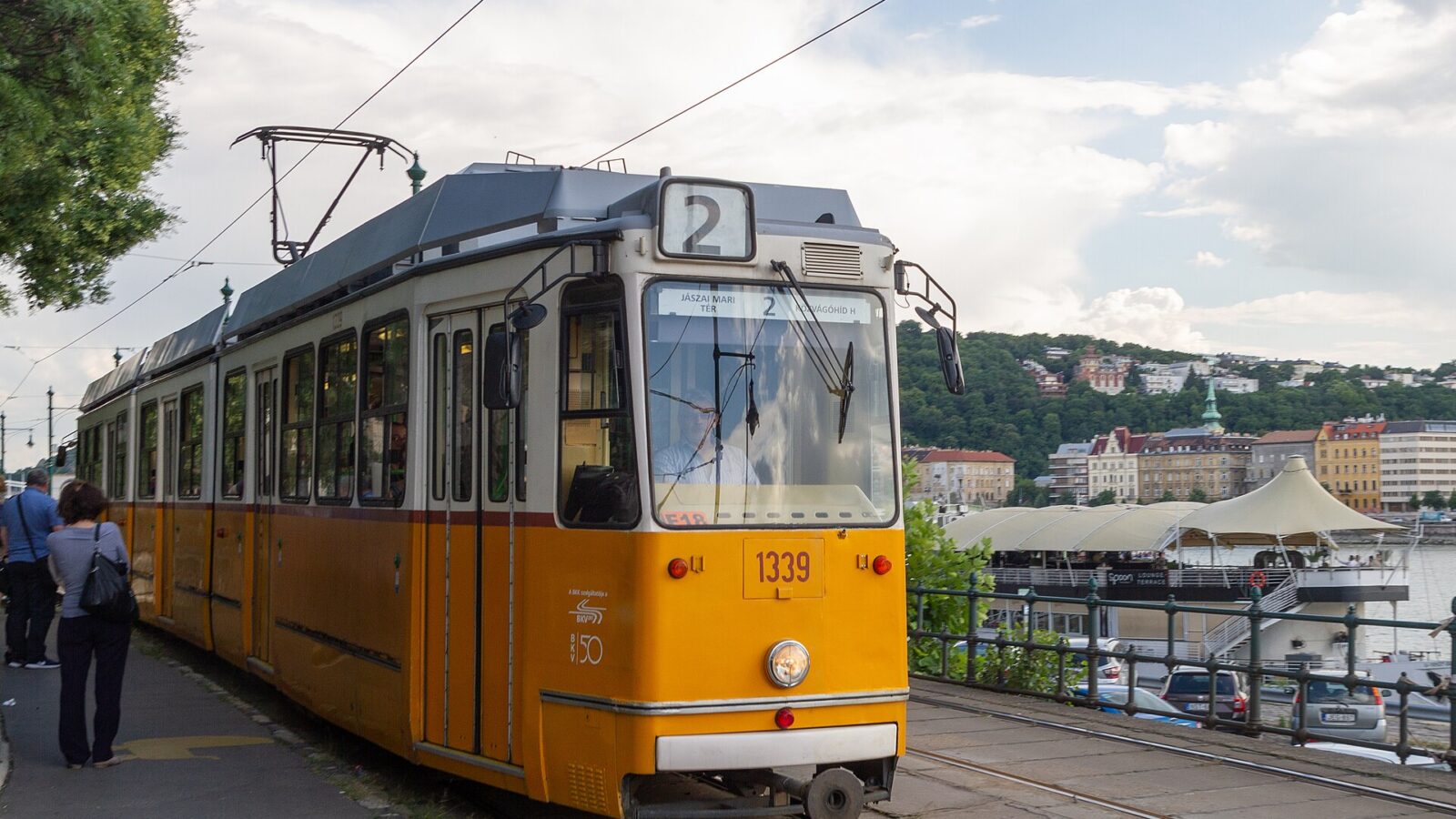
The 2 runs for six kilometres along the Pest embankment, from Jászai Mari tér beside the Margaret Bridge to Közvágóhíd in the south, and it regularly turns up on lists of the world’s most scenic tram rides. It deserves it. For most of its length the track runs right beside the Danube with nothing between you and the water but a railing, and across the river Castle Hill, the Royal Palace, the Fisherman’s Bastion and Gellért Hill line up one after another.
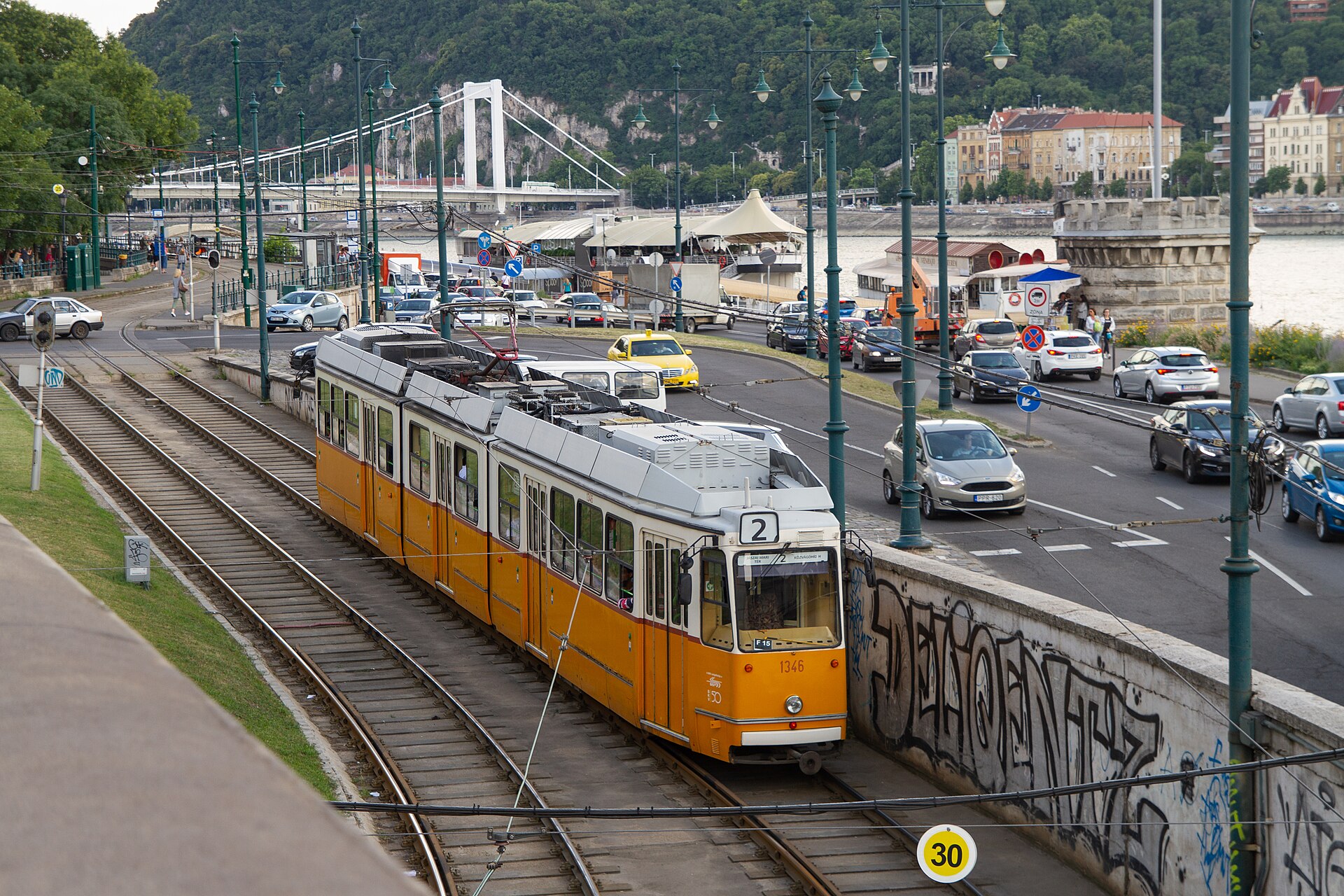
Heading south from Jászai Mari tér, sit on the right for the river side. The highlights come quickly:
- Kossuth Lajos tér — the stop for the Parliament, whose river façade fills the window as you pull in.
- Between Kossuth Lajos tér and Széchenyi István tér you pass the Shoes on the Danube memorial on the promenade, the iron shoes of the Holocaust victims shot into the river in 1944 and 1945.
- Széchenyi István tér — the Pest end of the Chain Bridge, with the Gresham Palace facing it.
- Vigadó tér — the Vigadó concert hall, and the piers for many of the river cruises.
- Fővám tér — the Great Market Hall and the Liberty Bridge.
After Fővám tér the view turns more workaday. The line carries on past Boráros tér and the Müpa arts centre and National Theatre to Közvágóhíd, where it meets the HÉV. Stay on only if you’re heading for a concert at Müpa. A related line, the 2B, continues further south to Pesterzsébet, which is useful to residents and not to you.
The honest caveat: this is a working tram line, not a tour. At rush hour it’s full of commuters, the windows aren’t always clean, and on a summer afternoon the older trams on the route can be stuffy. The best time to ride is early evening, when the Parliament and the Castle are floodlit and the commuters have gone home. It’s a fine substitute for a river cruise if you’re short of time or money, though not a full replacement; the Danube cruise guide covers the boats, and the photography spots guide has the best places to shoot the 2 itself.
Trams 4 and 6: the Grand Boulevard
If the 2 is Budapest’s postcard, the 4 and 6 are its workhorse, and the busiest tram line in the city. Both run from Széll Kálmán tér in Buda across the Margaret Bridge, then round the whole arc of the Grand Boulevard (Nagykörút) — Szent István körút, Teréz körút, Erzsébet körút, József körút and Ferenc körút — before crossing back to Buda over the Petőfi Bridge. The 6 ends at Móricz Zsigmond körtér; the 4 carries on to Újbuda-központ. Between Széll Kálmán tér and the Petőfi Bridge they share the same track and stops, so take whichever comes first.
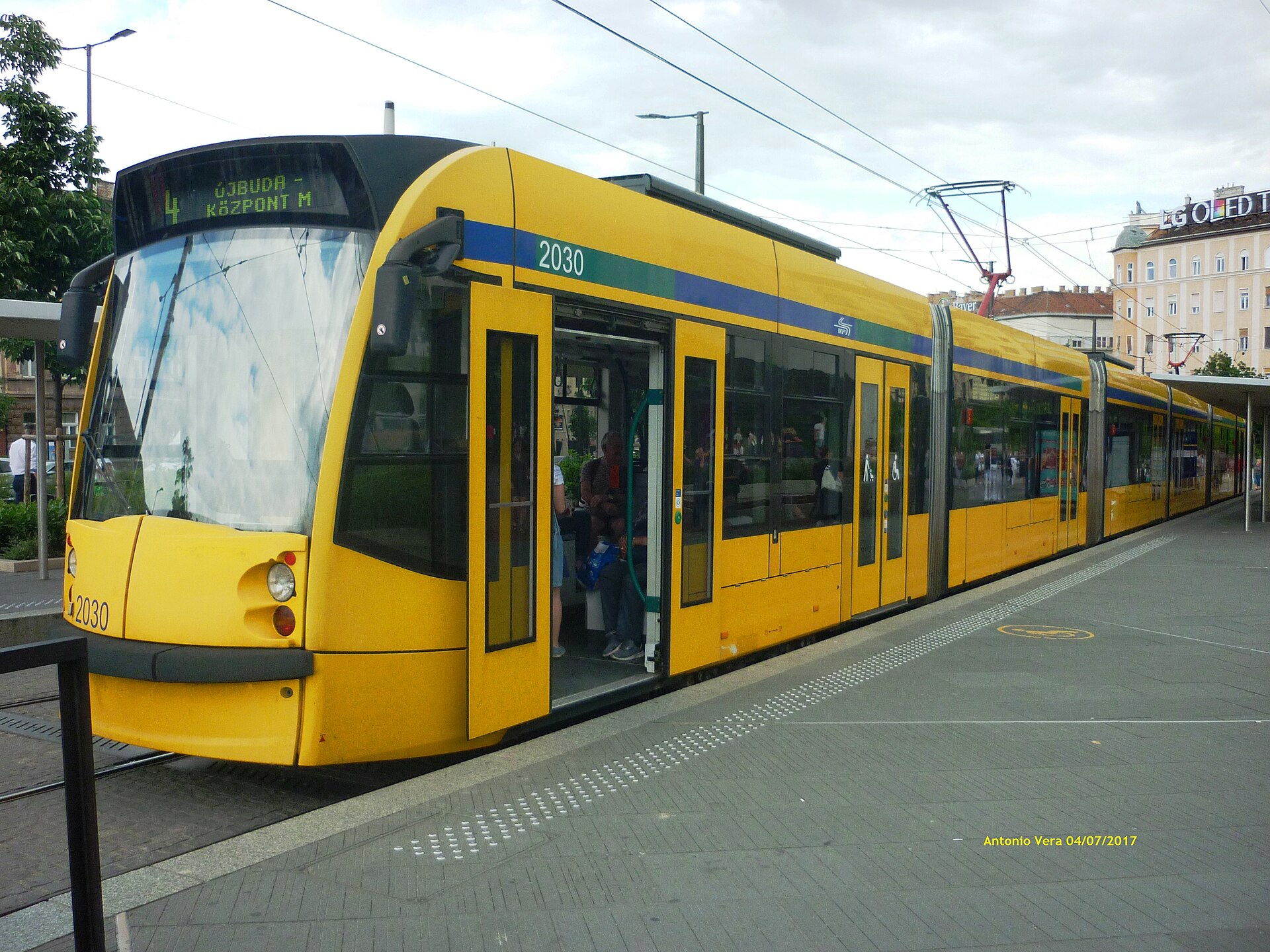
The trams on the route are Siemens Combinos, long, low-floor and articulated — among the longest trams in service anywhere — and they arrive every few minutes through the day. The 6 is the only tram in the city that runs all night, which makes it the answer to most “how do I get home at 3am?” questions in District VII.
The stops worth knowing:
- Margitsziget, in the middle of the Margaret Bridge — the entrance to Margaret Island, and a better view downriver than most people realise.
- Jászai Mari tér — the northern end of the 2, for the Parliament and the embankment.
- Nyugati pályaudvar — the Western Station, and the M3.
- Oktogon — Andrássy út and the M1, for the Opera and the walk to Heroes’ Square.
- The Erzsébet körút stops — the edge of the old Jewish Quarter and the ruin bars, with the New York Café on the boulevard itself.
- Blaha Lujza tér — the M2, and one of the city’s big interchanges.
- Corvin-negyed — the M3 again, and the Corvin Cinema, a key site of the 1956 revolution.
The 4 and 6 aren’t a scenic ride in the way the 2 is, but the boulevard is a fine piece of late-19th-century city building, and you see a lot of ordinary Budapest life from the window. They’re also crowded, particularly between about 7 and 9am and 4 and 6pm. Keep bags in front of you; the safety guide has the rest of the advice on pickpockets.
Trams 47 and 49: across the Liberty Bridge
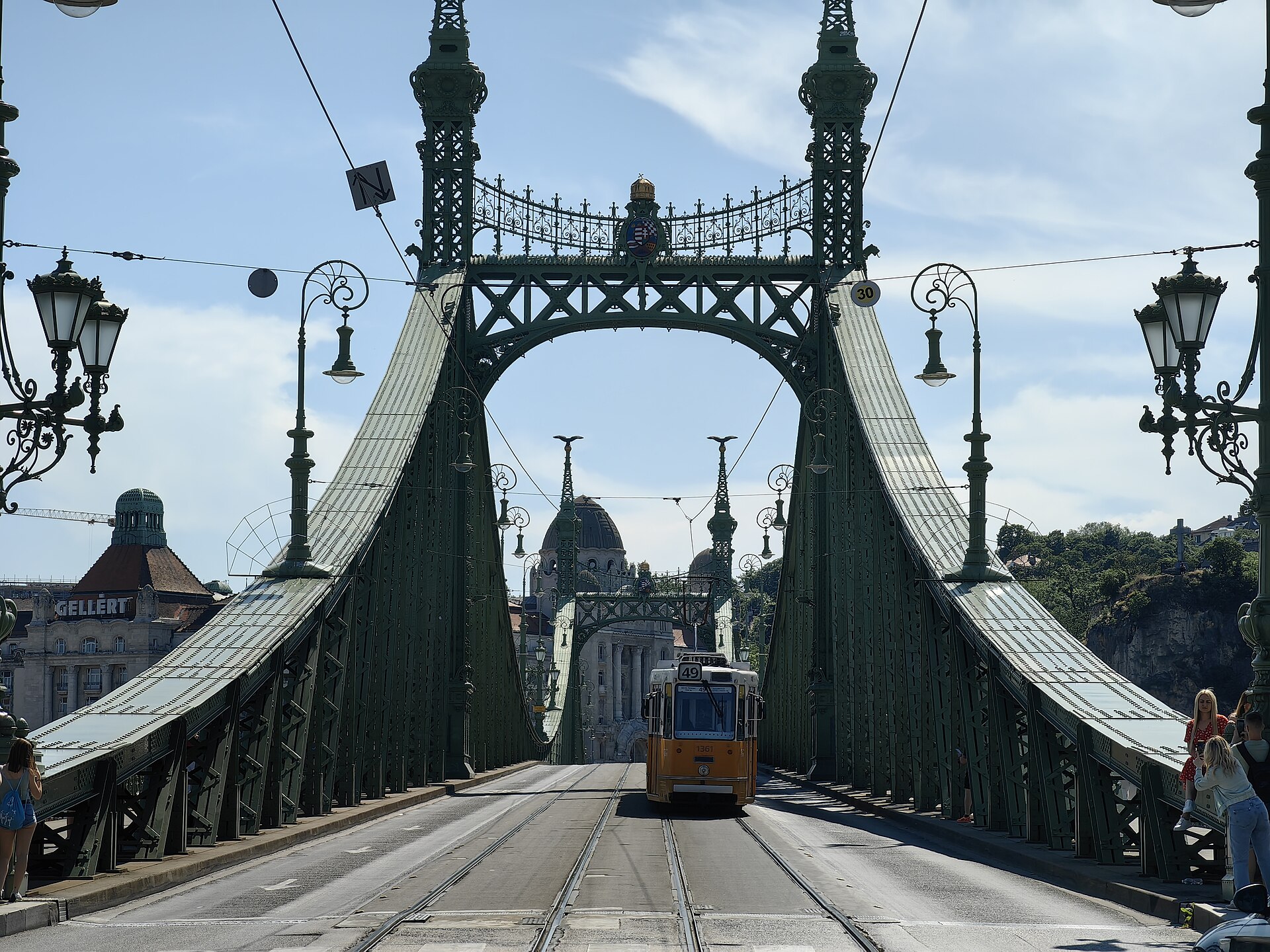
The 47 and 49 start at Deák Ferenc tér and run down the Kiskörút, the Small Boulevard, past Astoria and Kálvin tér to Fővám tér, then cross the Danube on the Liberty Bridge (Szabadság híd), the green iron bridge of 1896 with a mythical turul bird perched on each of its towers. The crossing takes about a minute and a half, and it’s the best ninety seconds of tram travel in the city: straight ahead of you is the Gellért, hotel and baths, with Gellért Hill rising behind it. The baths themselves are closed for a multi-year renovation, due to reopen around 2028, but the building is still the view.
On the Buda side both lines stop at Szent Gellért tér, for the Gellért building (the baths are closed for renovation until around 2028) and the climb to the Citadella, then run down Bartók Béla út, which has become a strip of cafés and small galleries, to Móricz Zsigmond körtér. After that the 47 carries on south to Budafok and the 49 heads west, and neither leg holds much for a visitor.
The useful stops on the Pest side: Kálvin tér for the Hungarian National Museum, and Fővám tér for the Great Market Hall. If you’re doing the market in the morning and want a thermal soak in the afternoon, take the 47 or 49 two stops to Szent Gellért tér and change to the 19 or 41 for one stop along the embankment to the Rudas Baths, which are open.
The other lines worth knowing
19 and 41: the Buda embankment
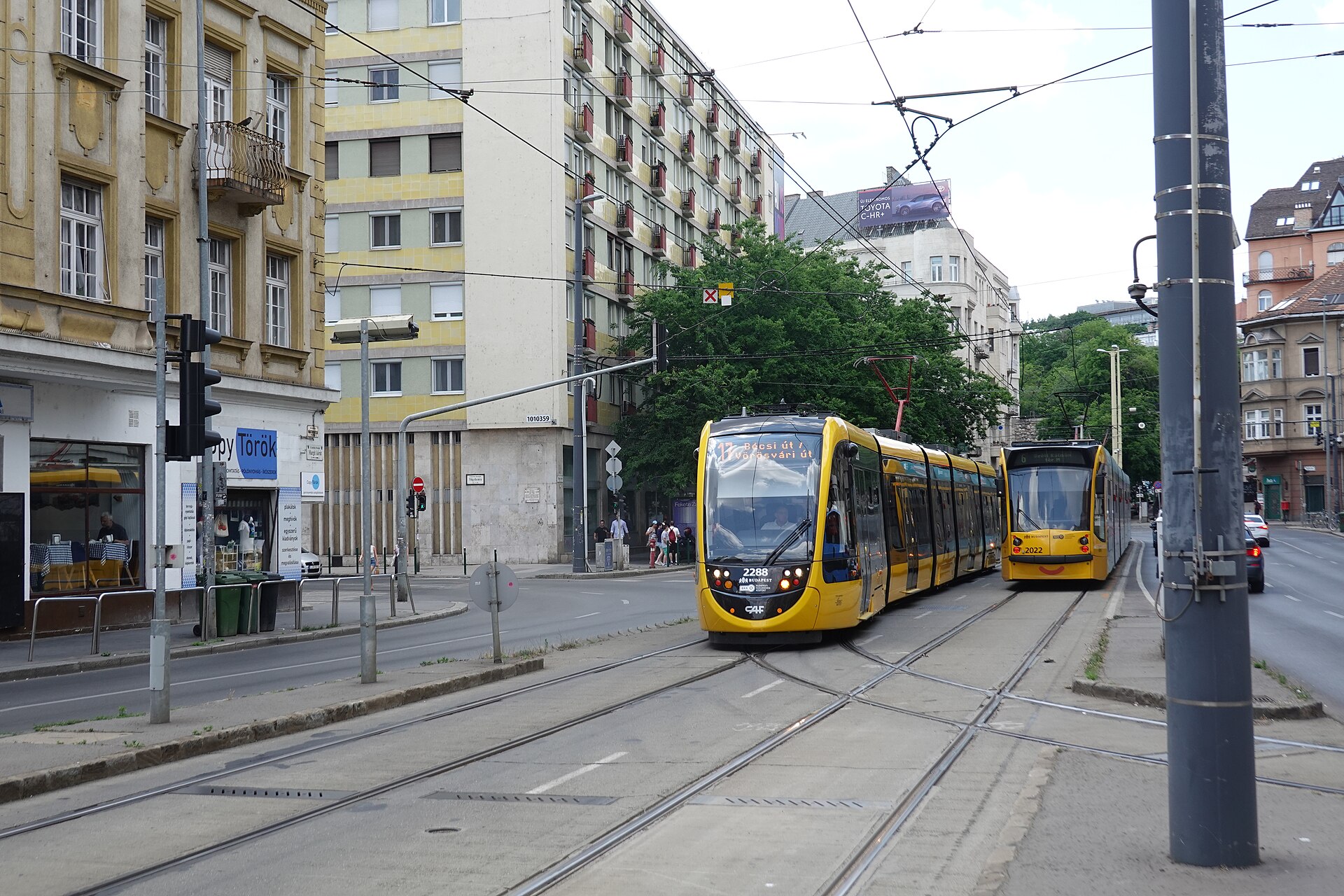
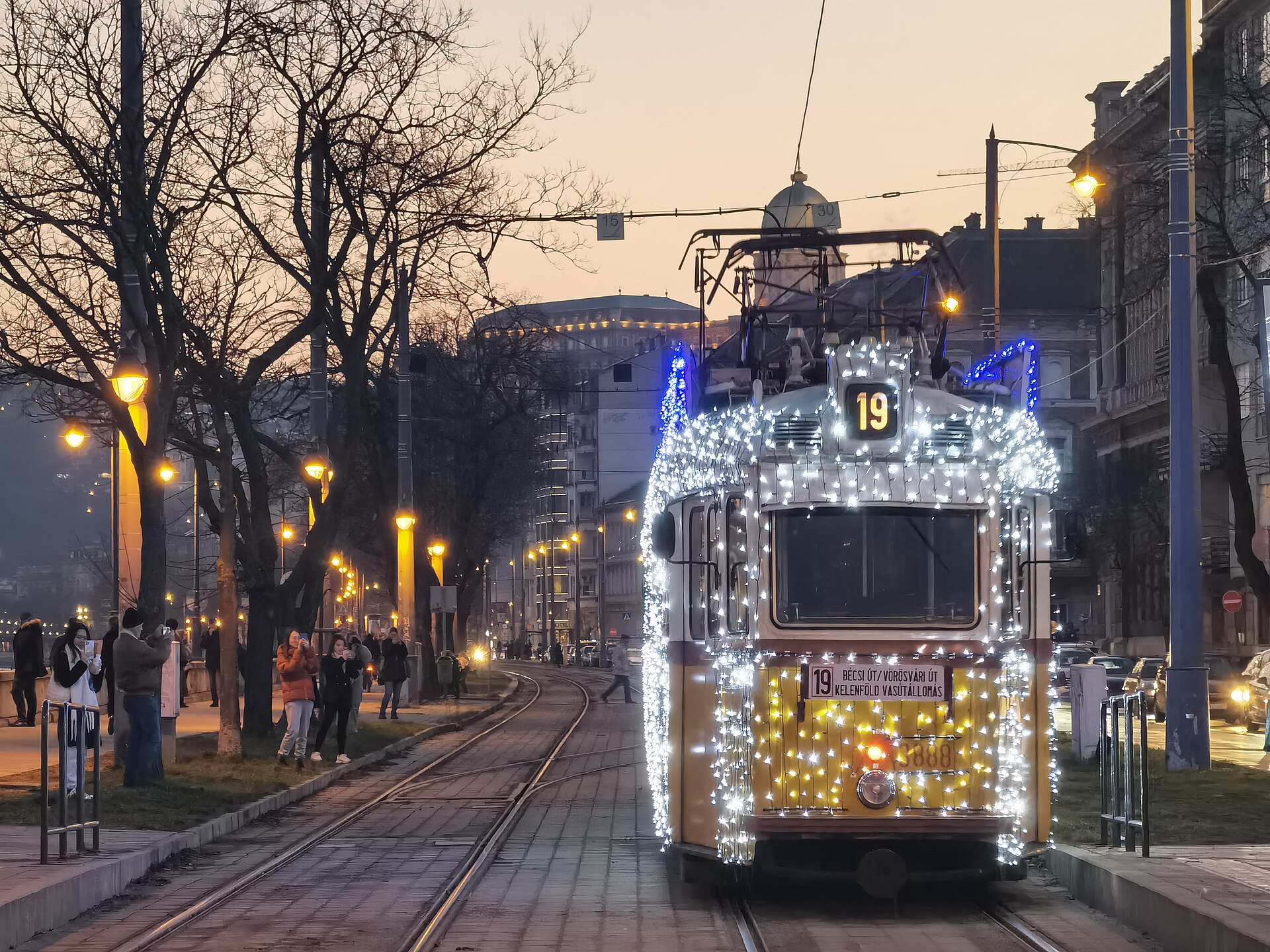
The mirror image of the 2 runs along the Buda side of the river. The 19 and 41 pass Batthyány tér, where you get the classic view of the Parliament across the water, then run beneath Castle Hill to Clark Ádám tér, for the Chain Bridge and the funicular up to Buda Castle, and on to Döbrentei tér for the Rudas Baths and Szent Gellért tér. The 19 runs from Óbuda (Bécsi út/Vörösvári út) all the way to Kelenföld station; the 41 heads out to Kamaraerdő. For views, the stretch between Batthyány tér and Szent Gellért tér is the one to ride.
56 and 61: up into the Buda hills
From Széll Kálmán tér, trams including the 56 and 61 climb through leafy Buda to Hűvösvölgy, at the edge of the forest. It’s the starting point for the Children’s Railway (Gyermekvasút), a narrow-gauge line through the hills where most of the jobs apart from driving the train are done by schoolchildren. The Children’s Railway is not part of BKK and needs its own ticket.
60: the Cogwheel Railway
The Cogwheel Railway (Fogaskerekű) is officially tram line 60, and ordinary BKK tickets and travelcards are valid on it. It grinds up from Városmajor, a short walk or tram ride from Széll Kálmán tér, to Széchenyi-hegy, where the Children’s Railway has its other terminus. That makes a classic half-day loop, and a very good one with children: tram to Városmajor, cogwheel up, Children’s Railway across the hills to Hűvösvölgy, and the 56 or 61 back down. Check BKK’s service notices before you set out, as the hill lines are sometimes replaced by buses for engineering works. Budapest with kids has more on the loop.
1: the outer ring
The 1 runs a long outer arc from Óbuda across the Árpád Bridge, round the Hungária körút and back over the Rákóczi Bridge to Kelenföld station, with long CAF trams. You’re unlikely to ride it for pleasure, but it’s handy for crossing between the outer districts without going through the centre, and for reaching Kelenföld with bags if you’re catching a train there.
Night trams and the Christmas light trams
The metro shuts down around 11pm, and after that the city runs on night buses, numbered in the 900s, and the 6 tram, which keeps going round the Grand Boulevard all night. The 6 is frequent, well used and generally safe, though at 3am on a Saturday it carries a good share of the city’s nightlife home with it. Sort out which night bus or tram you need before the last round; if nothing fits, the taxi and Bolt guide explains how to book a cab without getting ripped off.
From late November into early January, BKV runs its fényvillamos, or light trams: ordinary trams wrapped in thousands of lights, running in normal service on regular lines, so an ordinary ticket gets you aboard. In the 2025 season they ran from 28 November to 6 January, daily from about 4pm, except on 24 and 31 December. Six light trams worked the Grand Boulevard and other routes, and the traditional old UV-type tram, lit from end to end, ran mainly on the 2. BKK marks light-tram departures with a snowflake in its timetables, and you can follow them live in BudapestGO. The 2026 dates are usually announced in November. If you’re here for the Christmas markets, a ride on the lit-up 2 at dusk is one of the nicest free-ish things to do in Budapest in winter.
Three tram rides worth doing for their own sake
- The 2 at blue hour. Board at Jászai Mari tér about half an hour after sunset, sit on the right, and ride to Fővám tér. Walk across the Liberty Bridge afterwards, and take the 47 or 49 back if your legs give out. Twenty minutes, one ticket, and the best view of the city lit up that doesn’t involve a boat.
- The Grand Boulevard on the 6. From Széll Kálmán tér across the Margaret Bridge (hop off mid-bridge for Margaret Island if you like) and round to Boráros tér. It’s the quickest way to understand how the centre of Pest fits together.
- The Buda hills loop. Tram to Városmajor, the Cogwheel Railway up to Széchenyi-hegy, the Children’s Railway to Hűvösvölgy, and the 56 or 61 back down. Allow half a day, and pack a picnic.
Accessibility, pushchairs and luggage
How easy the trams are depends heavily on the line. The Combinos on the 4 and 6 and the newer CAF trams on the 1 and several Buda lines are low-floor, and at the rebuilt stops you roll straight on, which is ideal for wheelchairs, pushchairs and suitcases. Some routes, including the 2, have long used older high-floor trams with steps at the doors. BudapestGO can show which departures are wheelchair accessible, which is worth checking before you set off. Many stops are islands in the middle of the road, reached by pedestrian crossings, and the older ones have kerbs rather than ramps.
Suitcases and pushchairs are fine on the trams, but the 4 and 6 at rush hour are no place for either. Travel mid-morning or after 7pm if you can. For step-free routes on the metro, see the metro guide.
Practical tips
- Buy a 72-hour travelcard on arrival if you’re staying three days. At 5,750 Ft it pays for itself at about four rides a day, and it removes all the validating and changing rules at a stroke.
- If you’re using singles, validate the moment you step aboard, every time, and buy the 30-minute ticket if you’ll change.
- Sit on the river side of the 2: the right heading south from Jászai Mari tér, the left heading north.
- Avoid the 4 and 6 with luggage between 7 and 9am and 4 and 6pm.
- Use BudapestGO for live departures. Tram timetables are frequent enough that you rarely need them, but the app shows disruptions too.
- The Budapest Card includes unlimited public transport, trams included; the Budapest Card guide works out whether it’s worth it for you.
For how the trams fit with the metro, buses and boats, see the public transport guide and the getting around Budapest hub.
Frequently asked questions
Which tram is the most scenic in Budapest?
The 2, which runs along the Pest embankment past the Parliament, the Chain Bridge and the Great Market Hall, with Castle Hill across the river. The 19 and 41 give a mirror-image view from the Buda side, and the 47 and 49 cross the Liberty Bridge.
How much is a tram ticket in Budapest?
A single ticket is 500 Ft (€1.25) for one journey without changes. The 30-minute ticket at 600 Ft allows changes, and travelcards cost 2,750 Ft for 24 hours and 5,750 Ft for 72 hours. Prices were checked in September 2026.
Do I need to validate my ticket on the tram?
Yes. Punch a paper ticket in the validator by the door as soon as you board, or activate and scan an app ticket. Riding without a valid ticket costs a 12,000 Ft fine paid on the spot, or 25,000 Ft paid later.
Can I buy a ticket on the tram?
No. Buy from a BKK machine at a metro station or larger tram stop, or in the BudapestGO app, before you board.
Do trams run all night in Budapest?
Only the 6, which runs around the Grand Boulevard all night. The rest of the night service is by bus, on routes numbered in the 900s.
Which tram goes to the Parliament?
The 2, to Kossuth Lajos tér. The 4 and 6 stop at Jászai Mari tér, a short walk away, and the 19 and 41 give the best view of it from Batthyány tér across the river.
When do the Christmas light trams run?
From late November into early January. In 2025 they ran from 28 November to 6 January, daily from about 4pm, except on 24 and 31 December. They run in normal service, so an ordinary ticket is all you need.
Photo credits
Tram 2 on the Pest embankment: 2018-06-26 Tram 1339 on line 2 in Budapest by Maksym Kozlenko, CC BY-SA 4.0, via Wikimedia Commons.
Tram 2 by the Elisabeth Bridge: 2018-06-26 Tram 1346 on line 2 in Budapest by Maksym Kozlenko, CC BY-SA 4.0, via Wikimedia Commons.
Combino tram on line 4: 2030 BKV – Flickr – antoniovera1 by Antonio Vera, CC BY-SA 2.0, via Wikimedia Commons.
Tram 49 on the Liberty Bridge: Budapest, Szabadság híd, 49-es villamos (1361), 6 by Random photos 1989, CC BY-SA 4.0, via Wikimedia Commons.
CAF trams in Buda: Budapest tram 2026 06 by Smiley.toerist, CC BY-SA 4.0, via Wikimedia Commons.
Light tram on line 19: Budapest, Batthyány tér, fényvillamos, 3 by Random photos 1989, CC0, via Wikimedia Commons.