Budapest Jewish Quarter: Best History, Synagogues & Culture (2026)
A guide to the Budapest Jewish Quarter (District VII): the Dohany Street Synagogue, Holocaust memorials, ruin bars, kosher food and street art.

In this guide
- A quick history of the Quarter
- The Dohány Street Synagogue
- The Holocaust memorials
- The Rumbach Street Synagogue
- The Kazinczy Street Orthodox Synagogue
- Ruin bars: where it all began
- Eating in the Jewish Quarter
- Street art and the creative scene
- The courtyards: Gozsdu Udvar
- How to visit: tickets, dress code and tours
- Getting there and when to go
- A suggested plan
- Frequently asked questions
This article contains advertising. Our booking links are routed through a partner that adds commission tracking automatically, so if you book through one we earn a commission from the provider, at no extra cost to you. It never affects what we recommend. Affiliate disclosure
No neighbourhood in Budapest holds as many contradictions in one square kilometre as the old Jewish Quarter. In a single afternoon here you can stand inside the largest synagogue in Europe, walk the streets that formed the wartime ghetto, eat a plate of flódni in a hundred-year-old bakery, and end the night in a candle-lit ruin bar built into a crumbling tenement. This is District VII — Erzsébetváros — and it wears its history and its reinvention on the same sleeve.
I always tell first-time visitors that the Budapest Jewish Quarter rewards slow wandering more than a tick-list. The synagogues are the anchors, but the texture of the place — the courtyards, the murals, the smell of frying lángos drifting past a memorial plaque — is the real experience. Here’s how to make sense of it in 2026, from tickets and opening hours to where to eat and drink.
A quick history of the Quarter
Jewish life concentrated in this part of Pest from the late 18th century, and by the early 20th the district was the beating heart of one of Europe’s largest and most cultured Jewish communities. That world was shattered in 1944–45, when the area was sealed off as the Budapest ghetto and tens of thousands were deported or died here in the final months of the war. The diplomats who issued protective passes — Raoul Wallenberg among them — saved many thousands more, and their memory is woven through the neighbourhood.
After decades of post-war neglect under communism, the Quarter slid into dereliction — which, paradoxically, is what saved its character. The abandoned buildings became the canvas for the ruin-bar movement in the 2000s, and the district has since blossomed into Budapest’s most creative, layered and atmospheric quarter, where memorials and nightlife share the same streets.
The Dohány Street Synagogue
The natural starting point is the Dohány Street Synagogue, the Great Synagogue — the largest in Europe and the second largest in the world. Built between 1854 and 1859 in a flamboyant Moorish Revival style, with twin onion-domed towers and a richly patterned interior seating nearly three thousand, it’s a genuinely breathtaking building. In 2026 adult admission is around 9,051 HUF (roughly €24), with under-sixes free, and the ticket covers far more than the prayer hall.
Your ticket also includes the Hungarian Jewish Museum, the moving ghetto exhibition in the cellar, the Heroes’ Temple, the Lapidarium and the courtyard cemetery — an unusual feature, since Jewish tradition normally separates burials from synagogues, but the wartime dead were buried here out of necessity. Guided tours are included at no extra cost and are well worth joining. Summer hours (May to September) generally run Sunday to Thursday 10am–8pm and Friday 10am–4pm, with shorter hours in autumn; it’s closed on Saturdays and Jewish holidays, so plan around that. Buy online for fast-track entry, and come early or late, because the queues at midday can be brutal.
The Holocaust memorials
Behind the synagogue lies the Raoul Wallenberg Memorial Park, and within it the Tree of Life — Imre Varga’s weeping willow sculpted in metal, each leaf engraved with the name of a victim. It’s one of the most affecting memorials in the city, and standing beneath its drooping silver branches is a powerful counterpoint to the grandeur of the synagogue itself. Take a few quiet minutes here. The wider story of the city’s twentieth century, including its darkest chapters, is explored in our guide to Budapest’s history and culture.

The Rumbach Street Synagogue
A short walk away stands the quarter’s quiet showstopper. The Rumbach Street Synagogue was designed in 1872 by the great Viennese architect Otto Wagner in a luminous Moorish style, and after years of dereliction a major restoration reopened it in 2021. The octagonal interior, banded in soft blues and golds and crowned by a dome, is exquisite — and because it sees far fewer visitors than Dohány, you can linger in near silence. It now functions partly as an exhibition space telling the community’s story. Opening hours run Sunday to Thursday with a shorter Friday and closure on Saturday.
The Kazinczy Street Orthodox Synagogue
Completing the trio is the Kazinczy Street Synagogue, the district’s Orthodox house of worship, an elegant Hungarian Art Nouveau building from 1913 tucked between the ruin bars. It remains an active congregation, so access can be more limited, but its colourful facade and the kosher life around it — bakeries, butchers, a kosher restaurant or two — give you a sense of the living community rather than the museum-piece version.
Ruin bars: where it all began
The other reason the world knows this neighbourhood is the ruin bars, and the original is right here on Kazinczy Street. Szimpla Kert opened in 2002 in a derelict building and more or less invented the genre: a warren of mismatched furniture, fairy lights, graffiti, a Trabant turned into seating and a sprawling courtyard. It’s touristy now, yes, but still atmospheric, and on Sunday mornings it transforms into a farmers’ market with brunch and live jazz — a lovely, low-key way to experience it without the night-time crowds. The district is dense with others, from Instant-Fogas to the upmarket Mazel Tov. Our dedicated guides to Budapest’s ruin bars and to Szimpla Kert go deeper if nightlife is on your agenda.

Eating in the Jewish Quarter
Few parts of the city eat as well or as variously. A short, very partial list of what to seek out:
- Flódni — the dense layered cake of walnut, poppy seed, apple and plum jam that’s the signature Hungarian-Jewish sweet; buy it from a traditional bakery in the quarter.
- Mazel Tov — Israeli-Mediterranean food in a plant-filled courtyard, equal parts restaurant and stylish bar.
- Kosher dining — a handful of strictly kosher restaurants and a kosher bakery cluster around Kazinczy Street.
- Hummus and falafel bars — quick, cheap and excellent throughout District VII.
- Karaván street-food court — the line of food trucks beside Szimpla serving lángos, burgers and vegan plates; see our Budapest street food guide for more.
Street art and the creative scene
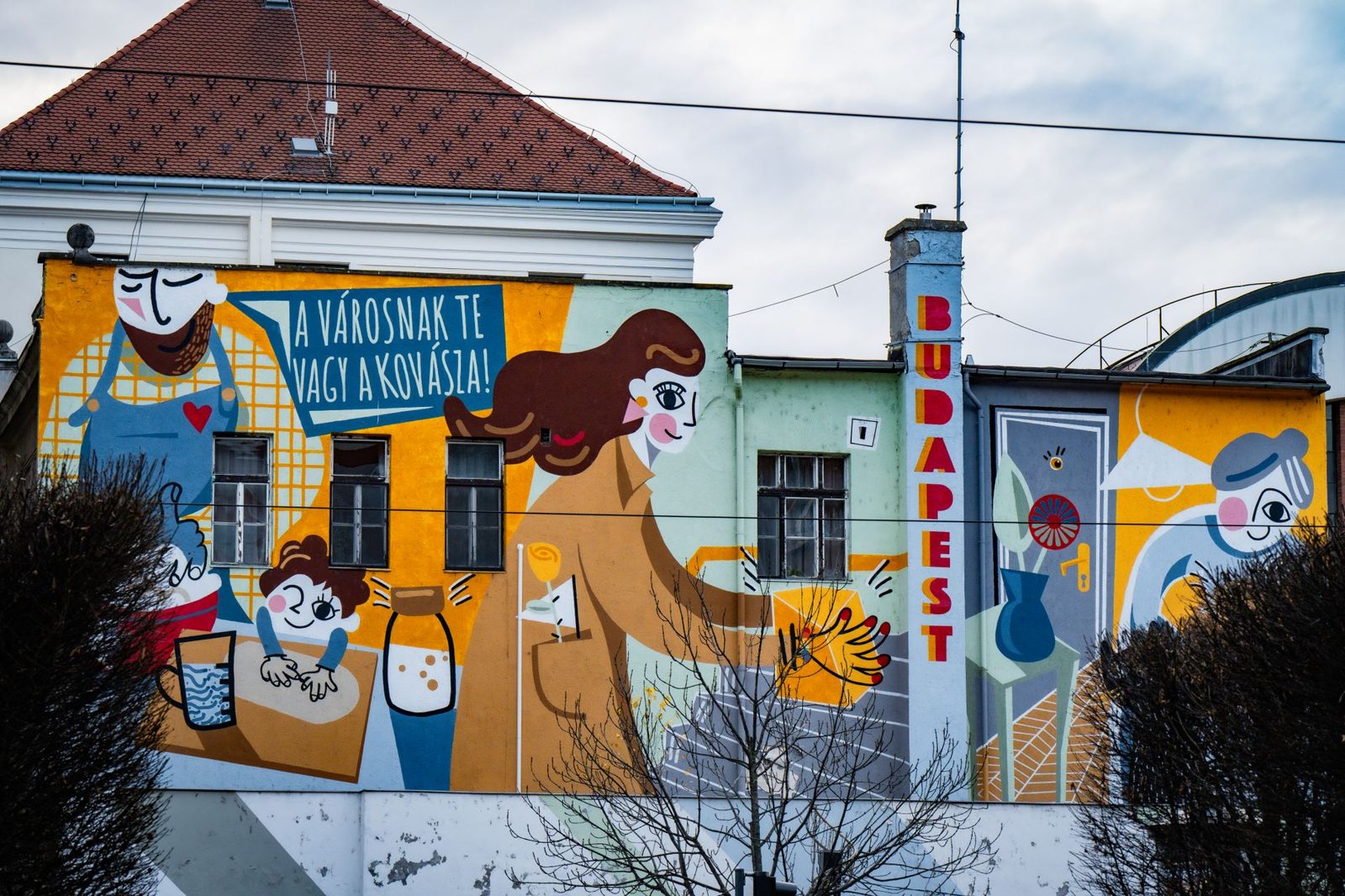
The Quarter doubles as Budapest’s open-air gallery. Huge murals cover fire walls and courtyards — local art collectives repaint many of them each year, so the line-up changes — and a good hunt starts around Rumbach Sebestyén Street, home to the much-photographed Rubik’s Cube tribute (a nod to the Hungarian-invented puzzle). Madách tér and the lanes off it gather independent cafés, design shops and the bars where the city’s creative young crowd actually hangs out.
The courtyards: Gozsdu Udvar
Don’t miss Gozsdu Udvar, a chain of seven interlinked courtyards running between Király and Dob streets. Once a faded passage, it’s now a buzzing corridor of bars, restaurants and terrace tables, with a weekend antiques-and-design market under the arches. It captures the neighbourhood’s whole trick in one space: historic bones, contemporary energy.
How to visit: tickets, dress code and tours
Dress modestly for the synagogues — shoulders and knees covered — and men are asked to cover their heads, with paper kippahs provided at the door. Remember that the synagogues close on Saturdays for Shabbat and on Jewish holidays, so build your visit around weekdays or Sundays. Because the history here is dense and not always self-evident, this is one part of Budapest where a guided walk genuinely pays off; our overview of Budapest walking tours covers the Jewish-heritage options. If you’re combining sights, the sobering House of Terror on nearby Andrássy Avenue makes a natural, if heavy, pairing.
Getting there and when to go
The Quarter is dead central and easy to reach: it sits just behind Deák Ferenc tér, the only point where all three metro lines (M1, M2, M3) meet, and trams 47 and 49 skirt its southern edge. From there everything is on foot. As for timing, late spring and early autumn are loveliest for wandering the courtyards and terraces, while the heart of summer brings the Jewish cultural calendar to life — the Budapest Jewish Summer Festival and smaller community events fill the synagogues and streets with concerts and food. Weekday mornings are quietest at the synagogues; weekend evenings belong to the bars. To line your dates up with good weather and events, see the best time to visit Budapest.
A suggested plan
Start mid-morning at the Dohány Street Synagogue before the crowds build, taking the included tour and lingering in the memorial garden. Walk to Rumbach Street for its serene interior, then loop past the Kazinczy Orthodox synagogue. Break for lunch — kosher, Israeli or street food, your choice — then spend the early afternoon hunting murals and dipping into Gozsdu Udvar and the design shops around Madách tér. If you’ve the appetite for it, end with a coffee or an early drink at Szimpla before the night crowd arrives. That’s a full, rich half-to-full day in one walkable district.
Twenty minutes west, on the Danube embankment, stands the memorial that gives the ghetto’s story its sharpest single image. Our Shoes on the Danube guide covers what happened on that stretch of riverbank in the winter of 1944–45 — and makes the case for visiting it before the synagogue rather than after.
The synagogue at the centre of this district needs its own page, mostly because the ticket price confuses people: 13,000 HUF buys admission to six sites, not one. Our Dohany Street Synagogue guide sets out what is included, the Saturday closure, and why there is a cemetery in the courtyard.
Frequently asked questions
How much does the Dohány Street Synagogue cost in 2026?
Adult admission is around 9,051 HUF (about €24), with children under six free. The ticket also covers the Hungarian Jewish Museum, the cellar ghetto exhibition, the Heroes’ Temple, the Wallenberg memorial park and the courtyard cemetery, plus a guided tour. Booking online adds fast-track entry.
Is the Budapest Jewish Quarter safe to visit?
Yes. District VII is one of the busiest, most visited parts of the city, lively day and night. Normal city-centre caution applies — watch for pickpockets in crowded bars and on transport — but it’s a welcoming, well-trodden neighbourhood for visitors.
When are the synagogues closed?
The Dohány, Rumbach and Kazinczy Street synagogues all close on Saturdays for Shabbat and on Jewish holidays, and they shut earlier on Fridays. Plan your visit for a weekday or a Sunday, and check the specific holiday closure dates for 2026 before you go.
What is there to do in the Jewish Quarter besides synagogues?
Plenty: explore the famous ruin bars led by Szimpla Kert, hunt the ever-changing street-art murals, eat your way through kosher bakeries, hummus bars and the Karaván street-food court, and wander the Gozsdu Udvar courtyards full of restaurants and weekend markets.
How long should I spend in the Jewish Quarter?
Allow at least half a day to see the Dohány synagogue properly and wander the streets; a full day lets you add Rumbach, a long lunch, the street art and an evening in a ruin bar. It’s compact and walkable, so the time goes into soaking it up rather than covering ground.
Last updated June 2026. Photos: KITSUN YUEN (Pexels); cottonbro studio (Pexels); Mihai Vlasceanu (Pexels); Elijah Cobb (Pexels).