Dohany Street Synagogue: Europe’s Largest, and How to Visit It
The 13,000 HUF ticket is not admission to a building — it is admission to six, one of them a cemetery. What it covers, the Saturday closure, and whether it earns the money.

In this guide
- At a glance
- What the ticket actually covers
- The building
- Why the inside looks the way it does
- What to look for inside
- The building’s own twentieth century
- Concerts
- A half-day that works
- The cemetery in the courtyard
- The Emanuel Tree
- Hours, closures and the Saturday rule
- Dress code and etiquette
- Is it worth 13,000 forints?
- Around it: the Jewish Quarter
- Theodor Herzl
- Getting there
- Frequently asked questions
- Photo credits
This article contains advertising. Our booking links are routed through a partner that adds commission tracking automatically, so if you book through one we earn a commission from the provider, at no extra cost to you. It never affects what we recommend. Affiliate disclosure
The number on the board stops people. Thirteen thousand forints — about thirty-three euros — is more than the Parliament tour for an EU citizen, more than four times what Matthias Church charges, and roughly what a decent dinner costs. A fair number of visitors read it, look at the twin onion-domed towers, and walk on. That is a mistake, but it is an understandable one, because nothing at the entrance explains that the ticket to dohany street synagogue is not admission to a building. It is admission to six of them, one of which is a cemetery that exists for reasons the price board does not mention.
This page sets out exactly what the ticket covers, when the complex is open and when it emphatically is not, what to look at, and how to fit it into the wider Jewish Quarter. Prices and hours were checked in September 2026 and are given in forints with a euro figure in brackets; treat them as the right order of magnitude.
At a glance
| Detail | |
|---|---|
| Adult ticket | 13,000 HUF (≈ €33) |
| Students | 10,500 HUF (≈ €26) |
| Budapest Card | 10% off — a discount, not free entry |
| Included | Synagogue, Hungarian Jewish Museum, the Cellar ghetto exhibition, Wallenberg Memorial Park, Lapidarium, cemetery |
| Closed | Saturdays and Jewish holidays |
| Winter hours | Sun–Thu 10:00–16:00, Fri 10:00–14:00 |
| Spring hours | Sun–Thu 10:00–18:00, Fri 10:00–16:00 |
| Last entry | One hour before closing; ticket sales stop then too |
| Time to allow | 90 minutes, two hours if you read everything |
| Nearest metro | Astoria (M2) or Deák Ferenc tér (M1, M2, M3) |
| Dress code | Shoulders and knees covered; men are given a paper kippah |
Note the seasonal hours and the one-hour cut-off: in winter, ticket sales stop at three in the afternoon. Turning up at half past three on a January day means you do not get in, and there is no discretion about it.
What the ticket actually covers
Six things, and it is worth knowing all of them before you decide whether the price is fair.
- The synagogue itself — the main hall, seating around three thousand, and the reason most people come.
- The Hungarian Jewish Museum, in the wing on the corner, covering Jewish life in Hungary from the Roman period to the twentieth century.
- The Cellar exhibition on the Budapest ghetto — the smallest space in the complex and, for a lot of visitors, the one that lands hardest.
- The Raoul Wallenberg Memorial Park, the courtyard behind the synagogue, with Imre Varga’s steel weeping willow.
- The Heroes’ Temple, a smaller synagogue built in 1931 in memory of the Hungarian Jewish soldiers who died in the First World War.
- The cemetery in the courtyard, and the Lapidarium of recovered stones.
Most tickets also include a guided tour in your language, which runs frequently and lasts around half an hour. Take it. The site is thinly labelled and the guides are the interpretation.
Divide 13,000 forints by six and it starts to look different. It is still the most expensive single ticket in this batch of Budapest sights — our attractions guide has the comparison — but it is buying more than the photograph on the front of it suggests.
The building
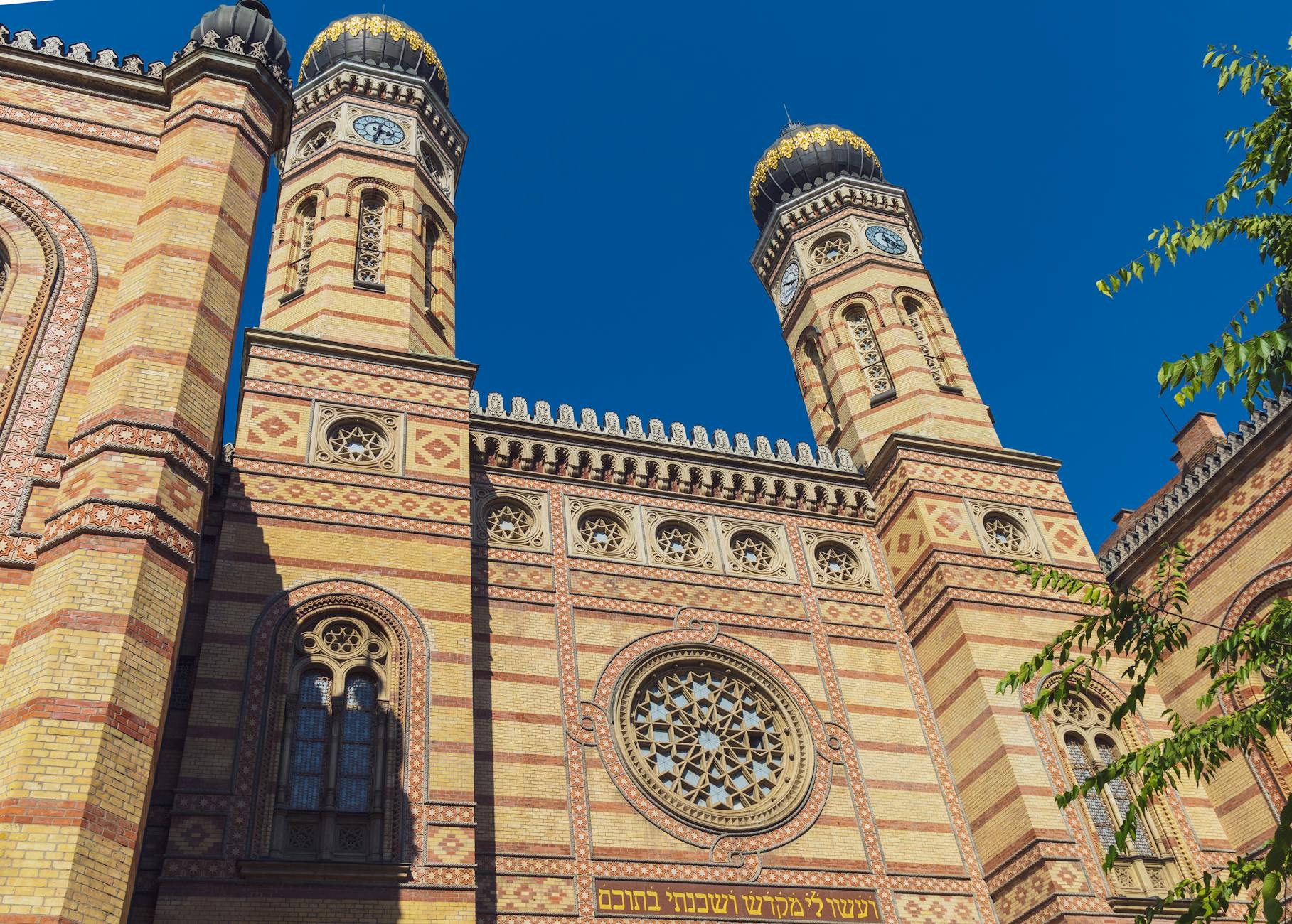
Built between 1854 and 1859 to a design by the Viennese architect Ludwig Förster, it is the largest synagogue in Europe and among the largest in the world, seating around three thousand people. The style is Moorish Revival: horseshoe arches, horizontal bands of yellow and red brick, geometric rose windows, and two onion-domed towers on the street front that from a distance read as minarets and up close read as nothing else in Budapest.
Förster’s reasoning was explicit. Nineteenth-century European Jewish communities building large public synagogues faced a question of architectural language — Gothic and Baroque were the vocabularies of the church, and classicism belonged to the state. Moorish and Near Eastern forms offered an alternative that gestured towards the community’s own origins without borrowing from Christian architecture. The same decision was taken in Vienna, Berlin and a dozen other cities; Budapest’s is the largest surviving example.
Why the inside looks the way it does
Walk in and you will notice something that surprises people who have visited synagogues elsewhere: a long central nave with aisles, tiered galleries, pews facing forward, a raised platform at the far end, and an organ.
That is because Dohány Street is a Neolog synagogue. Neolog Judaism emerged in nineteenth-century Hungary as a modernising movement — comparable in impulse, though not identical, to Reform elsewhere — and it adopted elements of the surrounding architectural culture, including choral music and instrumental accompaniment, that Orthodox practice does not use. The building is laid out with a basilica’s geometry because its congregation wanted it to be.
The organ is a real instrument and a good one. Franz Liszt and Camille Saint-Saëns both played the original. The current organ dates from the 1990s, and concerts are held here — worth checking if you are in Budapest for any length of time.
What to look for inside
The guided tour will point most of this out, but it moves quickly.
- The Ark. At the eastern end, behind the platform, in a tall arched recess. It holds Torah scrolls, some of them recovered after the war from communities that no longer exist.
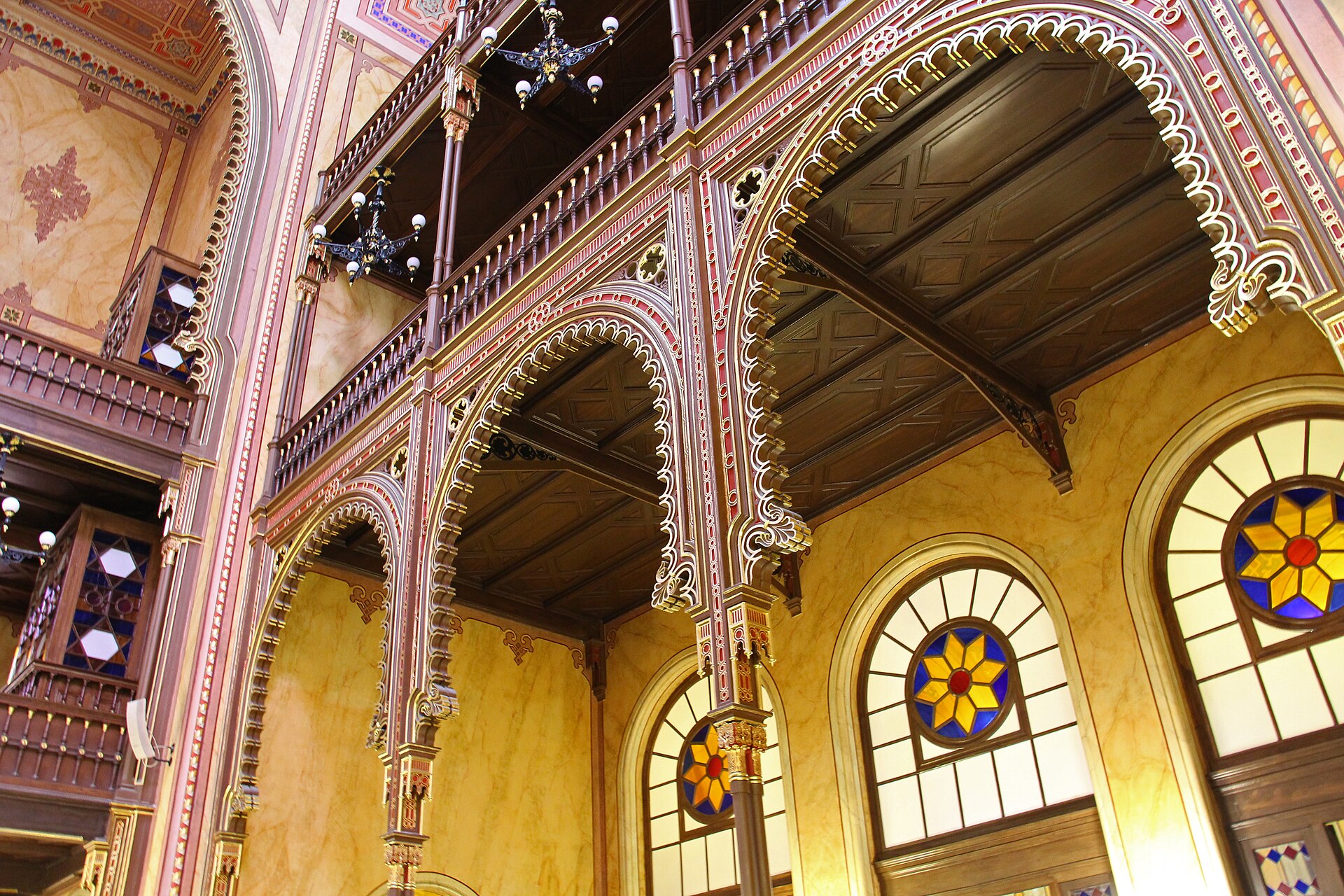
- The galleries. Two tiers of wooden balconies down both sides, traditionally the women’s seating, carried on slim cast-iron columns. The ironwork is worth looking at — this is a building from the first generation that could use structural iron decoratively.
- The ceiling. Painted geometric panelling in deep blue, red and gold, with the eight-pointed star motif that repeats throughout the building — in the windows, the floor and the ironwork.
- The rose window on the Dohány utca front, best seen from the street outside, with the same star geometry.
- The towers. Two of them, forty-three metres, with onion domes. Twin towers on a synagogue were unusual and controversial, and they are one of the clearest signals of how much this building was designed to be a civic landmark as well as a house of prayer.
- The chandeliers and gas fittings, converted to electricity but original in form, hanging from the gallery arches.
The building’s own twentieth century
The synagogue did not come through the war as a building that merely stood nearby while things happened to other people.
During the German occupation it was used as a radio station and, at times, as a stable. It stood on the boundary of the sealed ghetto, and its courtyard became the burial ground described above. It was damaged by bombing and by artillery during the siege, and after 1945 it was left largely as it was — a shattered building serving a community that had lost most of its members.
Under communism it was neither destroyed nor repaired. For four decades it deteriorated: the roof leaked, the plaster came off, sections were unusable, and the congregation that remained worshipped in a fraction of the space. Photographs from the 1970s show something close to a ruin.
The restoration came after 1989 and took most of the decade, funded by the Hungarian state, the Jewish community worldwide, and private donors — among them the Emanuel Foundation set up by Tony Curtis, and Estée Lauder, whose mother was Hungarian. What you walk into now is a building brought back from a genuinely bad condition within living memory, which is worth knowing while you are looking at the gilding.
Concerts
The organ and the acoustics are used. Concert programmes run through the year — organ recitals, klezmer, choral and chamber music — and tickets are sold separately from the daytime visit.
Hearing the room used rather than walking through it is a different experience, and given the daytime ticket price the evening is not much of a premium. Our festivals and events guide tracks what is on, and the Jewish Summer Festival, usually in late August and early September, uses this building among its main venues.
A half-day that works
The synagogue on its own is ninety minutes. Built out, it makes one of the better half-days in Budapest.
- 09:30 — Shoes on the Danube Bank on the Pest embankment. Free, twenty minutes, and the sharper of the two memorials.
- 10:15 — walk east into District VII, twenty minutes through the streets of the former ghetto.
- 10:30 — the synagogue complex as it opens: the tour, the museum, the Cellar, the cemetery, the willow.
- 12:15 — lunch on Kazinczy utca or in the Karavan street-food yard.
- 13:30 — the Rumbach Street Synagogue, five minutes north, and the Kazinczy Street Orthodox Synagogue.
- 15:00 — Szimpla Kert in daylight, when it functions as a cafe and market rather than a crush.
That sequence does the history first and the living quarter second, which is the right way round. Our itinerary planner fits it into a wider trip, and the food guide covers where to eat in the middle of it.
The cemetery in the courtyard
Jewish law does not permit burials on synagogue grounds. There is a graveyard in this courtyard anyway, and the reason is the whole of the twentieth century compressed into one small space.
In November 1944 the Arrow Cross sealed a ghetto around these streets, into which around seventy thousand people were forced. Through the winter of 1944–45, under siege conditions, thousands died of cold, starvation and disease, and there was nowhere to take them. They were buried where they were — in the synagogue courtyard, in mass and individual graves, in violation of every normal practice, because there was no alternative.
Around two thousand people lie there. The graves are marked, there are stones on many of them, and it is the quietest part of the complex. If you visit nothing else here, stand in that courtyard for five minutes.
The Emanuel Tree
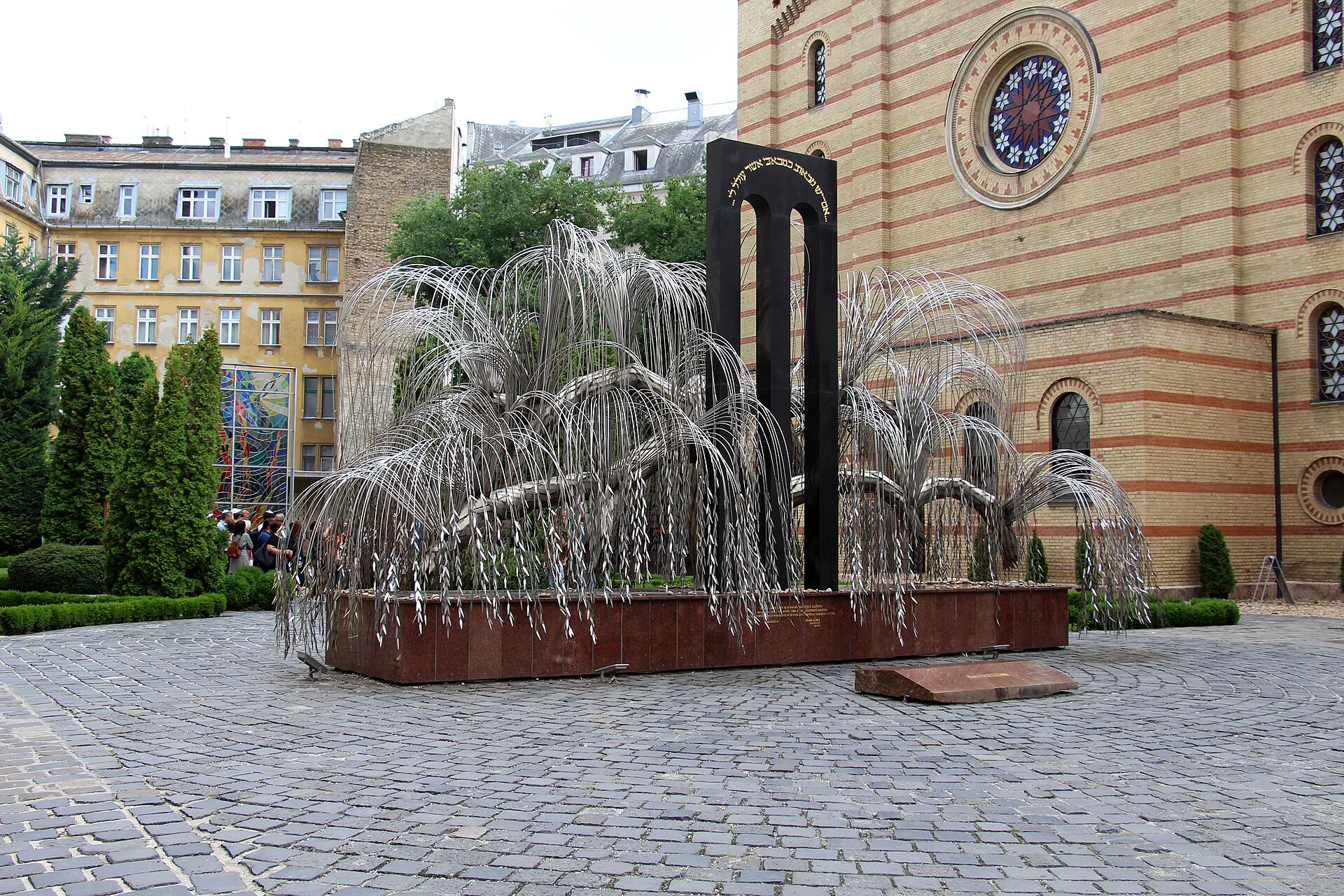
Behind the synagogue, in the Raoul Wallenberg Memorial Park, stands Imre Varga’s weeping willow in stainless steel, its branches falling to the ground. Every one of the thousands of metal leaves is inscribed with the name of a victim of the Hungarian Holocaust, and families continue to have names added.
It was installed in 1990, funded in part by the Emanuel Foundation established by the actor Tony Curtis, whose father emigrated from Hungary — the tree is named after him. Around it are plaques honouring the diplomats and others who worked to save Hungarian Jews: Wallenberg, Carl Lutz, Ángel Sanz Briz, Giorgio Perlasca and Hungarians who sheltered people at their own risk.
The willow is the most photographed object in the complex. It rewards walking round to the far side, where the branches make a canopy and you can read the leaves close up.
Hours, closures and the Saturday rule
Opening runs Sunday to Thursday and Friday mornings, with the exact hours changing four or five times a year — roughly 10:00 to 16:00 in winter and 10:00 to 18:00 in spring and autumn, with Fridays finishing two hours earlier.
It is closed on Saturdays. This is Shabbat and there is no visitor access at all — not a reduced service, not a shorter day. It is also closed on Jewish holidays, which move each year against the Gregorian calendar and which catch out a large number of visitors every autumn around Rosh Hashanah and Yom Kippur. Check before you plan a specific day.
Combined with the one-hour-before-closing cut-off on entry and ticket sales, this means the Dohány Street Synagogue is the single easiest sight in Budapest to arrive at and be turned away from. Plan it for a morning.
Dress code and etiquette
- Shoulders and knees covered, for everyone. Shawls are available at the entrance if you need one.
- Men cover their heads. Paper kippot are handed out at the door; there is no charge and no fuss.
- Photography is permitted inside without flash. In the cemetery, use judgement.
- This is an active synagogue with a congregation, not only a monument. Services take place and the building is used.
- Security is real. Bag checks at the entrance are standard and there is a permanent police presence outside. Do not be alarmed by it; do allow a few extra minutes.
Is it worth 13,000 forints?
Yes — with a caveat about how you use it.
The building alone is not worth thirty-three euros. If you walk in, photograph the ceiling, walk out and leave in twenty minutes, you will feel overcharged and you will be right. Plenty of people do exactly that.
The complex is worth it. Ninety minutes across the synagogue, the museum, the Cellar exhibition, the courtyard cemetery and the willow is one of the most substantial and affecting things you can do in this city, and it is the single best place to understand what happened here in 1944 and 1945 — which is not a small part of understanding Budapest at all. Take the guided tour, read the Cellar, and stand in the courtyard.
The Budapest Card gives ten per cent off, which is about €3. Our Budapest Card guide explains why that is not enough on its own to justify the card.
Around it: the Jewish Quarter
The synagogue sits at the corner of District VII, and the streets behind it were the ghetto. Doing it as an isolated stop wastes the walk.
Do the Shoes on the Danube Bank first, twenty minutes’ walk west on the embankment. It takes twenty minutes, it is free, and it is the sharper of the two — coming here afterwards gives you the context for what you have already seen rather than the other way round. Our guide to the memorial covers it.
Afterwards, the Rumbach Street Synagogue a few minutes north — Otto Wagner’s only synagogue, restored and reopened after decades of dereliction — and the Kazinczy Street Orthodox Synagogue complete the picture of a community that was never monolithic. The three buildings together, Neolog, status quo ante and Orthodox, are the architectural record of a nineteenth-century argument about how to be Jewish and Hungarian at once.
Then the quarter as it is now: courtyards, street food, murals and the ruin bars, of which Szimpla Kert is the original. The juxtaposition — a memorial cemetery and a party district within four hundred metres of each other — is jarring on a first visit and is a real feature of the neighbourhood rather than an accident. Our Jewish Quarter guide covers the walk properly, and the ruin bars guide takes the evening from there.
Theodor Herzl
The founder of modern political Zionism was born in 1860 in a house immediately beside the synagogue. It no longer stands — the Jewish Museum wing occupies the site — and there is a plaque. It is a small thing that most visitors walk past, and it is a reasonable reminder of how much of the nineteenth and twentieth centuries ran through these two hundred metres of Pest.
Getting there
Dohány utca 2, on the corner with Károly körút, in District VII.
- Astoria on the M2 is two minutes’ walk.
- Deák Ferenc tér, where all three older metro lines meet, is five minutes.
- Trams 47 and 49 stop at Astoria; buses run along Károly körút.
Our getting around Budapest guide has the ticket options. The area is flat and easy on foot, and the synagogue has step-free access at the main entrance, though parts of the courtyard are cobbled.
Frequently asked questions
How much is the Dohány Street Synagogue?
13,000 HUF for an adult, about €33, with students at 10,500 HUF and a ten per cent discount for Budapest Card holders. The price covers the synagogue, the Hungarian Jewish Museum, the Cellar ghetto exhibition, the Wallenberg Memorial Park, the Heroes’ Temple, the Lapidarium and the cemetery, and usually a guided tour.
Why is it so expensive?
Because it is not one building. The ticket is admission to a six-part memorial complex including a museum and a cemetery, and it funds the upkeep of all of it. Judged as an entry fee to a single hall it looks steep; judged as ninety minutes across the whole site with a guide, it is reasonable.
Is the Dohány Street Synagogue open on Saturday?
No. It is closed all day on Saturdays for Shabbat, and on Jewish holidays, which move against the Gregorian calendar each year. Visitor hours run Sunday to Thursday plus Friday mornings, and both entry and ticket sales stop one hour before closing.
Is it the largest synagogue in Europe?
Yes, and among the largest in the world, seating around three thousand people. It was built between 1854 and 1859 to a design by the Viennese architect Ludwig Förster.
Do I need to cover my head?
Men do. Paper kippot are handed out free at the entrance. Everyone should have shoulders and knees covered; shawls are available if you need one.
Why is there a cemetery in the courtyard?
Because there was nowhere else. Around seventy thousand people were sealed into the ghetto around these streets in November 1944, and thousands died there through the winter of 1944–45 under siege conditions. Roughly two thousand were buried in the synagogue courtyard, contrary to normal Jewish practice, because burial elsewhere was impossible.
How long do you need at the Dohány Street Synagogue?
Ninety minutes to do it properly, or two hours if you read the museum and the Cellar exhibition carefully. Twenty minutes is enough to see the main hall and is the fastest way to conclude you were overcharged.
What is the Emanuel Tree?
Imre Varga’s stainless steel weeping willow in the memorial park behind the synagogue, installed in 1990. Each of its thousands of metal leaves carries the name of a victim of the Hungarian Holocaust, and names are still added. It was funded in part by a foundation established by the actor Tony Curtis in memory of his Hungarian-born father Emanuel.
Does the Budapest Card include the synagogue?
No — it gives around ten per cent off, roughly €3 on a full-price ticket. The synagogue is one of several major Budapest sights, along with the Parliament and the House of Terror, that the card discounts rather than covers.
Photo credits
The interior: Budapest – Dohány utcai Zsinagóga (37721229754) by Fred Romero, CC BY 2.0, via Wikimedia Commons.
The Emanuel Tree: Budapest – A holokauszt áldozatainak emlékműve (38404557112) by Fred Romero, CC BY 2.0, via Wikimedia Commons.