The Chain Bridge: Budapest’s Most Famous Crossing, Explained
Private cars have been banned since 2023, which changed the bridge completely. The renovation, the 1849 story, the truth about the lions' tongues, and when to walk it.
In this guide
- At a glance
- What the renovation changed
- The car ban
- How it got built
- Two Clarks
- 1945
- The engineering, briefly
- Getting there and access
- Things people get wrong
- The lions and their tongues
- Walking it
- Photographing it
- What is at each end
- Clark Ádám tér, the Buda end
- Széchenyi István tér, the Pest end
- Where it fits
- Frequently asked questions
- Photo credits
This article contains advertising. Our booking links are routed through a partner that adds commission tracking automatically, so if you book through one we earn a commission from the provider, at no extra cost to you. It never affects what we recommend. Affiliate disclosure
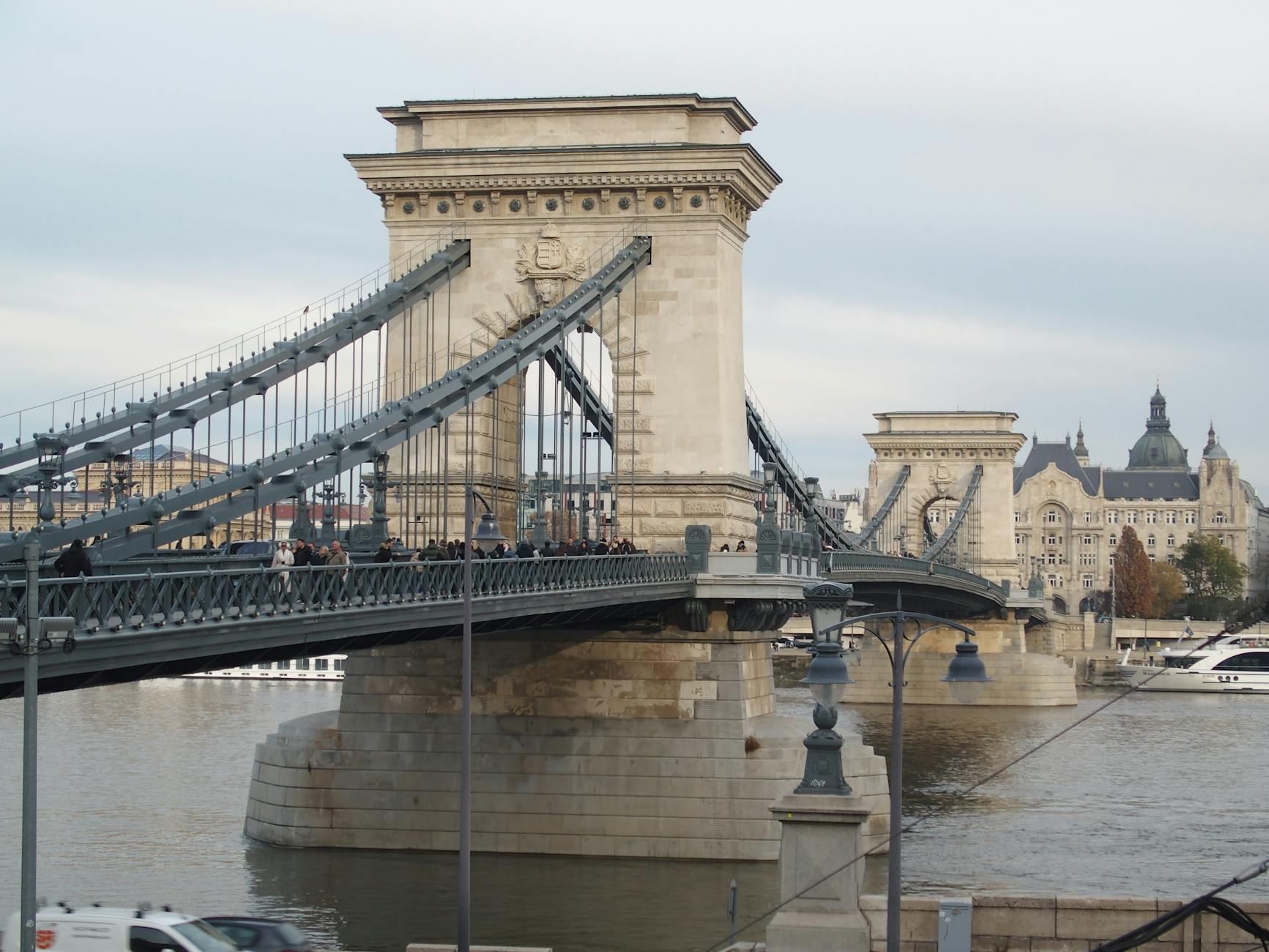
Cross it at about half past nine on a summer evening and the thing you notice is how quiet it has become. There are people on the pavements in both directions, a bus every few minutes, the occasional taxi, a cyclist — and no cars at all, because private vehicles have been permanently banned since 2023. For a hundred and seventy years the chain bridge budapest put on its postcards was also one of the most congested pieces of road in the city. It is not any more, and that single change has turned the most famous crossing in Hungary back into something you can actually stand on.
This page covers what the renovation did and what it cost, how the bridge came to be built by an Englishman and a Scotsman for a Hungarian count, the truth about the lions and their tongues, and how to walk and photograph it now. Details were checked in September 2026.
At a glance
| Detail | |
|---|---|
| Cost to cross | Free, on foot, at any hour |
| Opened | 20 November 1849 |
| Length | 375 m, with a 202 m central span |
| Designed by | William Tierney Clark; built by Adam Clark, no relation |
| Traffic today | Buses, taxis, cyclists and pedestrians. No private cars. |
| Last renovated | 2021–2023, reopened fully to pedestrians 4 August 2023 |
| Renovation cost | 26.75 billion HUF, against an 18.8 billion estimate |
| Buda end | Clark Ádám tér — funicular, tunnel, the 0 km stone |
| Pest end | Széchenyi István tér — Gresham Palace, the Academy of Sciences |
| Time to walk it | 8–10 minutes, longer if you stop, which you will |
What the renovation changed
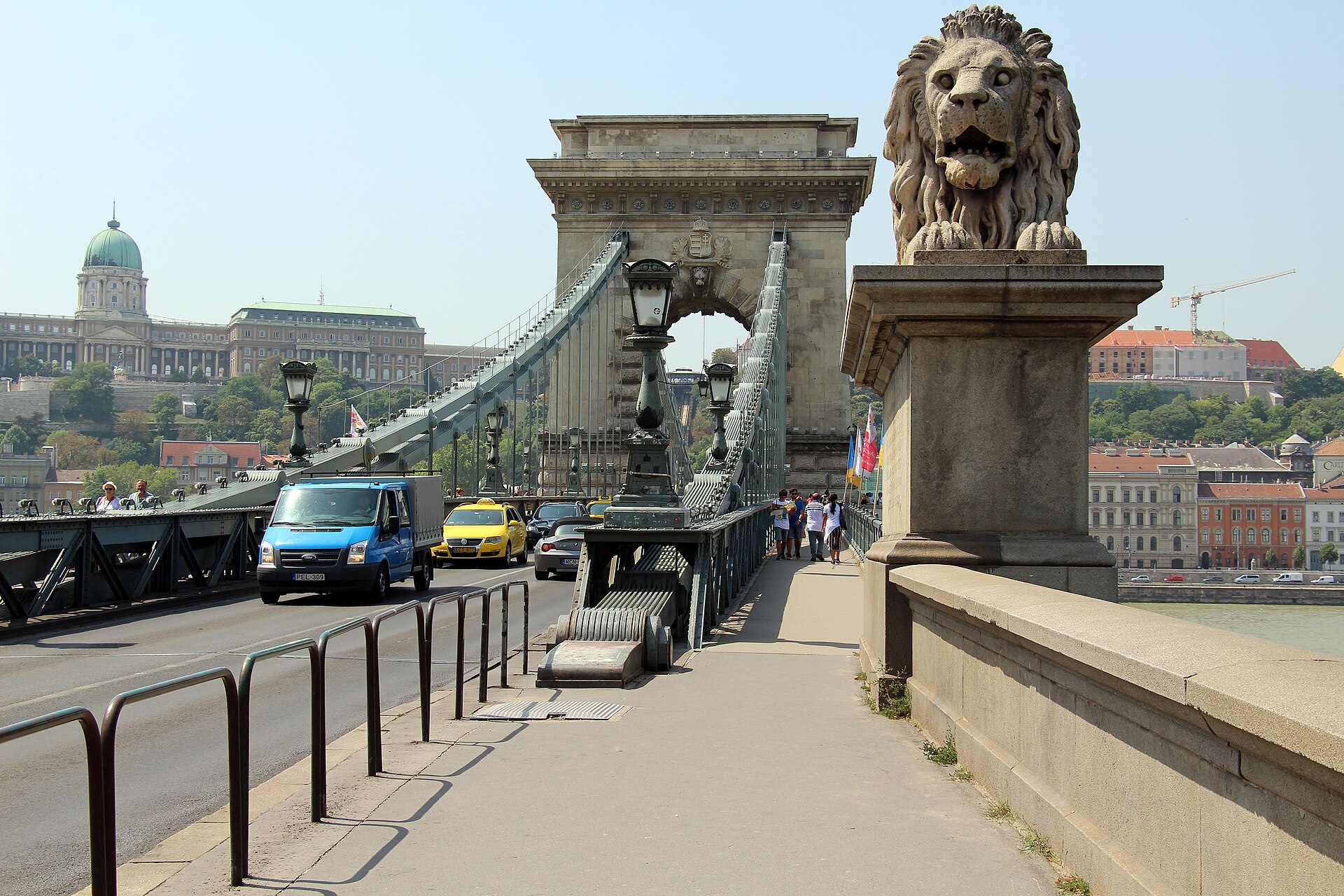
Work started in January 2021 on a bridge that had not had a proper overhaul since 1988 and was visibly failing. The roadway was reopened in December 2022 and the whole structure, pavements included, reopened on 4 August 2023.
The engineering was more drastic than the finished thing suggests. Three hundred and fifty metres of old reinforced-concrete deck were demolished and rebuilt on custom eight-tonne steel rods three and a half metres wide. The chains were inspected and treated, the stonework cleaned, and all four lions taken off and restored.
It cost 26.75 billion forints against an initial estimate of 18.8 billion — an overrun of about forty per cent, which produced the sort of argument you would expect and which is still occasionally rehearsed in the Hungarian press.
The car ban
The change that matters to a visitor is not structural. In June 2023 the city ran a public consultation on whether to let private cars back on. Seventy-nine per cent voted for the car-free option, and the ban became permanent.
What crosses now is buses, taxis, cyclists and people on foot. The pavements are wider, the noise is a fraction of what it was, and standing in the middle of the span to look at the Parliament no longer means shouting over four lanes of traffic. Older guidebooks describing a busy road bridge are describing something that no longer exists, and if you read that the crossing is unpleasant on foot, that advice is out of date.
How it got built
The story starts with a funeral and a river with no bridge.
In the winter of 1820, Count István Széchenyi was on the Pest side when word came that his father had died. He needed to cross to Buda and could not — the Danube was carrying ice, the pontoon bridge had been taken up for the winter, and the ferrymen would not go. Accounts differ on exactly how long he waited; the versions run from one day to over a week. What is not in doubt is that he spent the following two decades making a permanent crossing happen.
Széchenyi was the great reformer of Hungary’s nineteenth century — steam navigation on the Danube, the Academy of Sciences, the regulation of the Tisza — and the bridge was his signature project. He raised the finance, fought the political battles, and pushed through something genuinely radical for the time: nobles would pay the toll like everyone else. In a country where aristocratic tax exemption was a foundational privilege, that clause did more social work than the span itself.
Two Clarks
The design came from the English engineer William Tierney Clark, who had built a suspension bridge over the Thames at Marlow and effectively scaled the same idea up. Construction was supervised on site by a Scottish engineer, Adam Clark, no relation, who moved to Hungary for the job, stayed for the rest of his life, married a Hungarian and has the square at the Buda end named after him.
When it opened on 20 November 1849 it was the first permanent bridge between Buda and Pest, and one of the largest suspension bridges in the world. The timing was grim: Hungary’s war of independence had been crushed a few months earlier, Széchenyi was in a sanatorium, and the bridge he had spent twenty years building was inaugurated by the Austrian general who had put down the revolution. Its first official crossing had in fact been made a few months earlier, by retreating Austrian troops.
1945
The retreating Germans blew up every bridge in Budapest in January 1945. The Chain Bridge went with the rest, and for four years the two halves of the city were connected only by pontoons.
It was rebuilt and reopened on 20 November 1949 — the hundredth anniversary of the original opening, to the day. That was not an accident, and it is the sort of gesture that tells you what the bridge means here. Our history and culture guide covers the siege and the reconstruction in more depth.
The engineering, briefly
It is a chain suspension bridge, not a cable one, and the difference is visible from the pavement. Instead of the spun steel-wire cables of a modern suspension bridge, the deck hangs from two chains made of flat wrought-iron links pinned together — each link a separate forged bar, each joint a visible pin. Stand under the pylon and look up and you can count them.
That was the state of the art in the 1840s and it is why the bridge looks the way it does: heavier, more articulated and more obviously hand-made than a twentieth-century span. The central span is 202 metres, which in 1849 put it among the longest in the world, and the whole structure runs 375 metres between the abutments.
The chains you see are not the originals. The bridge was substantially reconstructed between 1913 and 1915, when the chains were replaced and the deck widened to cope with traffic the 1840s had not imagined — and then rebuilt again after 1945. What has survived continuously since the 1840s is the stonework of the pylons and abutments, the overall geometry, and the lions from 1852. The bridge is genuinely old; it is also, in the way of all working infrastructure, largely a series of replacements of itself.
The two stone pylons carry the Hungarian coat of arms and are pierced by the arches the roadway runs through. They are load-bearing towers, not decoration, and the chains pass over saddles at the top of each one.
Getting there and access
The bridge connects Széchenyi István tér in Pest with Clark Ádám tér in Buda, and both ends are easy to reach.
- Pest end: a five-minute walk from Vörösmarty tér on the M1, or from Deák Ferenc tér. Tram 2 stops on the embankment just south of the square.
- Buda end: bus 16 or 105 stop at Clark Ádám tér, and Batthyány tér on the M2 is about ten minutes’ walk north along the embankment.
- Bus 16 crosses the bridge itself, from Deák Ferenc tér up to Castle Hill, if you would rather ride than walk.
Accessibility. The pavements are level, wide since the renovation, and continuous from end to end, with dropped kerbs at both approaches. The Buda end at Clark Ádám tér involves crossing a busy roundabout, and the walk up to the castle from there is stepped — bus 16 is the step-free route to the top of the hill.
Things people get wrong
- “The lions have no tongues.” They do. You cannot see them from below.
- “The sculptor drowned himself.” He did not. Marschalkó lived another twenty-five years.
- “It is closed for renovation.” It reopened fully on 4 August 2023. Anything saying otherwise is out of date.
- “It is unpleasant to walk because of the traffic.” Also out of date. Private cars have been banned since 2023.
- “It is the oldest bridge in Budapest.” True as a permanent crossing — but the structure you walk on has been rebuilt twice, in 1913–15 and after 1945.
- “Take the funicular up afterwards.” Around 5,000 HUF for two minutes, replacing a nine-minute walk. Walk, or take bus 16.
The lions and their tongues
Four stone lions, one at each corner, carved by János Marschalkó and installed in 1852, three years after the bridge opened.
The story every Budapest guide tells goes like this: a boy in the crowd at the unveiling shouted that the lions had no tongues; the humiliated sculptor threw himself into the Danube. It is a very good story. It is also not true — Marschalkó lived until 1877 and died in bed.
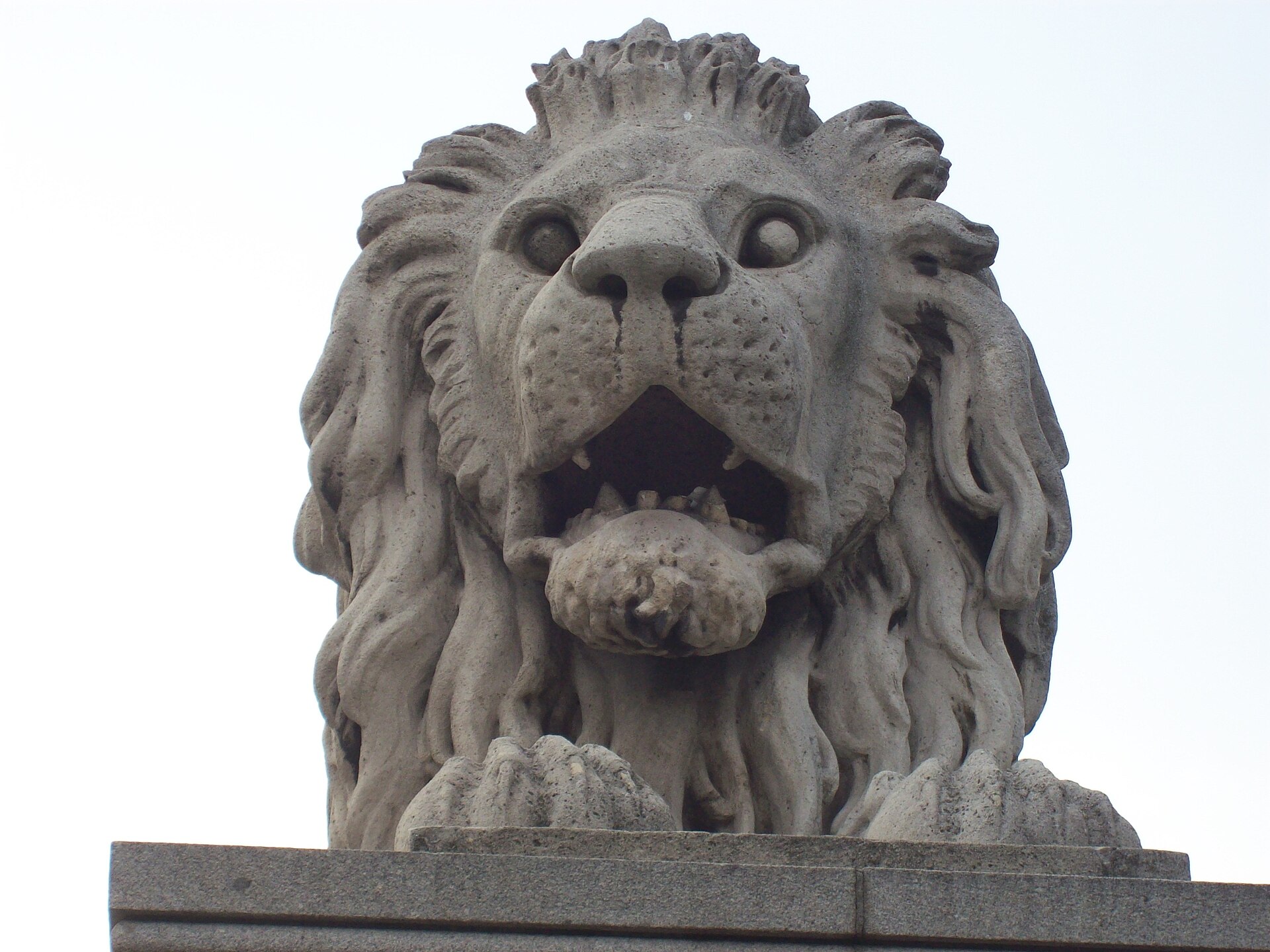
The more interesting question is whether the lions have tongues at all, and the answer is yes. They are carved, set well back inside the open mouths, and completely invisible from street level because of the angle you look up at them from. The myth persists because from the pavement — which is the only place ninety-nine per cent of people ever see them from — the mouths do look empty.
All four were removed, cleaned and restored during the recent renovation, which is why they now read as pale grey rather than the near-black they had gone in the previous decades.

Walking it
Eight to ten minutes end to end, and it is worth doing in a specific direction and at a specific time.
Walk from Pest to Buda. You start at Széchenyi István tér with the Gresham Palace behind you, and the whole way across you are walking towards Buda Castle rising in front of you, with the Parliament over your right shoulder whenever you turn round. The reverse direction puts the best view behind you the entire time.
Go after dark. The bridge is strung with lights along the chains, the Parliament is floodlit upstream, the castle is floodlit above you, and the water carries all of it. This is the single best free thing to do in the evening in Budapest, and our free things to do guide does not exaggerate in saying so.
Stop in the middle. There are viewing points at the pylons where the pavement widens. Since the car ban you can stand there for as long as you like, which was not comfortable before 2023.
Photographing it
- From the bridge itself, looking north up the river to the Parliament, with a chain in the foreground.
- From the Pest embankment just south of Széchenyi István tér, where you get the whole span with Buda Castle behind it — the classic postcard.
- From Fisherman’s Bastion or Gellért Hill, where the bridge becomes one element in the wider panorama rather than the subject.
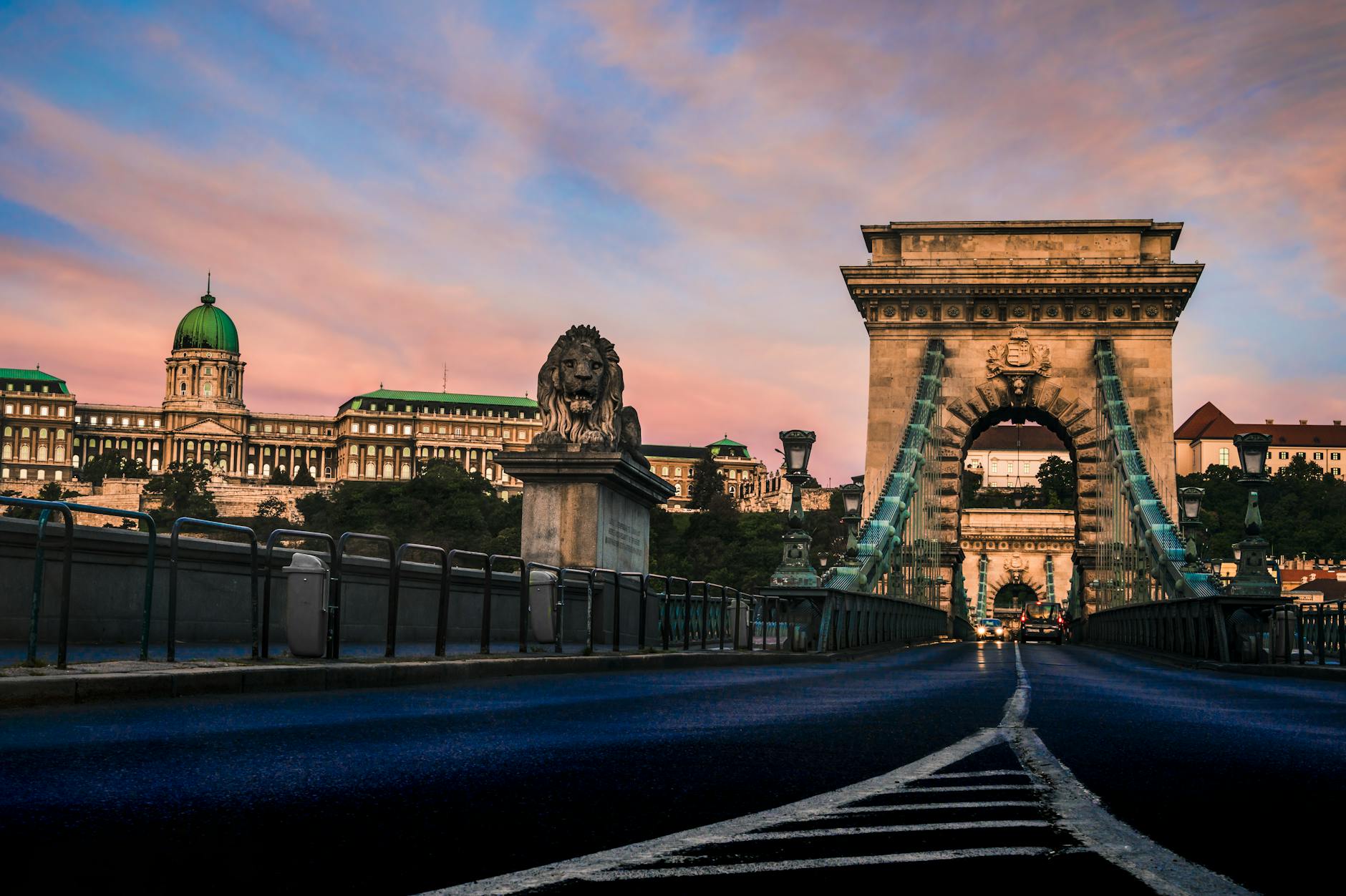
- From the Buda embankment near Clark Ádám tér, low and close, with the pylon arch framing the Pest bank behind.
Blue hour is better than full dark: twenty minutes after sunset the sky still holds colour and the lights are already on. Our photography spots guide has the seasonal timings, and the sunset guide covers where to be beforehand.
What is at each end
Clark Ádám tér, the Buda end
A roundabout with more going on than it looks. The Buda Castle Tunnel runs straight through the hill from here, finished in 1857 by Adam Clark, and the old joke — that the tunnel was built so the bridge could be slid into it when it rained — is still repeated. The funicular up to the castle starts from the same square, at around 5,000 HUF one way, which our getting around guide advises against; the nine-minute walk up is better.
In the middle of the roundabout is the 0 kilometre stone, a stylised zero in limestone from which every road distance in Hungary is measured. People walk past it constantly without knowing what it is.
From here it is nine minutes up to Fisherman’s Bastion and Matthias Church, or bus 16 if you would rather not walk.
Széchenyi István tér, the Pest end
Named for the man who made the bridge happen, and holding two buildings worth a look. The Gresham Palace, on the corner facing the bridge, is one of the great Art Nouveau buildings in Europe — built in 1906 for a British insurance company, wrecked in the war, used as flats under communism, and restored as a hotel in 2004. Walk into the lobby; nobody minds, and the ironwork and glass are extraordinary. Our Art Nouveau guide covers it properly.
On the north side is the Hungarian Academy of Sciences, which exists because Széchenyi offered a year of his estate’s income to found it in 1825.
Five minutes’ walk north along the embankment brings you to Shoes on the Danube Bank, and ten minutes east to St Stephen’s Basilica.
Where it fits
The Chain Bridge is the oldest and the most symbolically loaded of Budapest’s crossings, but it is not automatically the best one to walk. Liberty Bridge, in Art Nouveau green with turul birds on the pillars, is the prettier structure and closes to traffic on some summer weekends so people can sit on it. Margaret Bridge has the better view of both banks at once and a tram running down the middle of it. Our Budapest bridges guide compares all of them and lays out a walking route that takes in several.
What the Chain Bridge has that the others do not is the combination: the castle rising directly in front of you, the Parliament in view the whole way, the lions, and now the quiet. Our attractions guide lists it among the free sights, which it is, and among the essential ones, which it also is.
Frequently asked questions
Can you walk across the Chain Bridge?
Yes, free, at any hour, on pavements on both sides. Since the 2023 reopening the bridge carries only buses, taxis, cyclists and pedestrians — private cars are permanently banned — so it is far quieter and more pleasant on foot than it was for most of its history.
Why can’t cars use the Chain Bridge?
Because Budapest ran a public consultation in June 2023 on whether to let them back after the renovation, and 79 per cent of those who voted chose the car-free option. The ban was made permanent. Buses, taxis and bicycles still cross.
When was the Chain Bridge built?
Between 1839 and 1849, opening on 20 November 1849 as the first permanent bridge between Buda and Pest. It was designed by the English engineer William Tierney Clark and built on site by the Scottish engineer Adam Clark, who were not related. It was destroyed by the retreating Germans in January 1945 and rebuilt, reopening on 20 November 1949 — the centenary of the original opening, to the day.
Do the Chain Bridge lions have tongues?
Yes. They are carved, set well back in the open mouths, and invisible from the pavement because of the angle. The old story that the sculptor drowned himself in shame after a boy pointed out the missing tongues is entirely untrue — János Marschalkó lived until 1877.
How long does it take to walk across the Chain Bridge?
Eight to ten minutes at a normal pace, and longer in practice because there are widened viewing points at the pylons and you will stop at them. Walk from Pest to Buda so that Buda Castle is in front of you the whole way.
What is the best time to see the Chain Bridge?
Blue hour — the twenty minutes or so after sunset, when the chain lights and the floodlighting on the Parliament and the castle are on but the sky still has colour in it. In winter that happens at about half past four, which is a good deal more convenient than half past nine in June.
How much did the Chain Bridge renovation cost?
26.75 billion forints, roughly $75 million, against an initial estimate of 18.8 billion. Work ran from January 2021, the roadway reopened in December 2022, and the bridge reopened fully to pedestrians on 4 August 2023.
Is the Chain Bridge free?
Yes, entirely. There was a toll when it opened in 1849 — payable by nobles as well as everyone else, which was the genuinely radical part — but there has been no charge to cross for well over a century.
What is the 0 kilometre stone?
A limestone sculpture of a zero in the middle of Clark Ádám tér at the Buda end, from which every road distance in Hungary is measured. It is free, unfenced and walked past by almost everyone who crosses the bridge.
Photo credits
The bridge and lion: Budapest – Széchenyi Lánchíd (26706202689) by Fred Romero, CC BY 2.0, via Wikimedia Commons.
Lion detail: Budapest, Lánchíd – lion by Jarba, public domain, via Wikimedia Commons.