Matthias Church: Tickets, the Tower Climb and That Roof
The Zsolnay roof is the famous part; the painted interior is the surprising one. 2026 prices, the Saturday opening trap, and whether the 197-step tower earns its separate ticket.
In this guide
- At a glance
- The roof
- Inside
- Things to find
- The Madonna in the wall
- The square outside
- When to go, and where to stand
- Eight hundred years, most of them interrupted
- Two coronations and a Mass
- The tower climb
- Hours, services and closures
- The concerts
- Getting there and fitting it in
- Is it worth 3,400 HUF?
- Frequently asked questions
- Photo credits
This article contains advertising. Our booking links are routed through a partner that adds commission tracking automatically, so if you book through one we earn a commission from the provider, at no extra cost to you. It never affects what we recommend. Affiliate disclosure
Everyone photographs the roof and then walks inside expecting Gothic gloom. What they get instead is a room painted from floor to vault in dense red, blue and gold geometric pattern — repeating lozenges, interlaced bands, stencilled borders running up every pier — that looks a great deal more like the interior of a mosque than anything in Cologne or Chartres. That is not a coincidence, and understanding why is most of the reason matthias church is more interesting than the postcard suggests.
This page covers the two separate tickets and which to buy, the opening hours including the Saturday cut-off that catches people, the tower climb, what to look at inside, and the eight hundred years of history that produced a building this strange. Prices and hours were checked in September 2026 and are given in forints with a euro figure in brackets; treat them as the right order of magnitude, because Hungarian prices move.
At a glance
| Detail | |
|---|---|
| Church admission, adult | 3,400 HUF (≈ €8.50) |
| Students and seniors | 2,700 HUF (≈ €6.75) |
| Under 6 | Free |
| Bell and Lookout Tower | 4,000 HUF (≈ €10), separate ticket |
| Both together | 7,400 HUF (≈ €18.50) |
| Hours, Mon–Fri | 09:00–17:00 |
| Hours, Saturday | 09:00–12:00 |
| Hours, Sunday | 13:00–17:00 |
| Tower climb | 197 steps to a terrace at 47 m; hourly tours, max 15 people |
| Time to allow | 45 minutes for the church, 90 with the tower |
| Getting there | Bus 16 from Deák Ferenc tér, or 16A and 116 from Széll Kálmán tér |
| Dress code | Shoulders and knees covered; it is an active parish church |
The two things to take from that table. The Saturday noon close is the trap — half a Saturday is not a full one, and a lot of weekend visitors turn up at two on a Saturday afternoon to a locked door. And the tower is a genuinely separate product, sold on hourly timed slots to groups of fifteen, which means it can be full when the church is not.
The roof
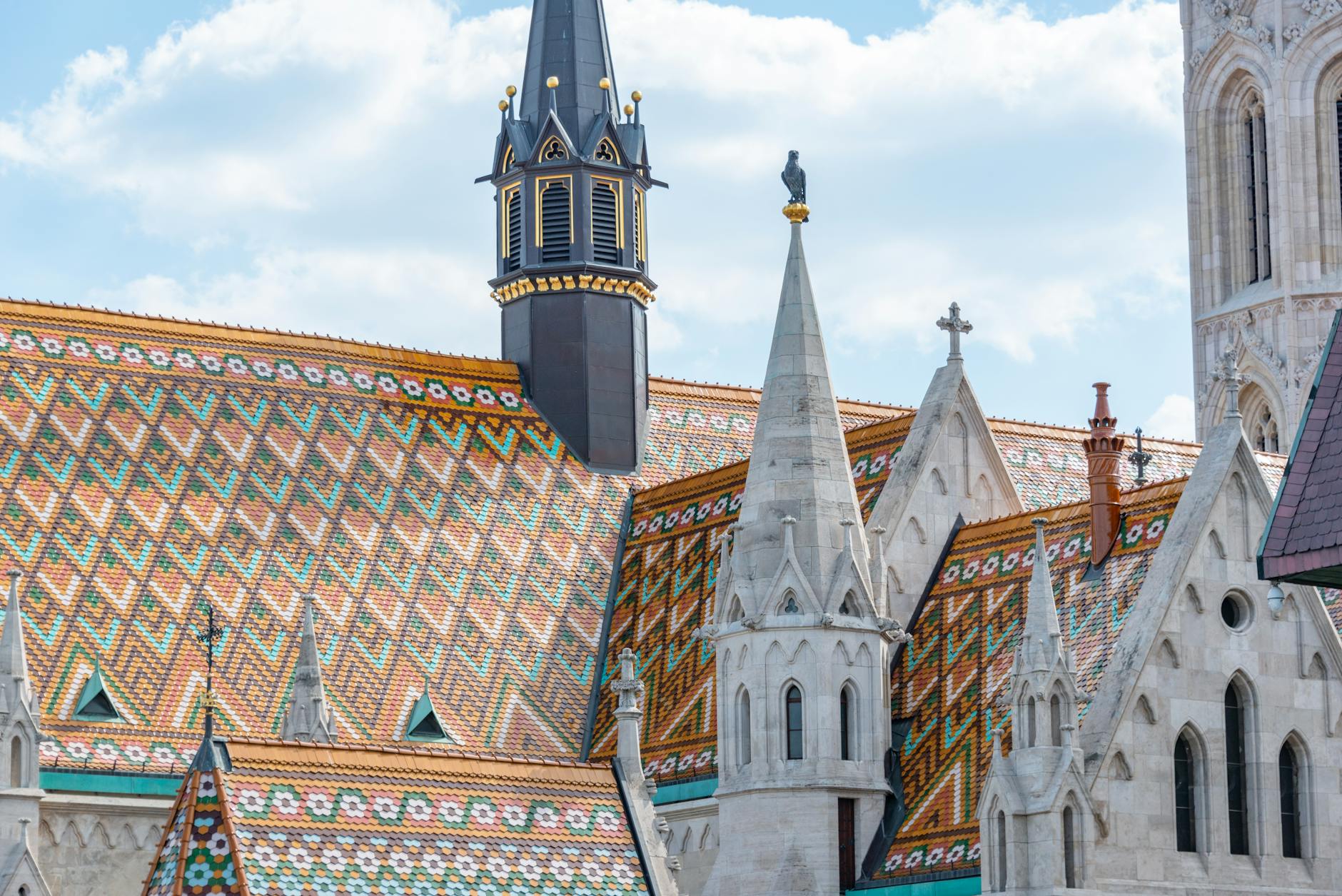
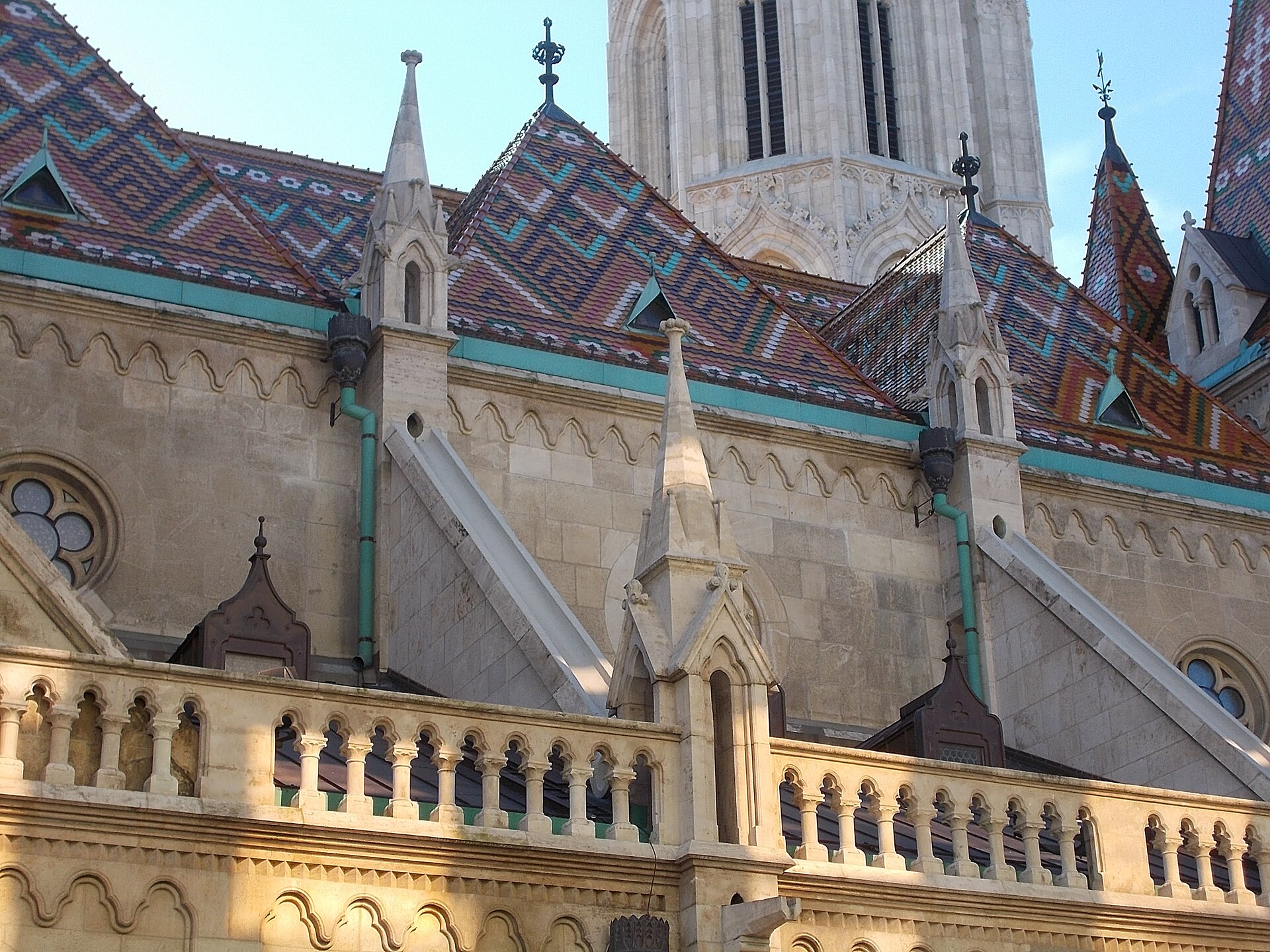
Start where everyone starts. The roof is a diamond lattice of glazed ceramic tiles from the Zsolnay factory in Pécs, laid in interlocking patterns of turquoise, ochre, white and burnt orange, with the ridge picked out in green. Zsolnay’s frost-proof pyrogranite was one of the technical triumphs of nineteenth-century Hungarian industry, and it turns up all over the country — but this is its most famous application by a distance.
It is not medieval. It dates from Frigyes Schulek’s rebuilding in the 1870s and 1890s, and it is a deliberate piece of national romanticism: a Central European Gothic church wearing a roof pattern that reads as Eastern, on a hill that had been Ottoman for a century and a half. Schulek was making an argument about where Hungary comes from, and he made it in ceramic.
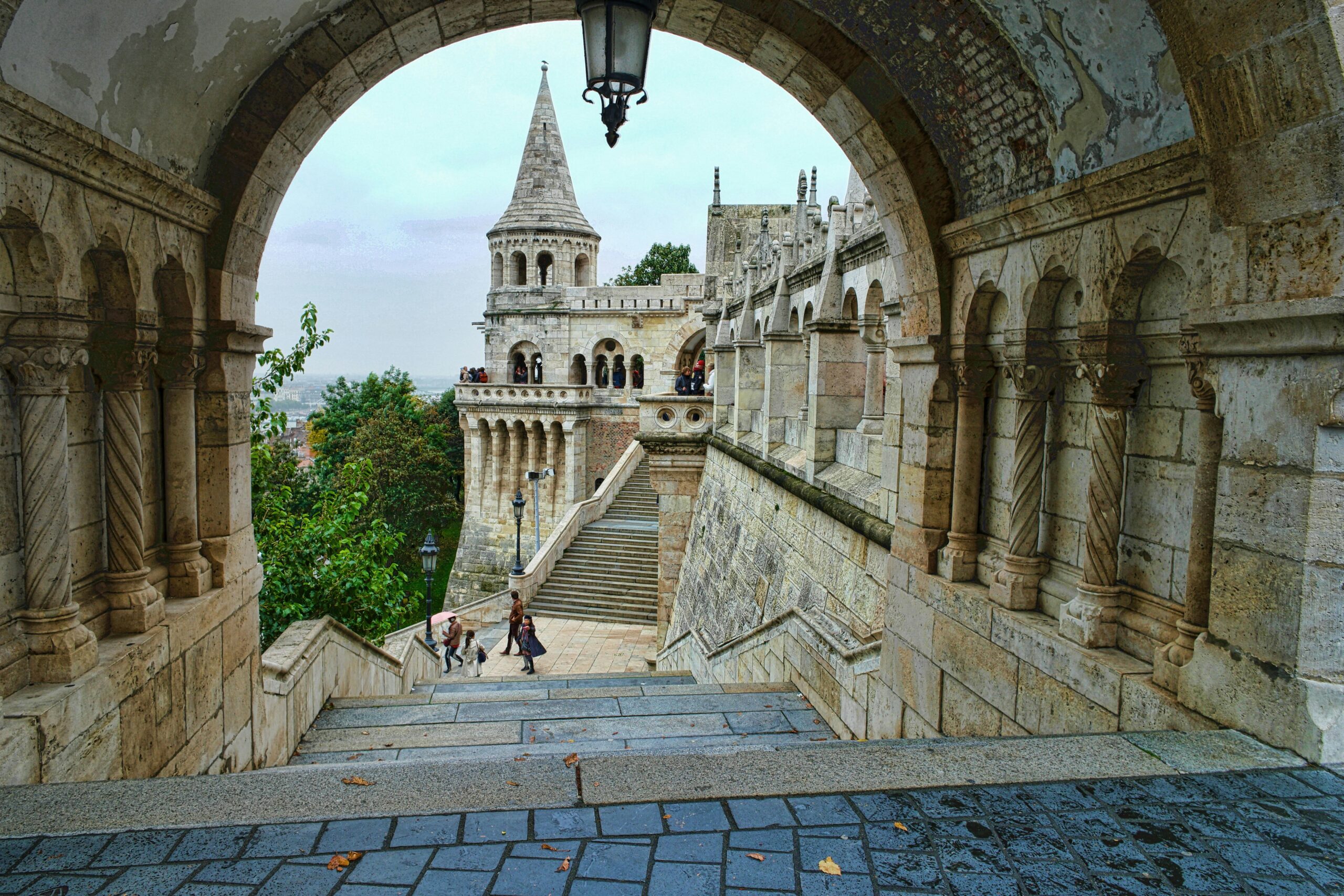
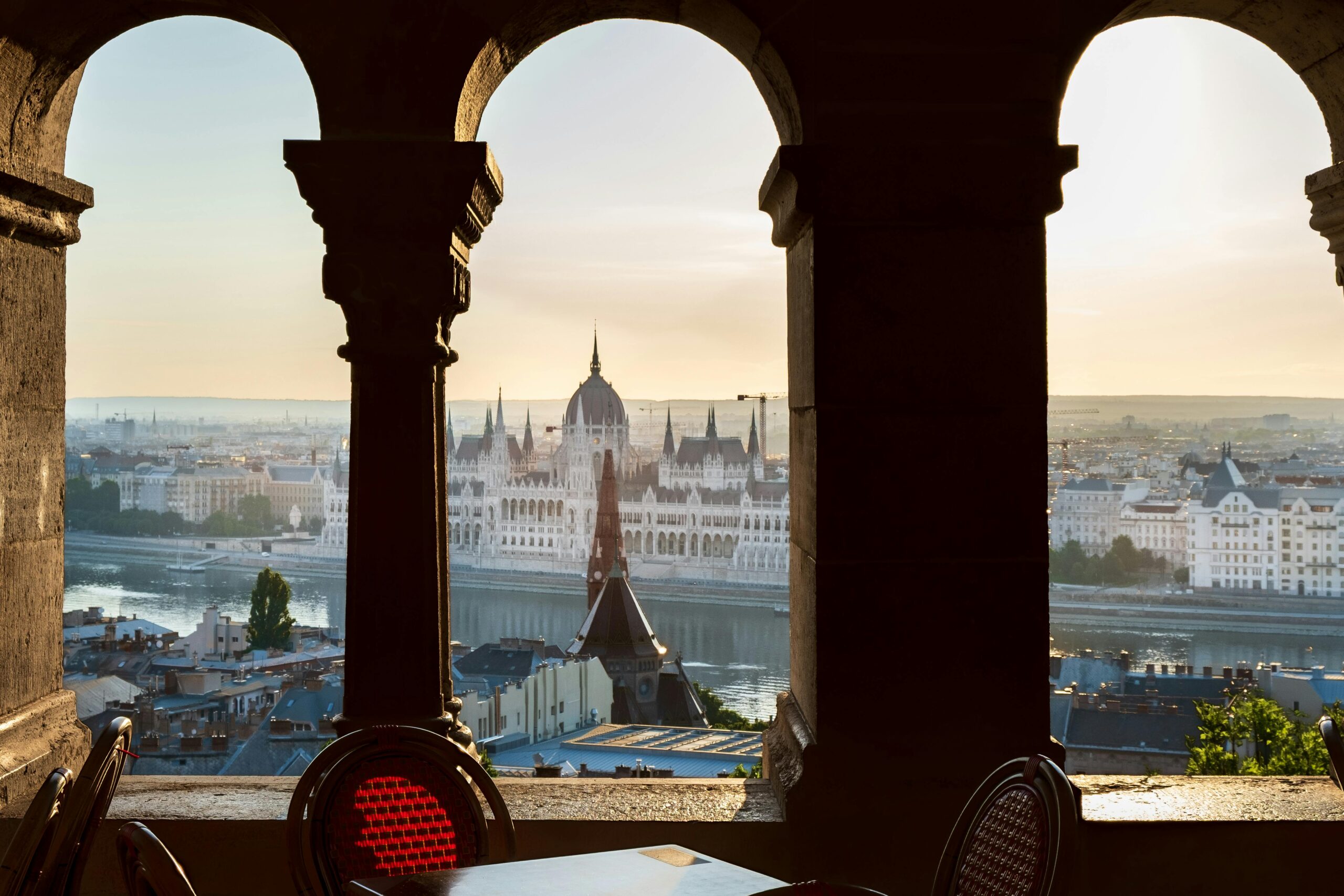
The best views of it are from the terraces of Fisherman’s Bastion next door, which Schulek also designed and which he laid out specifically to frame this building. Late afternoon sun makes the glaze do what it is supposed to do.
Inside
This is where the church earns the ticket. The nave is not the pale stone interior the exterior implies. Every surface is painted — walls, piers, vaults, window surrounds — in dense repeating geometric and floral ornament in deep reds, blues, greens and gold leaf. The designs are by Bertalan Székely and Károly Lotz, working in the 1890s, and they were consciously drawing on the decorative traditions of a church that had spent 145 years as a mosque.
The effect is genuinely disorienting for anyone who has done a run of European cathedrals. There is no soaring emptiness. The room is small, low-lit, saturated with pattern, and closer in feeling to Córdoba or Istanbul than to Vienna. It is the most surprising interior in Budapest.
Things to find
- The Loreto Chapel and its Madonna. The most famous object in the building, and the story attached to it is the best in the city — see below.
- The royal oratory, up a stair on the south side, which now holds the Ecclesiastical Art Museum: liturgical objects, vestments, and replicas of the Hungarian coronation regalia. It is included in the church ticket and most people miss it entirely.
- The crypt, with medieval stone fragments recovered during Schulek’s rebuilding, including carved capitals from the earlier church.
- The tomb of Béla III and Anne of Antioch, a twelfth-century king and queen whose remains were found at Székesfehérvár in 1848 and reinterred here — the only Árpád-dynasty royal burial in Hungary whose location is certain.
- The rose window on the west front, and the stained glass by Lotz and Székely in the sanctuary.
The Madonna in the wall
In 1541 the Ottomans took Buda and converted the church into the Great Mosque. The furnishings were stripped, the frescoes whitewashed and the interior reordered for Islamic worship.
The story, which is repeated by every guide on Castle Hill and which appears in the church’s own account of itself, runs like this. During the siege of 1686, when the Holy League was bombarding the hill, a wall inside the mosque collapsed — and behind it stood a statue of the Virgin Mary, walled up by the city’s Catholics a hundred and forty-five years earlier. It was revealed in front of the Muslim congregation at prayer. Morale broke, and Buda fell that day.
Treat it as legend rather than documented fact; the timing is a little too neat and the versions differ. But the Loreto Chapel and its Madonna are real, they are the first thing many Hungarian visitors go to, and the story is part of what the building means here. Our history and culture guide covers the Ottoman period in more depth.
The square outside
Szentháromság tér, the small square the church stands on, is worth ten minutes in its own right and most people cross it without stopping.
In the middle is the Holy Trinity Column, a baroque plague column raised in the 1710s in thanks for the ending of an epidemic — the same impulse that produced the plague columns of Vienna and Prague, and a reminder that Buda in the early eighteenth century was a half-empty town recovering from a siege. The carved figures at its base are worth a look, and the whole thing is a survivor: almost nothing else baroque on this hill made it through Schulek’s rebuilding and the 1945 siege intact.
On the east side is the Hilton hotel, which sounds like an intrusion and is in fact one of the more interesting buildings on Castle Hill. It was built in the 1970s around the surviving remains of a thirteenth-century Dominican priory and the tower of St Nicholas’s Church, and the medieval stonework is incorporated into the structure and visible from the street. Whether it works is a matter of taste. That it preserved something the ruins would otherwise have lost is not really in dispute.
Behind the church, the streets of the Castle District — Úri utca, Országház utca, Tárnok utca — are lined with houses whose Gothic sedilia, the carved stone niches in their gateways, survive from the fourteenth and fifteenth centuries. They are free, they are almost empty even in August, and they are the medieval fabric that the church itself no longer quite is. Our hidden gems guide has more in the same vein.
When to go, and where to stand
The church opens at nine and the first coaches reach Castle Hill at about half past. That half hour is the whole game: at nine the nave is quiet enough to hear the room, and by half past ten it is not.
Light matters more here than at most churches, in both directions. Inside, the painted decoration is dark and needs the sun coming through the south windows to lift it, which means late morning is better than late afternoon for the interior. Outside, the roof is the opposite — the glaze reads best in low, warm, oblique light, which means late afternoon, and best of all in the hour before sunset in autumn when the sun comes in almost horizontally from the west.
For the roof specifically, four positions:
- The Bastion’s upper walkway, which looks down onto the roof from the north — the classic angle, and the one the free lower terrace does not quite give you.
- The square itself, from the far corner by the Hilton, which gets the west front, the spire and the roof in one frame.
- The Bastion’s northern arcade, where the roof sits against the Danube behind it.
- The tower terrace at 47 metres, which is the only place you look straight down onto the tiles.
Our Budapest photography spots guide has the seasonal timings for the whole hill.
Eight hundred years, most of them interrupted
A church has stood on this site since the eleventh century, traditionally founded by St Stephen around 1015. The building whose bones survive was begun in the mid-thirteenth century under Béla IV, in the rebuilding of Buda that followed the Mongol invasion. Its formal name has always been the Church of the Assumption of the Blessed Virgin Mary; nobody uses it.
The name everyone does use comes from Matthias Corvinus, the Renaissance king who ruled from 1458 to 1490, was married here twice, and had his coat of arms — the raven with a ring in its beak — set into the south tower, which has been called the Matthias Tower ever since.
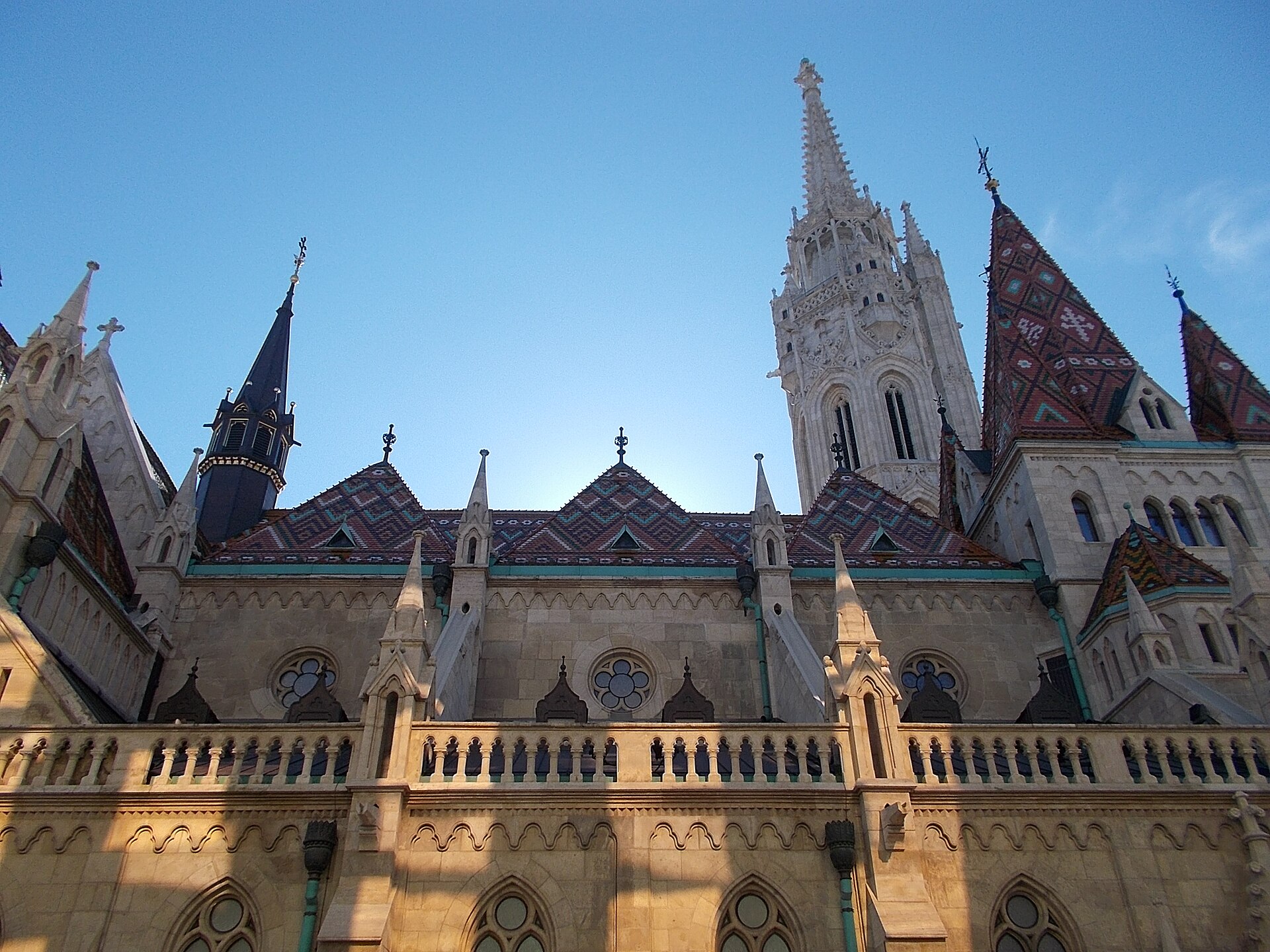
Then 145 years as a mosque, from 1541 to 1686. Then a baroque reworking by the Jesuits. Then, from 1874 to 1896, Frigyes Schulek‘s comprehensive rebuilding, which stripped away the baroque, reconstructed a fourteenth-century church partly from evidence and partly from imagination, and added the roof, the ornament and the spire that define it today. Purists have argued about it ever since. It is not an authentic medieval building; it is a superb nineteenth-century one about a medieval building.
Two coronations and a Mass
The church was where the Habsburgs were crowned kings of Hungary, and two of those events matter.
In 1867, Franz Joseph and Elisabeth — Sisi, who learned Hungarian and was genuinely popular here in a way her husband never was — were crowned following the Compromise that created Austria-Hungary. Franz Liszt wrote his Hungarian Coronation Mass for the occasion. In 1916, in the middle of the First World War, Charles IV was crowned here: the last coronation of a Habsburg monarch anywhere, ever. Two years later the empire was gone.
The building was badly damaged in the 1944–45 siege — used as a German army camp, with the Soviet artillery working on it from across the river — and restored over the following decades. A full external restoration was completed in the 2010s, which is why the tiles look as sharp as they do.
The tower climb
The Bell and Lookout Tower is sold separately, at 4,000 HUF, and it is worth understanding what you are buying. It is 197 steps up a narrow spiral staircase to a terrace at 47 metres, on hourly guided departures limited to fifteen people.
The view is close-range and unusual: you are above the Bastion, looking down onto its turrets and across at the Parliament, with the roof tiles immediately below you. It is not a wider panorama than you get free from Fisherman’s Bastion twenty metres away — it is a different one, higher and more vertical, and the roof from above is the part people remember.
Practical points. The staircase is genuinely tight and there is no lift. The hourly slots and the fifteen-person cap mean it does sell out on summer afternoons, so ask at the desk when you buy the church ticket rather than at the end of your visit. And if you have already paid to go up the turrets at the Bastion, this is a third view of much the same scene — pick one.
Hours, services and closures
Visiting hours are Monday to Friday 09:00–17:00, Saturday 09:00–12:00 and Sunday 13:00–17:00.
The Saturday and Sunday patterns exist because this is a working parish church with a full liturgical schedule, and Saturday afternoons in particular are heavily booked for weddings. This is one of the most sought-after wedding venues in Hungary, and a wedding closes the building to visitors without much notice. If your visit is fixed to a Saturday, go in the morning and go early.
Services also close the church during the week. The Sunday 10:00 Mass is sung with the church’s own choir and orchestra and is open to anyone who comes to worship — that is attending Mass, not sightseeing, and photography during it is not on.
The concerts
Evening organ and choral concerts run regularly, and as at St Stephen’s Basilica they are the better way to experience the building. A small, saturated, acoustically live room does things to choral music that a large one does not, and you are sitting down rather than shuffling. Tickets are separate from the daytime admission. Our churches and basilicas guide covers the programme.
Getting there and fitting it in
Matthias Church stands on Szentháromság tér on Castle Hill, in District I, immediately behind Fisherman’s Bastion.
- Bus 16 from Deák Ferenc tér, over the Chain Bridge and up the hill.
- Bus 16A or 116 from Széll Kálmán tér on the M2.
- On foot, about nine minutes up from Clark Ádám tér — stepped, and pleasant.
- Not the funicular, which costs around 5,000 HUF one way and puts you at the far southern end of the hill, ten minutes’ walk away. Our getting around Budapest guide has the alternatives.
Do not come up for the church alone. In an unhurried morning you can do Fisherman’s Bastion at eight before the ticket desk opens, the church at nine as it opens, the back streets of the Castle District at ten, and Hospital in the Rock or Buda Castle after that. Everything on that list is within ten minutes’ walk of everything else, and our attractions guide prices it all up.
Is it worth 3,400 HUF?
Yes, and more confidently than most tickets on Castle Hill. Three reasons.
It is the only interior in Budapest that will genuinely surprise you if you have seen a lot of European churches. It includes the Ecclesiastical Art Museum and the crypt, which people forget, so the ticket is doing more work than it looks. And at 3,400 HUF it is roughly a quarter of what the Dohány Street Synagogue costs and half of the basilica’s combined ticket.
The tower at a further 4,000 HUF is the marginal call. If you are going to pay for exactly one elevated view on Castle Hill, and Fisherman’s Bastion’s lower terraces are already free, the tower is a luxury rather than a necessity. Buy it for the roof from above, not for the panorama.
Frequently asked questions
How much does Matthias Church cost?
3,400 HUF for an adult, about €8.50, with students and seniors at 2,700 HUF and under-6s free. The Bell and Lookout Tower is a separate 4,000 HUF ticket, or 7,400 HUF for both together.
What are Matthias Church’s opening hours?
Monday to Friday 09:00–17:00, Saturday 09:00–12:00 and Sunday 13:00–17:00. The Saturday noon close catches a lot of weekend visitors, and weddings can close the church at short notice on Saturday afternoons.
Is Matthias Church worth visiting?
Yes. The exterior is famous for the Zsolnay tiled roof, but the reason to go inside is the interior — painted wall to vault in dense geometric ornament that owes as much to the building’s 145 years as an Ottoman mosque as to any Gothic tradition. It is the most surprising interior in the city, and it is cheaper than most of the alternatives.
Why does the inside look like a mosque?
Because the nineteenth-century decorators were consciously acknowledging that it had been one. The Ottomans held Buda from 1541 to 1686 and used the church as the Great Mosque. When Bertalan Székely and Károly Lotz designed the painted scheme in the 1890s they drew on that decorative tradition deliberately, as part of a wider argument about Hungary’s place between East and West.
Is the tower climb worth it?
It depends what else you have paid for. 197 steps take you to a terrace at 47 metres, with the tiled roof directly below you and the Bastion turrets beneath that — a genuinely unusual view. But it is not a wider panorama than the one you get free from Fisherman’s Bastion next door. Buy it for the roof from above.
Do I need to book Matthias Church in advance?
Not for the church itself, which takes walk-ups. The tower is different: hourly departures capped at fifteen people, so ask at the desk as soon as you arrive rather than after you have looked around.
Why is it called Matthias Church?
After Matthias Corvinus, king of Hungary from 1458 to 1490, who was married here twice and whose raven coat of arms was set into the south tower. Its formal name is the Church of the Assumption of the Blessed Virgin Mary, which nobody uses.
Is Matthias Church accessible?
Buses 16, 16A and 116 reach the top of Castle Hill, and the church has step-free access at ground level, though the surrounding square is cobbled and uneven. The tower is not accessible — a narrow spiral staircase of 197 steps with no lift.
Can you attend a service at Matthias Church?
Yes. It is an active parish church, and the Sunday 10:00 Mass is sung with the church’s own choir and orchestra. Attending worship is free; it is not a sightseeing visit, and photography during the service is not appropriate.
Photo credits
Zsolnay roof detail: Holy Trinity chapel and Saint Emeric chapel, Matthias Church, 2016 Budapest by Globetrotter19, CC BY-SA 3.0, via Wikimedia Commons.
The church and tower: Illuminated Matthias Church, 2016 Budapest by Globetrotter19, CC BY-SA 3.0, via Wikimedia Commons.