St Stephen’s Basilica: Dome Panorama, Treasury and Organ Concerts
Three different tickets, one of which is not what people think it is. The 2026 prices, the Sunday opening trap, the dome climb and why the evening concert beats the daytime visit.
In this guide
- At a glance
- Which ticket do you actually want?
- Church hall only, around 2,600 HUF
- Panorama terrace and treasury, around 5,000 HUF
- Combined, around 6,800 HUF
- Opening hours, and the Sunday trap
- The dome panorama
- What to look at once you are inside
- When to come
- Basilica or Matthias Church?
- The Holy Right Hand
- The treasury
- Organ concerts, which are the best value in the building
- A building that took fifty-four years and fell down once
- Getting there and what is around it
- Etiquette and practicalities
- Frequently asked questions
- Photo credits
This article contains advertising. Our booking links are routed through a partner that adds commission tracking automatically, so if you book through one we earn a commission from the provider, at no extra cost to you. It never affects what we recommend. Affiliate disclosure
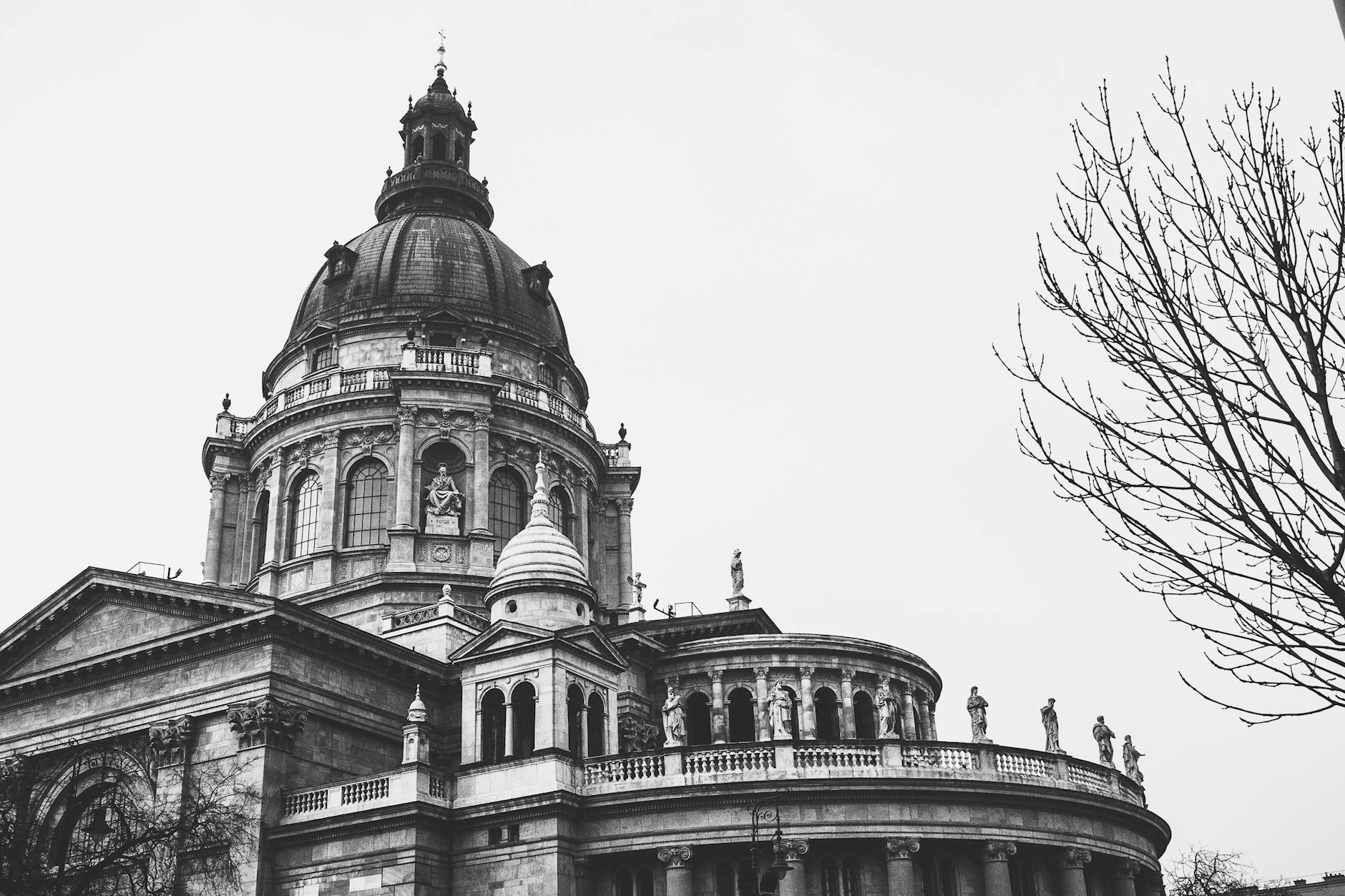
There is a glass reliquary in a side chapel containing a blackened, mummified human hand. It belongs, according to the church, to Stephen I, the king who dragged Hungary into Christian Europe around the year 1000, and it has been venerated for the better part of a millennium. You put a coin in a slot beside it and a light comes on for two minutes so you can see it properly. Nothing else in st stephens basilica budapest quite prepares you for that particular collision of the sacred and the coin-operated, and it is a fair summary of how the building works: enormous, gilded, theatrical, and entirely unembarrassed about it.
This page covers the three different tickets and which one you actually want, the opening hours including the Sunday trap, the dome panorama, the evening organ concerts, and what is worth your attention inside. Prices were checked in September 2026 and are given in forints with a euro figure in brackets; treat them as the right order of magnitude, and see the note below about how the basilica publishes them.
At a glance
| Detail | |
|---|---|
| Church hall only | ≈ 2,600 HUF (≈ €6.50) |
| Panorama terrace + treasury | ≈ 5,000 HUF (≈ €12.50) |
| Combined ticket, all three | ≈ 6,800 HUF (≈ €17) |
| Groups of 15+ | ≈ 1,800 / 4,000 / 5,200 HUF per person |
| Church hall hours | Mon–Sat 09:00–18:00 · Sun 13:00–18:00 |
| Terrace and treasury hours | Daily 09:00–19:00 |
| Concessions | Student, senior, clergy and disabled — ticket window only, ID required |
| Height | 96 metres to the top of the dome |
| Time to allow | 45 minutes for the church, 75 with the terrace |
| Nearest metro | Bajcsy-Zsilinszky út (M1) or Arany János utca (M3) |
| Dress code | Shoulders and knees covered; it is an active parish church |
One honest note on those prices. The basilica publishes its price list on its own website only as images, which means the figures cannot be read out of the page in any reliable way, and third-party sites are where most people end up getting them. The numbers above match across several sources and the hours match the basilica’s own site exactly — but check the board at the ticket office before you commit to the expensive combined ticket, because this is a place where a price rise could go unremarked online for months.
Which ticket do you actually want?
Three products, and the right answer depends entirely on what you came for.
Church hall only, around 2,600 HUF
Gets you into the nave. You see the marble, the gilding, the Gyula Benczúr painting of Stephen offering the crown to the Virgin, the mosaics in the dome, and — the reason most people are actually here — the Holy Right Hand in its chapel to the left of the sanctuary. Forty-five minutes is plenty. If your interest is “see the inside of the famous church”, this is the ticket.
Panorama terrace and treasury, around 5,000 HUF
Gets you up to the base of the dome and into the treasury, but not into the nave. This trips people up: the terrace ticket is not a cheap way into the church, it is a different visit entirely. Buy this one if you have already seen the interior, or if you genuinely only want the view.
Combined, around 6,800 HUF
All three. It saves roughly 800 HUF against buying the church hall and the terrace separately, which is a real but modest saving. Worth it if you are doing the whole building; not worth it if you suspect you will lose interest after the nave.
The verdict: for a first visit with limited time and budget, the church hall alone is the efficient choice, and Fisherman’s Bastion or Gellért Hill give you a better and cheaper view of the city than the dome does. For a photographer, or for anyone who wants the view from the middle of Pest looking outward rather than from Buda looking in, the combined ticket earns it. Our Budapest attractions guide puts that trade-off alongside the rest of the city’s ticketed sights.
Opening hours, and the Sunday trap
The church hall opens Monday to Saturday 09:00–18:00 and Sunday 13:00–18:00. The panorama terrace and the treasury run daily 09:00–19:00.
The Sunday morning gap catches a lot of visitors: this is an active parish church and Sunday mornings belong to Mass, not to sightseeing. If Sunday is your only day, do the terrace in the morning and the nave after one o’clock, or come to a service and behave like a member of the congregation rather than a tourist with a camera.
The same applies in miniature on weekdays. Services, weddings and funerals happen, and when they do, sections close without warning. Nobody will be rude about it, but you may find the Holy Right Hand chapel roped off for half an hour.
The dome panorama
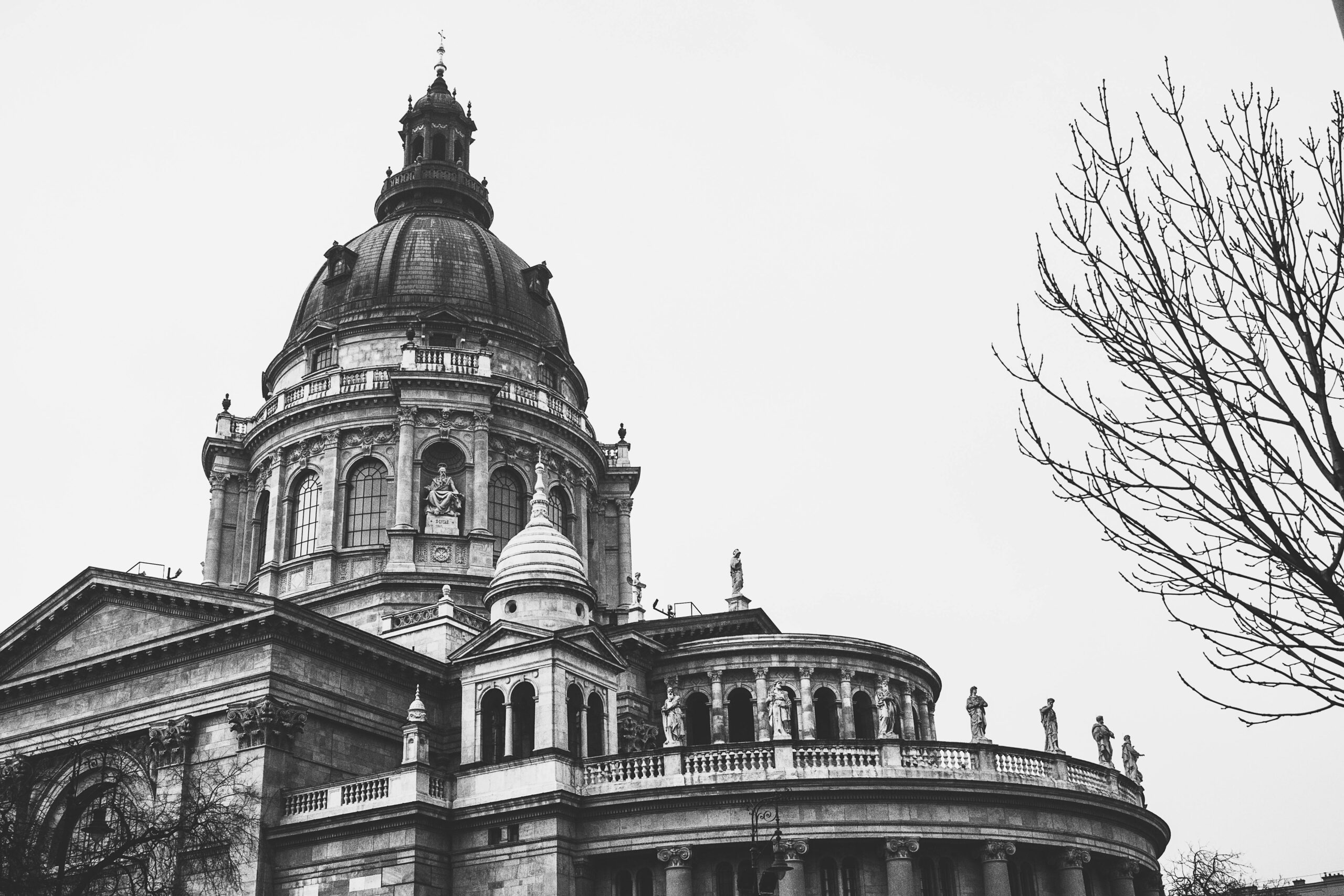
The basilica is 96 metres tall, which by long-standing tradition is exactly the height of the Parliament — the two buildings were deliberately matched so that neither church nor state should stand higher than the other, and 96 refers to the Magyar conquest of 896. It is a good story and it is broadly true.
The observation deck is a full circular walkway around the outside of the drum, and because the basilica sits in the middle of flat Pest, the view is fundamentally different from the ones you get on the Buda hills. From Gellért Hill or Fisherman’s Bastion you look at the city from outside it. From here you are standing in the middle of it, at rooftop height, with the Pest grid running away in every direction, the river and Castle Hill to the west, and the whole thing close enough to pick out individual streets.
Two lifts run most of the way up, then there are around forty steps to the deck itself. You can also take the stairs the whole way — 364 of them — which is worth doing at least in one direction because the staircase passes through the structural cavity between the inner and outer domes, a raw brick-and-steel space that looks nothing like the rest of the building.

The deck is open to the weather and the railings are chest-high with mesh, which is reassuring but does mean you are shooting through it. Go in the last hour before closing for the light. It is not a huge space, so a coach party arriving at the same time as you will make it feel very small.
What to look at once you are inside
The nave is large and busy and most visitors walk a circuit of it in ten minutes without settling on anything. Five things repay attention.
The high altar statue. The white marble figure of St Stephen behind the altar is by Alajos Stróbl — the same sculptor who made the equestrian St Stephen on Fisherman’s Bastion. Around it runs a cycle of bronze reliefs on the king’s life. It is the focal point of the whole interior and it is designed to be looked at from the centre of the nave, from some distance back, rather than up close.
The Benczúr painting. Gyula Benczúr’s canvas showing Stephen offering the Hungarian crown to the Virgin Mary sits in the chapel dedicated to the king. The moment it depicts is the founding myth of the Hungarian state: the crown given to the Virgin, making Mary the patroness of the kingdom. Nineteenth-century national painting at full volume, and worth five minutes even if the genre leaves you cold.
The dome mosaics. Károly Lotz designed the mosaics in the cupola. Stand directly beneath the centre and look straight up — the composition only resolves from that one spot, which is deliberate and which almost nobody does because everybody is looking at the altar.
The marble. Very little of the colour in here is paint. The columns, the floors and the wall panels are coloured stone, and a good deal of it is Hungarian — the reds in particular. On a bright day the light through the drum windows moves across it noticeably over the course of an hour.
The side chapels. There are several beyond the famous one, most of them empty of visitors. The chapel of the Holy Cross and the chapel of St Gerard are both quiet places to sit for a moment, which is not something you can say of the nave in July.
When to come
The building is at its worst between eleven and three in summer, when the coach parties and the river-cruise excursions arrive within an hour of each other and the nave holds several hundred people. It is at its best in the first hour after opening, when the light through the eastern windows is low and the place is close to empty.
For the terrace, reverse it: the last hour before the 19:00 close gives you low sun across the Pest rooftops and, in winter, the city lights coming on while you are up there. December is unexpectedly good — the market below, the projection on the facade, and a terrace that is cold enough to be quiet.
Avoid Sunday morning entirely unless you are coming to Mass, and be aware that weddings on Saturday afternoons can close sections at short notice.
Basilica or Matthias Church?
Visitors with time for one church ask this constantly, and the answer is not close. They are doing completely different things.
The basilica is big, gilded and imperial — a nineteenth-century statement of national confidence in marble, with a relic, a treasury and a viewing deck attached. It is in the middle of Pest and easy to reach. Matthias Church, up on Castle Hill, is small, dark and strange — every surface painted in dense red and blue patterning that owes more to Ottoman decoration than to Western church art, under a roof of glazed Zsolnay tiles.
If you want spectacle and a view, come here. If you want the more unusual building, go up the hill — and if you have any interest in church music, the evening concerts at both are better than the daytime visits at either. Our Fisherman’s Bastion guide covers the Castle Hill visit that Matthias Church sits inside.
The Holy Right Hand
The Szent Jobb — the mummified right hand of St Stephen — sits in its own chapel behind the sanctuary, in a gilded reliquary shaped like a small Gothic church. The relic’s history is genuinely remarkable: separated from the body when Stephen was canonised in 1083, moved repeatedly through Transylvania, Vienna and Ragusa across the centuries, and flown out of Hungary and back again during the Second World War.
The chapel is dim and the reliquary is behind glass. There is a coin-operated light — a couple of hundred forints, roughly, for two minutes of illumination — and it is worth the coin, because without it you will see very little. Photography is permitted but flash is not, and it is a place of veneration for Hungarian Catholics rather than an exhibit, so keep your voice down.
Every 20 August, the feast of St Stephen and Hungary’s national day, the relic is carried through the streets of Pest in a procession. If you are in the city that week it is the single most striking piece of public ritual you will see here — our festivals and events guide has the date and the route.
The treasury
Up a staircase off the nave, and the least visited of the three parts. It holds liturgical silver and gold, vestments, monstrances, and a set of objects connected with Cardinal József Mindszenty, the primate imprisoned by the communist government who spent fifteen years living inside the American embassy a few streets away. There is also a scale model of the basilica that makes the structure much easier to understand than standing inside it does.
It takes twenty minutes and it is the part most people skip. If you have the combined ticket you have already paid for it; go.
Organ concerts, which are the best value in the building
The basilica’s organ is one of the largest in Hungary, and there is a regular programme of evening concerts — organ recitals, choral programmes, and the reliable tourist favourites played on a very serious instrument in a very large room. Tickets are sold separately from the daytime visit.
This is the honest recommendation of the page. A concert gets you into the nave in the evening, lit, with the acoustics doing what the architecture was built for, sitting down, for a price in the same region as the daytime combined ticket. If you are choosing between paying 6,800 HUF to walk around the building in the afternoon and paying something similar to hear it properly at eight in the evening, hear it properly. The churches and basilicas guide covers the programme and the other venues doing the same thing.
A building that took fifty-four years and fell down once
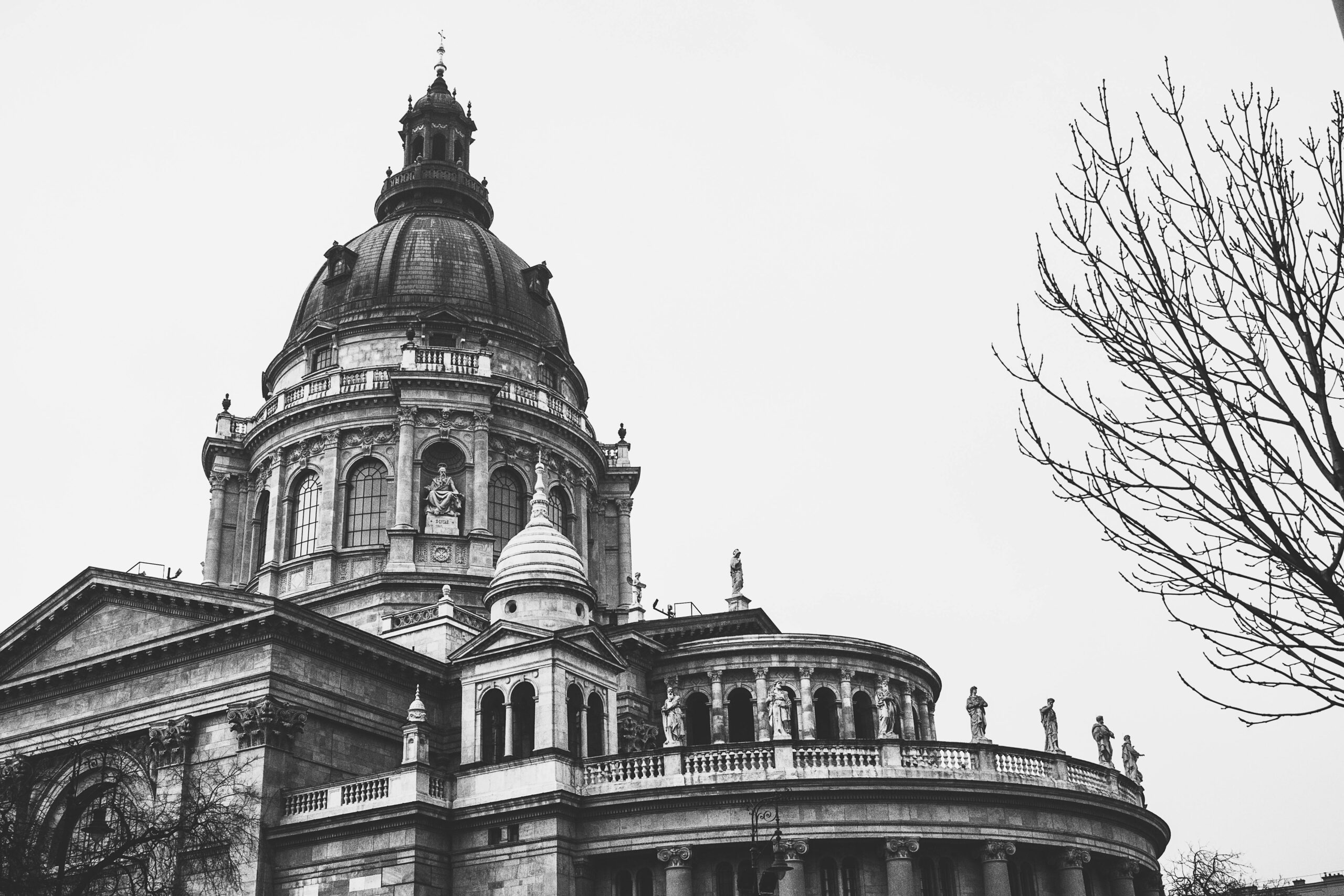
Construction began in 1851 under József Hild, who designed it as a neoclassical building. Hild died in 1867. The following year, on 22 January 1868, the dome collapsed — a storm brought down the whole unfinished structure, and the walls had to be demolished and rebuilt from the ground.
Miklós Ybl took over, changed the design to neo-Renaissance, and got most of the way through before dying himself in 1891. József Kauser finished it. The building was consecrated in 1905, fifty-four years after the first stone, with Emperor Franz Joseph in attendance — and the story, repeated by every guide in the city, is that he spent the ceremony glancing up at the dome.

It is worth knowing this because it explains why the building feels stylistically confused if you look at it carefully: a neoclassical plan wearing a neo-Renaissance dome, finished by a third architect to a fourth set of compromises. It is also, at 96 metres, joint-tallest building in Budapest, and there is a city rule preventing anything from exceeding it — which is why the Pest skyline is as flat and as legible as it is.
Getting there and what is around it
The basilica stands on Szent István tér in District V, a few minutes’ walk from Deák Ferenc tér. The nearest metro stations are Bajcsy-Zsilinszky út on the M1 and Arany János utca on the M3, both about four minutes away. Trams and buses along the Kiskörút drop you within a short walk. Full options are on our getting around Budapest guide.
The square in front is pedestrianised and lined with restaurant terraces, most of which are charging a location premium for indifferent food. Zrínyi utca, running east from the square, is the famous view — the basilica framed at the end of the street — and is the most photographed sightline in Pest after the Parliament. It also has better places to eat than the square itself.
In December the square becomes one of the city’s two main Christmas markets, with a small ice rink around the fountain and a light projection onto the basilica facade after dark. It is the prettier of the two markets and much the more crowded — see our Christmas markets guide.
Ten minutes’ walk west takes you to the Danube promenade, the Parliament and the Shoes on the Danube Bank memorial. Ten minutes east takes you into the Jewish Quarter. The basilica is a natural pivot point in a day in Pest, which our itinerary planner makes use of.
Etiquette and practicalities
- Dress with shoulders and knees covered. It is enforced politely but it is enforced.
- Photography is allowed in the nave; flash and tripods are not.
- Silence in the Holy Right Hand chapel. People are praying there.
- Cards are accepted at the ticket office, but bring a few hundred forints in coins for the reliquary light.
- Concessions — student, senior, clergy, disabled — are sold only at the window, on production of ID, not online.
- Accessibility: the nave is step-free and the lifts reach most of the way to the terrace, but there are around forty steps at the top with no alternative.
Frequently asked questions
How much does St Stephen’s Basilica cost?
Around 2,600 HUF for the church hall alone, around 5,000 HUF for the panorama terrace and treasury together, and around 6,800 HUF for a combined ticket covering all three — roughly €6.50, €12.50 and €17. Groups of fifteen or more pay less. Student, senior, clergy and disabled concessions are available at the ticket window with ID.
Is St Stephen’s Basilica free to enter?
Not for sightseeing. There is a ticket for the church hall as well as for the terrace and treasury. You may of course attend a service without paying, but that is attending Mass, not visiting — behave accordingly.
Is the dome climb worth it?
It depends what else you are doing. The view is genuinely different from the Buda viewpoints because you are standing in the middle of flat Pest at rooftop height rather than looking in from a hill. But Fisherman’s Bastion and Gellért Hill both give you a more dramatic panorama for nothing. If your budget is tight, spend it elsewhere; if you want the inside-out view of Pest, this is the only place to get it.
Are there lifts up to the panorama terrace?
Yes, two lifts run most of the way, leaving around forty steps to the deck itself. The full stair route is 364 steps and passes through the cavity between the inner and outer domes, which is interesting enough to be worth taking in one direction if you can.
What are St Stephen’s Basilica’s opening hours?
The church hall is open Monday to Saturday 09:00–18:00 and Sunday 13:00–18:00. The panorama terrace and treasury are open daily 09:00–19:00. Sunday mornings are reserved for Mass, and sections can close at short notice for services and weddings.
What is the Holy Right Hand?
The mummified right hand of St Stephen, Hungary’s first Christian king, kept in a reliquary in a chapel behind the sanctuary. It has been venerated since the eleventh century and travelled across half of Europe over the centuries. A coin-operated light illuminates it for a couple of minutes; without the coin you will see almost nothing.
Do I need to book tickets in advance?
No. Tickets are sold at the office beside the basilica and online through the official ticketing site, and the queue rarely amounts to more than a few minutes. Organ concerts are a different matter and are worth booking, particularly in summer.
Can you go to an organ concert at St Stephen’s Basilica?
Yes, and it is the best-value way into the building. Evening recitals run regularly on one of the largest organs in Hungary, tickets are sold separately from the daytime visit, and you get the nave lit and seated with the acoustics working as intended rather than shuffling round it in the afternoon.
How tall is St Stephen’s Basilica?
96 metres, deliberately matched to the Hungarian Parliament so that neither would stand above the other — the number referring to the Magyar conquest of 896. A city rule still prevents any building in Budapest from exceeding that height, which is why the Pest skyline stays as low and as readable as it does.
Photo credits
Between the domes: Budapest, Szent István Bazilika, kupola, 10 by Random photos 1989, CC BY-SA 4.0, via Wikimedia Commons.
Tympanum and inscription: Saint Emeric, Stephen I and Madonna at the St. Stephen’s Basilica tympanum, 2016 Budapest by Globetrotter19, CC BY-SA 3.0, via Wikimedia Commons.