Heroes’ Square and City Park: Budapest’s Grandest Open Space
Heroes' Square is free and takes fifteen minutes. City Park behind it is a half-day: the zoo, a fake medieval castle, Europe's biggest thermal bath and two striking new buildings most guides still miss.

In this guide
- At a glance
- What Heroes’ Square actually is
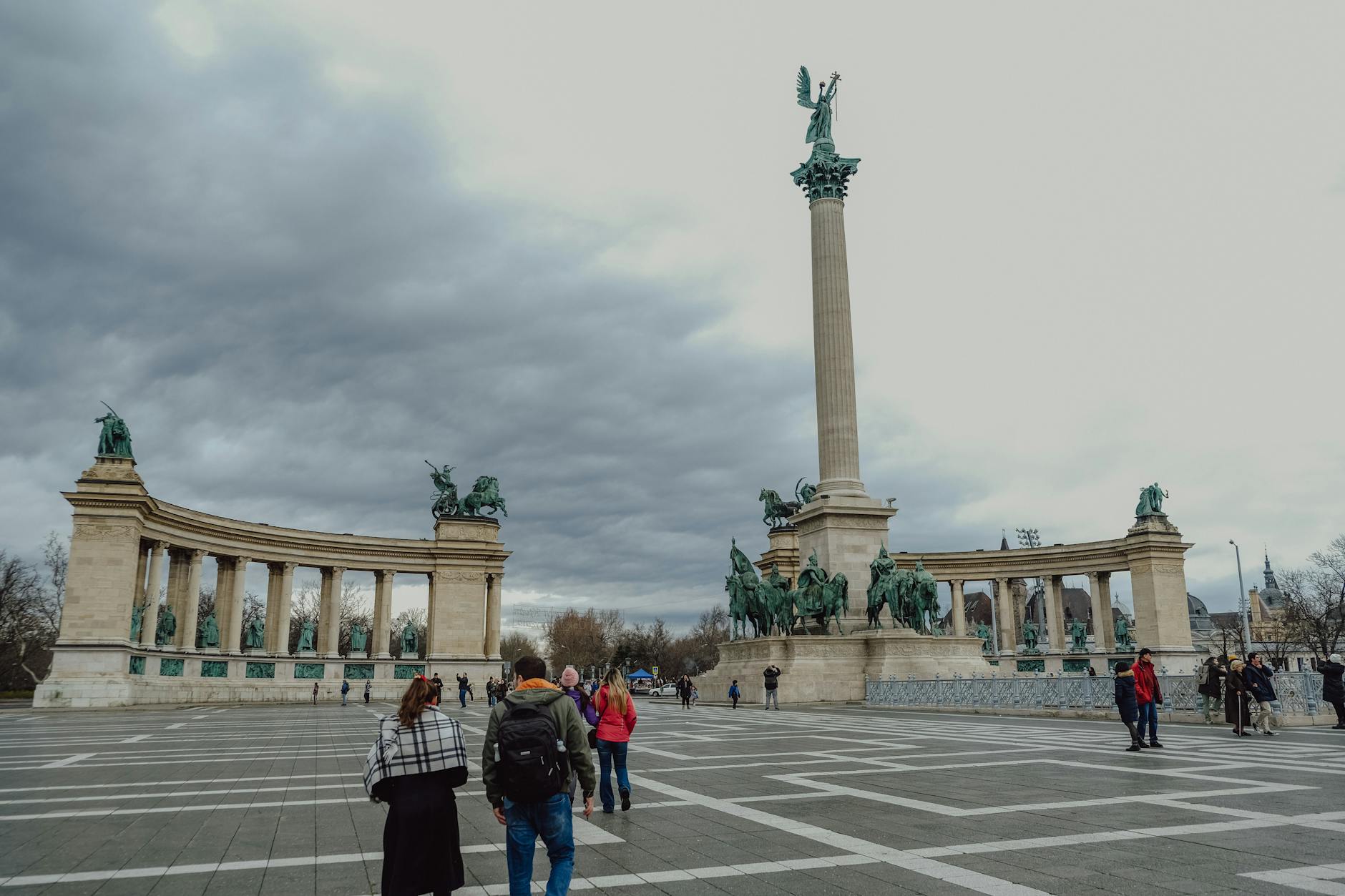
- The Millennium Monument
- What the square has seen
- The two museums that frame the square
- Museum of Fine Arts (Szépművészeti Múzeum)
- Műcsarnok (Hall of Art)
- City Park (Városliget): what’s actually behind the square
- Vajdahunyad Castle
- Budapest Zoo and the Great Circus
- Széchenyi Thermal Bath
- The newer buildings: House of Music and the Museum of Ethnography
- The ice rink and boating lake
- Getting to Heroes’ Square
- Walking up Andrássy Avenue instead
- When to visit
- Practical tips
- The honest verdict
- Frequently asked questions
- Photo credits
This article contains advertising. Our booking links are routed through a partner that adds commission tracking automatically, so if you book through one we earn a commission from the provider, at no extra cost to you. It never affects what we recommend. Affiliate disclosure
Stand at the top of Andrássy Avenue and the city stops being narrow. The buildings fall away, the sky opens up, and a 36-metre column full of angels and chieftains appears in the middle of a stone plaza the size of a small airfield. That’s Heroes’ Square Budapest (Hősök tere), and unlike almost everything else on this list, there’s no ticket booth, no opening hours and no queue. It’s a public square. It’s open all the time, it costs nothing, and most visitors still get it wrong — they photograph the column, glance at the two colonnaded museums flanking it, and walk straight past the actual reason to linger, which is what’s behind the square, not on it.
This guide covers the square itself, the Millennium Monument’s statues and what they mean, the two grand museum buildings that frame it, and City Park (Városliget) stretching out behind — the zoo, the castle, the thermal bath, and a scattering of newer buildings most guidebooks haven’t caught up with yet. It’s one stop on the wider Budapest attractions guide, but easily deserves a dedicated half-day of its own. Prices and hours below were checked in September 2026; Hungarian museum pricing changes with some regularity, so treat the figures as the right order of magnitude and confirm anything time-sensitive before you go.
At a glance
| What | Cost | Hours |
|---|---|---|
| Heroes’ Square itself | Free | Open 24/7 |
| Museum of Fine Arts (Szépművészeti Múzeum) | from ~4,400 HUF (€11) permanent collection | Tue–Sun 10:00–18:00, closed Mon |
| Műcsarnok (Hall of Art / Kunsthalle) | Varies by exhibition | Tue–Sun, hours vary by show |
| Budapest Zoo | ~4,400 HUF (€11) adult, ~3,000 HUF (€7.50) child 3–14 | Daily, seasonal hours from ~09:00 |
| City Park Ice Rink (Nov–Feb only) | ~3,000–5,000 HUF (€7.50–12.50) depending on day | Seasonal, roughly late Nov–Feb |
| Nearest metro | Included in any BKK ticket | M1 (yellow line), Hősök tere station |
What Heroes’ Square actually is
The square was built for Hungary’s Millennium celebrations in 1896 — marking (a few years late, as these things often run) one thousand years since the Magyar tribes settled the Carpathian Basin — and finished in 1900. It sits at the far end of Andrássy Avenue, itself a UNESCO World Heritage site, and forms a formal, symmetrical full stop to the city’s grandest boulevard. It was also, less romantically, the backdrop to some of Hungary’s ugliest twentieth-century moments: Nazi rallies in 1944, and Soviet propaganda gatherings under the communist government that followed. The square has absorbed all of it and still reads, today, as a monument to national continuity rather than any one regime — which is roughly the point.
The Millennium Monument
The centrepiece is a 36-metre Corinthian column topped by a bronze statue of the Archangel Gabriel, holding the Hungarian Holy Crown in one hand and the double apostolic cross Pope Sylvester II supposedly granted to King Stephen I in the other. According to legend, Gabriel appeared to Stephen in a dream to offer him the crown — a founding myth given monumental, very literal form.
At the base of the column stand the seven mounted chieftains of the Magyar tribes who led the conquest of the Carpathian Basin around 895 AD, with Árpád — regarded as the founder of the Hungarian nation — at the front on the tallest horse. Behind them, a semicircular colonnade sweeps out on both sides of the square, holding fourteen statues of kings and statesmen: Stephen I, Ladislaus I, Coloman the Learned, Andrew II, Béla IV, Charles I, Louis the Great, John Hunyadi, Matthias Corvinus, and on through to Lajos Kossuth, leader of the 1848 revolution, at the far end. Reliefs above the colonnade depict Work and Welfare, War, Peace, and Knowledge and Glory — the greatest hits of nineteenth-century civic sculpture in one place.
In front of the column, a low stone slab marks the Tomb of the Unknown Soldier, guarded by a permanent, low-key honour presence rather than a formal changing-of-the-guard show. Hungarians lay wreaths here on national holidays — 15 March, 20 August and 23 October — and it’s worth knowing what the flowers are for if you happen across the square on one of those dates.
What the square has seen
Look past the sculpture and the square has a harder history worth knowing before you stand on it. In 1944, the Arrow Cross regime — Hungary’s homegrown fascist government during the last, worst months of the war — used the square for rallies, and the wider area became a staging ground during the Nazi occupation and the subsequent siege of Budapest. After the war, under four decades of communist rule, Heroes’ Square became a fixture of state pageantry: May Day parades, military processions, and the kind of engineered public spectacle that authoritarian governments tend to like about big, symmetrical open spaces. The statues themselves survived every regime change largely untouched, which is unusual for Budapest — the city’s communist-era monuments were mostly pulled down after 1989 and relocated to a dedicated statue park on the city’s outskirts, but the Millennium Monument’s kings and chieftains predate that whole chapter and were never treated as part of it. The square’s most recent brush with history was 1989, when the reburial of 1956 revolution leader Imre Nagy took place here, drawing a crowd estimated at a quarter of a million people and marking, in retrospect, the beginning of the end of communist rule in Hungary.
The two museums that frame the square
Heroes’ Square is flanked by two large Neoclassical buildings, mirror images of each other in scale if not in purpose.
Museum of Fine Arts (Szépművészeti Múzeum)
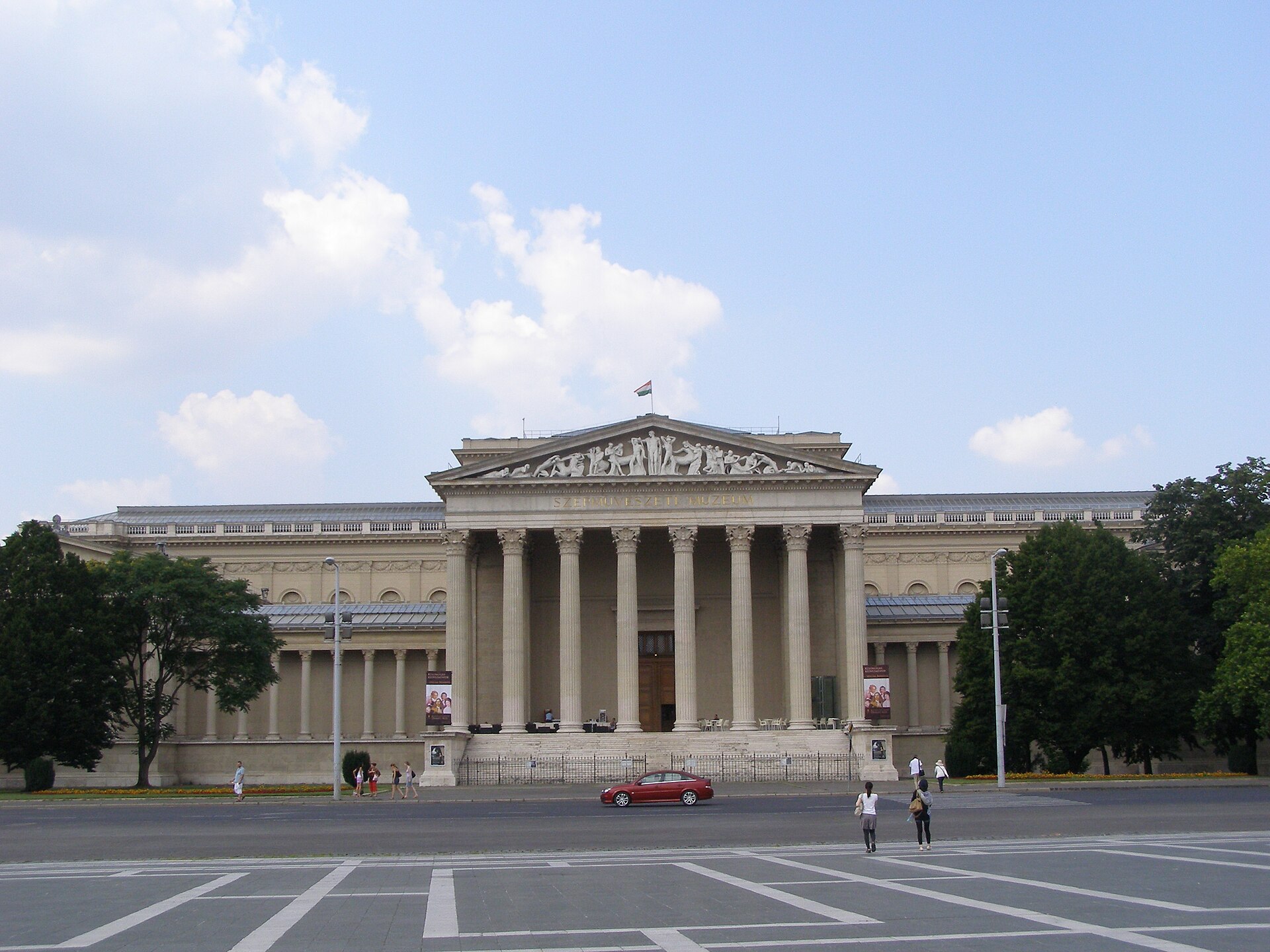
On the northwest side, behind a Corinthian portico that could pass for a Greek temple, sits Hungary’s largest public art collection outside the National Gallery: Old Masters (a genuinely strong Spanish collection — El Greco, Goya, Velázquez — that surprises people who weren’t expecting it in Budapest), Egyptian and classical antiquities, and a sculpture hall modelled on the Basilica of Constantine in Rome. It’s open Tuesday to Sunday, 10:00 to 18:00, closed Mondays. Full permanent-collection admission runs from around 4,400 HUF (€11), with temporary exhibitions ticketed separately and combined tickets usually working out cheaper than paying for both — check current pricing at the ticket desk or mfab.hu, since exhibition-linked pricing shifts a few times a year.
Műcsarnok (Hall of Art)
Directly opposite, the Műcsarnok — sometimes called the Kunsthalle in English-language material — holds no permanent collection at all. It exists purely for temporary exhibitions: contemporary Hungarian and international art, photography, design retrospectives, the occasional architecture show. That makes it impossible to give a standing admission price here that will still be true by the time you read this; check whatever’s currently showing before you commit an afternoon to it. It’s the more skippable of the two museums for a first visit to Budapest, but worth a look if the current show happens to interest you.
City Park (Városliget): what’s actually behind the square
Most people photograph Heroes’ Square and turn around. That’s the mistake. Walk past the monument and you’re in Városliget, one of the world’s oldest public parks (opened to the public in 1751, landscaped into its current form in the early 1800s) and easily the most attraction-dense green space in the city. Budapest’s authorities have also spent the last decade quietly rebuilding it — the “Liget Budapest” project has added several major buildings since 2020 that don’t show up in older guidebooks.
Vajdahunyad Castle
A five-minute walk from the square, across a small lake, sits what looks like a genuine medieval castle and is in fact an 1896 stage set that Budapest liked so much it rebuilt in permanent stone a few years later. It borrows pieces of real Hungarian buildings from every architectural period — Romanesque, Gothic, Renaissance, Baroque — stitched into one fantastical composite, and it deserves its own visit rather than a rushed detour: a hooded statue in the courtyard, a working agricultural museum inside, and the same lake in front that freezes over for skating in winter.
Budapest Zoo and the Great Circus
On the park’s northern edge, Budapest Zoo and Botanical Garden dates to 1866 and still has some of its original Art Nouveau animal houses standing — the Elephant House in particular is worth seeing as architecture even if you’re indifferent to elephants. Adult admission runs around 4,400 HUF (€11), children 3–14 around 3,000 HUF (€7.50), with under-3s free; exact pricing shifts seasonally, so check zoobudapest.com before you go. Next door, the Fővárosi Nagycirkusz (Great Circus) runs a full circus programme in a permanent building — one of very few state-funded circuses left in Europe. For a deeper look at what’s actually inside the zoo, see the dedicated Budapest Zoo guide; if you’re travelling with children, this whole corner of the park is also covered from a family-logistics angle in the Budapest with kids guide.
Széchenyi Thermal Bath
City Park’s other headline attraction is Széchenyi, the largest thermal bath complex in Europe and the one with the postcard shot everyone’s seen — men playing chess shoulder-deep in a steaming yellow pool with a Baroque palace behind them. It’s a fifteen-minute walk from Heroes’ Square along the park’s western edge, or one stop further on the M1. The full Széchenyi guide covers ticket tiers, locker versus cabin, and which of the eighteen pools are actually worth queueing for.
The newer buildings: House of Music and the Museum of Ethnography
Two buildings completed in the early 2020s have changed the skyline of the park’s eastern half, and both are the product of the “Liget Budapest” redevelopment — a state-funded project that’s spent over a decade turning City Park’s quieter corners into a cluster of contemporary architecture, largely below the radar of visitors still working from a guidebook written before 2020.
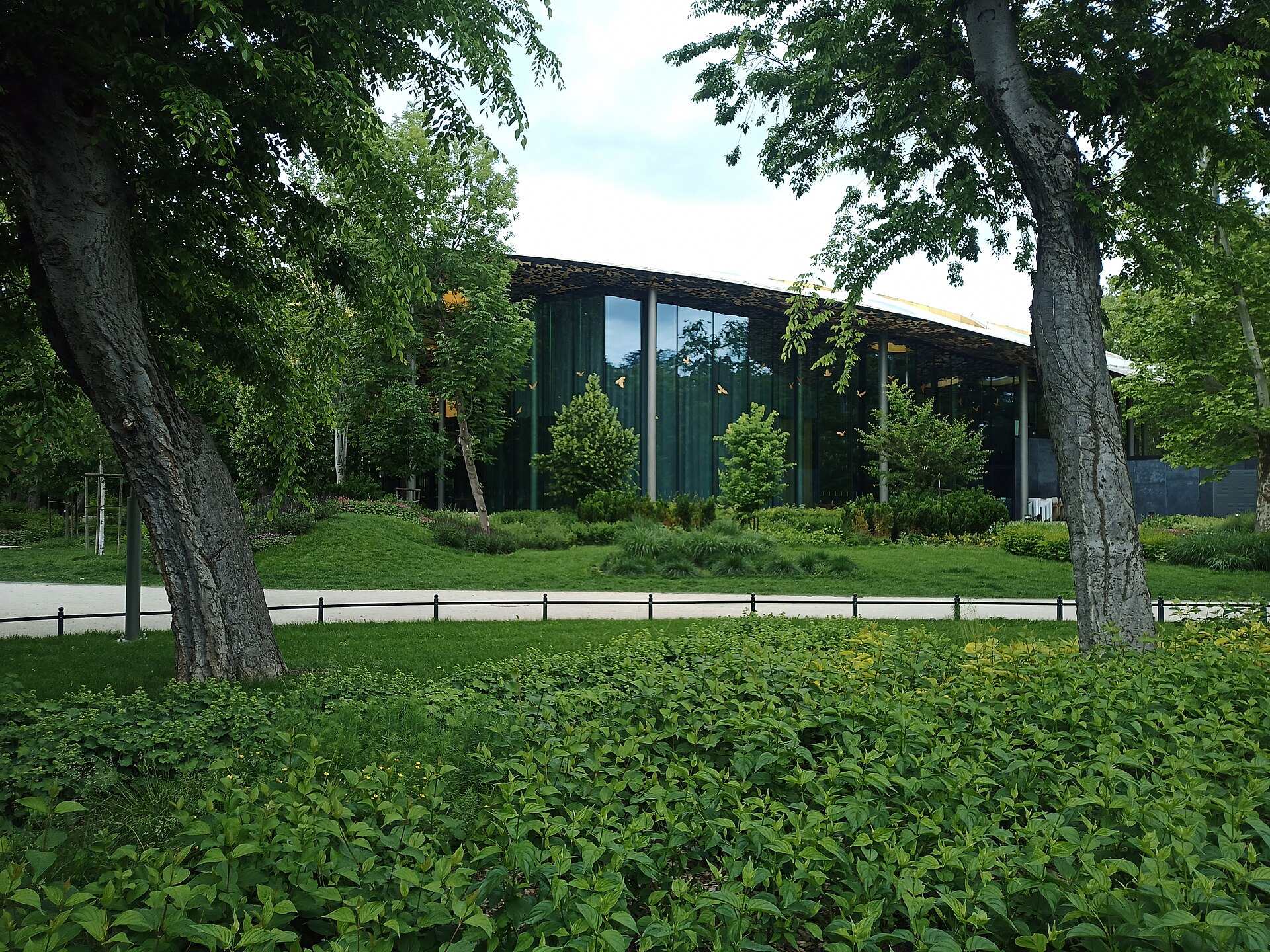
The House of Hungarian Music (Magyar Zene Háza), designed by the Japanese architect Sou Fujimoto, is a low glass structure under a swooping perforated roof that lets dappled light and, in places, actual trees punch through the canopy. Inside, it houses a sound-history exhibition tracing Hungarian music from folk roots through Bartók and Kodály to the present, concert spaces that host regular performances, and a café that’s a genuinely pleasant place to sit out a rain shower. It photographs better than almost any other new building in the city, particularly from underneath the roof looking up.
Nearby, the new Museum of Ethnography relocated here in 2022 into a striking building with a roof shaped as a walkable public terrace, offering a rooftop view back across the park that costs nothing even if you skip the exhibitions inside. Neither building has settled into the standard tourist circuit yet, which is exactly why they’re worth the short detour if you already have City Park on the itinerary and want to see something that isn’t in every other visitor’s photo feed.
The ice rink and boating lake
The same lake that fronts Vajdahunyad Castle does double duty: rowing boats in the warmer months, and — from late November through February, weather permitting — one of Europe’s oldest and largest outdoor ice rinks, operating since 1870. Typical season pricing runs roughly 3,000–3,500 HUF (€7.50–8.50) on weekdays and 4,000–5,000 HUF (€10–12.50) at weekends, with family group tickets available; exact dates and prices are set closer to the season each year, so check nearer the time if you’re visiting in winter. Outside the skating season, the lake is simply a nice place to sit.
Getting to Heroes’ Square
The easiest approach is the M1 metro — Budapest’s oldest underground line, opened in 1896 for the same Millennium celebrations the square itself commemorates, and still running its original shallow, tiled stations. Get off at Hősök tere, which puts you directly on the square. Search heroes square budapest in Google Maps or a taxi app and it will drop the pin on the same stop, which is a reasonable shorthand for how central and easy to find this place is. Trams and buses also run along the edge of the park, but for a first visit the M1 is simpler and lets you ride a piece of transport history on the way. The Getting Around Budapest guide covers fares and travelcards if you haven’t sorted out tickets yet.
Walking up Andrássy Avenue instead
If you have the time, skip the metro on the way there and walk the length of Andrássy Avenue from Deák Ferenc tér instead — it’s roughly 2.3 km and takes 30–35 minutes at an unhurried pace. The avenue itself is the point: opened in 1876 as Budapest’s answer to the Champs-Élysées, it runs dead straight past the Hungarian State Opera House, a run of late-nineteenth-century townhouses with elaborate facades, and the Franz Liszt Academy of Music, before the buildings drop away and the avenue opens directly onto the square. It’s the approach the square’s original architects designed for, and arriving that way — rather than popping up from the metro directly onto the plaza — makes the scale of the place land properly. Ride the M1 back if you’re tired by the time you’re done with the park.
When to visit
Early morning is genuinely the best time for photographs: the square faces roughly east-southeast, so the Millennium Monument catches good light for the first couple of hours after sunrise, and you’ll have the plaza close to empty before tour groups arrive from around 10:00. Late afternoon works almost as well and lets you follow the light into the park behind. Avoid the middle of the day in July and August — there’s very little shade on the stone plaza itself, though City Park behind it stays comfortably shaded under mature trees.
Public holidays are worth timing around rather than avoiding: on 15 March, 20 August and 23 October the square hosts official wreath-laying at the Tomb of the Unknown Soldier, which is a striking (if slightly more formal) thing to witness if your visit happens to line up.
Practical tips
There’s no café or toilet block directly on the square itself — the nearest reliable options are inside the Museum of Fine Arts (accessible without a ticket, from the lobby) or a short walk into City Park towards the House of Hungarian Music, which has a public café open even to non-visitors. Bring water in summer; there’s no shade on the stone plaza and the nearest kiosk is a five-minute walk in.
Benches are limited directly on the square but plentiful once you’re a hundred metres into the park, so if you want to sit and take the monument in rather than just photograph it and move on, walk to the edge of the lake near Vajdahunyad Castle and look back. The view from there — statue, colonnade and the museum facades lined up beyond — is arguably a better composition than anything you’ll get standing directly in front of the column.
If you’re combining Heroes’ Square with a longer City Park visit, a Budapest Card is worth weighing up: it doesn’t cover Széchenyi or the zoo for free, but it does bundle unlimited public transport with discounts at several City Park museums, and pays back fastest for visitors planning to hit three or more paid sights in a day. It’s rarely worth it for Heroes’ Square alone, since the square itself is free.
The honest verdict
Heroes’ Square on its own is a fifteen-minute stop — impressive, free, easy to reach, and genuinely worth seeing, but not a destination in itself. The mistake is treating it as one. Budget half a day if you want to do City Park properly: the square, one of the two museums if either interests you, a walk past Vajdahunyad Castle, and either the zoo or Széchenyi depending on what else is on your itinerary. Trying to fit all of it into a single visit tends to mean rushing everything; picking two or three pieces and doing them properly beats ticking every box in a hurry.
Around 1 May the park behind the square fills with the city’s biggest May Day fair, with funfair rides, food stalls and evening concerts. The Budapest in May guide covers the fair and the rest of the month’s festivals.
Frequently asked questions
Is Heroes’ Square free to visit?
Yes. The square itself has no admission charge and no opening hours — it’s a public plaza, accessible at any time. Only the buildings around and behind it (the two museums, the zoo, Széchenyi, Vajdahunyad Castle’s interior) charge admission.
How long does it take to see Heroes’ Square?
The square alone takes 15–20 minutes to walk around and photograph properly. If you’re including a walk through City Park to Vajdahunyad Castle and back, budget an hour. Adding the zoo, a museum, or Széchenyi turns it into a half-day or full-day outing.
What’s the best metro line to reach Heroes’ Square?
The M1 (yellow line), Budapest’s oldest metro, stops directly at Hősök tere. It’s the most direct route from central Pest and runs in the original 1896 tunnel and station shells, which makes the ride itself mildly historic.
Are the Museum of Fine Arts and Műcsarnok worth visiting?
The Museum of Fine Arts is worth it if you have any interest in European Old Masters — its Spanish collection in particular is stronger than most visitors expect from a Central European city. The Műcsarnok has no permanent collection, so its value depends entirely on whichever temporary exhibition is running when you visit; check what’s on before planning around it.
Can you visit City Park in winter?
Yes, and it’s one of the few times of year City Park has a headline attraction of its own: the outdoor ice rink by Vajdahunyad Castle, running roughly late November through February. The park itself, the zoo and Széchenyi all stay open year-round, though zoo and outdoor sightseeing hours shorten in winter.
Is Heroes’ Square accessible for wheelchairs and pushchairs?
The square itself is flat, paved stone with no steps, and easily accessible. City Park’s main paths are similarly level. The Museum of Fine Arts and the newer buildings (House of Hungarian Music, Museum of Ethnography) have step-free entrances and lifts; older structures like Vajdahunyad Castle have more uneven, cobbled sections.
Photo credits
Museum of Fine Arts, Budapest, seen from Heroes’ Square by Andrzej Otrębski, CC BY-SA 3.0, via Wikimedia Commons.
The House of Hungarian Music, seen through the trees of City Park by Aktron, CC BY-SA 4.0, via Wikimedia Commons.