Hungarian State Opera House: Tours, Tickets and the Cheap Seats
A tour costs about the same as a cheap performance ticket, and the performance is the better deal. What the guided tour includes, current ticket tiers, and how to get a seat for a few euros.
In this guide
- At a glance
- A building built to lose an argument on purpose
- Inside: what the auditorium actually looks like
- Taking the guided tour
- Seeing an actual performance
- What’s actually on: opera, ballet, and how to book
- A closer look at the history
- The 2022 restoration
- Getting there
- Practical tips
- The honest verdict
- Frequently asked questions
- Photo credits
This article contains advertising. Our booking links are routed through a partner that adds commission tracking automatically, so if you book through one we earn a commission from the provider, at no extra cost to you. It never affects what we recommend. Affiliate disclosure
Franz Joseph paid part of the bill personally, on one condition: it could not, in any dimension, outdo the Vienna State Opera. Budapest’s architect Miklós Ybl took the brief literally — built it smaller than Vienna’s — and then spent the difference on décor, which is why the Hungarian State Opera House is, almost everyone who’s seen both agrees, the more beautiful of the two buildings. It opened in 1884, reopened in March 2022 after a five-year, multi-hundred-million-euro restoration, and remains one of the very few places left in Europe where you can watch a full opera or ballet production, in a genuinely world-class house, for less than the price of a cinema ticket.
This guide covers what a guided tour costs and includes, how to buy a seat for an actual performance (and how cheap the cheap seats really are), what the 2022 restoration changed, and what to expect inside. Prices below were checked in September 2026 against opera.hu and current tour operators; opera ticket pricing moves production to production, so treat any single figure as an example rather than a quote.
At a glance
| What | Cost | Notes |
|---|---|---|
| Guided building tour, English | ≈10,500 HUF (€26) | Daily, several departures afternoon; check opera.hu for current times |
| Guided building tour, Hungarian | ≈5,800 HUF (€14.50) | Same route, Hungarian-language commentary |
| Performance ticket, cheapest seats | from ≈6,000 HUF (€15) | Upper circle and side seats with a partial view |
| Performance ticket, best seats | up to ≈35,900 HUF (€90) | Ground floor and first-circle centre for major productions |
| Standing room | ≈900–1,500 HUF (€2–4) | Sold at the box office roughly two hours before evening shows, when available |
| Nearest metro | Included in any BKK ticket | M1 (yellow line), Opera station, directly outside |
A building built to lose an argument on purpose
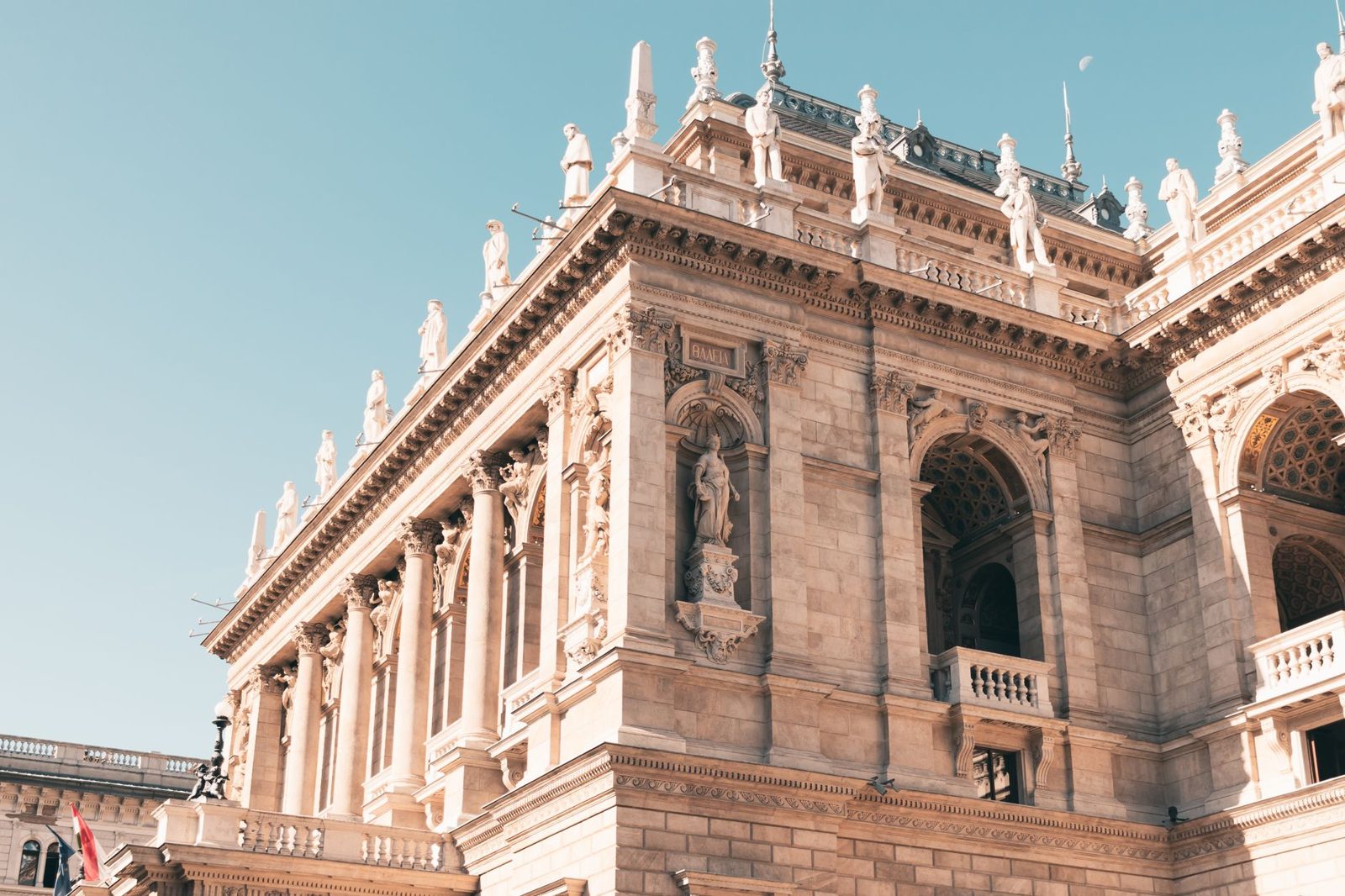
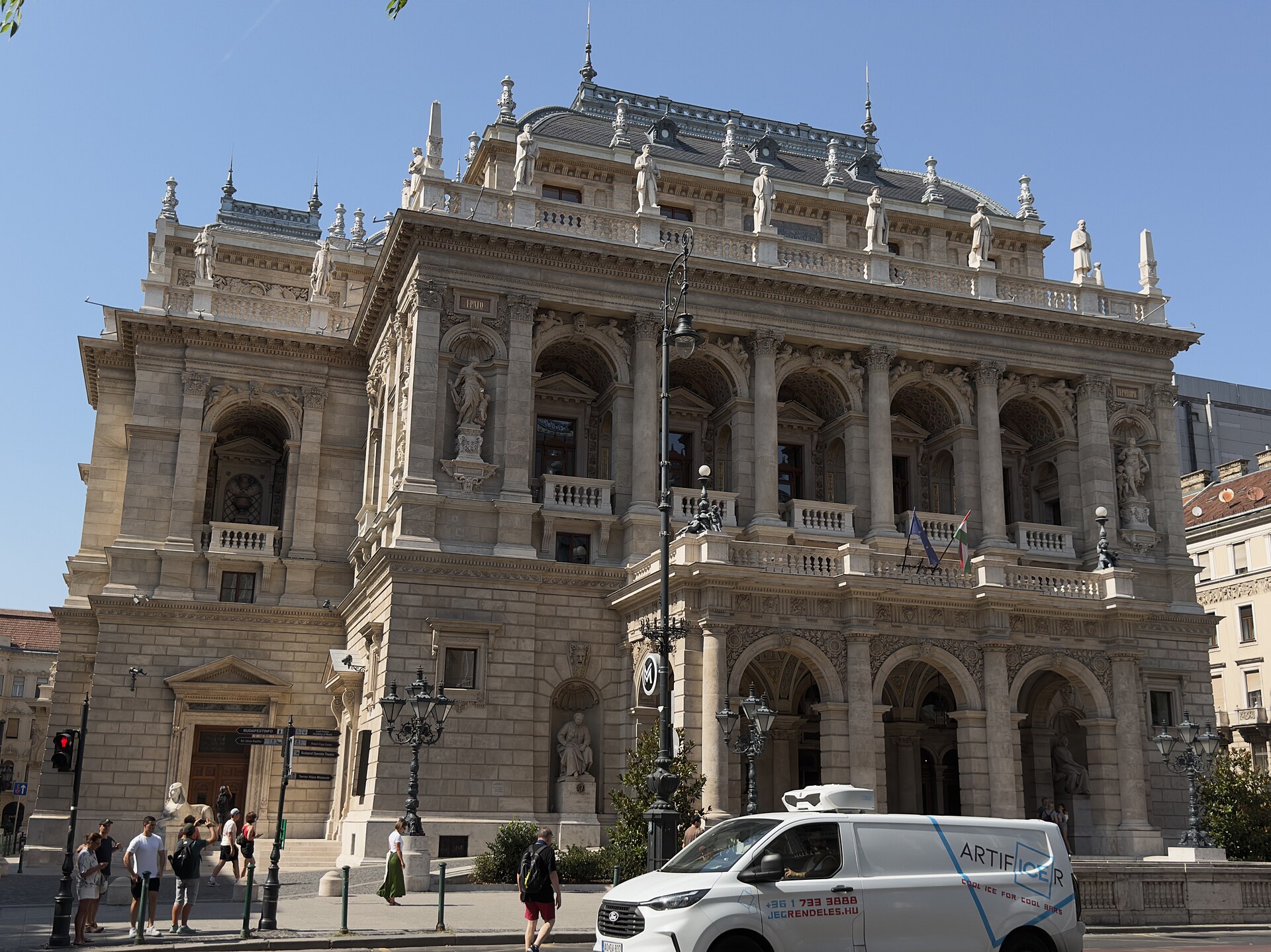
The neo-Renaissance building standing at Andrássy út 22 today was designed by Miklós Ybl, one of the defining architects of nineteenth-century Budapest, and took nine years to build, opening on 27 September 1884 with Emperor Franz Joseph I in attendance. Franz Joseph funded part of the construction from his own pocket, and the condition attached — that it not surpass the Vienna State Opera in size — is one of the best-known anecdotes in Hungarian architectural history. Ybl’s response was to build a smaller auditorium but pour the budget into ornament instead: gold leaf, frescoed ceilings, marble columns and bronze statuary throughout, to the point that many visitors who’ve seen both houses rate Budapest’s as the finer of the two, technicality notwithstanding.
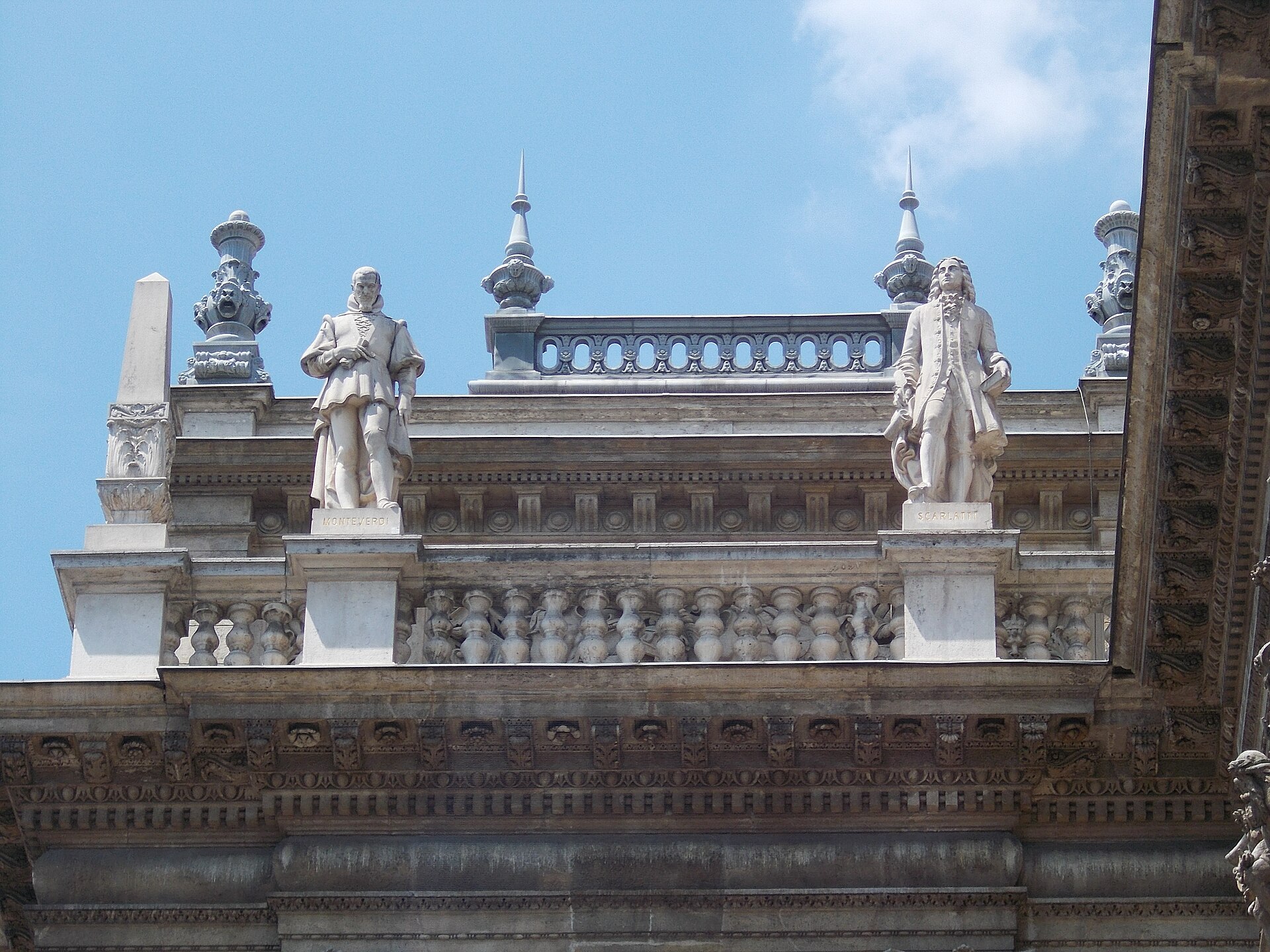
The facade carries sixteen limestone statues of composers along its upper balustrade — Monteverdi, Scarlatti, Rossini, Donizetti, Smetana, Moniuszko and others among them — and two bronze sphinxes flank the main staircase at street level. Above the main entrance sit statues of Franz Liszt and Ferenc Erkel, composer of the Hungarian national anthem and the Opera’s first musical director, marking out the building’s two great patron figures before you’ve even reached the door.
Inside: what the auditorium actually looks like
The interior is horseshoe-shaped, seating a little over 1,200 across three tiers plus box seating, and it’s the ceiling that stops most first-time visitors mid-step: a fresco by Károly Lotz titled the Apotheosis of Music, painted directly onto the dome above a vast bronze chandelier weighing several tonnes. Lotz also painted the main curtain and a second fresco above the grand staircase. The acoustics are frequently ranked among the best in Europe for a house this size — a side effect, opera obsessives will tell you, of exactly the horseshoe proportions and materials Ybl was constrained to by the smaller footprint.
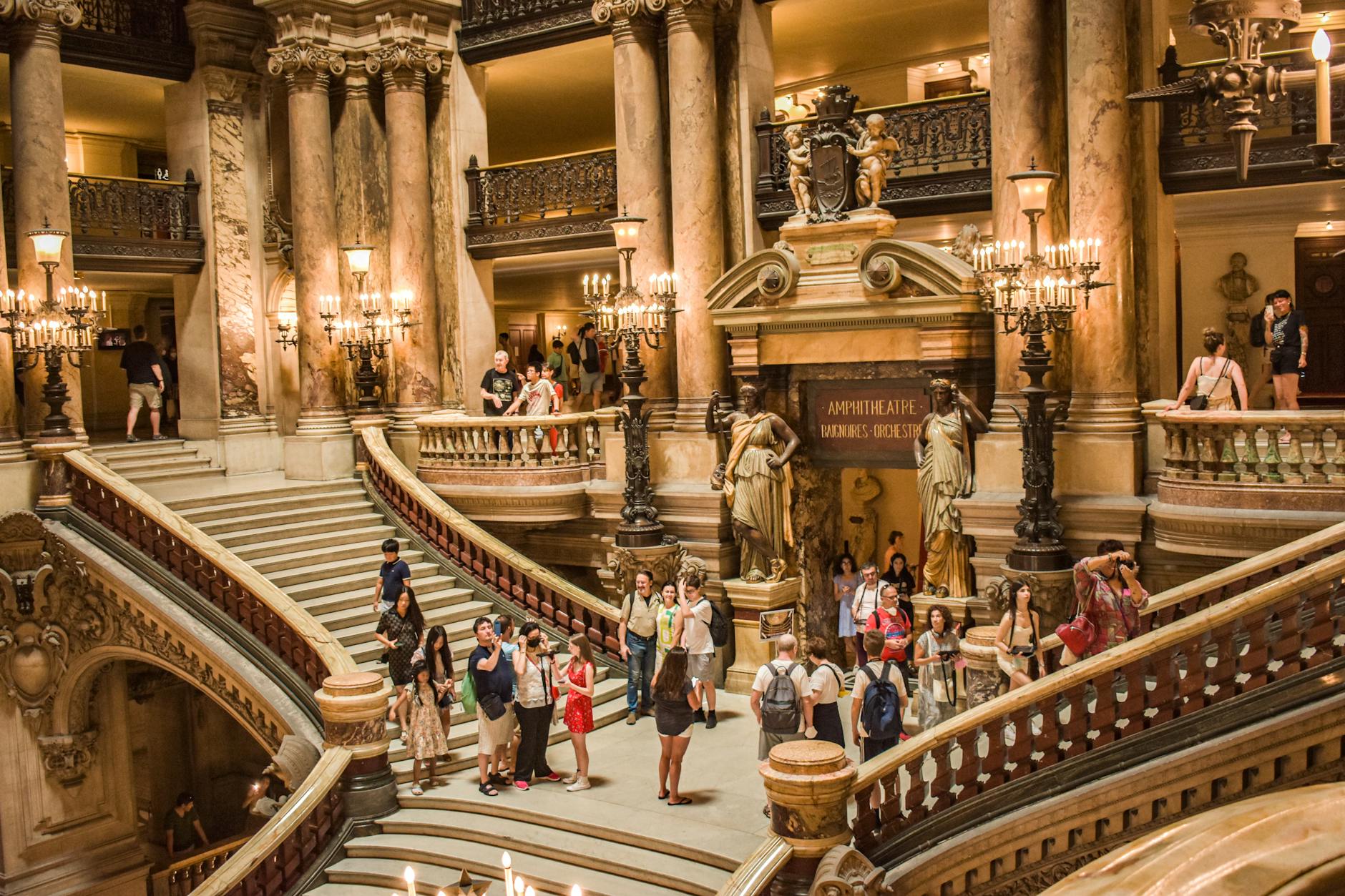
The grand staircase and foyer are worth as much attention as the auditorium itself: marble in half a dozen colours, gilded balustrades, and a run of ceiling frescoes that most visitors on a performance ticket only glimpse for a few minutes during the interval. This is the main argument for taking the guided tour even if you’re also planning to see a performance — the auditorium during a show is dim and you’re facing the stage; the tour is the only way to actually look at the room in full light.
Taking the guided tour
OperaTour, the official guided walk, runs daily with English-language departures typically in the early-to-mid afternoon — check opera.hu’s guided tours page for the current day’s exact times, since the schedule shifts around rehearsals and matinees. The English tour runs about 10,500 HUF (€26) per adult; the Hungarian-language version is considerably cheaper at around 5,800 HUF (€14.50) if you’re comfortable following along. Most tours now end with a short mini-concert from a soloist or two in the auditorium, which is as close as a non-performance visit gets to hearing the room actually used for its purpose. The tour covers the grand staircase, the main foyer, and the auditorium itself (subject to rehearsal schedules — occasionally the auditorium is swapped for the rehearsal hall if a production is in progress on stage), with a guide talking through Ybl’s design, the 2022 restoration, and the building’s near-miss with demolition under communist rule in the 1950s, when a modernisation plan was drawn up and, fortunately for the building, never carried out.
Buy tour tickets either online in advance through opera.hu or at the box office (Andrássy út 22, generally open Tuesday to Sunday from 11:00) — advance booking is worth it in peak season, since tour groups are capped in size and afternoon slots sell out.
Seeing an actual performance
This is the part most visitors underrate. A tour shows you the building; a performance ticket gets you the building doing what it was built for, and prices for the cheapest available seats are startling by Western European standards. Full performance tickets range roughly from 6,000 HUF (€15) at the bottom of the scale — side seats and the upper circle, where the view is partial but the sound is not — up to around 35,900 HUF (€90) for prime centre seats at a major production. Mid-range seats for most shows land somewhere in the 10,000–20,000 HUF (€25–50) band. The opera and ballet company both perform here regularly through the season (roughly September to June, with a lighter summer schedule), so check the current programme on opera.hu before you commit to dates — this isn’t a nightly variety show, and what’s actually on varies week to week.
If your budget or your schedule is tight, the standing-room tickets are the real trick: roughly 900–1,500 HUF (€2–4), sold at the box office about two hours before an evening performance (about one hour before a matinee) whenever the house hasn’t sold out its seats. You’ll be on your feet in the upper gallery, but the acoustics up there are still genuinely good, and it is, by a wide margin, the cheapest full opera or ballet experience available in a major European capital. Dress code is smart-casual at minimum; a jacket is welcome but not compulsory for most performances, and Hungarians dress a notch more formally for opening nights and gala performances than for a Tuesday-evening repertory show.
What’s actually on: opera, ballet, and how to book
The Hungarian State Opera House is home to both the Hungarian State Opera and the Hungarian National Ballet, and the two companies alternate through the season, so a given week might offer a Verdi opera on Tuesday and a Tchaikovsky ballet on Thursday. The repertoire leans heavily on the European classical canon — Verdi, Puccini, Mozart, Wagner, alongside Hungarian works by Ferenc Erkel and occasional contemporary programming — performed mostly in the original language with Hungarian and English surtitles. The main season runs from September to June; a lighter summer programme fills July and August, often with more accessible, shorter works aimed partly at visiting tourists rather than the core subscriber audience.
Booking is straightforward through opera.hu, which has a full English-language interface: pick a date from the calendar, use the interactive seating chart to see the price and sightline for each category before you commit, and pay by card. Tickets for popular productions and weekend dates can sell out weeks ahead in peak season (roughly April to June and the December holiday period), so if you have specific dates in mind, book as soon as your travel dates are confirmed rather than waiting until you land. For flexible travellers, booking a day or two ahead usually still finds seats in the mid and lower price tiers, since the top categories sell first.
If you’d rather combine the visit with dinner, the romantic Budapest guide covers a few restaurants within easy walking distance that work well either side of a performance — worth booking ahead too, since curtain times cluster around 19:00 and the pre-theatre crowd fills tables fast.
A closer look at the history
The building survived the Second World War more intact than much of central Budapest — it suffered some damage during the 1944–45 siege but avoided the catastrophic destruction that levelled the Chain Bridge and gutted the Royal Palace, and performances resumed relatively quickly after the war ended. Under four decades of communist rule that followed, the Opera House continued operating largely as before; opera and ballet were considered acceptably “high culture” by the state and the building itself was left structurally alone, which is one reason so much of Ybl’s original decorative scheme survived intact into the 2017–2022 restoration rather than having been stripped out by a mid-century modernisation, unlike a number of other historic Budapest interiors. Tickets during the socialist decades were also kept deliberately cheap as a matter of policy — culture as a subsidised public good rather than a luxury — and while the economics of running the house have changed considerably since 1989, the relatively low price of a seat here today, by the standard of major European opera houses, is a faint echo of that older arrangement rather than a coincidence.
By the early 2000s, decades of pollution, unresolved 1970s-era repairs and general wear had left the building overdue for serious intervention, which set the stage for the 2017 closure. The scale of the eventual restoration — new stage machinery, structural reinforcement, full electrical and fire-safety rebuilding, and the redecoration work described above — reflects just how much had been deferred by that point, and is a large part of why the project ran to five years rather than the initial, more optimistic timeline.
The 2022 restoration
The Opera House closed for renovation in 2017 and reopened on 12 March 2022 after a restoration that went well beyond a cosmetic refresh: original nineteenth-century decorative schemes were researched and recreated where later renovations had painted over or altered them, the stage machinery was rebuilt to modern technical standards, and accessibility was substantially improved with new lifts and step-free routes that the 1884 building never had. If your mental image of the Opera House is from an older guidebook or a pre-2017 photo, expect the interior colours in particular to look brighter and more saturated than you remember — much of the restoration work involved stripping back decades of accumulated grime and older, duller repaint jobs to get back to Ybl’s original palette.
Getting there
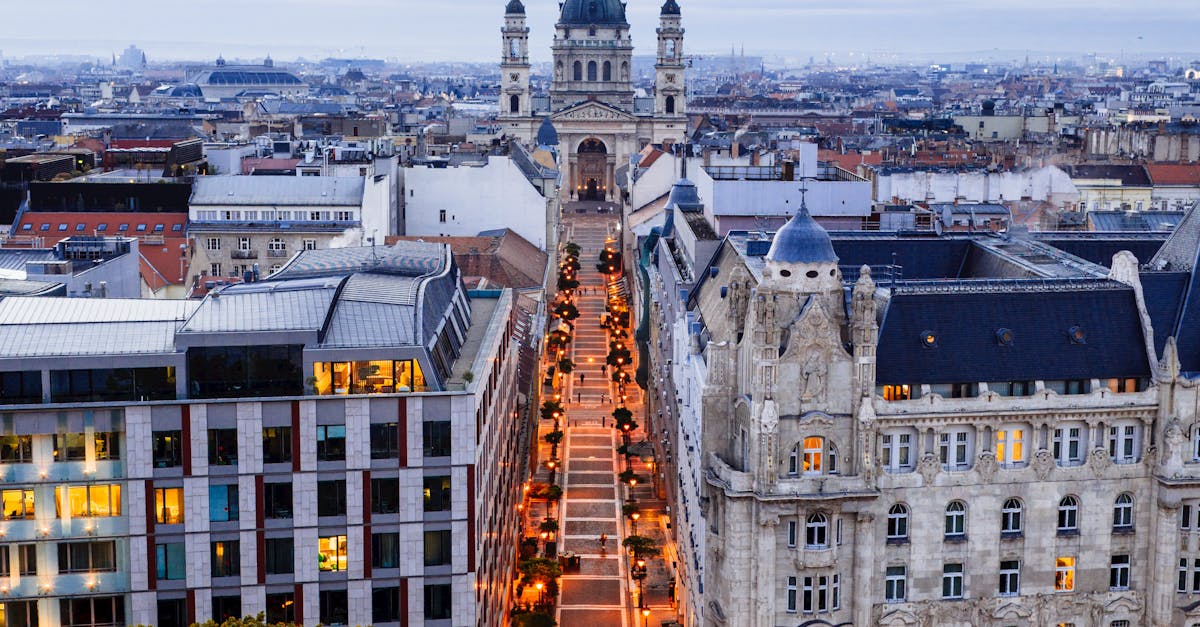
The Opera House sits directly on Andrássy Avenue, with the M1 metro’s Opera station opening right outside — this is the same 1896 line that runs the length of the avenue up to Heroes’ Square. If you’re coming from the Heroes’ Square end, it’s one of the most rewarding stretches of the walk down Andrássy Avenue, since the Opera House is roughly two-thirds of the way along and gives you a reason to pause. Trams and buses run nearby too, but the M1 is the simplest approach for a first visit. See the Getting Around Budapest guide for fares if you haven’t bought a travelcard yet.
The Opera House also makes a natural anchor for a wider Andrássy Avenue afternoon. The Franz Liszt Academy of Music, a working conservatory with its own Art Nouveau concert hall, sits a short walk further up the avenue and hosts affordable student and faculty recitals worth checking if a full opera ticket doesn’t fit the schedule. In the other direction, the House of Terror museum occupies a former secret-police headquarters a few minutes’ walk down the same avenue — a considerably heavier stop, and one best not scheduled directly before an evening at the opera.
Practical tips
Photography without flash is generally permitted in the public areas (staircase, foyer) but restricted inside the auditorium during performances — the tour is the more relaxed option if photographing the room is a priority, and the staircase in particular is one of the better interior shots on Budapest’s list of photogenic interiors, gilded ceiling and all. Cloakrooms are free and, for performances, effectively compulsory for coats and large bags. There’s a small café inside serving coffee and a glass of something for the interval, though it gets busy fast in the fifteen-minute break, so decide in advance whether you’re queueing for it or just stretching your legs in the foyer instead. Latecomers to a performance are generally held until a suitable pause in the music, not seated mid-scene, so arrive with the standard opera-house margin of at least fifteen minutes before curtain.
Air conditioning was part of the 2022 upgrade, which matters more than it sounds in a Budapest summer — older accounts of the Opera House in July and August, when the building relied on its nineteenth-century ventilation, are no longer an accurate picture of what performances feel like. Toilets are available on multiple floors; the ones nearest the main foyer get the longest interval queues, so if you have a choice, the upper-floor facilities tend to move faster. Bag checks and a security scan are standard at the entrance for performances, arriving a little earlier than you think you need to is the safer bet, particularly on nights when a popular production has the foyer at capacity before the doors to the auditorium even open.
The honest verdict
If you only have time for one of the two — the tour or a performance — and you have any interest at all in classical music, book the performance. The tour is a good, efficient way to see the building in full light and hear the history, but a standing-room ticket for a fraction of the price gets you the building working, the chandelier lit, the orchestra playing, and an hour or two actually justifying why Franz Joseph’s compromise turned into one of the most beautiful theatres in Europe. If you’re short on time or opera genuinely isn’t your thing, the tour alone is still a worthwhile 45 minutes, and the mini-concert at the end makes it feel like more than a straight architecture walk. Either way, this is one of the rare Budapest attractions where the cheapest option and the best option aren’t far apart — a standing-room ticket and a mid-tier seat put you in the same room, hearing the same orchestra, for a price difference that barely registers next to what a comparable seat would cost in London, Paris or Vienna.
The M1 stop right outside is part of Budapest’s oldest metro line, still running carriages that trace back to 1896 — the full metro guide covers what makes this particular line worth riding for its own sake.
Frequently asked questions
How much does it cost to visit the Hungarian State Opera House?
A guided tour runs around 10,500 HUF (€26) in English or 5,800 HUF (€14.50) in Hungarian. Seeing an actual performance can cost less than the tour — cheap seats start around 6,000 HUF (€15), and standing-room tickets, when available, run roughly 900–1,500 HUF (€2–4).
Is it worth taking a guided tour if I’m already seeing a performance?
It depends on your schedule rather than your interest — the two experiences don’t overlap much. A performance ticket puts you in a dim auditorium facing the stage; the tour is the only way to see the grand staircase, foyer and auditorium in full light with a guide explaining the architecture and history. If you can only do one, most visitors with any interest in opera or ballet get more out of an actual performance.
What should I wear to the Budapest Opera House?
Smart-casual is the practical minimum for a performance; jeans and trainers will get you in but you’ll be underdressed against most of the audience. Jackets and more formal wear are common but not compulsory, except at opening nights and galas, where dressing up is the norm.
How do I get standing-room tickets?
Standing-room tickets are sold at the box office (not always online) roughly two hours before an evening performance, or about one hour before a matinee, and only when the house hasn’t already sold out in seats. Arrive at the box office in good time if you’re relying on this option, since availability isn’t guaranteed and can’t be booked ahead.
Is the Opera House wheelchair accessible?
Yes, substantially more so since the 2022 restoration, which added lifts and step-free routes that the original 1884 building lacked. Contact the box office ahead of a visit to confirm accessible seating for a specific performance, since not every seating category has step-free access.
How do I get to the Hungarian State Opera House?
Take the M1 metro to Opera station, which opens directly outside the building on Andrássy Avenue. It’s a stop directly between Deák Ferenc tér and Heroes’ Square, so it’s easy to combine with a walk along the avenue in either direction.
Do I need to book performance tickets in advance?
For popular productions and weekend dates in peak season (roughly April–June and the December holidays), yes — book as soon as your travel dates are fixed. Outside peak periods, or for mid- and lower-tier seats, tickets are often still available a day or two ahead through opera.hu.
What language are performances in?
Operas are generally performed in their original language — Italian, German, French or Hungarian depending on the work — with Hungarian and English surtitles displayed above the stage, so following the plot doesn’t require fluency in either.
Is the Opera House suitable for children?
Ballet tends to work better than opera for younger children, simply because there’s no language barrier and the visual spectacle carries more of the experience. Full-length performances run two to three hours including an interval, which is a long sit for a young child — the occasional shorter matinee or family-oriented production, when scheduled, is a gentler introduction than a standard evening programme.
Photo credits
The Hungarian State Opera House facade on Andrássy Avenue by Mike is Michi, CC BY-SA 4.0, via Wikimedia Commons.
Composer statues of Monteverdi and Scarlatti on the Opera House facade by Globetrotter19, CC BY-SA 4.0, via Wikimedia Commons.