Budapest Airport (BUD): Terminals, Lounges, Food and Departures
Terminal 1 has been closed since 2012, yet it still confuses visitors. What's actually at Budapest Airport today — 2A, 2B, the Skycourt, lounges, security timing and left luggage.
In this guide
- Terminal 1 is closed — stop looking for it
- 2A vs 2B: which one is your flight?
- Which airlines use which terminal
- Baggage claim and connections
- The Skycourt
- Lounges
- Food and shopping
- Where to stay near the airport
- Security and arrival timing
- Left luggage
- SIM cards and staying connected
- Parking and car rental
- Accessibility
- Getting into the city
- Practical tips
- The honest verdict
- Frequently asked questions
- Photo credits
This article contains advertising. Our booking links are routed through a partner that adds commission tracking automatically, so if you book through one we earn a commission from the provider, at no extra cost to you. It never affects what we recommend. Affiliate disclosure
Terminal 1 shows up in more online forum threads than it has any right to — it closed in 2012, yet visitors still email hotels asking which terminal their budget airline uses, expecting an option that hasn’t existed for over a decade. Budapest Airport — officially Liszt Ferenc International Airport, IATA code BUD — now runs on two connected terminals, 2A and 2B, joined by a five-storey glass structure called the Skycourt that holds most of the shops, restaurants and lounges. Getting that basic layout right saves more confusion than almost anything else in this guide.
This covers the terminal layout, what’s actually in the Skycourt, lounge options, security and arrivals timing, left luggage, and SIM cards — everything about the building itself, rather than how to get into the city, which the dedicated airport transfer guide already covers in full. Prices and details were checked in September 2026.
Terminal 1 is closed — stop looking for it
This is worth stating plainly because outdated information about it still circulates: Terminal 1, a smaller building that once handled budget carriers, closed permanently in 2012 and has since been repurposed for cargo and other non-passenger use. Every commercial passenger flight into and out of Budapest today uses Terminal 2, split across two connected buildings, 2A and 2B. If an old blog post, a years-old forum thread, or an outdated map mentions Terminal 1 for passenger flights, ignore it.
The airport itself has gone by a few names, which adds to the confusion for anyone researching an older trip report. It operated for decades as Ferihegy Airport, named for the district it sits in, and was renamed Liszt Ferenc International Airport in 2011 to honour the composer Franz Liszt — Hungarians write his name surname-first, hence “Liszt Ferenc” on signage and official documents even though English-language sources usually flip it back to “Franz Liszt.” The IATA code BUD and the airport’s physical location haven’t changed through any of this, so flight bookings and airline websites remain unaffected by the name history — it’s really only relevant if you’re cross-referencing an old guidebook or a pre-2011 travel account.
2A vs 2B: which one is your flight?
Terminal 2A handles Schengen-area flights — destinations within the EU’s passport-free zone, where you won’t clear a passport check at either end. Terminal 2B handles non-Schengen flights, including the UK, Ireland, and destinations outside Europe, where a passport check applies. Airlines are generally assigned to one terminal or the other based on their typical route mix, though a specific flight’s terminal depends on its actual destination rather than the airline alone — always confirm your terminal on your boarding pass or the airport’s live departures board rather than assuming based on a previous trip with the same carrier.
Both terminals sit on the same site, connected airside and via the Skycourt, and both have arrivals on their ground floor. If you’re dropping someone off or picking someone up, the terminal matters for where you park or wait; if you’re just passing through security to fly out, the practical difference is smaller, since check-in, security, shops and food are broadly mirrored between the two.
Which airlines use which terminal
As a rough guide, budget and low-cost carriers with heavy EU route networks — the kind of airlines running frequent short-hop flights to Western and Central Europe — cluster more often at 2A, while flights to the UK, and long-haul routes to the Middle East, Asia and North America, run through 2B for the passport check. This is a generalisation rather than a fixed rule, since an airline can operate from both terminals depending on the specific route, so always verify against your boarding pass rather than assuming based on the carrier alone. Wizz Air, Ryanair and easyJet between them cover a large share of the airport’s short-haul traffic, alongside national carriers serving direct routes from most major European capitals; full-service long-haul connections are comparatively limited, and many intercontinental itineraries route through a connecting hub such as Frankfurt, Istanbul, Doha or London rather than flying direct.
Baggage claim and connections
Baggage claim belts sit immediately past immigration (where applicable) on the ground floor of each terminal, clearly numbered and matched to your flight on the arrivals screens. If you’re connecting onward from an international flight to a domestic or further international leg, Budapest doesn’t operate a large enough network of connecting flights to warrant a dedicated transit terminal — most connections simply mean clearing security again for the next departure gate, so budget normal transfer time rather than expecting a streamlined transit-only path.
The Skycourt
The Skycourt is the five-storey glass link building between 2A and 2B, and it’s where the airport concentrates most of what makes an airport bearable: the bulk of the shops, the sit-down restaurants, the SkyCourt Lounge, and the tourist information and SIM card desks. Structurally it sits before the security split between the two terminals for some services and after it for others, so it’s worth checking whether a specific shop or restaurant you want is landside (before security, accessible to anyone) or airside (after security, ticketed passengers only) before planning around it — the airport’s own terminal maps, available on screens throughout and on bud.hu, mark this clearly.
Lounges
The SkyCourt Lounge, on the Skycourt’s mezzanine level, is the largest and most central lounge option, positioned before the Schengen/non-Schengen split so it’s usable regardless of which terminal your flight departs from. Walk-in pricing runs around 15,600 HUF (€39) for roughly two hours, and it accepts Priority Pass and DragonPass memberships, which is the cheaper route in if you already hold one through a credit card or airline status. Inside: comfortable seating, workspaces, charging points, free wifi, flight information screens, and food service that shifts through the day — breakfast in the morning, hot dishes from around midday into the afternoon, drinks available throughout. Typical opening hours run roughly 04:30 to 21:00, covering the airport’s early-departure traffic. Additional Plaza Premium and Platinum-branded lounges operate within 2A and 2B individually at broadly similar walk-in pricing, useful if your gate is well past security and doubling back to the Skycourt isn’t appealing. None of the lounges require a specific airline or alliance affiliation to buy walk-in access, which is a meaningfully more open model than some larger European hubs where certain lounges are restricted to a single carrier’s premium-cabin passengers — at Budapest, if you’re willing to pay, you’re generally welcome.
Whether a lounge is worth it comes down to layover length and how much a quiet seat and free food matter to you — for a flight with more than 90 minutes of dead time after security, most travellers find the walk-in price reasonable; for a quick 30-minute buffer, it’s rarely worth the queue to get in and settled.
Food and shopping
Food options split fairly evenly between quick-service chains — coffee, sandwiches, a few familiar international fast-food names — and a handful of sit-down restaurants in the Skycourt serving Hungarian dishes alongside more generic international menus, aimed squarely at travellers wanting one real meal before a flight rather than culinary exploration. Prices run noticeably above what the same dish costs in central Budapest, which is standard for any major airport and not worth resenting too much given the captive setting. Duty-free and general retail cluster in the Skycourt and airside in both terminals, with the usual mix of spirits, perfume, Hungarian specialty foods (paprika, tokaji wine, chocolate) that make reasonable last-minute gifts, and standard electronics and travel-accessory shops.
If you’re catching an early flight and haven’t eaten, a handful of coffee and pastry counters open before the sit-down restaurants do, generally from around 04:00–05:00 to cover the airport’s earliest departures — useful to know if you’ve cleared security for a 06:00 flight and want more than a vending machine. Landside, before security, a smaller selection of cafés serves anyone waiting to meet an arriving passenger, though pricing and choice there are more limited than airside.
Where to stay near the airport
A short list of airport hotels operates within a few minutes of the terminals by shuttle, aimed at early departures, late arrivals, or long layovers rather than a proper stay in Budapest — comfortable, functional, and priced at a premium for the convenience, but with none of the character or restaurant access of a stay in the city itself. Unless your flight timing genuinely requires it, staying in central Budapest and using the transfer options covered in the dedicated transfer guide is almost always the better choice for anything longer than an overnight layover, given how straightforward the 100E bus and taxi options are.
Security and arrival timing
Security wait times at Budapest Airport typically run 10 to 30 minutes under normal conditions and can move faster during quieter midday windows. Peak periods — early morning departures, late afternoon, weekends, and school-holiday travel weeks — can push waits beyond 40 minutes, particularly when several flights are scheduled close together. Fast-track lanes exist for business-class passengers and travellers with qualifying frequent-flyer status, cutting significantly into that wait when available, and a paid fast-track pass is also purchasable in advance for anyone without either, worth considering on a tight connection or a busy early-morning departure. As a general rule, arrive at the airport two hours before a Schengen flight and closer to three hours before a long-haul or non-Schengen departure during peak periods, and lean toward the longer end of that range if you’re travelling in July, August, or around the December holidays.
Check-in desks typically open two to three hours before departure and close somewhere between 40 and 60 minutes before, depending on the airline — low-cost carriers in particular tend to enforce closing times strictly, with no flexibility for late arrivals, so treat the posted closing time as a hard deadline rather than a guideline. Online check-in and bag-drop-only counters, where available, meaningfully cut the time spent in the terminal before security and are worth using whenever an airline offers them, since the physical check-in queue is often the least predictable part of the whole pre-security process.
For arriving passengers, clearing the airport — disembarking, walking to immigration if applicable, and collecting checked luggage — typically takes around 20 minutes off-peak, longer if several wide-body or long-haul flights land in the same window. Bus and taxi options from the arrivals level are covered in full, with current pricing, in the airport transfer guide — the short version is that the 100E express bus and standard city taxis both operate from clearly marked stands directly outside arrivals at both terminals, and neither requires advance booking to use on arrival.
Left luggage
A staffed left-luggage desk operates on the departures level of Terminal 2B, run by a dedicated baggage-storage operator, open daily from roughly 06:00 to 22:00. Pricing starts around 2,750 HUF (€7) per item for up to 4 hours and roughly 5,500 HUF (€14) for up to 24 hours, useful for a long layover, a late checkout with hours to kill before a flight, or a same-day trip where carrying luggage around the city isn’t appealing. There’s no left-luggage service in Terminal 2A itself, so factor in the walk between terminals if you’re departing from 2A but need to drop a bag first.


SIM cards and staying connected
Free, unlimited wifi covers the whole terminal, landside and airside, with no time limit or registration hurdles beyond accepting the network’s terms — a genuinely traveller-friendly policy compared with airports that cap free wifi at 30 or 60 minutes. If you need a local number rather than just wifi, Hungarian mobile operators run prepaid-SIM desks in the arrivals hall at both terminals, selling tourist SIM packages with data bundles aimed squarely at short-stay visitors; prices and data allowances change regularly enough that comparing the two or three desks on the spot, rather than pre-researching, tends to get the better deal. An eSIM bought in advance through any of the widely available international eSIM apps is worth considering too, since it activates the moment you land without needing to queue at a desk at all, and pricing is often competitive with the airport’s own offers for a short trip. The dedicated SIM card guide compares the local operators’ tourist packages against eSIM options in more detail than fits here.
Parking and car rental
Short-stay parking sits directly outside both terminals for drop-offs and pickups, priced steeply by the hour to discourage long waits — a quick kerbside stop is fine, but leaving a car there for more than a few minutes gets expensive fast. Longer-stay car parks sit a short walk or shuttle-bus ride further out, at a considerably better daily rate, and pre-booking online ahead of arrival is consistently cheaper than paying the walk-up rate at the barrier. Car rental desks for the major international agencies cluster on the arrivals level of both terminals, worth considering if a day trip beyond the city — to Lake Balaton or across the border — is part of your plans, though for a trip confined to Budapest itself a car is more liability than asset given the city’s parking and one-way streets.
Accessibility
Budapest Airport provides assistance for passengers with reduced mobility, including wheelchair transfer between check-in and the gate, priority boarding coordination with airlines, and accessible routes throughout both terminals and the Skycourt — request assistance through your airline at booking or at least 48 hours ahead of travel for the smoothest experience, since arranging it on the day is possible but less reliable. Accessible toilets, lifts and ramped routes are standard throughout the terminal buildings, and both terminals have accessible parking close to the entrances. If you’re travelling on to the city centre and need step-free transport, note that the 100E express bus is low-floor and wheelchair-accessible, while not every standard city taxi carries wheelchair-accessible vehicles as standard — worth requesting specifically when booking a transfer.
Getting into the city
This guide deliberately doesn’t duplicate transfer pricing and route detail that’s covered properly elsewhere — the airport transfer guide has the full breakdown of the 100E and 200E express buses, standard taxi fares, private transfers and shuttle options, with current pricing. In short: the 100E express bus runs from stands outside arrivals to Kálvin tér, Astoria and Deák Ferenc tér in the city centre, the cheaper 200E runs to the M3 metro at Kőbánya-Kispest, taxi ranks operate at both terminals under the same city-wide regulated tariff, and neither requires more than a short wait to find. For fares, journey times and which option suits your specific situation, that guide is the one to read.
Practical tips
Currency exchange desks operate in both terminals, though rates are consistently worse than ATMs or city-centre exchange offices — withdraw cash from an airport ATM if you need forints immediately, or wait until you’re in the city if you can — the currency guide covers exchange rates and where to get a fair deal in more depth. If you do need to exchange cash at the airport, compare the posted rate against a currency-conversion app before committing, since airport bureaux rely on travellers not checking and the difference versus a city-centre exchange can be significant. Charging points are plentiful throughout both terminals and the Skycourt, at gates and in seating areas, so a dead phone battery on arrival is rarely a real problem. If you’re connecting between 2A and 2B airside, allow a bit more walking time than the map suggests — the terminals are genuinely a few minutes’ walk apart even once you’re through security, longer if mobility is a factor.
Travelling with young children, a couple of things are worth knowing in advance: baby-changing facilities are available in the washrooms of both terminals, and a small play area for children operates in the Skycourt during peak travel periods, though it isn’t staffed and shouldn’t be treated as supervised childcare. Pet relief areas exist for travellers flying with animals, marked on the terminal maps and generally located close to the terminal entrances rather than airside. Traveling with an infant, a small selection of family-friendly check-in and security lanes are typically signposted separately from the main queues at busier times, worth asking about at the entrance to security if you don’t see one immediately.
If your flight is delayed or cancelled, the airline — not the airport itself — is responsible for rebooking, meals and, where EU rules apply, compensation, so head to your airline’s check-in desk or service counter rather than a general airport information point for anything beyond basic flight-status questions. EU261 passenger-rights rules apply to flights departing from Budapest regardless of the airline’s home country, and to flights arriving into Budapest on an EU-based carrier, which covers a meaningful share of disruption scenarios travellers encounter here — worth knowing before accepting a first offer from an airline desk if a flight is delayed for hours or cancelled outright. Keep boarding passes and any receipts for meals or incidental expenses purchased during a long delay; airlines typically ask for these before processing a reimbursement claim, and it’s much easier to hand them over on the spot than to reconstruct a paper trail weeks later from memory.
The honest verdict
Budapest Airport is a mid-sized, well-organised airport that rewards a little advance knowledge more than most — knowing your terminal, roughly how long security will take at your departure time, and where left luggage actually is (2B only) saves real friction that catches out visitors relying on outdated information about a Terminal 1 that no longer exists. It’s not a destination airport with headline attractions of its own, and there’s no reason to arrive earlier than the timing guidance above just to explore it. Spend the time you save instead in the city itself, and treat this guide as reference material for the one or two hours you’ll actually spend inside the building on either end of your trip. For everything else about arriving in and settling into the city — currency, SIM cards, first impressions, general orientation — the wider Budapest travel tips guide is the natural next stop once you’ve cleared the terminal.
Frequently asked questions
Does Budapest Airport still use Terminal 1?
No — Terminal 1 closed permanently in 2012 and is no longer used for passenger flights. All commercial flights use Terminal 2, split between 2A (Schengen) and 2B (non-Schengen), connected by the Skycourt.
How early should I arrive at Budapest Airport?
Two hours before a Schengen flight is generally enough outside peak periods; allow closer to three hours for long-haul or non-Schengen departures, and lean toward the longer end during July, August and the December holidays, when security queues run longest.
Is there a lounge at Budapest Airport?
Yes — the SkyCourt Lounge in the Skycourt building is the largest and most central, with walk-in pricing around 15,600 HUF (€39) and Priority Pass/DragonPass access. Smaller Plaza Premium and Platinum lounges operate within each terminal individually.
Where can I store luggage at Budapest Airport?
A staffed left-luggage desk operates on the departures level of Terminal 2B only, open roughly 06:00–22:00, from about 2,750 HUF for up to 4 hours. There’s no equivalent service in Terminal 2A.
Is wifi free at Budapest Airport?
Yes, unlimited and free throughout both terminals and the Skycourt, with no time cap. Prepaid local SIM cards are also available from desks in both arrivals halls if you need a Hungarian number rather than just wifi.
Which terminal is my flight in — 2A or 2B?
It depends on the destination rather than the airline: 2A generally handles Schengen-area flights (no passport check), and 2B handles non-Schengen flights, including the UK and long-haul destinations. Check your boarding pass or the live departures board rather than assuming, since a single airline can use both terminals depending on the route.
Can I walk between Terminal 2A and 2B?
Yes, both landside via the Skycourt and, for connecting passengers, airside as well — but budget a genuine few minutes on foot rather than expecting it to be instant, and more if you’re moving with heavy luggage or limited mobility.
What happened to Budapest’s old Terminal 1?
It closed to passenger traffic in 2012 and has since been used for cargo and other non-passenger purposes. If you’re researching a trip based on an older guidebook or blog post that mentions it, that information is out of date — all passenger flights now use Terminal 2.
Photo credits
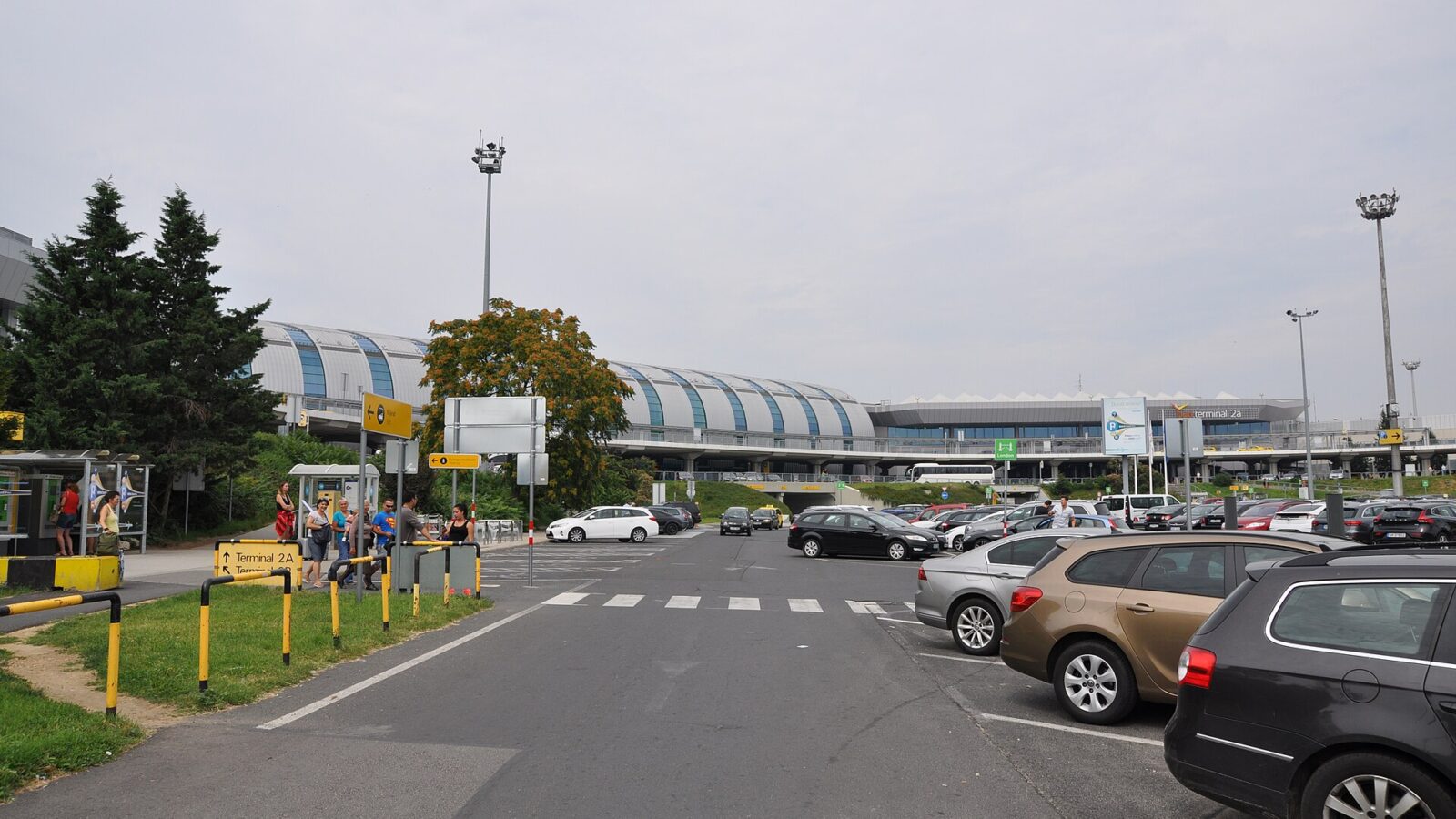
Terminal 2A’s entrance at Budapest Airport, with the Skycourt’s curved roof behind it by Christo, CC BY-SA 4.0, via Wikimedia Commons.
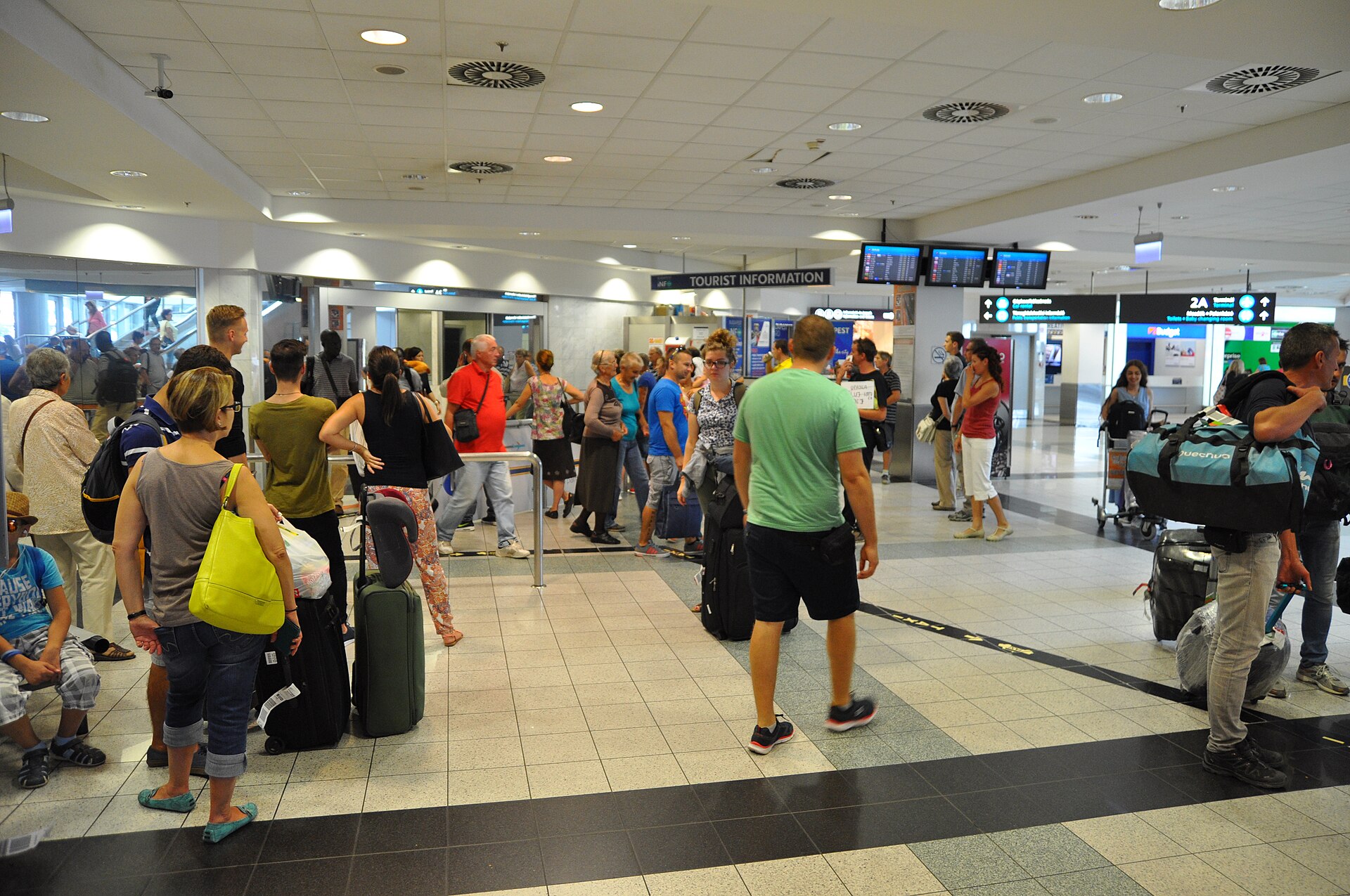
The arrivals hall at Budapest Airport, with Tourist Information and Terminal 2A signage by Christo, CC BY-SA 4.0, via Wikimedia Commons.
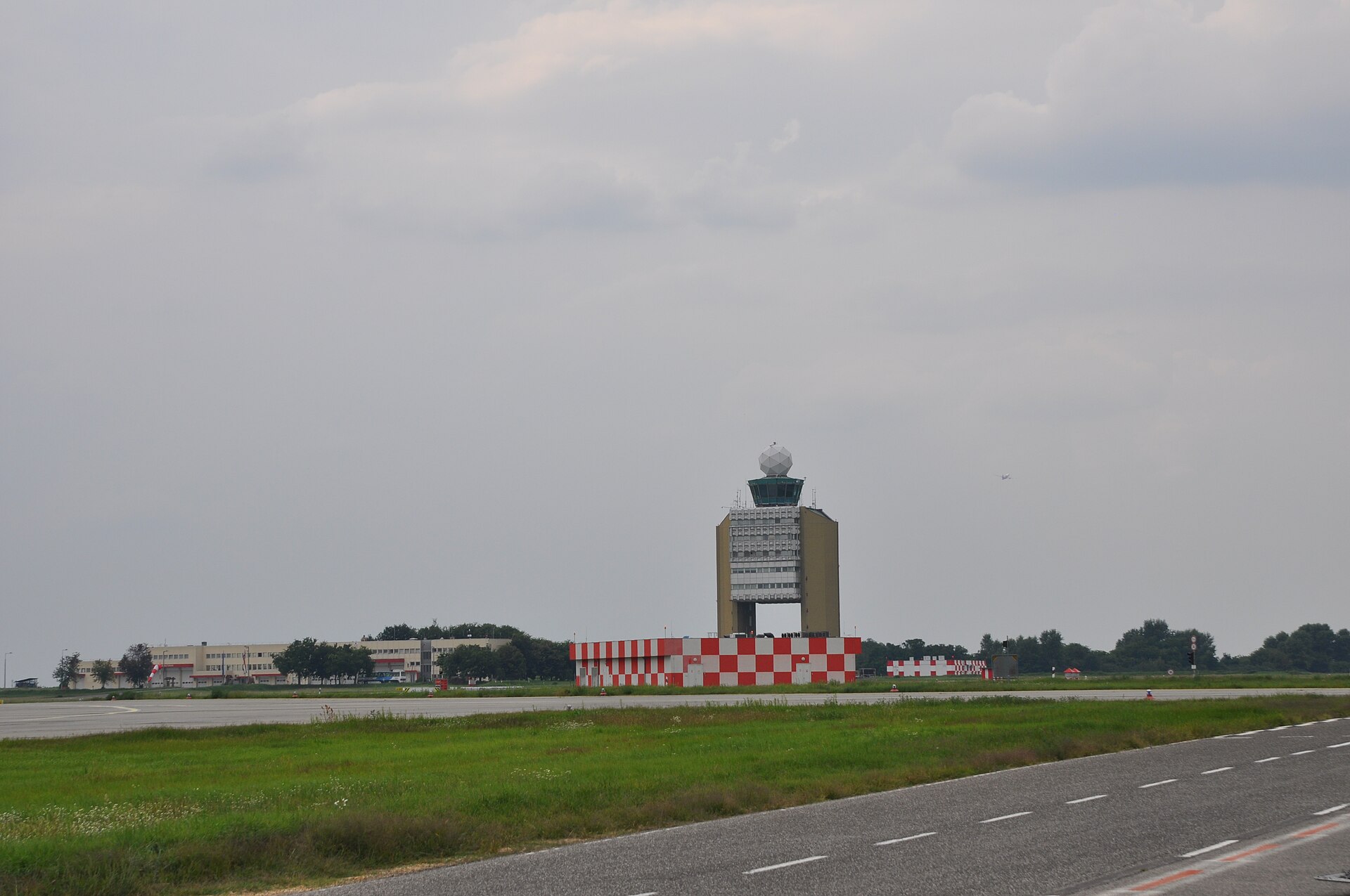
Budapest Airport’s control tower, seen from the runway by Christo, CC BY-SA 4.0, via Wikimedia Commons.