Budapest Airport Transfer: Best Transport Options Compared (2026)
Every Budapest airport transfer option compared for 2026 — the 100E Airport Express, metro, official Fotaxi, Bolt and private shuttles, by price, time and who each suits.

In this guide
- Your options at a glance
- Bus 100E Airport Express — the sweet spot
- Bus 200E plus metro — the cheapest route
- Official taxi (Főtaxi)
- Bolt and ride-hailing
- Private transfers and the miniBUD shuttle
- Which should you choose?
- Tickets, cash and how to pay
- Getting back to the airport
- Avoiding the common mistakes
- Timing your arrival around traffic
- Travelling with family or heavy luggage
- Arriving late at night
- Is it worth pre-booking?
- Frequently asked questions
This article contains advertising. Our booking links are routed through a partner that adds commission tracking automatically, so if you book through one we earn a commission from the provider, at no extra cost to you. It never affects what we recommend. Affiliate disclosure
Landing in Budapest is refreshingly painless. Ferenc Liszt International (airport code BUD) sits only about 16 kilometres southeast of the centre, and there’s a single, modern Terminal 2 to find your way out of — none of the cross-city sprawl you get at some European capitals. The catch is that the choice of how to get into town ranges from a dirt-cheap public bus to a private car waiting with your name on a sign, and the right pick depends on your budget, your luggage and what time you touch down.
I’ve taken just about every route over the years, in daylight and at 2am, with a backpack and with a heavy suitcase. This guide lays out each Budapest airport transfer option honestly — what it costs in 2026, how long it takes, and who it actually suits — so you can decide before you land rather than getting talked into an overpriced cab at the exit. For the wider picture on organising your visit, see my full Budapest travel guide.
Your options at a glance
| Option | Time to centre | Cost (2026) | Best for |
|---|---|---|---|
| Bus 100E Airport Express | ~45 min | 2,500 HUF (€6.25) | Most travellers, light luggage |
| Bus 200E + M3 metro | ~50–60 min | 500 HUF single ticket | Tightest budgets |
| Official taxi (Főtaxi) | ~30–40 min | €34–40 | Groups, late arrivals, comfort |
| Bolt (ride-hailing) | ~30–40 min | Same regulated tariff as a taxi | App users; estimate before booking, card payment in the app |
| miniBUD shared shuttle | ~40–60 min | from ~2,490 HUF pp | Door-to-door on a budget |
| Private transfer | ~30 min | €30–45 | Stress-free, name-board pickup |
Bus 100E Airport Express — the sweet spot
For most visitors, the 100E is the answer. This dedicated express runs 24/7 between the terminal and Deák Ferenc tér in the heart of the city, with only a couple of stops (Kálvin tér and Astoria) along the way, and takes around 45 minutes in normal traffic. Buses leave every 10–15 minutes by day and roughly every half hour overnight. At 2,500 HUF it’s brilliant value for a direct ride into the centre.
One crucial thing to know: the 100E needs its own special airport ticket. Your regular single ticket, travelcard or 24-hour pass does not cover it, and inspectors do check. Buy the 100E ticket from the machines or the BKK desk at the airport, or in the BudapestGO app, before you board. From Deák tér you’re connected to all three metro lines for the final hop to your accommodation.
Bus 200E plus metro — the cheapest route
If you’re counting every forint, the local bus 200E paired with the M3 metro is as cheap as it gets. The 200E runs from the terminal to the Kőbánya-Kispest metro station, where you change onto the M3 line into the centre. The whole journey is covered by a standard 500 HUF single ticket (you’ll technically want the transfer covered, so a short-period pass or a couple of tickets is simplest), and it takes 50–60 minutes. It’s slower and involves lugging your bags through a metro change, but it’s a fraction of the price of the express. I cover the city’s tickets and passes in detail in my Budapest public transport guide.
Official taxi (Főtaxi)
Főtaxi is the airport’s official taxi partner, with a marshalled rank right outside arrivals. Expect roughly €34–40 (about 13,500–16,000 HUF, including the 800 HUF airport surcharge) to a central address, depending on traffic and exactly where you’re headed. It’s quick, comfortable and a sensible choice if you’re in a group, arriving late, or simply don’t fancy public transport after a long flight. Always use the official Főtaxi desk or rank — never accept a ride from a driver who approaches you inside the terminal.
Bolt and ride-hailing
Budapest is well served by the Bolt app, which uses licensed taxis on the same regulated tariff as the official rank, so it isn’t cheaper, but it shows an estimate before you book and lets you pay by card without any cash-or-language fuss. Expect much the same fare as a taxi from the rank. There’s a designated ride-hailing pickup point at the airport — follow the signage rather than meeting your driver at the kerb out front. You’ll need the app installed and a working data connection, so sort a SIM or eSIM before you travel if you’re relying on it.
Private transfers and the miniBUD shuttle
If you want zero friction, a pre-booked private transfer puts a driver at arrivals holding a sign and drives you straight to the door for around €30–45 — worth it for families, early flights or anyone who values certainty. The airport’s official shared-shuttle operator, miniBUD, is the budget version of the same idea: you share a minibus with other passengers heading roughly your way, door-to-door, from about 2,490 HUF per person. Shuttles make the most sense for groups or when you’ve got heavy bags and a late arrival.
Which should you choose?
My rough rule: solo or as a couple with carry-on bags, take the 100E — it’s cheap, frequent and drops you in the middle of everything. On the tightest of budgets, suffer the 200E and metro. Arriving as a group, late at night, or with a mountain of luggage, split a Főtaxi or Bolt, which can work out similar per person to the express anyway. And if you simply want to be looked after — a honeymoon, travelling with kids, an early start — book a private transfer in advance. Where you’re staying matters too; my guides to the best hotels in Budapest and the city’s hostels will tell you which district you’re aiming for.
Tickets, cash and how to pay
A little prep saves hassle. Download the BudapestGO app before you fly to buy bus and metro tickets (including the 100E) by card on your phone — it’s the easiest way and avoids machine queues. Card payment is widely accepted across the city, but having a small amount of forint for incidentals is wise, especially for shuttle tips or a market snack; I explain the money side in my Budapest currency guide. Validate paper tickets when you board, and keep them until you leave the system.
Getting back to the airport
The same options run in reverse, and the 100E is just as convenient outbound — catch it at Deák Ferenc tér, allowing a little extra time in case of traffic. For an early-morning flight when the metro hasn’t started, the 100E’s night service or a pre-booked taxi or transfer is your friend. As a rule, leave the centre about three hours before a short-haul departure to cover the ride, check-in and security comfortably. A few more arrival-and-departure pointers live in my Budapest travel tips.
Avoiding the common mistakes
Two traps catch first-timers. The first is the unofficial “taxi” tout who approaches you in the arrivals hall offering a ride — politely decline and walk to the official Főtaxi rank or the bus stop. The second is hopping on the 100E with a normal ticket; it won’t be valid, and a fine is a miserable way to start a holiday. Stick to the official channels, buy the right ticket, and the journey into Budapest is genuinely one of the smoother airport runs in Europe.
Timing your arrival around traffic
Budapest’s roads clog at predictable times, and it changes the maths. On a weekday between roughly 7–9am and 4–6pm, a taxi or Bolt that normally takes half an hour can crawl to 50 minutes or more, while the 100E bus — though not immune — at least uses bus lanes for part of the route. If you land in rush hour, the express bus can genuinely be as fast as a cab and a fraction of the price. Outside those windows, the car options pull comfortably ahead on speed.
Travelling with family or heavy luggage
The calculus shifts the moment you add children or a stack of suitcases. Wrangling big bags through a metro interchange on the 200E route is no fun, and even the 100E means a walk and a stand at busy times. For families, a pre-booked private transfer or a Főtaxi is usually worth the extra — door to door, with space for everyone and the cases, and no scramble for tickets with tired kids in tow. Per head, split between four, a taxi often isn’t much more than four express-bus fares.
Arriving late at night
Late landings are well covered. The 100E runs through the night, roughly every half hour, so even a midnight arrival has a cheap public option. That said, after a long flight many people happily pay for the certainty of a taxi or a transfer waiting outside — there’s no shame in it. If you do take the bus, just check the live departure time, as the overnight frequency is lower and a missed bus means a longer wait than in the daytime.
Is it worth pre-booking?
For the bus and metro, no — you simply buy a ticket on arrival or in the app. For a private transfer or shuttle, yes: book a day or two ahead to lock in the price and guarantee a driver, especially in peak season or for a group. Ride-hailing and the official taxi need no reservation, though having the Bolt app set up and a payment card loaded before you fly removes any on-the-spot friction. Whichever you choose, factoring the transfer into your wider Budapest budget keeps the first hour stress-free.
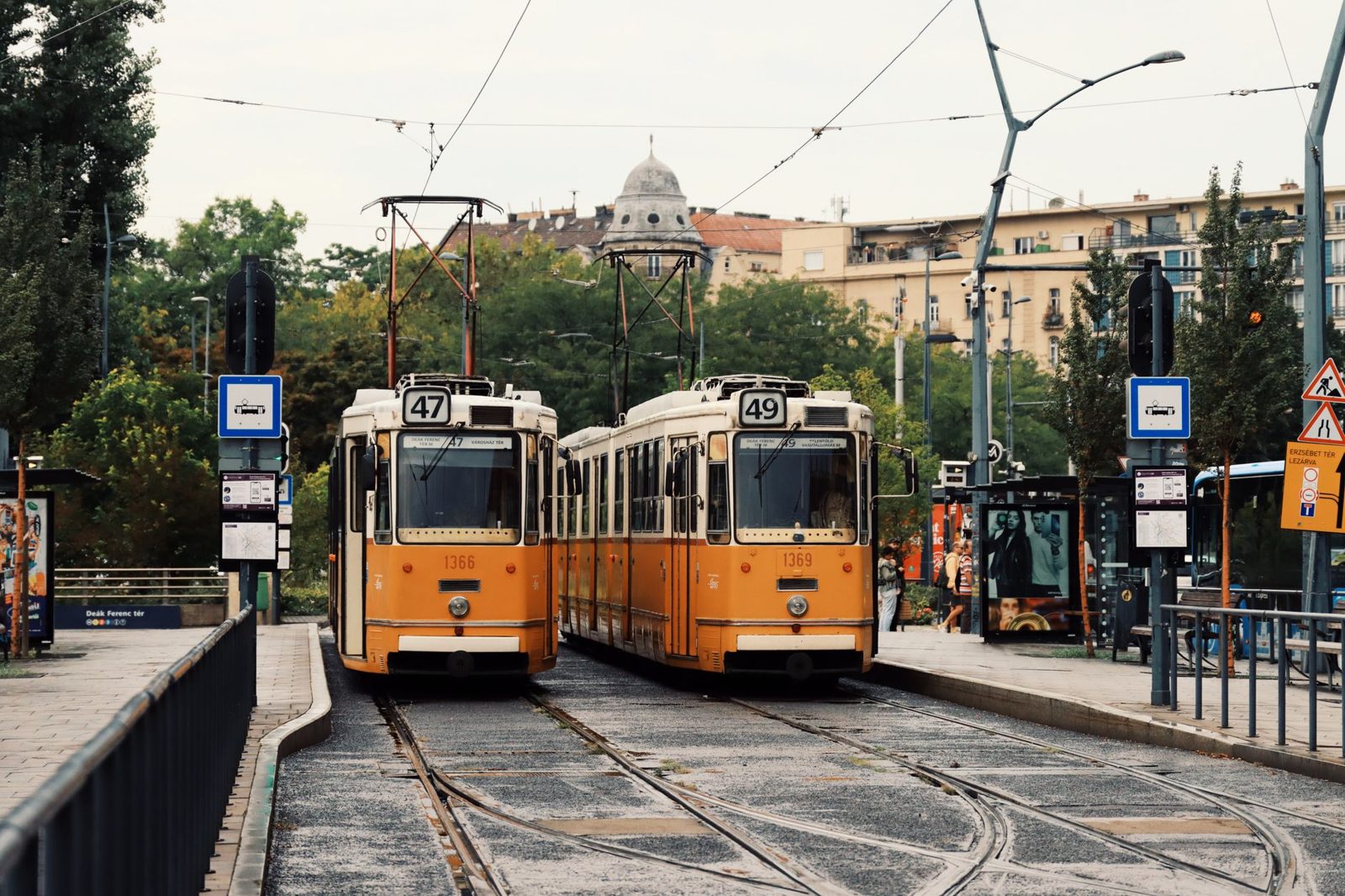
Once you are in town, the airport bus stops being the question and the tram network starts being it. Our getting around Budapest guide covers what to buy for the rest of the trip — and it is worth reading before you land, because the 100E ticket you use here is not valid on anything else.
For the terminal itself — 2A versus 2B, the Skycourt, lounges, security timing and left luggage — see the full Budapest Airport guide; this page stays focused on the ride into the city.
If a rental car is part of your onward plans rather than public transport into the city, the car rental guide covers which agencies operate at the airport, Hungary’s zero blood-alcohol rule, and the vignette system you’ll need before driving anywhere.
Taxi fares changed on 1 August 2026: the base fare rose to 1,300 Ft, and every airport trip now carries an 800 Ft surcharge in both directions. The full guide to Budapest taxis and Bolt works through what the airport run costs under the new tariff and how to avoid the touts in arrivals.
Frequently asked questions
What is the cheapest way from Budapest airport to the city?
The local bus 200E to Kőbánya-Kispest, then the M3 metro into the centre, covered by a standard 500 HUF ticket. It’s the cheapest option but the slowest, at 50–60 minutes with a change. The 100E Airport Express is far more convenient at 2,500 HUF.
How much is a taxi from Budapest airport?
An official Főtaxi to a central address costs roughly €34–40 (about 13,500–16,000 HUF, including the airport surcharge), depending on traffic and destination. Bolt uses licensed taxis on the same regulated tariff, so expect a similar fare. Always use the official rank and avoid drivers who approach you inside the terminal.
Does my travelcard work on the 100E airport bus?
No. The 100E Airport Express requires its own dedicated ticket, which a standard single, travelcard or 24-hour pass does not cover. Buy the 100E ticket at the airport or in the BudapestGO app before boarding, as inspectors do check.
How long does the airport transfer to central Budapest take?
The 100E bus takes about 45 minutes to Deák Ferenc tér; a taxi or Bolt is quicker at 30–40 minutes outside rush hour; and the 200E-plus-metro route takes 50–60 minutes. Allow extra during weekday traffic peaks.
Is there a train from Budapest airport to the city?
There’s no direct metro or rail link into the terminal in 2026. The 100E Airport Express bus is the fastest public option, connecting at Deák Ferenc tér to all three metro lines for onward travel across the city.
While you’re still at the airport, it’s the easiest place to sort data — see our Budapest SIM card and eSIM guide for which arrivals-hall kiosk is worth using and what to pay.
Last updated June 2026. Photos: Matthis Volquardsen (Pexels); Oliver Boese (Pexels); Richa W-Fryatt (Pexels); Efrem Efre (Pexels).