Central Market Hall Budapest: Best 2026 Visitor Guide
A 2026 visitor guide to the Central Market Hall in Budapest - opening hours, the three floors, what to buy, where to eat langos and how to get there.

In this guide
This article contains advertising. Our booking links are routed through a partner that adds commission tracking automatically, so if you book through one we earn a commission from the provider, at no extra cost to you. It never affects what we recommend. Affiliate disclosure
Walk in through the main doors off Fővám tér and the first thing that hits you is the smell — smoked paprika, frying dough, cured sausage and fresh bread all at once, under a vast iron-and-glass roof that looks more like a railway cathedral than a grocery shop. The Central Market Hall is the kind of place I tell every first-time visitor to hit early, before the rest of their day, because it’s equal parts food shop, history lesson and photo opportunity.
Hungarians call it the Nagyvásárcsarnok — the Great Market Hall — and it has been feeding the city since 1897. It’s unashamedly on the tourist trail now, especially upstairs, but that doesn’t make it a trap. Know where the locals shop, when to come and what’s actually worth buying, and it remains one of the most rewarding hours in Budapest. Here’s how to do it properly.
A cathedral built for cabbages
The hall was designed by architect Samu Pecz and opened in 1897 as the flagship of a network of covered markets meant to modernise how Budapest bought its food. The steel frame was cutting-edge for its day, and the steeply pitched roof is clad in colourful Zsolnay tiles — the same iconic Hungarian ceramics you’ll see on the Matthias Church. Bombed in the Second World War and left to decline under communism, it was beautifully restored in the 1990s and reopened in 1997, exactly a century after it first traded.
At roughly 10,000 square metres it’s the largest and oldest of the city’s indoor markets, and even if you buy nothing, the architecture alone justifies the visit. Stand at the back of the ground floor, look up the central nave toward the flags, and you’ll see why it’s one of the most photographed interiors in town.
How the three floors work
The market splits cleanly over three levels, and knowing the logic saves you wandering. The ground floor is the main event: rows of stalls selling fresh produce, strings of dried paprika and garlic, salami and sausage, cheese, bread, pickles, honey and — crucially — wine and Tokaji. This is where locals do their real shopping and where the prices are fairest.
The upper gallery is the tourist floor: souvenir stalls heavy with embroidery, lace, painted eggs and paprika in gift tins, plus a run of food counters. It’s pricier and busier, but it’s also where you’ll find the famous lángos. The basement is the workmanlike level — fishmongers, more pickles in giant barrels, a couple of butchers, an Asian grocer and a small supermarket — handy, atmospheric and almost entirely tourist-free.
What to buy
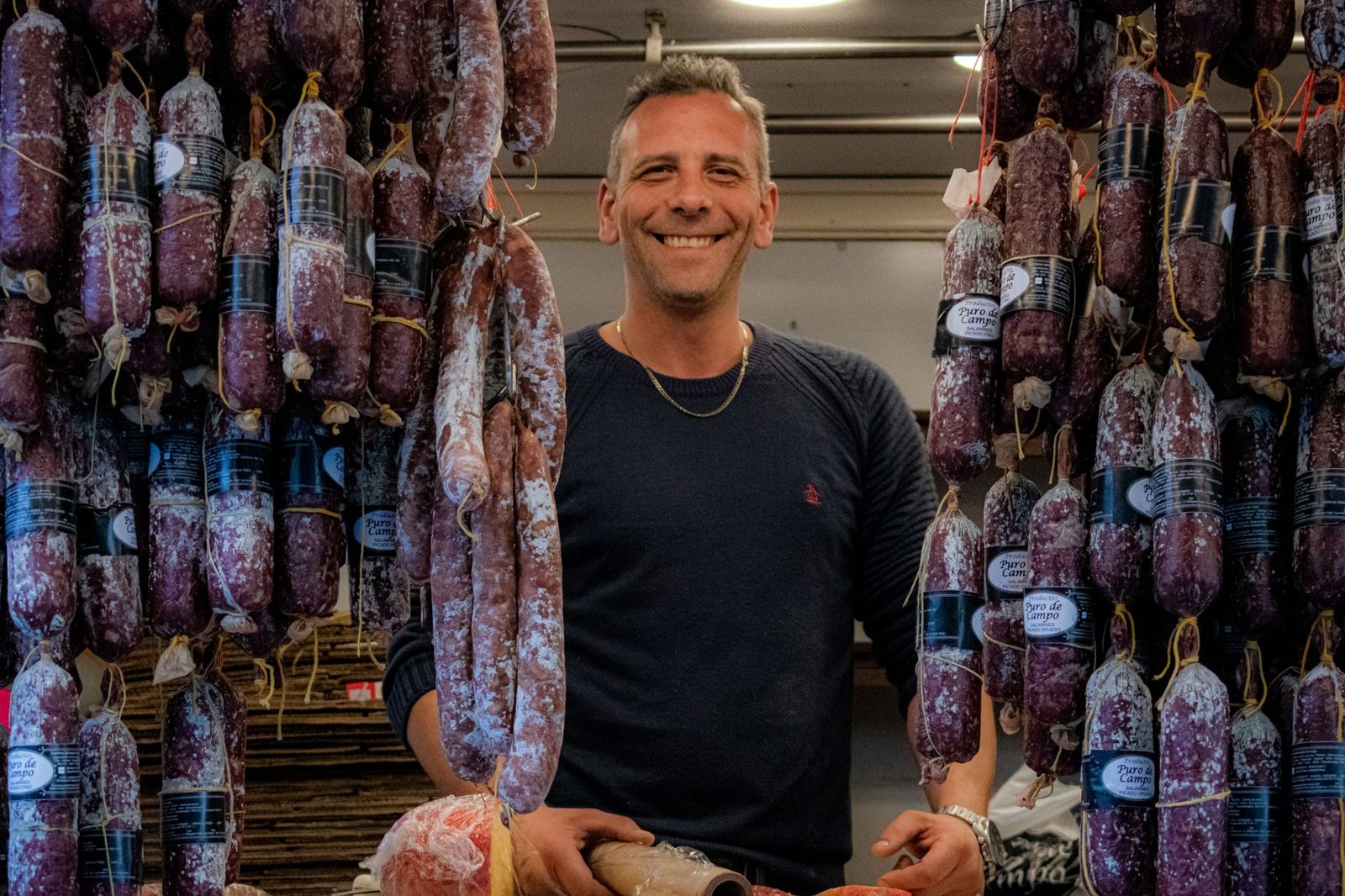
This is one of the best single spots in the city to stock up on edible souvenirs. Top of my list every time: a tin of quality paprika (look for Kalocsa or Szeged labelling), a stick of Pick winter salami, and a bottle or two of Tokaji Aszú. Mangalica products from Hungary’s curly-haired heritage pig — salami, ham, even crackling — make excellent gifts, as do jars of acacia honey and sour-cherry jam. For the full rundown of what’s worth your suitcase space, see our Budapest souvenirs guide.
A word on the upstairs souvenir stalls: the embroidery and lace can be lovely, but quality and price vary wildly, so compare a few before committing and check whether textiles are handmade. For wine, the ground-floor sellers will often let you taste, and several will vacuum-wrap bottles for your luggage. Our Hungarian wine guide helps you choose between the regions.
Eating at the market
Come hungry. The upstairs food counters are where most visitors get their first taste of lángos — a plate-sized disc of deep-fried dough, traditionally topped with sour cream and grated cheese (the garlic-rubbed version is the classic). It’s gloriously unhealthy and absolutely essential. You’ll also find kolbász (grilled sausage), stuffed cabbage, and goulash served in bread bowls.
For a proper sit-down meal, Fakanál, the self-service Hungarian canteen on the upper floor, ladles out hearty plates of paprikás, stews and schnitzel at fair prices, often with live folk music at lunchtime. It’s touristy, yes, but the food is honest and filling. To go deeper on the city’s food scene, our traditional Hungarian food guide and street food guide are good companions.
Opening hours
The market keeps proper market hours — early starts, and a firm close on Sundays that catches a lot of visitors out.
| Day | Opening hours |
|---|---|
| Monday | 6:00 – 17:00 |
| Tuesday – Friday | 6:00 – 18:00 |
| Saturday | 6:00 – 15:00 |
| Sunday | Closed |
It also closes on public holidays, so check the calendar if your trip falls near one. Individual stalls drift a little — some produce sellers wind down before the official close, especially on Saturday afternoons.
The best time to come
Aim for between 9:00 and 11:00. By then the stalls are fully stocked and the morning rush of locals has eased, but the tour groups that pile in around midday haven’t yet taken over the upper floor. Saturday mornings are wonderfully lively but busy; a weekday is calmer. Avoid the last hour before closing, when the fresh stalls start packing up and the choice thins out.
Getting there
The market sits at Fővám tér on the Pest side, right at the foot of the green Liberty Bridge — one of the prettiest of the city’s crossings, covered in our bridges guide. The M4 (green) metro stops directly outside at Fővám tér, and trams 47, 48 and 49 plus the scenic tram 2 along the river all stop nearby. It’s also an easy ten-minute stroll south from the bottom of Váci utca, so it slots neatly into a day of central sightseeing.
Practical tips
- Carry some cash. Many stalls now take cards, but smaller produce and craft sellers still prefer forints; there’s an ATM inside if you’re caught short.
- Mind your bag. Crowded tourist spots attract pickpockets — keep valuables zipped and in front of you, especially on the busy upper floor.
- Compare before you buy souvenirs. Upstairs prices vary stall to stall; a quick lap saves you money.
- Buy perishables last. Salami and hard cheese travel; pick them up on your way out rather than carrying them around all day.
- Bring a tote. Plastic bags cost extra and a reusable bag makes carrying wine and jars far easier.

Make a morning of it
The market’s location makes it a natural anchor for a half-day. Cross the Liberty Bridge straight out the back and you can ride the funicular-free path up toward Gellért Hill and the newly reopened Citadella, which since spring 2026 is once again a free public park with the best panorama in the city. The bridge itself is a green Art Nouveau beauty, and on summer weekends a stretch of it sometimes closes to traffic for picnics. North of the hall, the pedestrianised end of Váci utca leads you back into the centre past cafés and shops. Pair an early market visit with lunch upstairs and an afternoon climb and you’ve built a proper Pest-and-Buda day without ever needing a taxi.
A few things first-timers miss
Two small tips from repeat visits. First, the basement is where the bargains and the atmosphere hide — most tourists never go down, so you get the pickled-vegetable barrels and the fishmongers almost to yourself. Second, if you want that classic shot of the central nave with the flags and the tiled roof, head to the back of the ground floor and shoot back toward the entrance; the light through the end window in the morning is gorgeous, and there’s a viewing balcony upstairs for a wider angle.
Is it too touristy to bother?
It’s a fair question, and the honest answer is: the upstairs is touristy, the downstairs is not. If you only browse the souvenir gallery you might leave thinking it’s a tourist circus. But drop to the ground floor and basement, watch pensioners haggling over paprika and butchers breaking down Mangalica, and you’re seeing the real, working heart of how Budapest eats. Treat it as a living market with a tourist balcony rather than the other way round, and it’s genuinely worth your time. For more markets across the city, including the food halls and flea markets, see our complete markets guide and the dedicated Budapest shopping guide.
Should you take a guided food tour?
If you want the market decoded by someone who knows it, the hall is the starting point for many of the city’s food tours — a guide walks you between trusted stalls for tastings of salami, cheese, paprika, pálinka and pastries, explaining what to look for and steering you away from the tourist mark-ups. For a first-timer keen to understand Hungarian food fast, it’s money well spent, and most tours run a couple of hours before depositing you back at the bridge. If you’d rather explore solo, simply graze your way around the ground floor — many sellers are happy to offer a sliver of salami or a sip of wine before you commit.
Frequently asked questions
What are the Central Market Hall Budapest opening hours?
The market is open Monday 6:00–17:00, Tuesday to Friday 6:00–18:00, and Saturday 6:00–15:00. It is closed on Sundays and public holidays. The best time to visit is between 9:00 and 11:00, when stalls are stocked but the midday tour groups haven’t arrived.
Is the Central Market Hall worth visiting?
Yes. The 1897 building alone — with its iron framework and Zsolnay-tiled roof — is a sight in itself, and the ground floor and basement remain a genuine working market. The upper gallery is touristy and pricier, but the lángos and folk-craft stalls there are still fun.
What should I buy at the Central Market Hall?
The best buys are paprika (look for Kalocsa or Szeged labels), Pick winter salami, Mangalica pork products, Tokaji and other Hungarian wines, and jars of honey or sour-cherry jam. Upstairs you’ll also find embroidery, lace and paprika gift tins.
How do I get to the Central Market Hall in Budapest?
It’s at Fővám tér in District IX, at the Pest foot of Liberty Bridge. The M4 (green) metro stops right outside, and trams 47, 48, 49 and the riverside tram 2 stop nearby. It’s a ten-minute walk south from the end of Váci utca.
Can I eat at the Central Market Hall?
Absolutely. The upper-floor food counters serve lángos, grilled sausage and goulash, and the Fakanál canteen does sit-down Hungarian classics like paprikás and stews, often with live folk music at lunch. Come hungry and try the lángos with sour cream and cheese.
Does the Central Market Hall take credit cards?
Many stalls now accept cards, particularly the tourist-facing ones upstairs, but smaller produce and craft sellers often prefer cash. Carry some forints to be safe; there’s an ATM inside the building.
Last updated June 2026. Photos: Kostiantyn Klymovets (Pexels); maria daniela varela (Pexels); FOX ^.ᆽ.^= ∫ (Pexels); Incze Sándor Zoltán (Pexels).