Shoes on the Danube Bank: The Memorial Everyone Should Understand
Sixty pairs of iron shoes on the Pest embankment, with twenty-five words of explanation. What happened here, who made it, how to find it and how to visit it properly.
In this guide
- Practical details
- What happened here
- The memorial
- The plaque
- How to find it
- How to visit
- What to see alongside it
- With the Parliament
- With the Jewish Quarter
- The people who tried to stop it
- The memorial since 2005
- Why it is the most affecting thing in the city
- Accessibility
- Frequently asked questions
- Photo credits
This article contains advertising. Our booking links are routed through a partner that adds commission tracking automatically, so if you book through one we earn a commission from the provider, at no extra cost to you. It never affects what we recommend. Affiliate disclosure
People leave things in them. A tea light in the toe of a man’s work boot, a pebble balanced on a heel, a child’s drawing weighted down with a stone, a single rose laid across a pair of women’s shoes. Nobody organises this and nobody clears it away for long. The memorial known as shoes on the danube is sixty pairs of iron footwear bolted to a stone embankment, with no fence, no ticket and almost no explanation, and the small objects that accumulate along it are the only sign that thousands of people a day understand exactly what they are looking at.
This page covers what happened on this stretch of riverbank, who made the memorial and why it takes the form it does, how to find it, and how to visit it without being one of the people the regulars wince at. It costs nothing and it is open at every hour; the practical details below were checked in September 2026.
Practical details
| Detail | |
|---|---|
| Cost | Free |
| Opening hours | None — open embankment, accessible at all hours |
| Location | Pest embankment, between the Parliament and the Chain Bridge, below Széchenyi rakpart |
| Nearest metro | Kossuth Lajos tér (M2), about five minutes’ walk south |
| Nearest tram | Tram 2, Széchenyi István tér or Kossuth Lajos tér stops |
| Time to allow | 15–20 minutes |
| Created | Unveiled 16 April 2005 |
| By | Conceived by film director Can Togay, sculpted by Gyula Pauer |
| Accessibility | Level embankment, but reached by steps or a ramped section from the road above |
What happened here
In October 1944, with the Red Army approaching and Hungary’s regent trying to negotiate an exit from the war, the Germans installed the Arrow Cross Party in power in Budapest. The Arrow Cross was Hungary’s own fascist movement, and over the following three and a half months its militias conducted a campaign of murder against the city’s Jewish population that was chaotic, local and extraordinarily violent even by the standards of that winter.
Tens of thousands were force-marched west towards the Austrian border. Around seventy thousand were confined in a sealed ghetto around Dohány Street. And an unknown number — the estimates run into the thousands and the precise figure is not recoverable — were taken to the Danube embankment in groups, ordered to remove their shoes, and shot at the water’s edge so that the current would carry the bodies away.
The shoes were taken because leather had value. That is the whole of the reason. In a city where a pair of shoes could be sold or worn, the militiamen were not going to let them go into the river. It is a detail so small and so practical that it is more difficult to absorb than the killing itself, and it is the detail the memorial is built around.
Victims were frequently tied together in threes so that a single bullet through one person would drag the others in alive. Survivor testimony describing exactly this exists in the Hungarian Jewish archives and in the Yad Vashem collections. The killings continued until the Soviet siege closed on the city in January 1945.
None of that is written on the riverbank. You have to bring it with you, which is part of why this page exists.
The memorial
The work was conceived by the film director Can Togay and made by the sculptor Gyula Pauer, and it was unveiled on 16 April 2005 — Hungary’s Holocaust Memorial Day, marking the date in 1944 when the ghettoisation of Hungarian Jews began.
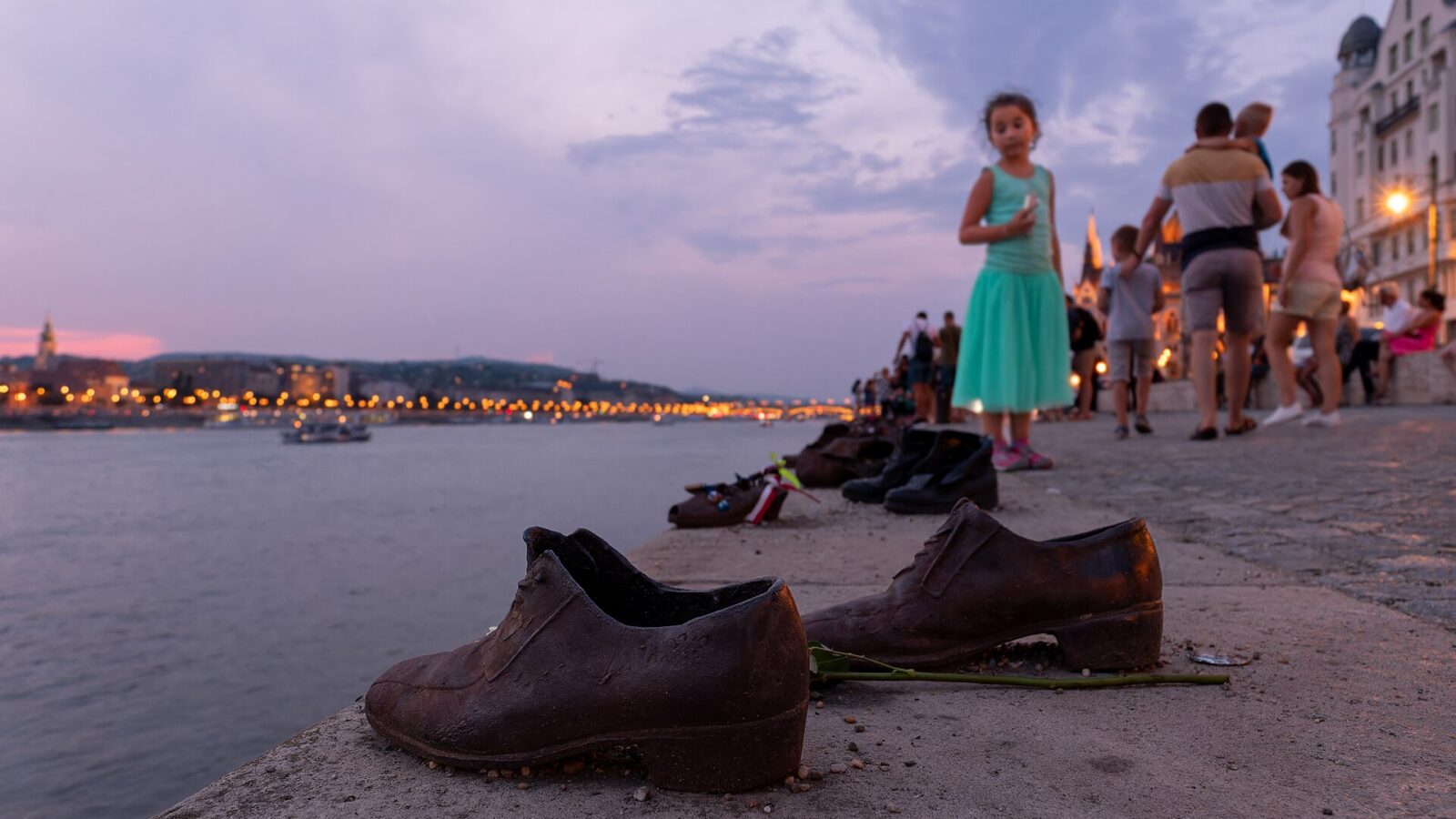
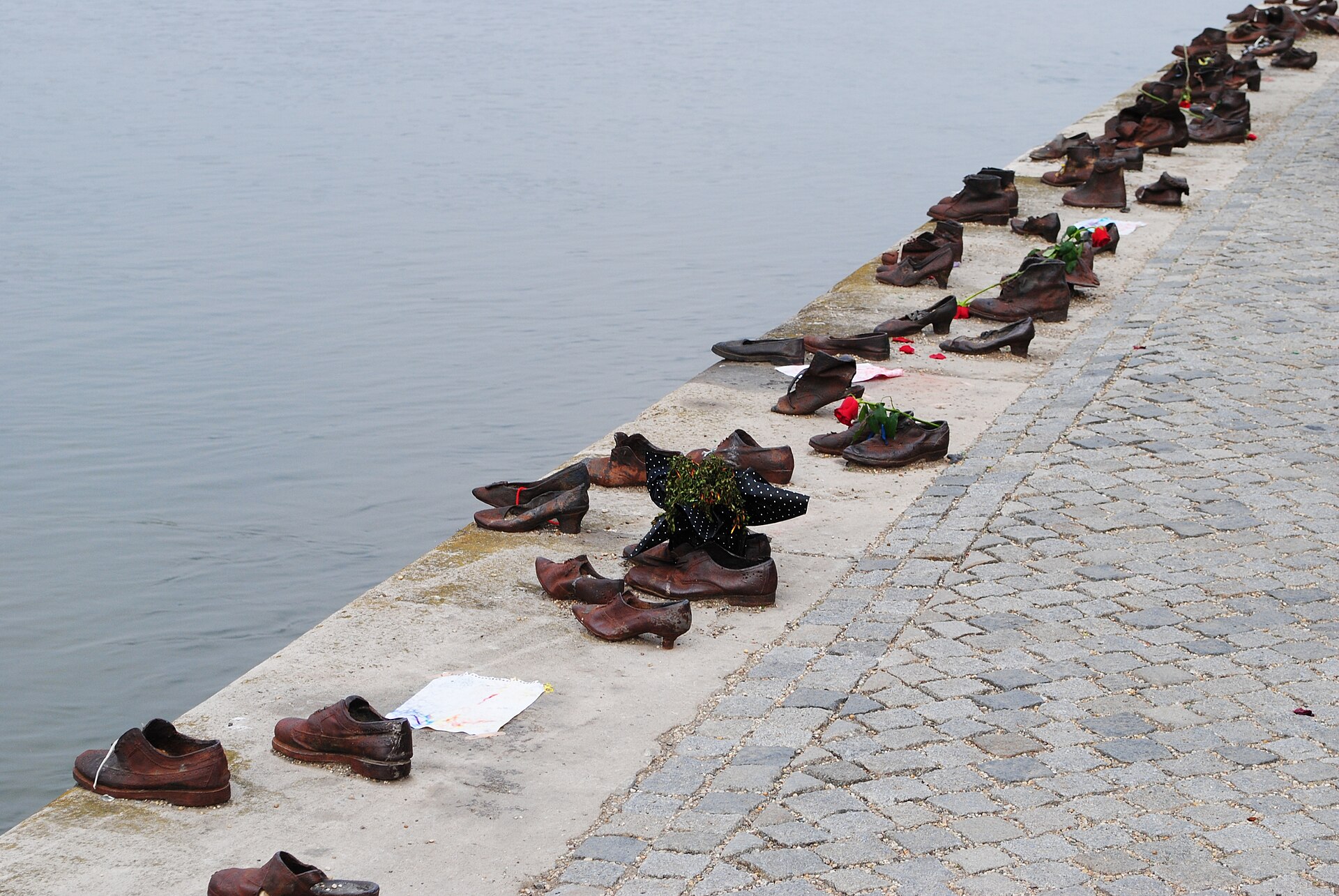
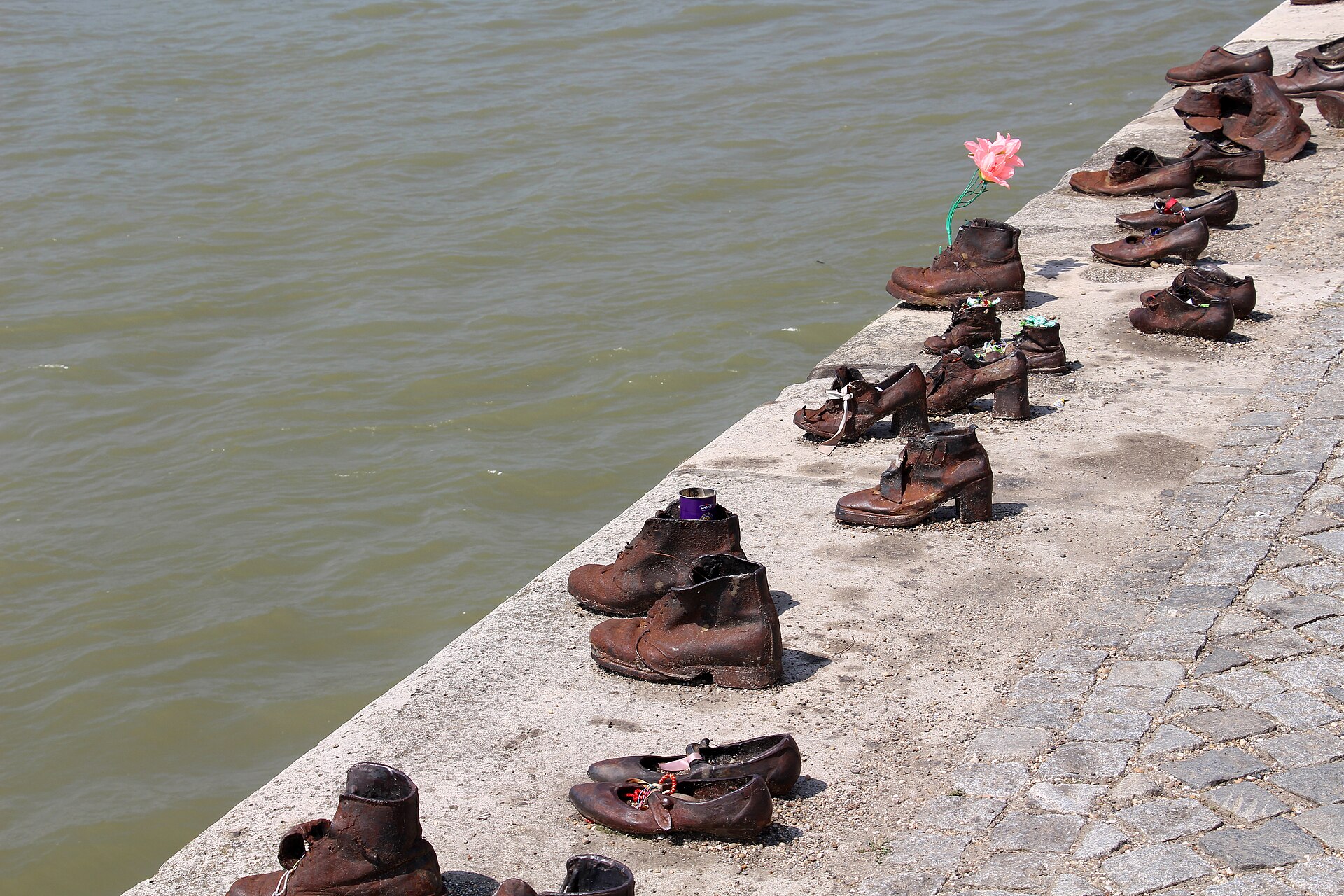
Sixty pairs of shoes, cast in iron, scattered in a loose line along about forty metres of embankment. They are not arranged in ranks. They lie as shoes lie when people step out of them: some paired neatly, some kicked apart, one tipped on its side. The styles are specifically of the period and specifically varied — men’s lace-up work boots and dress shoes, women’s court shoes with the low heavy heel of the 1940s, a pair of children’s boots, and one very small rounded shoe that stops most people who notice it.
They are set at the very lip of the stone, so that to look at them properly you stand where the people who wore them stood, facing the same water. That is the entire design, and it is why the memorial works when a conventional statue would not. There is no figure, no allegory and nobody to look at. There is an absence at ankle height and a river.
The iron has been left to rust and weather, which was intended. Twenty years on, the surfaces are pitted and orange-brown and read unmistakably as objects that have been outdoors for a long time rather than as sculpture.
The plaque
There are three cast-iron plaques set into the stone behind the shoes, in Hungarian, English and Hebrew. The English one reads: “To the memory of the victims shot into the Danube by Arrow Cross militiamen in 1944–45. Erected 16 April 2005.”
That is the entirety of the interpretation on site. Twenty-five words. There are no panels, no photographs, no names, no audio guide and no visitor centre. Some people find this a failure of the memorial. Most people, standing there, do not.
How to find it
The memorial is on the Pest bank of the Danube, on the lower embankment walkway below Széchenyi rakpart, roughly three hundred metres south of the Parliament and about the same distance north of the Chain Bridge.
The most straightforward approach is from Kossuth Lajos tér, the M2 metro station right beside the Parliament: come out on the river side, walk south along the top of the embankment, and take the steps down. Tram 2 stops at both Kossuth Lajos tér and Széchenyi István tér and runs directly along the top of the embankment, which makes it the easiest approach from further south in Pest. Our getting around Budapest guide has the tram and metro detail.
It is easy to walk straight past. From the road above, the shoes are below the parapet and out of sight, and the memorial is not signposted from street level in any prominent way. Look for the cluster of people standing still at the water’s edge.
How to visit
Fifteen or twenty minutes is enough, and there is no way to spend longer without simply standing there, which is a legitimate thing to do.
When. Early morning is quietest, and in winter the water is grey and high and the memorial is at its most affecting. Late evening is also quiet, and the shoes are not lit, so you are looking at silhouettes against reflected light off the water. The middle of a summer day brings a continuous flow of groups and it becomes difficult to be alone with it.
Etiquette. This is a memorial at a place where people were killed, and it is treated as such by Hungarians. Do not stand in the shoes, sit on them, put your own shoes beside them for a photograph, or pose smiling in front of them. Do not let children climb on them. If you leave a stone, a flower or a candle, that is a long-established and welcome gesture — placing stones on a memorial is a Jewish tradition and you will see many of them.
Photographs. Taking them is fine and normal. Photographing yourself with them is where people go wrong. If it helps, apply the test that most visitors apply without thinking: would you take this photograph in a cemetery?
Safety. There is no railing between the walkway and the water and the stone is slippery when wet. The Danube here is deep and fast.
What to see alongside it
The memorial is small and takes little time, and most people fold it into a wider morning in Pest. Two ways to do that well.
With the Parliament
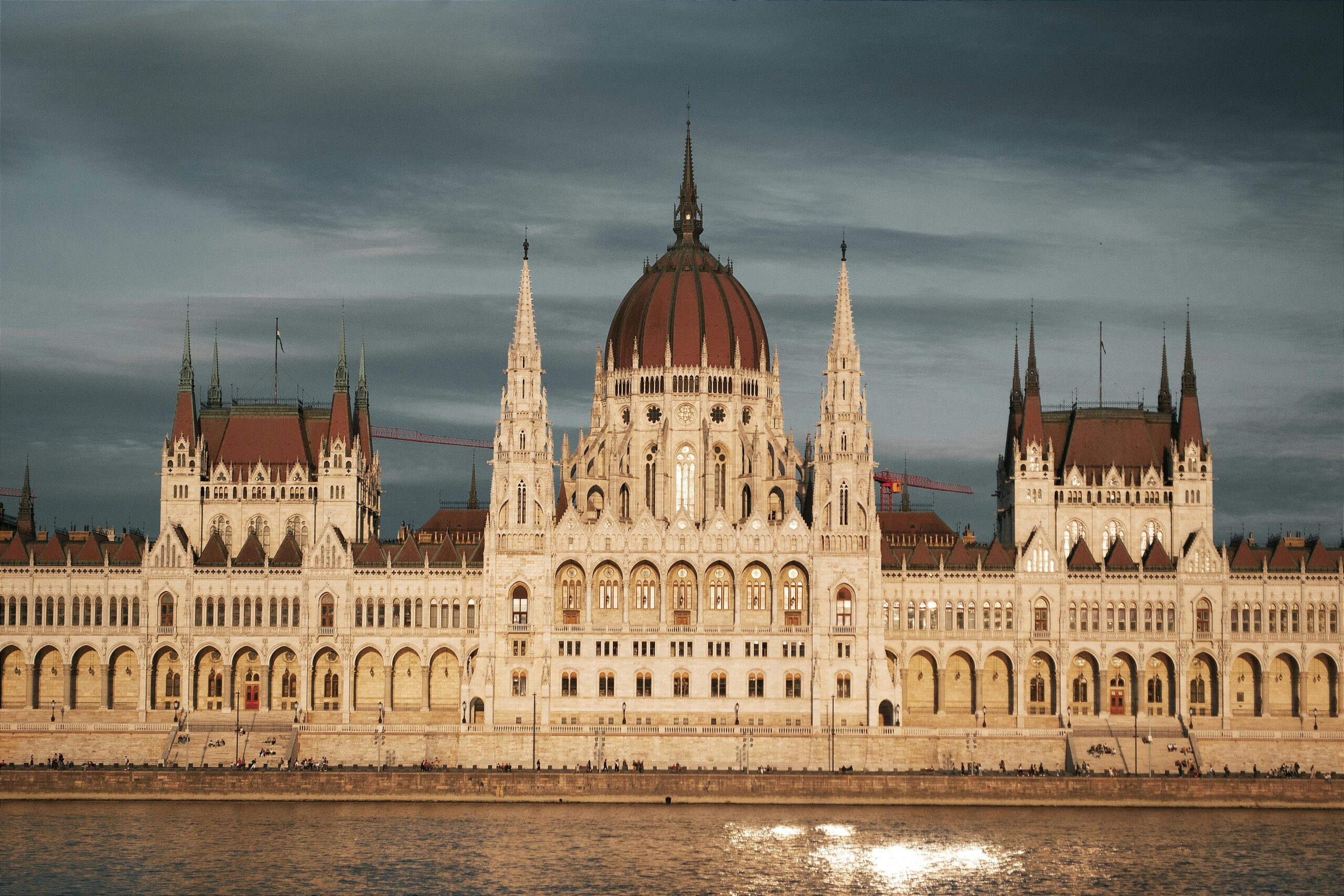
A five-minute walk north takes you to the Hungarian Parliament, and Kossuth Lajos tér itself holds several other memorials, including one to the victims of the 1956 uprising. Doing the Parliament tour and then walking south to the shoes gives you the state’s account of Hungarian history followed immediately by something that account has struggled with for eighty years, which is an unplanned but instructive sequence.
With the Jewish Quarter
The more coherent pairing. Fifteen minutes’ walk east is District VII, the area sealed as the ghetto in November 1944, and the Jewish Quarter holds the Dohány Street Synagogue, the Jewish Museum, the cemetery in the synagogue courtyard where those who died in the ghetto are buried, and the Raoul Wallenberg Memorial Park with Imre Varga’s weeping willow, each leaf carrying a name.
Do the shoes first. It is the sharper of the two and it takes twenty minutes; the synagogue complex takes ninety and provides the context. In the other order the memorial can feel like an afterthought at the end of a long morning, which it is not.
Further afield, the Holocaust Memorial Center on Páva utca in District IX is the city’s dedicated museum on the subject and is far less visited than it should be. The Glass House on Vadász utca, where Carl Lutz and others sheltered thousands of people under Swiss diplomatic protection, is open in a limited way and is one of the most extraordinary buildings in Budapest. Our history and culture guide covers both.
The people who tried to stop it
The same months produced one of the largest civilian rescue operations of the war, and it happened within a few hundred metres of this embankment.
Raoul Wallenberg, a Swedish diplomat sent to Budapest in July 1944, issued protective passports — Schutzpässe — that had no standing in international law but looked sufficiently official to work, and rented buildings that he declared Swedish territory. He is credited with saving tens of thousands of people. He was detained by Soviet forces in January 1945 and never seen again; what happened to him has never been established. The memorial park behind the Dohany Street Synagogue is named for him.
Carl Lutz, the Swiss vice-consul, did something similar at a larger scale and earlier, negotiating a quota of protective letters and then interpreting it so liberally that the single permit for eight thousand people became eight thousand permits for families. The Glass House on Vadasz utca, a former glazier’s showroom that operated as a Swiss protected building, sheltered around three thousand people in conditions that are difficult to imagine standing in the space today.
Angel Sanz Briz, the Spanish charge d’affaires, and Giorgio Perlasca, an Italian who simply continued issuing Spanish protective documents after Sanz Briz was withdrawn — having appointed himself to the post — between them protected several thousand more.
It is worth knowing these names while you are standing at the shoes, because the memorial can leave the impression that nothing stood against what happened here. A great deal did, at close range and at considerable personal risk, and much of it was improvised by a handful of foreign officials with no authority to do any of it.
The memorial since 2005
The shoes have not had an entirely quiet two decades. Individual pairs have been prised off and stolen more than once and have had to be recast and refixed; the memorial has been vandalised on a handful of occasions; and there was a period when small numbers of the shoes were missing at any given time. They are checked and maintained, and visitors notice and report gaps quickly.
The memorial also sits inside a live Hungarian argument. In 2014 a monument was erected on Szabadsag ter, a fifteen-minute walk away, depicting Hungary as the Archangel Gabriel being set upon by a German imperial eagle. Historians and much of the Hungarian Jewish community objected that it presented the country purely as a victim of German occupation and elided the Arrow Cross, the Hungarian gendarmerie and the Hungarian civil service, all of whom participated. A counter-memorial of personal objects, photographs and stones left by members of the public accumulated on the pavement in front of it and has been there, in one form or another, ever since.
You do not need to take a position on any of that to visit the shoes. But it explains why this small, wordless memorial on the riverbank carries more weight in Budapest than its scale suggests: it says one specific thing, about one specific place, with no adjectives, and it has never needed to be defended.
Why it is the most affecting thing in the city
Budapest is a city of large gestures — a 268-metre parliament, a basilica built to match it, a viewing terrace with seven turrets, an avenue two and a half kilometres long. Almost everything here is designed to be impressive at scale.
The shoes are the opposite of that and they are the thing visitors remember. Part of it is the scale: sixty pairs is a number you can count, unlike six million, and each pair is one person’s actual size. Part of it is that the objects are ordinary — a work boot, a court shoe, a child’s boot — and require no knowledge of Hungarian history to read. And part of it is the placement, at the edge of a working river that is still moving, in the middle of a busy modern city, with tram 2 rattling past above you.
It is on almost every list of Budapest landmarks and every list of free things to do, which is accurate and slightly beside the point. Our attractions guide lists it among the sights; it is better understood as the one stop on a Budapest itinerary that is not sightseeing at all.
Accessibility
The lower embankment walkway itself is flat, paved and easy. Getting down to it is the issue: the main approaches from Széchenyi rakpart are flights of steps. There is a ramped access point along the embankment, but it is not adjacent to the memorial and is not signposted, so a wheelchair user should expect to travel some distance along the lower walkway to reach the shoes.
From the parapet above, the shoes are largely hidden below the line of the stone, so viewing from the upper level is not a substitute.
Twenty minutes’ walk east, in the streets that were sealed as the ghetto in November 1944, the same history is told at length rather than in twenty-five words. Our Dohany Street Synagogue guide covers the complex, its courtyard cemetery and the Emanuel Tree — and it is the right place to go second.
Frequently asked questions
What do the shoes on the Danube represent?
They represent the Jewish Hungarians who were shot into the Danube by Arrow Cross militiamen in the winter of 1944–45. The victims were ordered to take off their shoes before they were killed, because leather had resale value. The sixty pairs are cast in iron in 1940s styles — men’s, women’s and children’s — and are set at the very edge of the embankment where the shootings took place.
Is the Shoes on the Danube memorial free?
Yes. It is on an open public embankment with no gate, no ticket and no opening hours. You can visit at any time of day or night.
Where exactly is the memorial?
On the Pest bank of the Danube, on the lower walkway below Széchenyi rakpart, about three hundred metres south of the Parliament and the same distance north of the Chain Bridge. The nearest metro is Kossuth Lajos tér on the M2; tram 2 runs along the embankment above it.
How long does it take to visit?
Fifteen to twenty minutes. It is a small memorial and there is no route to follow. Most people walk the length of it slowly, stand for a while, and leave.
Who created Shoes on the Danube Bank?
The film director Can Togay conceived it and the sculptor Gyula Pauer made it. It was unveiled on 16 April 2005, Hungary’s Holocaust Memorial Day.
How many people were killed on the Danube bank?
It is not known precisely. Estimates of the number shot into the river during the Arrow Cross terror of late 1944 and early 1945 run into the thousands, within a wider death toll for Budapest’s Jewish population in those months that runs to tens of thousands. Many of the killings were carried out by small militia groups without records.
Why are there only sixty pairs of shoes?
Because sixty is a number a person can take in. The memorial is not attempting to represent the total; it is representing individuals, at the size of individuals, at the place where they stood. The effect depends on the count being small enough to comprehend.
Can you take photos at the memorial?
Photographing the memorial is normal and nobody will object. Posing with it, standing in the shoes or placing your own shoes among them is not appropriate and is the thing that draws visible disapproval from other visitors. Treat it as you would a cemetery.
What should I visit alongside it?
The Jewish Quarter and the Dohány Street Synagogue, fifteen minutes’ walk east, which cover the ghetto and the wider history in depth — and do the shoes first, because they are the sharper of the two and take far less time. The Parliament is five minutes north in the other direction.
Photo credits
The memorial: 2022-03 Budapest – Shoes on the Danube Bank (1) by Marek Mróz, CC BY-SA 4.0, via Wikimedia Commons.
Detail: Budapest – Cipők a Duna-parton (38481941811) by Fred Romero, CC BY 2.0, via Wikimedia Commons.
At dusk: Girl contemplates Shoes on the Danube Bank (Budapest, Hungary) by Jules Verne Times Two, CC BY-SA 4.0, via Wikimedia Commons.