Taxis, Bolt and Not Getting Ripped Off in Budapest
Every licensed cab in Budapest charges the same decree tariff, raised in August 2026. What rides actually cost, how Bolt fits in, and the few places where overcharging still happens.
In this guide
- At a glance: what a taxi costs
- The tariff, and what a ride actually costs
- Four ways to get a taxi
- Bolt: what most people use
- The taxi firms’ apps and phone lines
- Taxi ranks
- Hailing on the street
- How to tell a real taxi
- The scams, and where they still happen
- The airport and the railway stations
- Paying, receipts and tipping
- Taxi or public transport?
- When cabs are hard to find
- Left something in a cab?
- Families, groups and accessibility
- A few words of Hungarian for the back seat
- Practical tips
- Frequently asked questions
- Photo credits
This article contains advertising. Our booking links are routed through a partner that adds commission tracking automatically, so if you book through one we earn a commission from the provider, at no extra cost to you. It never affects what we recommend. Affiliate disclosure
Every licensed cab in Budapest charges exactly the same fare. The tariff is set by the City Assembly, built into every meter and shown in every car, and on 1 August 2026 it went up for the first time since March 2023. That makes Budapest unusual among European capitals: the meter itself is rarely the problem. The problem is the car that isn’t really a taxi, the driver who “forgets” to switch the meter on, and the tired arrival who says yes to the first person offering a ride. Type taxi Budapest into a phone in the arrivals hall and you’ll get a page of firms, apps and warnings, most of them true and a good few years out of date.
This page covers the current tariff and what typical journeys actually cost, the four ways to get a cab (Bolt, the taxi firms’ own apps and phone lines, ranks, and the street), how to tell a real taxi from a chancer, where the scams still happen, and the practical bits: cards, tipping, child seats and the airport run. Fares were checked in September 2026, just after the August increase; treat the worked examples as the right order of magnitude, because the per-minute charge makes every real journey a little different.
At a glance: what a taxi costs
| Charge | Amount | Notes |
|---|---|---|
| Base fare (alapdíj) | 1,300 Ft (€3.25) | Shows on the meter as soon as you set off |
| Per kilometre | 520 Ft (€1.30) | While the car is moving at a reasonable speed |
| Per minute | 130 Ft (€0.33) | Waiting, or crawling in traffic |
| Airport surcharge | 800 Ft (€2) | Every trip to or from the airport, in both directions |
| Advance-booking fee | 800 Ft (€2) | New in August 2026, for taxis ordered ahead by app or phone, where the firm charges it |
| A typical 5 km ride | About 4,300 Ft (€10.75) | Five kilometres plus three minutes at traffic lights |
| Airport to the city centre | About 13,500–16,000 Ft (€34–40) | Depends on traffic and exactly where you’re going |
For comparison, a single BKK ticket for the metro, trams and buses is 500 Ft (€1.25), and the 100E airport bus is 2,500 Ft (€6.25).
The tariff, and what a ride actually costs
The Budapest tariff has three parts. You pay a flat 1,300 Ft the moment the meter starts, then either 520 Ft for each kilometre or 130 Ft for each minute, depending on whether the car is moving freely or stuck: the meter switches between the two by itself, so you’re never charged for distance and time at once. Every licensed firm uses the same numbers, and so does Bolt, whose cars in Budapest are licensed taxis rather than private-hire vehicles. There’s no cheaper company to hunt down and no premium one to avoid. The only thing that changes the price is the route and the traffic.
The August 2026 rise was about 18 per cent across the board, from a base fare of 1,100 Ft, 440 Ft per kilometre and 110 Ft per minute. The same decision added two new charges: an 800 Ft surcharge on every airport trip, in either direction, and an 800 Ft “convenience fee” on taxis ordered in advance by app or phone. Whether that second fee lands on an ordinary on-demand booking depends on the firm and how the order is classed, so look at the fare breakdown in the app before you confirm, and ask when you phone.
Here’s what the tariff works out at on some journeys visitors make all the time. These are estimates worked from the tariff in light traffic; add 130 Ft for every minute you spend sitting in a jam.
| Journey | Rough distance | Expected fare |
|---|---|---|
| Deák Ferenc tér to the Parliament | 1.5–2 km | About 2,300–2,700 Ft (€6–7) |
| Keleti station to Deák Ferenc tér | 2.5 km | About 2,900–3,300 Ft (€7–8) |
| Deák Ferenc tér to Buda Castle | 3 km | About 3,200–3,800 Ft (€8–9.50) |
| Deák Ferenc tér to the Széchenyi Baths | 3.5 km | About 3,500–4,000 Ft (€9–10) |
| Nyugati station to Szent Gellért tér | 4 km | About 3,700–4,300 Ft (€9–11) |
| Airport to Deák Ferenc tér | 21–24 km | About 13,500–16,000 Ft (€34–40), surcharge included |
One quirk worth knowing: private cars are banned from the Chain Bridge since its restoration, but taxis aren’t, which occasionally makes a cab the quickest way from the Pest riverside to Clark Ádám tér and the funicular.
Four ways to get a taxi
Bolt: what most people use
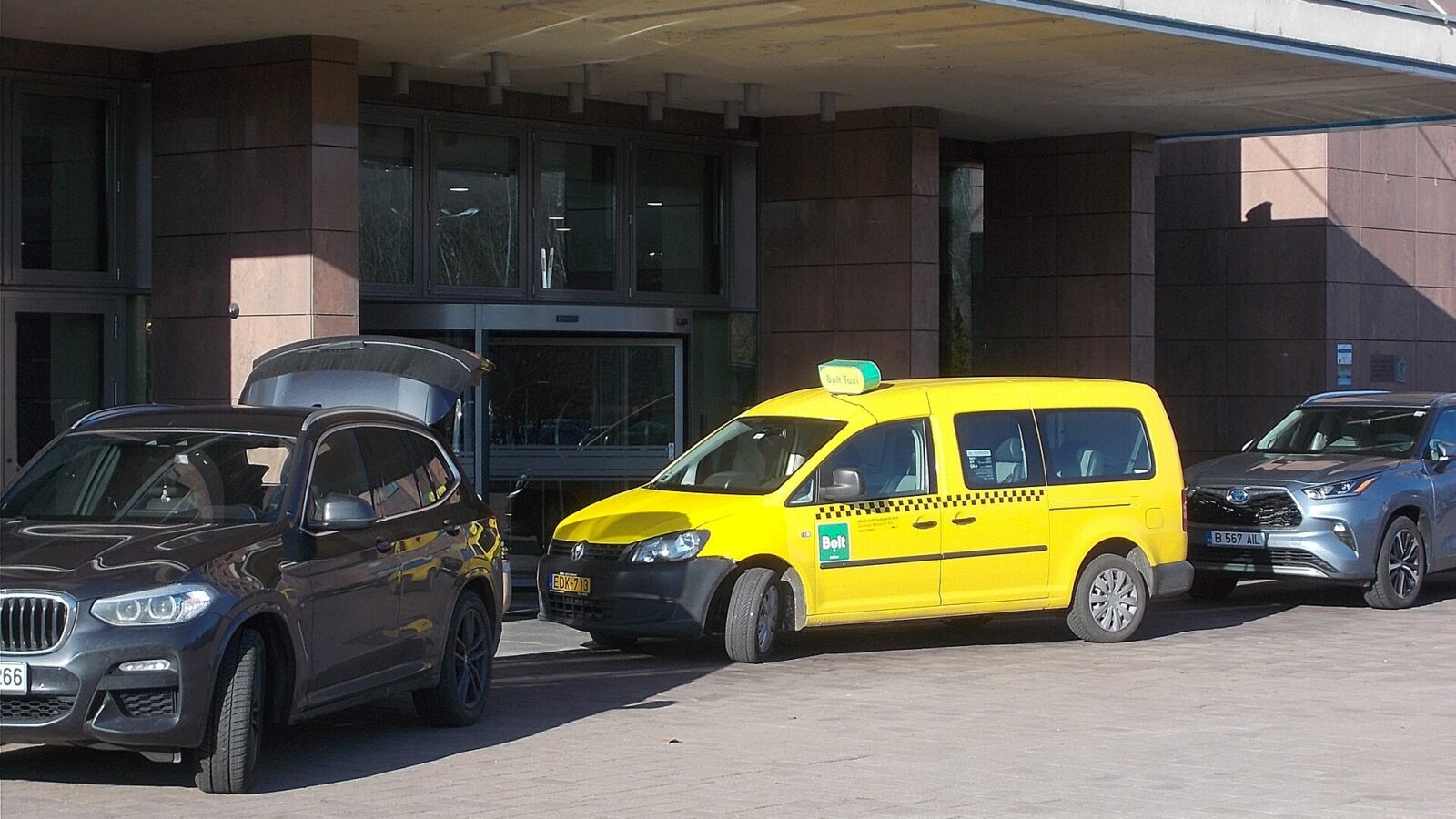
Uber pulled out of Hungary in 2016 after the government moved against it, and Bolt filled the gap. The important difference from Bolt in most other cities is that in Budapest its drivers are licensed taxi drivers in yellow licensed taxis, with a green Bolt sign on the roof, charging the decree tariff. So Bolt isn’t cheaper than a taxi. It is a taxi. What you get from the app is everything around the fare: an estimate before you book, the driver’s name, photo and number plate before the car arrives, a map of the route as you go, card payment without fumbling for forints, and a record of the trip if you leave a phone on the back seat or need to complain.
The app offers a standard car for up to four people, XL for up to six, Child Seat (a harnessed seat for children aged roughly two to six) and Pets, where dogs need a muzzle and small animals a carrier. It’s the option we’d recommend to most visitors, not because the ride is better but because the whole transaction is on your screen instead of in a conversation.
The taxi firms’ apps and phone lines
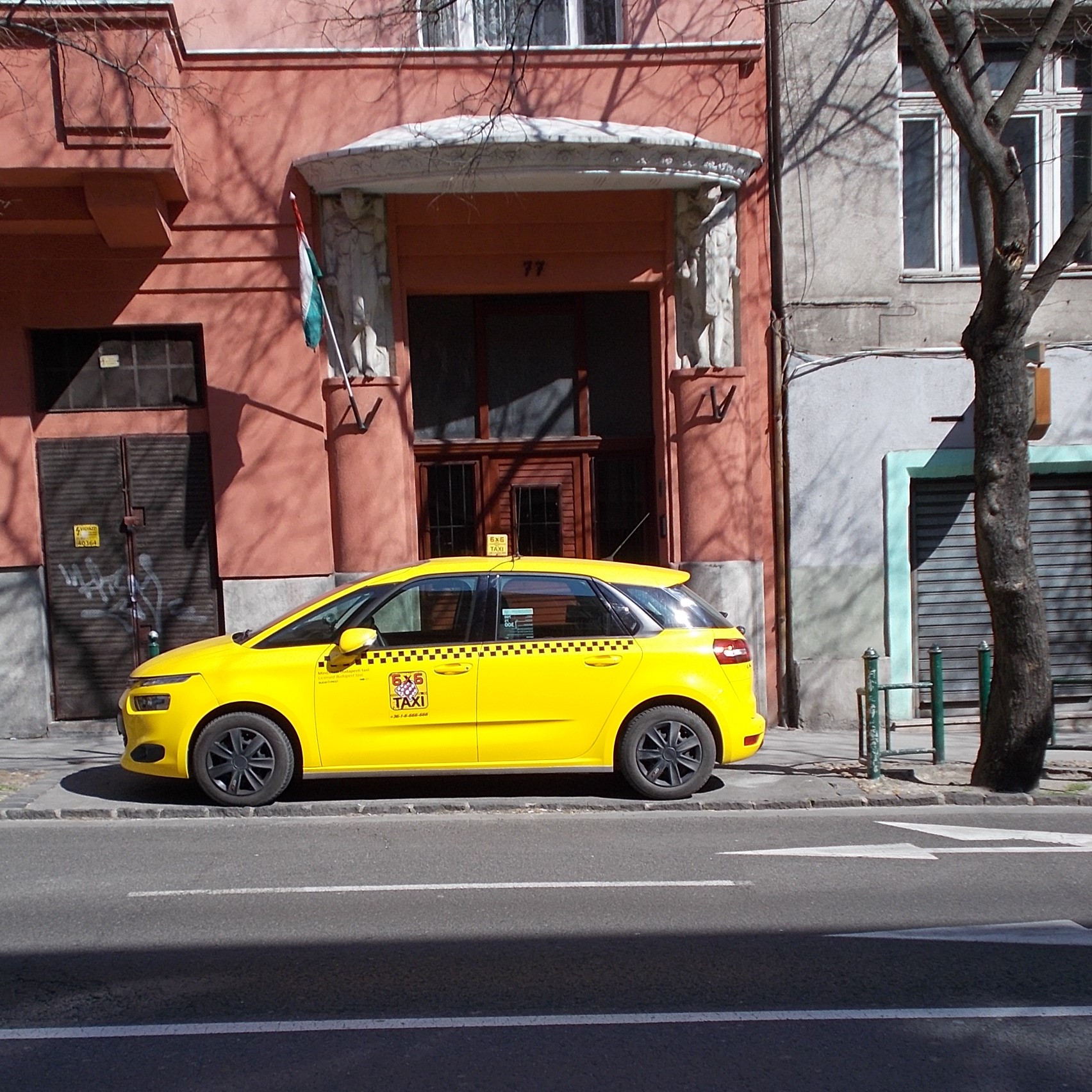
The big Budapest firms, among them Főtaxi, City Taxi and 6×6 Taxi, all take bookings by app and by phone, and their numbers are built from repeated digits precisely so that nobody forgets them. Their cars charge the same tariff as Bolt’s. Phoning is the old-fashioned route, and it works well: dispatchers are used to foreign callers and will tell you the car’s number and how long it’ll be. Easier still, ask your hotel reception, restaurant or bar to call one. They do it all day, and a cab ordered by a business is one with a traceable booking behind it.
Taxi ranks
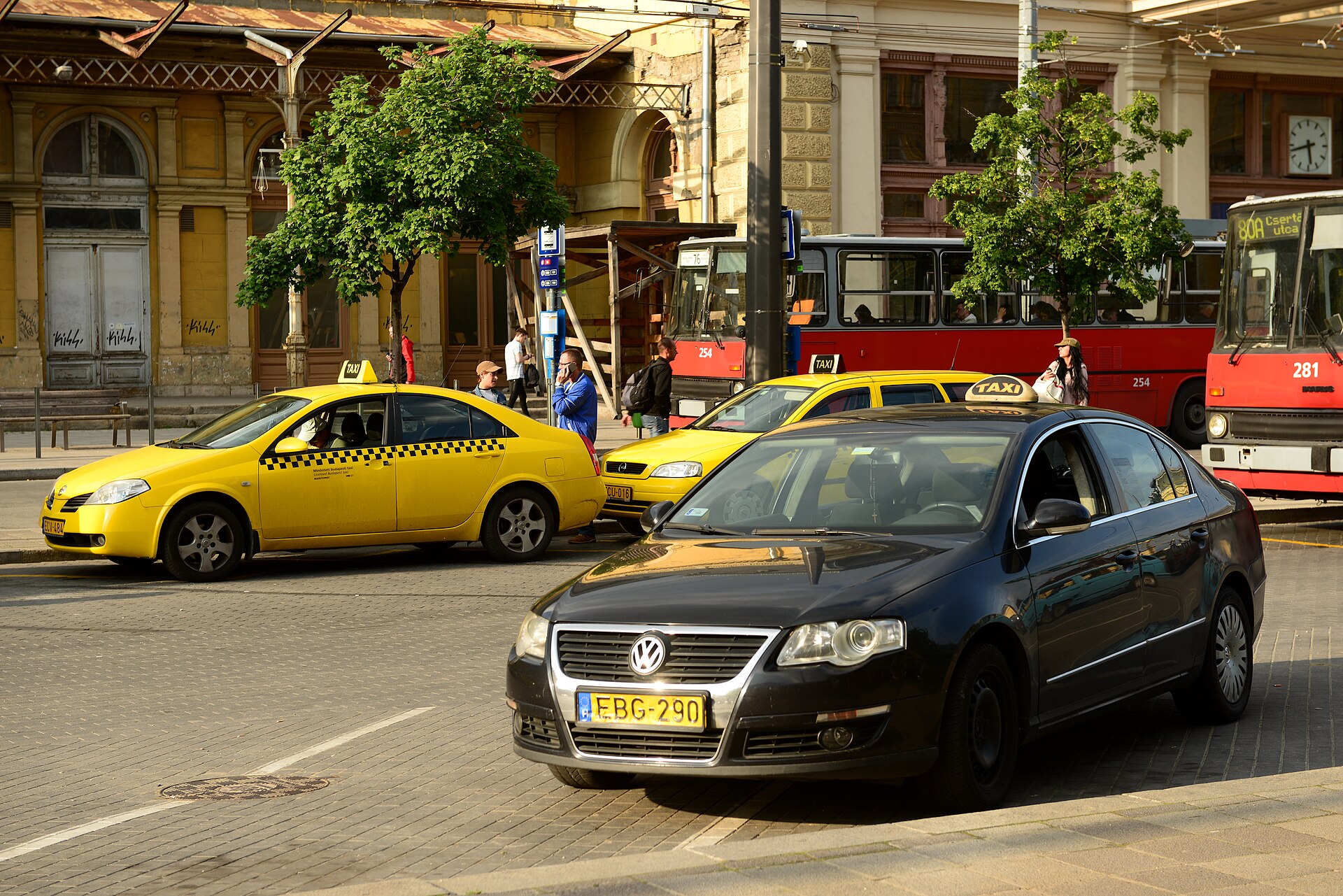
Marked ranks sit outside the main railway stations, on the big squares and in front of the larger hotels. A licensed cab at a rank charges exactly the same as one you book, and at a well-used rank in daylight, taking the first car in line is perfectly reasonable. The trouble is that ranks are also where freelancers loiter, particularly around Keleti and Nyugati, so walk to the cars themselves rather than following someone who approaches you on the concourse.
Hailing on the street
You can flag down a yellow cab with its roof light on, and a licensed one will charge the standard tariff. The standard advice not to do it isn’t about the price, which is fixed; it’s about the fact that you can’t vet a car in the five seconds it takes to pull over, least of all at 3am outside a bar in District VII. In daylight in the city centre, a clearly marked yellow cab is generally fine. Late at night in the party district, open the app instead.
How to tell a real taxi
Since the city’s taxi reforms, every licensed Budapest cab has to look the part, which makes a fake easier to spot than you’d think. A genuine taxi has:
- Yellow paint, all over, not just a yellow sign on a black car.
- A roof sign saying TAXI or carrying the firm’s name, lit when the car is free.
- The firm’s name and the words “Licensed Budapest taxi” (in Hungarian and English) on the front doors, usually with a chequered band along the side.
- Yellow number plates.
- The tariff displayed inside the car, and a meter the driver starts in front of you, showing 1,300 Ft at the start of the trip (2,100 Ft on an airport run, with the surcharge added).
- The driver’s taxi ID on display.
Anything missing from that list is a reason to walk away. A driver without a meter, or with one that’s “broken”, is not a taxi you want to be in, however reasonable the flat price he quotes.
The scams, and where they still happen
Budapest’s taxi reputation is a good ten years worse than its taxis. The licensed trade is regulated, metered and mostly honest, and most visitors never have a problem. The trouble has shrunk into a few predictable places and a handful of routines, which makes it easy to dodge once you know them.
| The scam | Where it happens | What to do |
|---|---|---|
| A “driver” approaches you and offers a ride | The airport arrivals hall, the concourses at Keleti and Nyugati | Say no and keep walking. Real taxis wait at the official rank; they don’t recruit inside the building. |
| A flat price, often in euros | Stations, club exits, the airport | Decline. A licensed cab runs the meter, and the meter counts in forints. |
| The meter “isn’t working” or is already running | Anywhere, usually late at night | Get out before you set off and book through an app. |
| The scenic route | Anywhere, especially from the airport | Follow the journey on your own map. On Bolt the route is logged. |
| “No change” or “the card machine is broken” | At the end of the ride | Ask before you set off whether card is fine. Pay in the app on Bolt. |
| Converting the fare into euros at a terrible rate | At the end of the ride | Pay in forints or by card in forints, never in euros at the driver’s rate. |
For the wider picture, including pickpockets and the “friendly stranger” bar scam, see the Budapest safety guide. And if you’re heading out to the ruin bars, sort out the ride home before you need it: the nightlife guide has the night buses and the late trams as well as the taxi advice.
The airport and the railway stations
The airport is where the most money changes hands for a single ride, and where tired arrivals make their worst decisions. Walk straight past anyone offering a taxi inside the terminal and head outside to the official rank, or book a Bolt from arrivals. Either way, expect the meter to open at 2,100 Ft, the 1,300 Ft base plus the 800 Ft airport surcharge, and the whole trip to a central hotel to come to roughly 13,500–16,000 Ft (€34–40) in normal traffic. The surcharge applies on the way back out too.
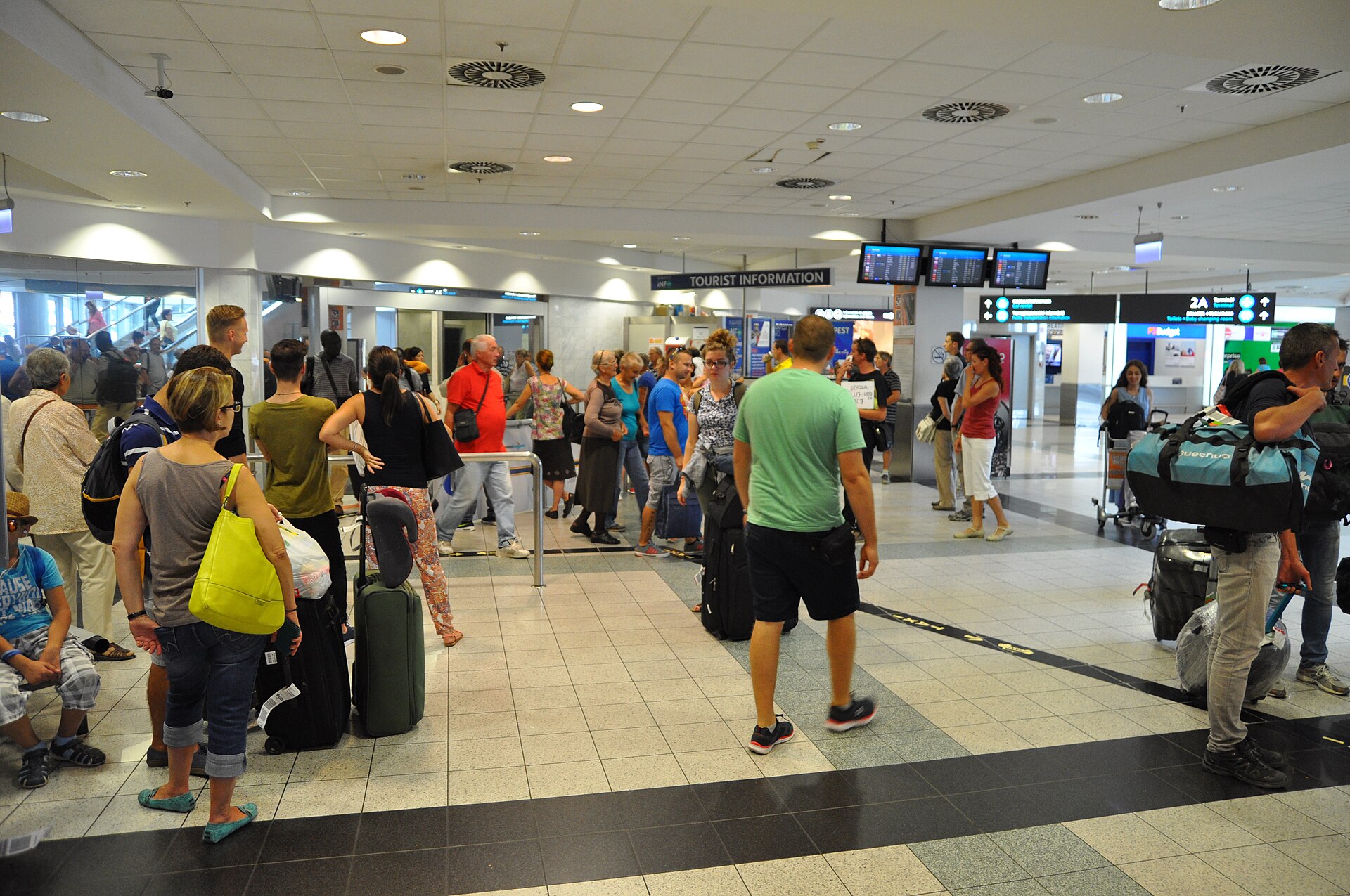
Is it worth it? For one or two people with light bags, not really: the 100E bus costs 2,500 Ft each and drops you at Kálvin tér, Astoria or Deák Ferenc tér. For a group of four the maths changes. Four bus tickets come to 10,000 Ft, and a taxi to the door costs only about 1,000–1,500 Ft a head more, with no lugging cases across the city at the other end. The airport transfer guide compares every option into town, and the Budapest Airport guide covers the terminal itself.
At the railway stations the pattern is the same: the freelancers work the concourse, and the licensed cabs wait outside. Walk out to the rank or book a car to the station entrance. If you’re arriving at Keleti from Vienna, or trying to work out which of the three big stations you actually need, see the guide to Budapest’s train stations and the Budapest to Vienna train guide.
Paying, receipts and tipping
Most licensed cabs take cards, but not every single one, so ask before you set off if you’re relying on plastic. On Bolt you can pay in the app and skip the question entirely. Pay in forints: if a driver offers to take euros, the exchange rate will be his, not the bank’s. The meter prints a receipt, and it’s worth asking for one on any longer ride; if something goes wrong later, it’s your evidence.
Tipping is customary but modest. Round the fare up to the next few hundred forints on a short hop, or add about 10 per cent for a longer ride, a driver who helps with heavy bags, or a pleasant airport run. Nobody expects more, and if the ride was bad you don’t owe anything. The money guide covers cash, cards and tipping more generally.
If you have a genuine complaint — an overcharge, a refusal to run the meter, a lost bag — keep the receipt, note the car’s plate and the driver’s ID number, and contact the firm first. BKK, the city’s transport authority, also regulates the taxi trade and deals with complaints the firm won’t resolve. With Bolt, the in-app help pages are the fastest route.
Taxi or public transport?
Honestly, for most daytime journeys in the centre you don’t need a taxi at all. Central Budapest is compact, the trams and metro are frequent, and a 500 Ft ticket covers a ride that would cost 2,500–3,500 Ft by cab. Where a taxi does earn its money:
- After the metro shuts, around 11pm. The night buses and the all-night 6 tram on the Grand Boulevard cover a lot, but not everything, and a cab home after midnight is money well spent.
- With luggage, especially to and from the stations and the airport, or to a hotel up in the Buda hills.
- In a group of three or four. A 3,500 Ft ride split four ways costs less than a coffee each, and it’s door to door.
- With small children, when a Bolt Child Seat saves a lot of wrangling on a crowded tram.
For everything else, the public transport guide and the metro guide will get you around for a fraction of the price, and the getting around Budapest hub puts every option side by side.
When cabs are hard to find
Most of the year you’ll have a car within a few minutes of booking. A handful of nights break that rule, and because the tariff is fixed by decree, busy nights show up as longer waits rather than higher fares. Plan around them:
- New Year’s Eve. From about 11pm until the small hours, waits stretch to an hour or more. Plan to walk, or use public transport, and see the New Year’s Eve guide for where the crowds gather.
- Sziget week in August. When the festival empties at night, the queues for cabs near the island are long and the roads around it are slow. The suburban train and the night buses are usually quicker; the Sziget guide has the details.
- The Formula 1 weekend. The Hungaroring is outside the city at Mogyoród, and a taxi back from the circuit after the race is a long, slow and uncertain business. The Grand Prix guide covers getting to and from the circuit.
- Friday and Saturday nights in District VII, between about 2am and 4am, when the ruin bars empty. Walk a few streets away from Kazinczy utca and the Gozsdu passage before you book, so the driver can actually reach you.
- The first heavy rain, or the first snow. Everyone has the same idea at the same moment.
Left something in a cab?
With Bolt, open the trip in the app and contact the driver or support from there; the trip history makes this the easy case. With a taxi firm, call the dispatcher with the time and place you were picked up and, ideally, the details from your receipt, which identifies the car. That’s one more reason to ask for the receipt, even on a short ride.
Families, groups and accessibility
Travelling with young children, the Bolt Child Seat category is the easy answer: you know before the car arrives that there’ll be a harnessed seat fitted. Otherwise, ask the taxi firm when you book, and don’t count on a car from a rank having one. For more on getting around the city with kids, see Budapest with kids.
Groups of five or six can book Bolt XL, or ask a taxi firm for a larger car, which usually means a people carrier on the same tariff. For wheelchair users the picture is less rosy. Few ordinary cabs can take a wheelchair, so book a specialist accessible transfer with a ramp well ahead, and ask your hotel to help arrange it; don’t expect to find one at a rank.
A few words of Hungarian for the back seat
Most Budapest drivers who work with tourists speak some English, and Bolt removes the need to talk at all. Still, a few phrases go a long way:
- Kérem, kapcsolja be a taxiórát. — Please switch on the meter.
- Kártyával fizethetek? — Can I pay by card?
- Mennyi lesz? — How much will it be?
- Itt jó lesz, köszönöm. — Here’s fine, thanks.
- Kérek egy nyugtát. — I’d like a receipt, please.
Practical tips
- Install Bolt and add a card before you land, so you’re not setting up an account on airport wifi with a queue of touts watching.
- Check the meter shows 1,300 Ft (or 2,100 Ft from the airport) as you pull away.
- Follow the route on your own map on anything longer than a couple of kilometres.
- Carry some small forint notes for tips and for the rare cab without a working card reader.
- On a night out, agree who’s booking the ride home before the last round, not after it.
- Don’t get into a car because someone walked up to you and offered one. That single rule avoids nearly every taxi scam in the city.
Frequently asked questions
How much is a taxi in Budapest?
Since 1 August 2026 the regulated tariff is a 1,300 Ft base fare plus 520 Ft per kilometre or 130 Ft per minute when you’re stuck in traffic. A typical 5 km ride across the centre comes to about 4,300 Ft (€10.75), and every licensed firm charges the same.
Is Bolt cheaper than a taxi in Budapest?
Not really. In Budapest, Bolt’s drivers are licensed taxi drivers charging the same decree tariff as any other cab. What Bolt adds is a fare estimate before you book, card payment in the app, the driver’s details up front, and a record of the trip.
Is there Uber in Budapest?
No. Uber left Hungary in 2016. Bolt is the ride-hailing app most people use, alongside the taxi firms’ own apps.
How much is a taxi from Budapest Airport to the city centre?
Roughly 13,500–16,000 Ft (€34–40) to a central hotel in normal traffic. That includes the 800 Ft airport surcharge, which applies to trips in both directions. Take cabs from the official rank outside arrivals or book through an app, never from someone who approaches you inside the terminal.
Can I pay by card in a Budapest taxi?
In most licensed cabs, yes, but check before you set off. With Bolt you can pay in the app. Always pay in forints rather than accepting a driver’s euro price.
Should I tip taxi drivers in Budapest?
It’s customary to round up on short rides and add around 10 per cent on longer ones or when the driver helps with luggage. It isn’t compulsory, and a bad ride doesn’t earn one.
Is it safe to hail a taxi on the street in Budapest?
A clearly marked yellow cab hailed in the centre in daylight is generally fine, and it charges the same tariff as a booked one. At night, and anywhere near the party district, book through Bolt or a taxi firm instead, so there’s a record of the car and the driver.
Photo credits
Bolt taxi outside Aquaworld: Aquaworld, VW Bolt taxi, 2024 Káposztásmegyer by Globetrotter19, CC BY-SA 4.0, via Wikimedia Commons.
6×6 Taxi on Attila út: Attila út 77, bejárat és taxi, 2020 Krisztinaváros by Globetrotter19, CC BY-SA 3.0, via Wikimedia Commons.
Budapest Airport arrivals hall: Budapest, Liszt Ferenc repülőtér, 3 by Christo, CC BY-SA 4.0, via Wikimedia Commons.
Taxis at a station rank: 14-05-06-budapest-RalfR-31 by © Ralf Roletschek – Fahrradtechnik und Fotografie, GFDL 1.2, via Wikimedia Commons.