District VII (Erzsébetváros): Living in the Party District
District VII by day and at 3am: the ruin bars and the streets behind them, the new rules on night venues and short-term lets, where to eat, the quiet outer district, and whether you should stay here.
In this guide
- District VII at a glance
- Two districts in one
- How the party district happened
- The party district by night
- Szimpla Kert
- Instant-Fogas
- Gozsdu udvar
- The rest
- What it’s really like at 3am
- Getting around, and getting home
- The rules: bars, crawls and short-term lets
- Nightlife
- Short-term rentals
- How the district is changing
- By day: the district without the hangover
- Eating and drinking
- Coffee
- The outer district
- District VII through the year
- Should you stay in District VII?
- A day in District VII
- Is District VII worth it?
- Frequently asked questions
- Photo credits
This article contains advertising. Our booking links are routed through a partner that adds commission tracking automatically, so if you book through one we earn a commission from the provider, at no extra cost to you. It never affects what we recommend. Affiliate disclosure
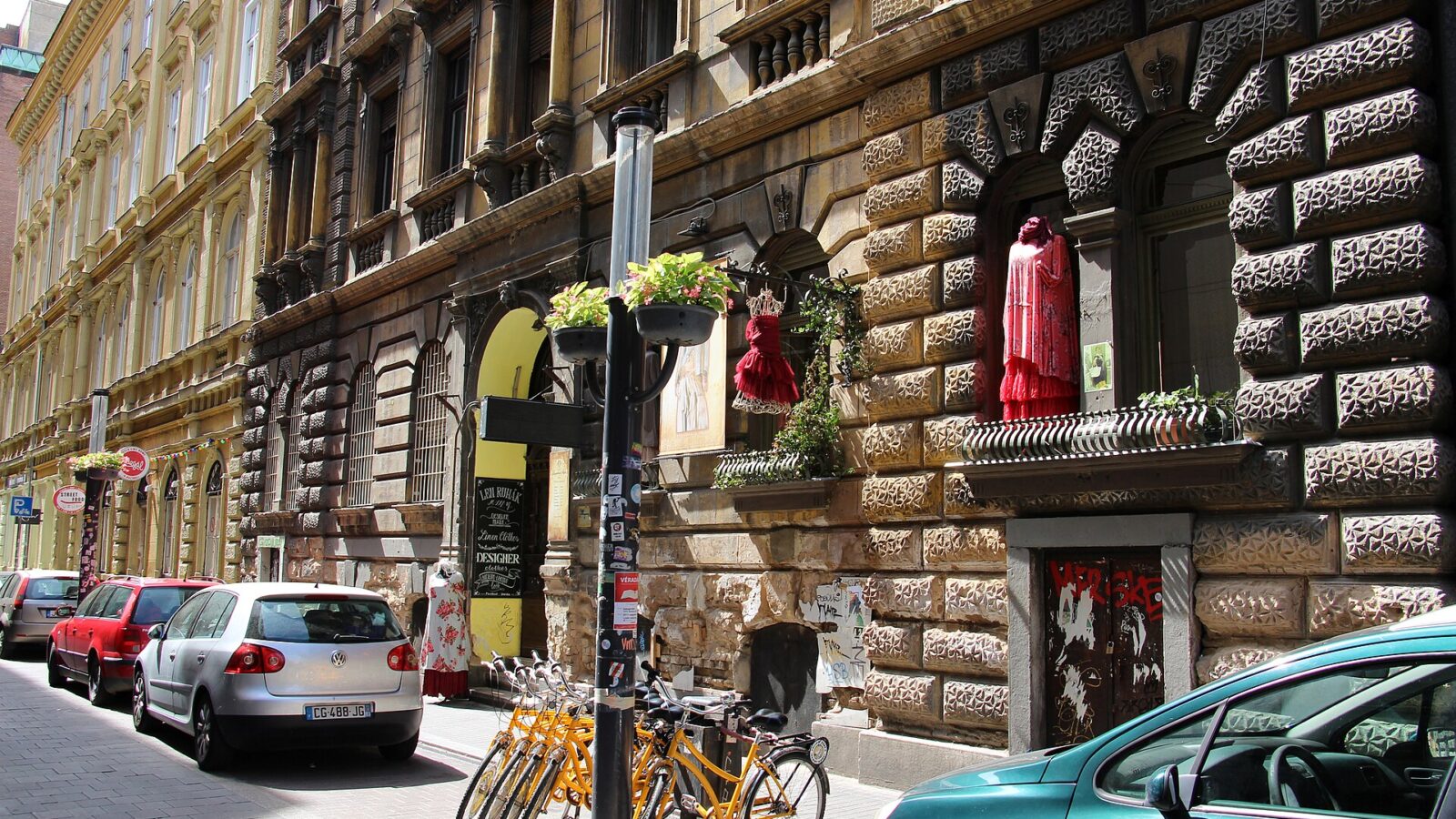
At three on a Saturday morning, Kazinczy utca is a river of people: stag groups in matching T-shirts, students sharing a bottle of wine on a doorstep, a queue outside a ruin bar, a delivery rider weaving through it all, and somewhere above, a resident at a third-floor window wondering why they ever moved here. Come back at nine on Sunday and the same street is being hosed down, an old man is buying bread, and the only sound is a tram on the boulevard. That’s District 7 Budapest, Erzsébetváros: the city’s party district, but also a dense, old, lived-in neighbourhood that has been arguing with itself about what it wants to be for twenty years.
This guide is about District VII as a place to spend time: what it’s like by day and at three in the morning, the bars and the food, the local rules that have changed the party quarter and the short-term rental market, the quieter outer half that most visitors never see, and whether you should stay here. Opening hours and rules were checked in October and November 2026; venues change fast here, so check before you go. For how it fits with the rest of the city, see our guide to Budapest’s districts.
District VII at a glance
| What | District VII |
|---|---|
| Official name | Erzsébetváros (Elizabeth Town) |
| Area | 2.09 km², one of the smallest districts |
| Population | 53,381 (2016), about 25,500 people per km² |
| Inner district | Király utca, Erzsébet körút, Rákóczi út and Károly körút: the old Jewish quarter and the party district |
| Outer district | East of the Grand Boulevard: residential, quieter, few visitors |
| Transport | M2 at Astoria and Blaha Lujza tér; trams 4 and 6 along the Grand Boulevard; Deák Ferenc tér (M1, M2, M3) just outside |
| Best for | Ruin bars, nightlife, street food, cheap eating, people-watching |
| Not for | Light sleepers who book in the wrong street |
Two districts in one
Erzsébetváros is really two places. The inner district, the triangle wedged between Király utca, the Grand Boulevard (Erzsébet körút), Rákóczi út and the Small Boulevard (Károly körút), is the old Jewish quarter and, since the 2000s, the centre of Budapest’s nightlife. Its streets are narrow, its buildings tall and close together, and its courtyards full of bars, restaurants, hostels and apartments. This is the District VII everyone talks about.
The outer district, east of the Grand Boulevard, is a different world: ordinary Pest residential streets, a mix of handsome nineteenth-century apartment blocks and tired ones, corner shops, schools, small parks and very few tourists. It feels more like the rest of the city than like the party quarter a few hundred metres away.
The inner district’s history as Budapest’s Jewish quarter, with its synagogues, the wartime ghetto and its memorials, deserves its own visit, and our Jewish Quarter guide covers it properly. This page is about what the district is like to be in today.
How the party district happened
By the end of the twentieth century much of inner Erzsébetváros was run down. Many buildings were crumbling, some were empty and waiting for redevelopment, and rents were low. In the early 2000s a handful of people had the idea of opening temporary bars in derelict buildings and courtyards, furnished with whatever was to hand: mismatched chairs, old bathtubs, bicycles hanging from the ceiling. The ruin bar was born. Szimpla Kert, which opened in 2002 and moved to its current home in an old building on Kazinczy utca in 2004, is generally regarded as the pioneer.
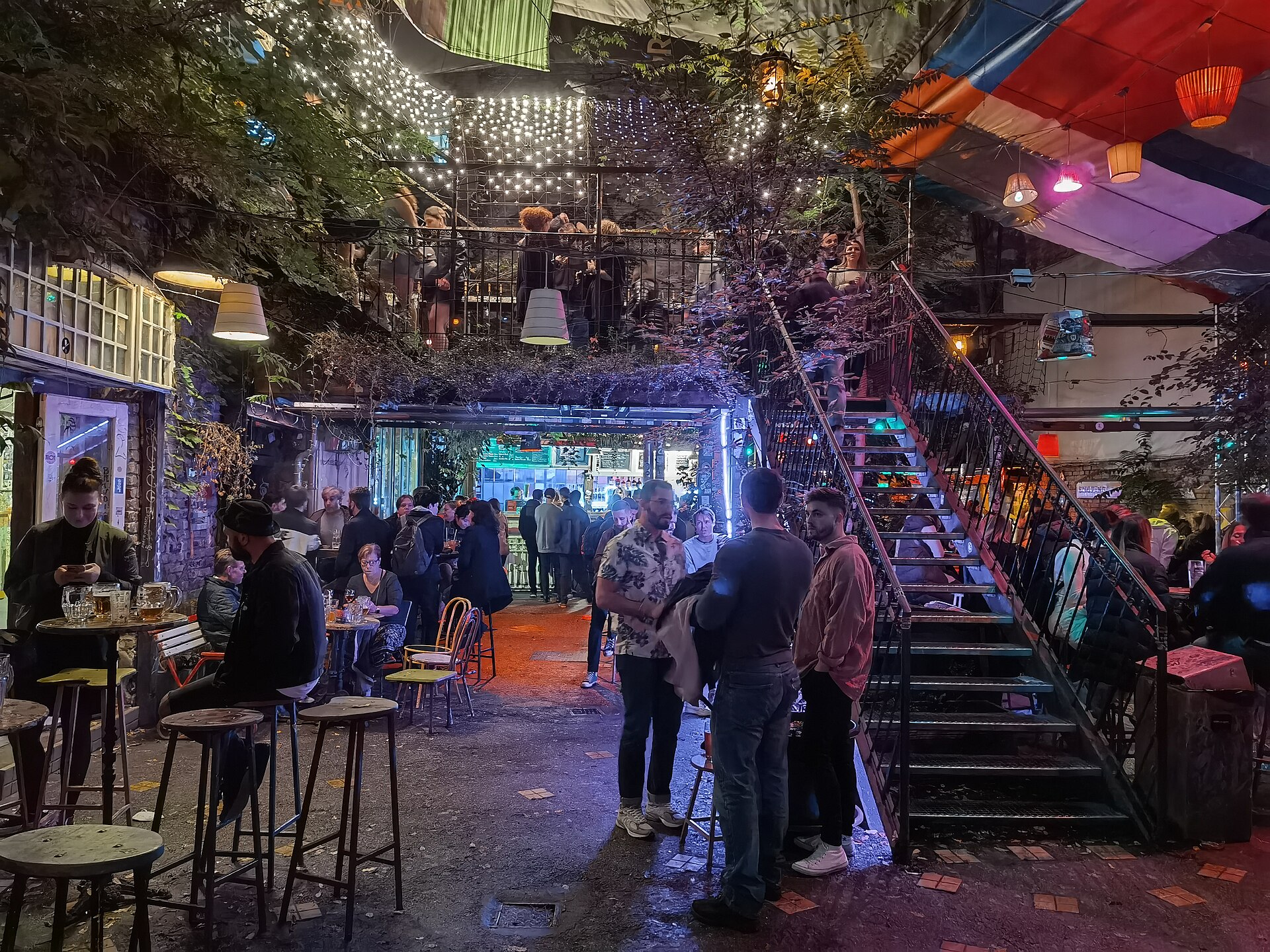
The idea spread fast. Within a decade the inner district had dozens of bars, cheap flights had made Budapest a stag and hen destination, and short-term rental apartments were filling the old buildings. The result was a booming nightlife economy, a lot of money for some people, and a lot of noise, rubbish and broken sleep for the residents. The tension between those two things has shaped the district ever since.
The party district by night
The heart of the nightlife is a handful of streets: Kazinczy utca, Dob utca, Király utca, Akácfa utca and the Gozsdu udvar passage. On a weekend night from spring to autumn they’re packed, and even on a wet Tuesday in February there’s something going on.
Szimpla Kert
Szimpla is the original and still the most famous ruin bar, a warren of rooms, courtyards and staircases full of junk-shop decor at Kazinczy utca 14. It’s now firmly on the tourist trail and very busy at weekends, but it’s still worth seeing, and it still feels like nowhere else. Go early in the evening for a look round before the crowds arrive. Check szimpla.hu for current opening hours and its market days. Our Szimpla Kert guide has more.
Instant-Fogas
On Akácfa utca, Instant-Fogas is the district’s big night out: the two former bars Instant and Fogas merged into one complex with, by its own count, 18 bars and six dance floors spread over several rooms. It opens daily from 16:00 to 06:00, and general entry is free, though some events in individual rooms are ticketed. If you want to dance until dawn, this is where you’ll end up.
Gozsdu udvar
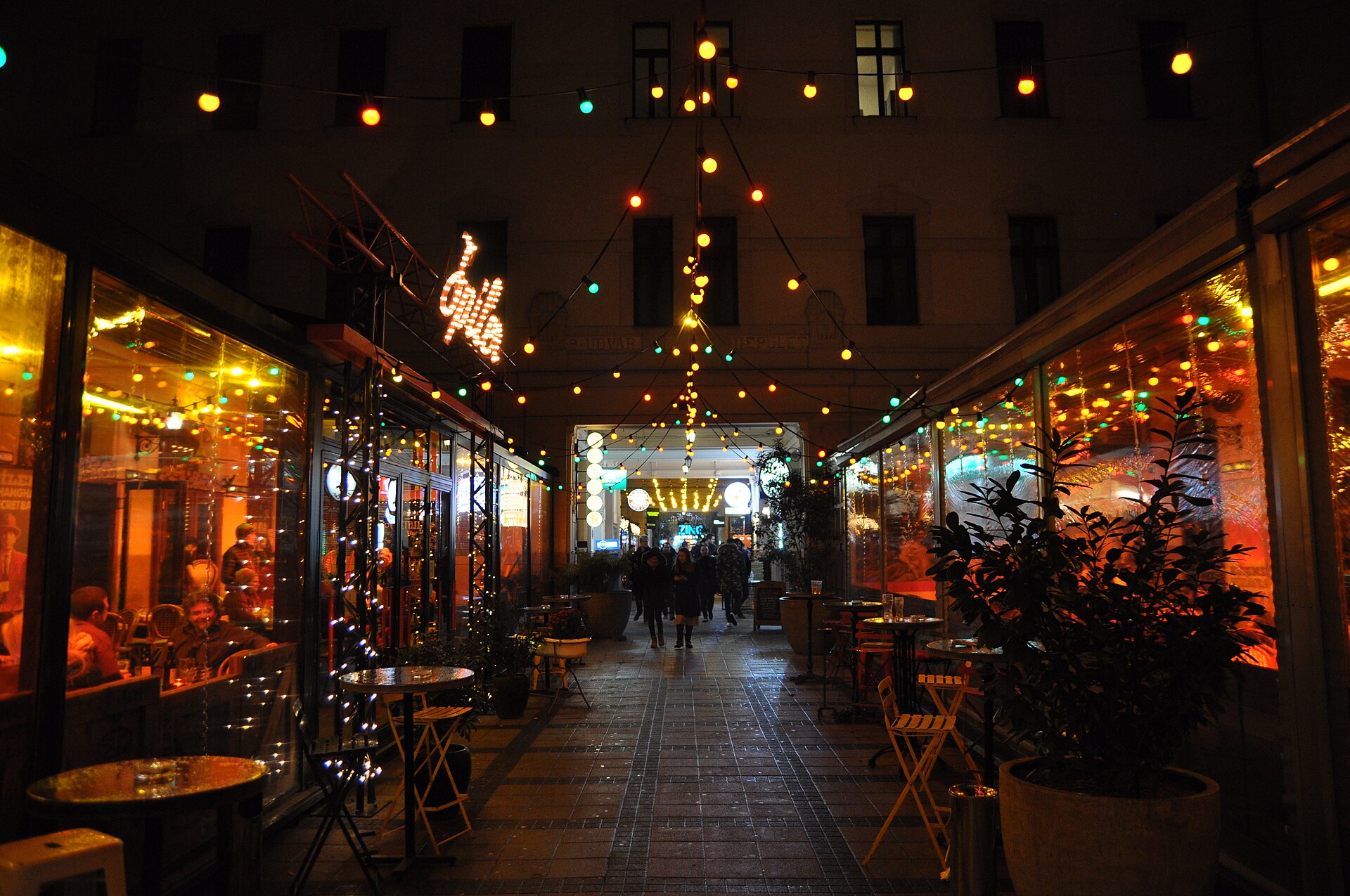
Gozsdu udvar is a long passage of linked courtyards between Király utca and Dob utca, lined with restaurants, bars and terraces. It’s more polished and more expensive than the ruin bars, and lively from early evening. At weekends it hosts the Gozsdu Weekend Market, open Friday to Monday from 10:00 to 17:00 (closed on Mondays in January and February), with antiques, crafts and vintage stalls.
The rest
Beyond the big names, the district has dozens of smaller bars, craft beer places, wine bars and late-night venues, and they open and close constantly. Some of the famous names of the 2010s, Ellátó Kert among them, have long gone. Rather than rely on an old list, ask at your accommodation, or see our guides to Budapest’s ruin bars, the nightlife guide and craft beer in Budapest.
What it’s really like at 3am
It depends where you’re standing. On Kazinczy utca, around Gozsdu and at the Király utca end of Dob utca, the weekend nights are loud and crowded until the small hours, and the noise doesn’t stop when the bars close: groups drift home, shout, sing, and wait for taxis. On a weekday night in winter it’s much calmer, and two or three streets away from the main strip it can be surprisingly quiet.
For visitors, the main things to know are practical. Keep an eye on your phone and wallet in crowded bars. Watch your drink. Use a ride-hailing app or a registered taxi firm rather than a car that pulls up offering a lift; our taxi and Bolt guide explains how. And don’t drink on the street: check erzsebetvaros.hu for the district council’s rules on drinking in public spaces, and keep your drinking to the bars. Our safety guide covers the rest.
For residents, the night is the problem. Many have lived here for decades, long before the bars arrived, and the conflict between sleep and the nightlife economy is the defining local political issue. That’s why the rules keep changing.
Getting around, and getting home
One of District VII’s great advantages is that you hardly need transport at all. The inner district is small enough to cross on foot in fifteen minutes, Deák Ferenc tér and the Basilica are a short walk from Gozsdu udvar, and the Danube is not much further. The M2 metro stops at Astoria and Blaha Lujza tér on the district’s southern edge, and trams 4 and 6 run along the Grand Boulevard, linking the district with Margaret Bridge, Nyugati station and Buda. A single ticket costs 500 Ft (€1.25) and a 24-hour travelcard 2,750 Ft (€6.90), converted at 400 Ft to the euro; our public transport guide explains which to buy.
Getting home late is easier than in most European cities. Tram 6 normally runs through the night along the Grand Boulevard, and a network of night buses covers the rest of the city, though engineering works sometimes replace the night trams with buses, so check BKK’s journey planner or the BudapestGO app before you set out. If you’d rather not wait at a stop at 3am, a ride-hailing app is the simplest option. What you shouldn’t do is accept a lift from a car that pulls up offering one outside a bar.
The rules: bars, crawls and short-term lets
The district council has spent years trying to rein in the party quarter, and the rules have tightened noticeably.
Nightlife
In March 2025 the council adopted new rules for night-time venues in inner Erzsébetváros, which took effect from 31 May 2025. Venues open at night may no longer offer erotic services or live striptease; they may not take part in organised pub crawls; and their windows may stay open only until 22:00. Pub crawls still run elsewhere in the city, but don’t be surprised if a crawl skips the venues you expected. Our pub crawl guide explains what’s on offer.
Short-term rentals
The bigger change is to holiday lets. Under a district decree in force since 1 January 2026, private and other non-hotel accommodation in District VII may be let for zero days a year, unless the building’s condominium agreement allows it, in which case it can be let all year. Fines run to 200,000 Ft (€500) for individuals and 2,000,000 Ft (€5,000) for companies. Hosts who were already registered have until 31 December 2026 to obtain and file their building’s agreement. It isn’t the outright ban that neighbouring District VI introduced, but it hands the decision to each building’s residents.
For visitors this means one thing: if you book an apartment in District VII, choose a reputable host or platform and be aware that supply may shrink through 2027. Hotels and hostels aren’t affected. Our Budapest Airbnb guide has more on renting an apartment in the city.
How the district is changing
Walk through the inner district today and you can see twenty years of change in a single street. Buildings that stood empty in the 2000s have become boutique hotels, aparthotels and renovated flats. Courtyards that once held makeshift bars now hold restaurants with designer lighting. Some of the original ruin bars have become institutions, with merchandise and coach parties; others have closed as their buildings were sold and redeveloped.
Not everyone is unhappy about it. The bars, restaurants and tourists have brought money, jobs and restored facades to streets that were falling apart. But many long-term residents feel the district has been handed over to visitors, and the council’s recent rules on night venues and holiday lets are a direct response to that feeling. How far the pendulum swings back towards residents over the next few years is the big question hanging over the party district. It remains the liveliest few blocks in Budapest, and the most contested.
By day: the district without the hangover
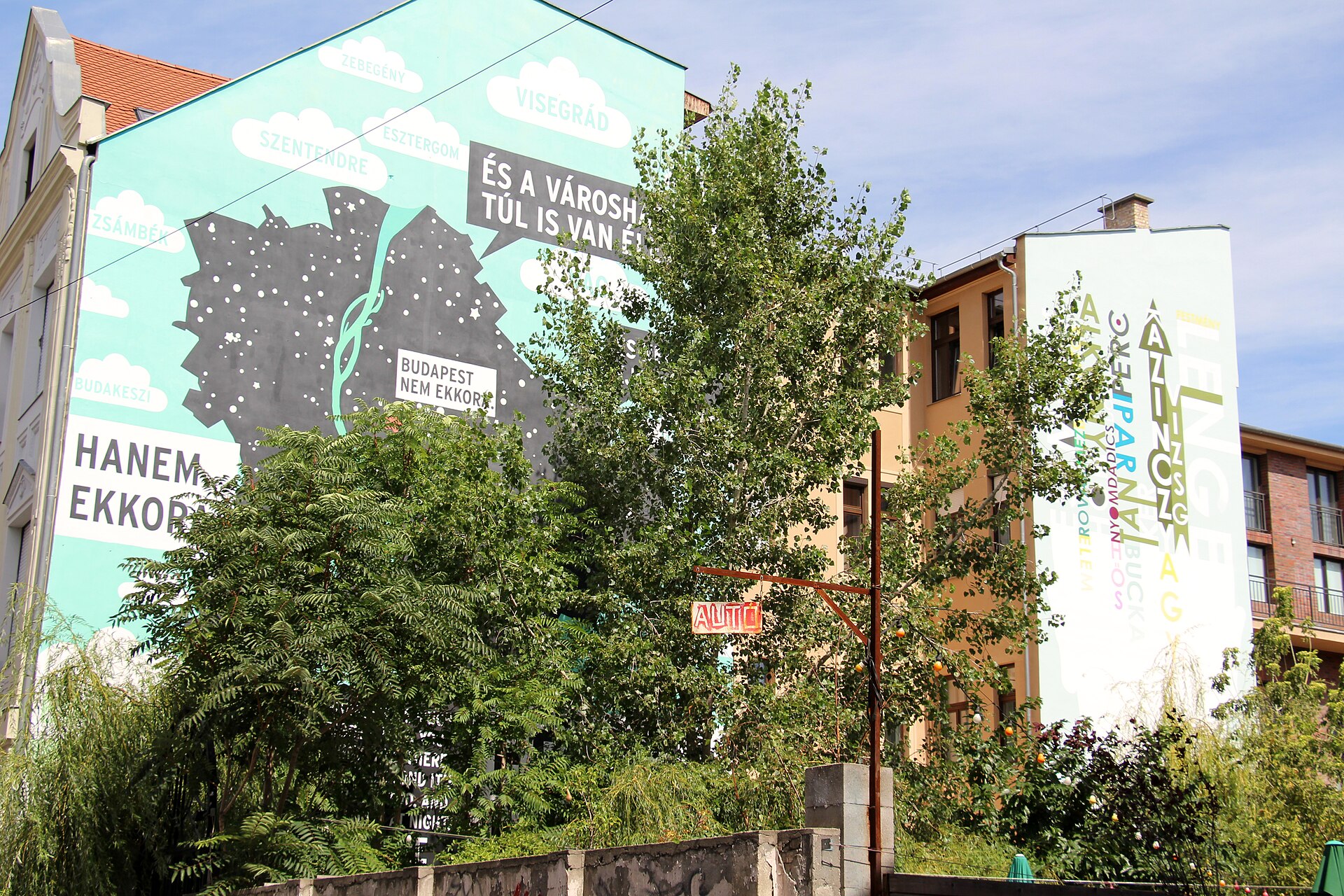
In daylight the inner district is a different place, and a much more interesting one than its reputation suggests. Look up: many of the buildings are grand nineteenth-century apartment blocks, some beautifully restored, some still crumbling, with ornate facades, iron balconies and big inner courtyards. Wander into an open gateway and you might find a garden, a workshop or a café. Huge murals cover many of the firewalls, the blank side walls left where neighbouring buildings were demolished, and they’re among the district’s best sights.
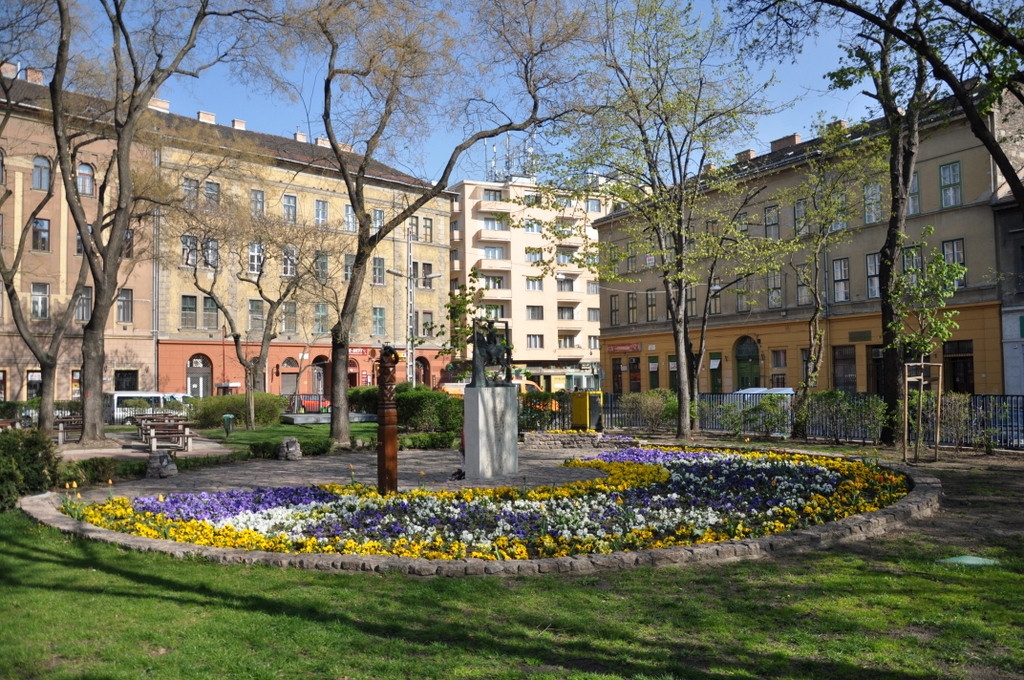
Klauzál tér, the district’s main square, is a good place to see the neighbourhood as locals use it: a small park with a playground, benches and pensioners, ringed by apartment blocks, with Kádár Étkezde, a classic old-style lunch canteen, on one side. On Sundays the streets around Kazinczy are at their calmest, and a morning walk followed by coffee is the best way to understand how people actually live here.
Eating and drinking
District VII is one of the best places in Budapest to eat cheaply and well, and one of the easiest to eat badly and expensively. The difference is mostly a matter of avoiding the terraces with laminated photo menus on the busiest corners.
- Kőleves, at Kazinczy utca 41, has been a district favourite since it opened in 2005, serving modern Hungarian and Jewish-influenced food. Its garden next door is seasonal, open from late April to early October.
- Mazel Tov, at Akácfa utca 47, is a Middle Eastern restaurant in a covered courtyard, open from noon every day, until 23:00 Monday to Thursday and midnight Friday to Sunday. Book at weekends.
- Kádár Étkezde, at Klauzál tér 9, is an old-fashioned lunch canteen, open daily from 08:30 to 17:00.
- Karaván, the street-food yard on Kazinczy utca near Szimpla, has been a late-night favourite for years; check that it’s open before you make a special trip.
For more, see our guides to street food in Budapest, vegan Budapest and the Budapest food guide.
Coffee
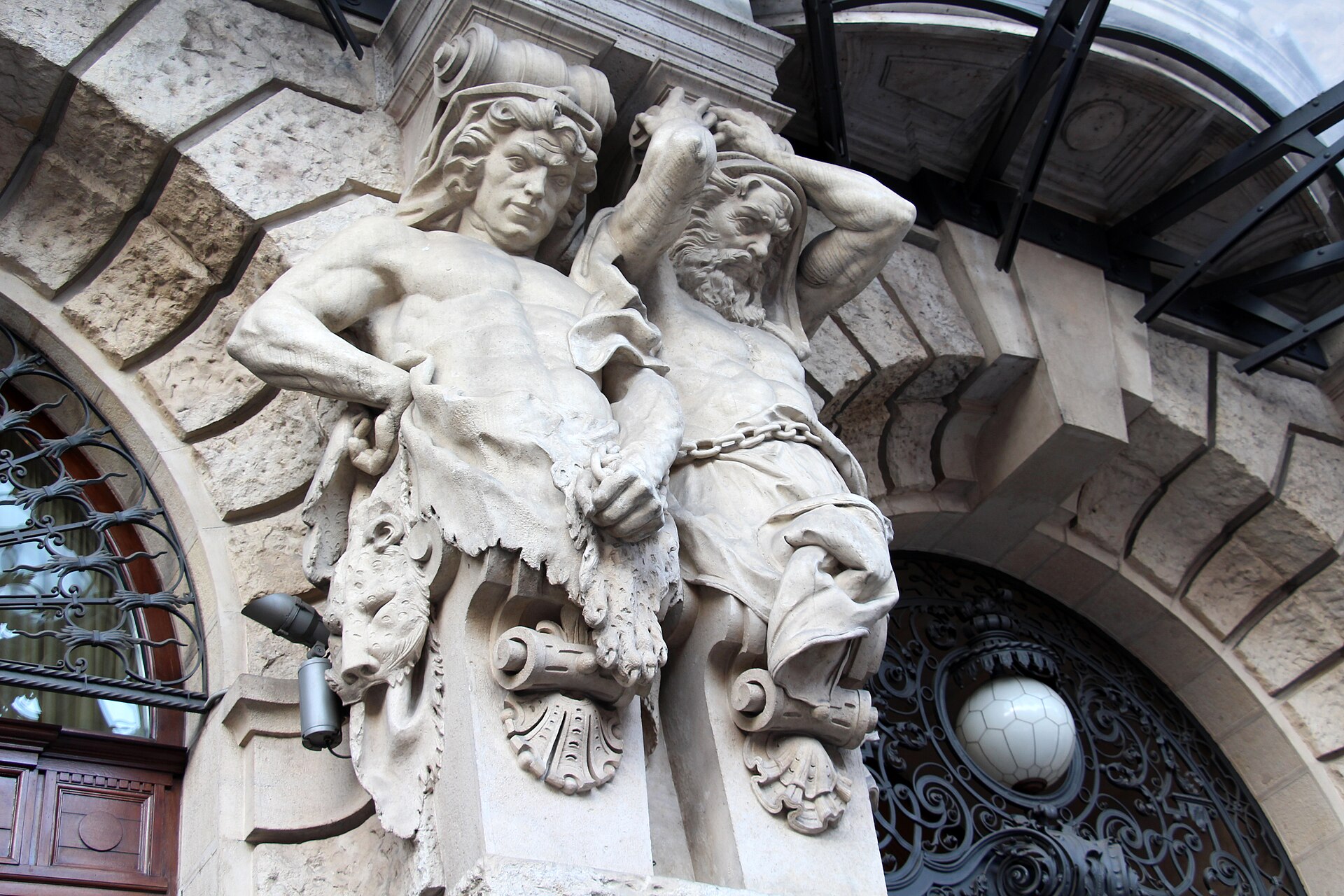
On the Grand Boulevard at the edge of the district stands the New York Palace, home of the New York Café, the most extravagant of the city’s coffee houses. It’s open from 07:00 every day, until midnight Monday to Wednesday and 01:00 Thursday to Sunday. It’s touristy and expensive, but the gilded interior is worth seeing once, ideally early in the morning before the queue builds. Our coffee house guide has quieter alternatives, several of them in the district’s side streets.
The outer district
Cross the Grand Boulevard heading east and the bars thin out within a block. The outer half of Erzsébetváros is residential Pest: long streets of apartment blocks, many in need of repair, with corner shops, cheap lunch places and a few handsome squares. It’s where much of the district’s population lives, and it has the ordinary rhythm the inner district has lost.
There’s little here a visitor must see, but it’s a pleasant walk if you’re heading towards City Park, and it gives you a sense of how the inner district must have felt before the bars came. It’s also, for the same reasons, a much quieter place to stay.
District VII through the year
The district changes a lot with the seasons. From late spring to early autumn the courtyards and garden bars are at their best, the terraces spill onto the pavements, and the weekend crowds are at their biggest, especially when stag and hen groups are in town. Kőleves’s garden, for example, is open only from late April to early October. Summer weekends are the noisiest time to stay.
In winter the party moves indoors. The big bars and clubs stay busy at weekends, and the covered courtyards and heated spaces keep going, but weekday nights are much calmer, and you can walk into most restaurants without booking. For a first look at the ruin bars without the crush, a weeknight between November and March is ideal. Our guide to Budapest in winter has more on the cold months.
Should you stay in District VII?
That depends almost entirely on what you want from your trip and which street you book.
It suits you if you’re here for the nightlife, you want to walk home from the bars, you’re travelling on a budget, or you like being in the middle of things. The location is excellent: Deák Ferenc tér, the Basilica and the Danube are a short walk away, and the trams and metro are on the doorstep.
It doesn’t suit you if you’re a light sleeper, travelling with young children, or here for a quiet, romantic weekend. If you’re unsure, look at the outer district, or at the edges of the inner district towards Rákóczi út or the Grand Boulevard, rather than the streets around Kazinczy, Gozsdu and Dob utca. Ask for a room facing the courtyard, and pack earplugs.
Our guide to which district to book compares Erzsébetváros with the alternatives, and where to stay in Budapest and the hostels guide have specific recommendations.
A day in District VII
- Morning: coffee at the New York Café before the queue, then a walk through the inner district’s side streets to look at the courtyards and murals.
- Lunch: something simple at Kádár Étkezde, or street food on Kazinczy utca.
- Afternoon: the district’s Jewish heritage, with our Jewish Quarter guide, or a browse at the Gozsdu Weekend Market if it’s a market day.
- Evening: dinner at Kőleves or Mazel Tov, then a first drink at Szimpla Kert while it’s still possible to move.
- Late: Instant-Fogas if you want to dance, or a quieter bar on a side street if you don’t.
Is District VII worth it?
Yes, but it’s not the whole of Budapest, and it’s not for everyone. The inner district is the best place in the city for a night out, cheap food and the ruin-bar experience that put Budapest on the map for a generation of travellers. By day it’s a fascinating, rough-edged neighbourhood of grand old buildings, courtyards and murals. But at its busiest it can feel like a theme park for drinking, and the people who live there pay the price.
So enjoy it, but be a good guest: keep the noise down on the way home, don’t drink on the street, and spend some daylight hours here too. If you want the Buda side’s calm by contrast, our guide to the Castle District is the opposite end of the spectrum.
Across Király utca, District VI is the calmer, grander neighbour, with Andrássy út, the Opera and the Liszt Academy; our guide to District VI covers it, including the 2026 rule that ended private short-term lets there.
Frequently asked questions
What is District 7 in Budapest known for?
Erzsébetváros, District VII, is known for its nightlife and ruin bars, centred on Kazinczy utca, Dob utca, Király utca and Gozsdu udvar, and for being Budapest’s historic Jewish quarter. It’s also one of the city’s best areas for cheap food.
Is District 7 a good place to stay in Budapest?
It’s excellent for nightlife and very central, but noisy, especially at weekends around Kazinczy utca and Gozsdu udvar. Light sleepers should choose a quieter street, a courtyard-facing room or the outer district.
Is District 7 safe?
It’s generally safe, but busy at night. Watch for pickpockets in crowded bars, keep an eye on your drink, and use a ride-hailing app or registered taxi firm to get home.
Can you still rent an Airbnb in District 7?
Under a district decree in force since 1 January 2026, short-term lets in District VII are allowed only where the building’s condominium agreement permits them, and existing hosts must file that agreement by 31 December 2026. Book with a reputable host and expect fewer apartments over time.
What is the best ruin bar in District 7?
Szimpla Kert on Kazinczy utca is the original and the most famous, and worth seeing at least once. Instant-Fogas on Akácfa utca is the place for dancing until dawn.
What is the difference between District 6 and District 7?
District VI (Terézváros), on the other side of Király utca, has Andrássy út, the Opera House and a more polished feel. District VII is denser, rougher-edged and has most of the ruin bars.
Is drinking on the street allowed in District 7?
Don’t count on it. Check erzsebetvaros.hu for the district council’s rules on drinking in public spaces; drinking in the bars is the safe choice.
Photo credits
Kazinczy utca (featured image): Budapest – Kazinczy útca by Fred Romero from Paris, France, CC BY 2.0, via Wikimedia Commons.
The courtyard at Szimpla Kert: Budapest, Szimpla Kert, 1 by Random photos 1989, CC0, via Wikimedia Commons.
Gozsdu udvar at night: Budapest, Gozsdu Udvar, 2 by Christo, CC BY-SA 4.0, via Wikimedia Commons.
Firewall mural on Kazinczy utca: Budapest, Kazinczy utca 45, ‘Budapest nem ekkora’ c. tűzfalfestmény by Fred Romero from Paris, France, CC BY 2.0, via Wikimedia Commons.
Klauzál tér: Klauzál Square, Budapest 02 by VinceB, CC BY-SA 3.0, via Wikimedia Commons.
The New York Palace: Budapest – New York-palota (24609968838) by Fred Romero from Paris, France, CC BY 2.0, via Wikimedia Commons.