The Castle District (District I): Buda’s Postcard Quarter
District I beyond the postcards: the old town on Castle Hill street by street, Víziváros, Tabán and Krisztinaváros below it, the cheapest ways up the hill, where to eat and when to come.
In this guide
- District I at a glance
- What District I actually is
- A short history
- The Hauszmann programme
- The old town on the hill, street by street
- Szentháromság tér and the middle of the plateau
- The northern streets: Úri utca, Országház utca, Táncsics Mihály utca and Fortuna utca
- Bécsi kapu tér and Kapisztrán tér
- Dísz tér and the government quarter
- The palace and its museums
- Under the hill
- Getting up the hill
- The Sikló funicular
- The buses
- On foot
- By car
- Víziváros: the Watertown
- Tabán: the quarter that disappeared
- Krisztinaváros and the west side
- Eating and drinking in District I
- When to come, and how long to give it
- A walk through the district
- Is the Castle District worth it?
- Frequently asked questions
- Photo credits
This article contains advertising. Our booking links are routed through a partner that adds commission tracking automatically, so if you book through one we earn a commission from the provider, at no extra cost to you. It never affects what we recommend. Affiliate disclosure
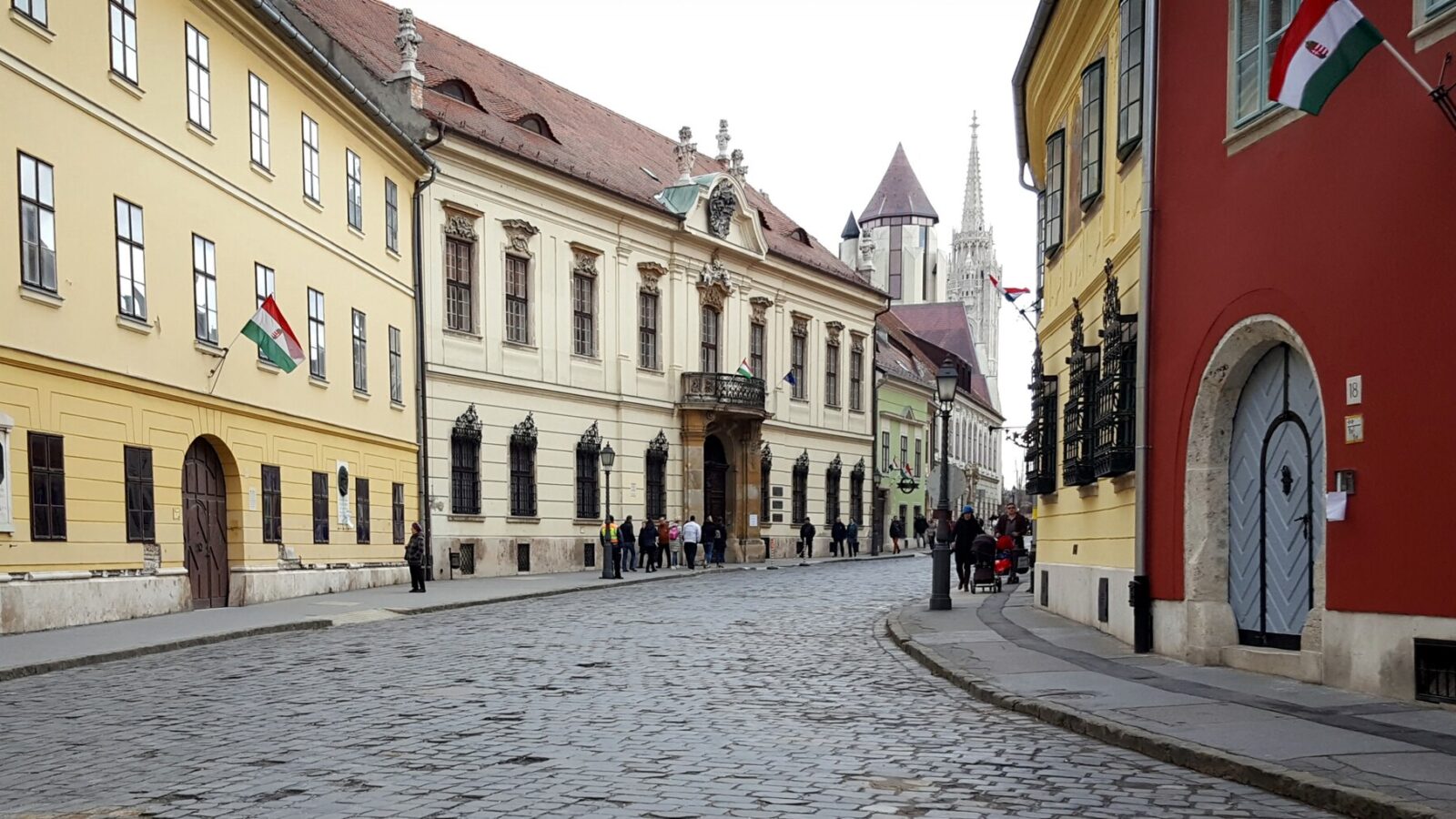
Walk up Táncsics Mihály utca at eight on a weekday morning and you could be in a provincial Habsburg town: pastel houses with heavy wooden gates, a cobbled street just wide enough for one car, a man walking a dachshund, and nobody else at all. Two hours later the same street is full of tour groups heading for the Fisherman’s Bastion. That double life is the key to the Castle District Budapest visitors know from the postcards, and to District I as a whole, which is far bigger and more interesting than the hilltop most people see.
This guide is about District I as a place rather than a list of sights: what the old town on Castle Hill is like to walk around, how it came to look the way it does, the quieter neighbourhoods at its foot (Víziváros, Tabán, Krisztinaváros and a slice of Gellért Hill), how to get up the hill without wasting money, where to eat, and when to come. Prices and opening hours were checked in October and November 2026; treat them as the right order of magnitude. The individual sights have their own pages, linked as we go, and our guide to Budapest’s districts puts District I alongside the other 22.
District I at a glance
| What | District I |
|---|---|
| Official name | Várkerület (literally “Castle district”) |
| Area | 3.41 km² |
| Population | About 25,000 |
| Neighbourhoods | Várnegyed (the old town on Castle Hill), Víziváros, Tabán, Krisztinaváros, Gellérthegy |
| Created | 17 November 1873, when Buda, Pest and Óbuda united as Budapest |
| Main sights | Buda Castle and its museums, Matthias Church, the Fisherman’s Bastion, the Hospital in the Rock, Sándor Palace |
| Getting there | M2 metro to Batthyány tér or Széll Kálmán tér; buses 16, 16A and 116 up the hill; the Sikló funicular from Clark Ádám tér |
| Best for | Walking, views, history, a quiet evening stroll |
| Not for | Nightlife, cheap eating on the hilltop, anyone who hates cobbles |
What District I actually is
Most visitors think of the Castle District as the walled plateau on top of Castle Hill: the Royal Palace at the southern end, Matthias Church and the Fisherman’s Bastion in the middle, and a grid of baroque streets running north to the Vienna Gate. That’s Várnegyed, the old town, and it’s what the postcards show. But District I runs well beyond the walls. Below the eastern slope, Víziváros (Watertown) stretches along the Danube to Batthyány tér. To the south, Tabán fills the dip between Castle Hill and Gellért Hill. To the west, Krisztinaváros runs out towards the Déli railway station and the start of the Buda Hills. And the district takes in part of Gellért Hill itself.
It’s a small district, one of the smaller ones in the city by area, and a quiet one by population: roughly 25,000 people live here, most of them down in Krisztinaváros and Víziváros rather than on the hill. The result is a district with two very different characters. The hilltop is a museum piece that empties out in the evening. The neighbourhoods below are ordinary, comfortable Buda: apartment blocks, schools, corner bakeries, a few good restaurants and almost no tourists.
A short history
Castle Hill has been the seat of Hungarian power, on and off, since the Middle Ages, when the kings moved their court here and a walled town grew up around the palace. The Ottomans took Buda in the sixteenth century and held it until 1686, when a Habsburg-led army besieged and recaptured it, leaving much of the medieval town in ruins. What you walk through today is largely the baroque town that was built on the old foundations in the eighteenth century, which is why so many houses have Gothic niches and arches showing through baroque facades.
The nineteenth century gave the hill its grand set pieces. The funicular opened in 1870, linking the river with the palace. Franz Joseph was crowned King of Hungary in Matthias Church on 8 June 1867. Frigyes Schulek built the Fisherman’s Bastion between 1895 and 1902, as a promenade and lookout on the line of the old walls. And the palace was rebuilt and enlarged into the huge neo-baroque complex that dominates the skyline.
Then came the Second World War. The siege of Budapest in 1944–45 ended with the German and Hungarian forces making their last stand on Castle Hill, and the palace and much of the old town were wrecked. The post-war rebuilding restored many of the houses carefully, but the palace was reconstructed in a simplified form, and several buildings around it were cleared rather than repaired.
The Hauszmann programme
Since the late 2010s the government’s National Hauszmann Programme has been rebuilding some of what was lost, named after Alajos Hauszmann, the architect of the palace’s last great expansion. Finished so far are St Stephen’s Hall inside the palace, the Riding Hall (Lovarda), the Main Guardhouse (Főőrség), the Csikós courtyard, the Stöckl staircase, the Hauszmann ramp, the Karakas Pasha tower with its Turkish garden, and the old Hungarian Red Cross headquarters. Work continues on the palace itself, the Archduke Joseph Palace and the former Army High Command building, so expect scaffolding and building sites around Szent György tér for some time yet. The Riding Hall can be seen only on a guided walk; check nemzetihauszmannprogram.hu for current tours and prices.
Whether you think the reconstructions are a fine recovery of lost heritage or a costly exercise in nostalgia depends on whom you ask; Budapest has argued about it for years. Either way, the area between the palace and the Sándor Palace looks very different from a decade ago.
The old town on the hill, street by street
The old town is small, a plateau about a kilometre and a half long, and you can walk it end to end in twenty minutes. But it rewards going slowly, and above all going early or late. Here’s how it fits together.
Szentháromság tér and the middle of the plateau
The square in front of Matthias Church, named after the plague column (the Holy Trinity statue) at its centre, is one of the old town’s busiest points and a common meeting place for walking tours. Matthias Church charges 3,400 Ft (€8.50) for the church and a separate 4,000 Ft (€10) for the tower in 2026, and its hours change around services and state visits, so check its calendar before you go. Behind the church, the Fisherman’s Bastion’s lower terraces are free; the upper level costs 1,700 Ft (€4.25) during charging hours, which in late autumn and winter run 09:00–19:00, and it’s free outside them. That’s the single most useful thing to know about the bastion: come at sunrise or after dark and the view is yours, for nothing. Our guides to Matthias Church and the Fisherman’s Bastion have the details.
The northern streets: Úri utca, Országház utca, Táncsics Mihály utca and Fortuna utca
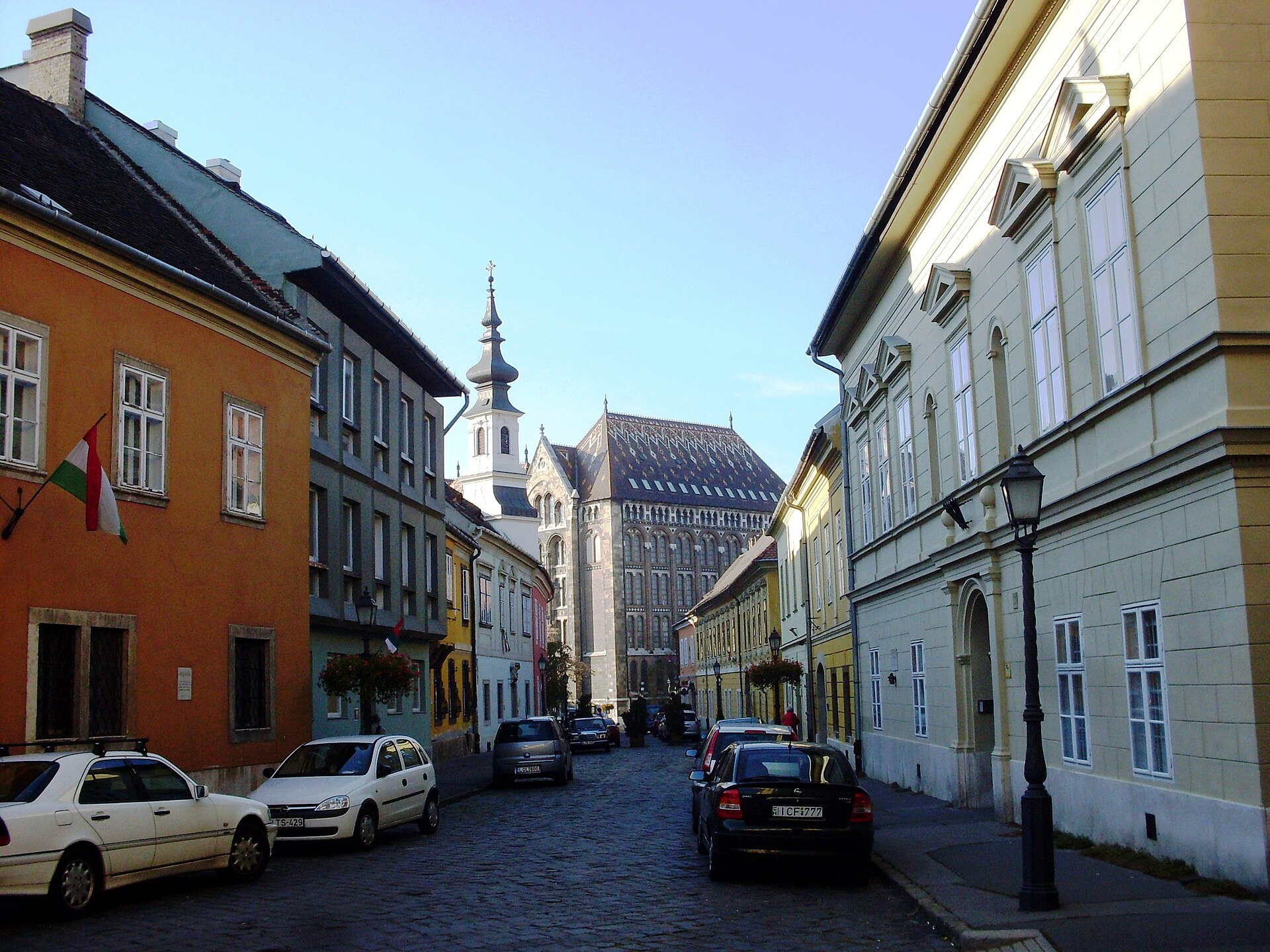
North of the church, four long parallel streets run up to the Vienna Gate, and this is where the old town feels most like a town. Úri utca is lined with baroque houses, many with stone plaques telling you who lived there and when. Országház utca takes its name from the late-eighteenth-century diet that met here. Táncsics Mihály utca and Fortuna utca, the quietest of the four, are where you’ll find the best of the peeling, pastel, slightly crooked facades that photographers love. Look into the open gateways: many have Gothic sedilia, the stone seat-niches that medieval houses had in their entrance halls, uncovered during the post-war restoration.
Bécsi kapu tér and Kapisztrán tér
At the northern end, the Vienna Gate (Bécsi kapu) opens onto a little square of colourful houses and the Lutheran church. A few steps west, Kapisztrán tér is dominated by the bulky building of the National Archives and by the lonely Gothic tower of the Church of Mary Magdalene, the main surviving part of a church wrecked in the war. From the walls here, the Tóth Árpád sétány promenade runs south along the western ramparts, lined with chestnut trees and benches and with a view over Krisztinaváros towards the Buda Hills. It’s the best walk on the hill, and the least crowded.
Dísz tér and the government quarter
South of Szentháromság tér, the plateau narrows towards the palace. Dísz tér has a statue of a hussar and the remains of the war-damaged former Ministry of Defence. Then come the two buildings that make this part of the hill the seat of government: the Sándor Palace, the residence and office of the President of the Republic, and the former Carmelite monastery next door, now the Prime Minister’s office. Check sandorpalota.hu for the palace’s Open Doors days, when the palace is open to visitors who register in advance.
The palace and its museums
The Royal Palace at the southern end houses the Hungarian National Gallery, open Tuesday to Sunday from 10:00 to 18:00, and the Budapest History Museum’s Castle Museum, which covers the palace’s own story and the medieval town, open daily from 10:00 to 18:00. The National Széchényi Library occupies the wing at the far end. The terraces in front of the palace look straight down the Danube to Gellért Hill and are free to wander. For the palace in detail, see our Buda Castle guide; for the gallery and the other big collections, the Budapest museums guide.
Under the hill
Castle Hill is honeycombed with natural caves and cellars. The best-known visit underground is the Hospital in the Rock on Lovas út, a wartime emergency hospital later turned into a nuclear bunker, seen on a guided tour; it’s open daily from 10:00 to 19:00 and the English tour costs €30 for adults. See our Hospital in the Rock guide. Check the current status of the Buda Castle Labyrinth on Úri utca before you plan around it.
Getting up the hill
Castle Hill is steep on every side, and how you get up makes more difference to your day than you might think.
The Sikló funicular
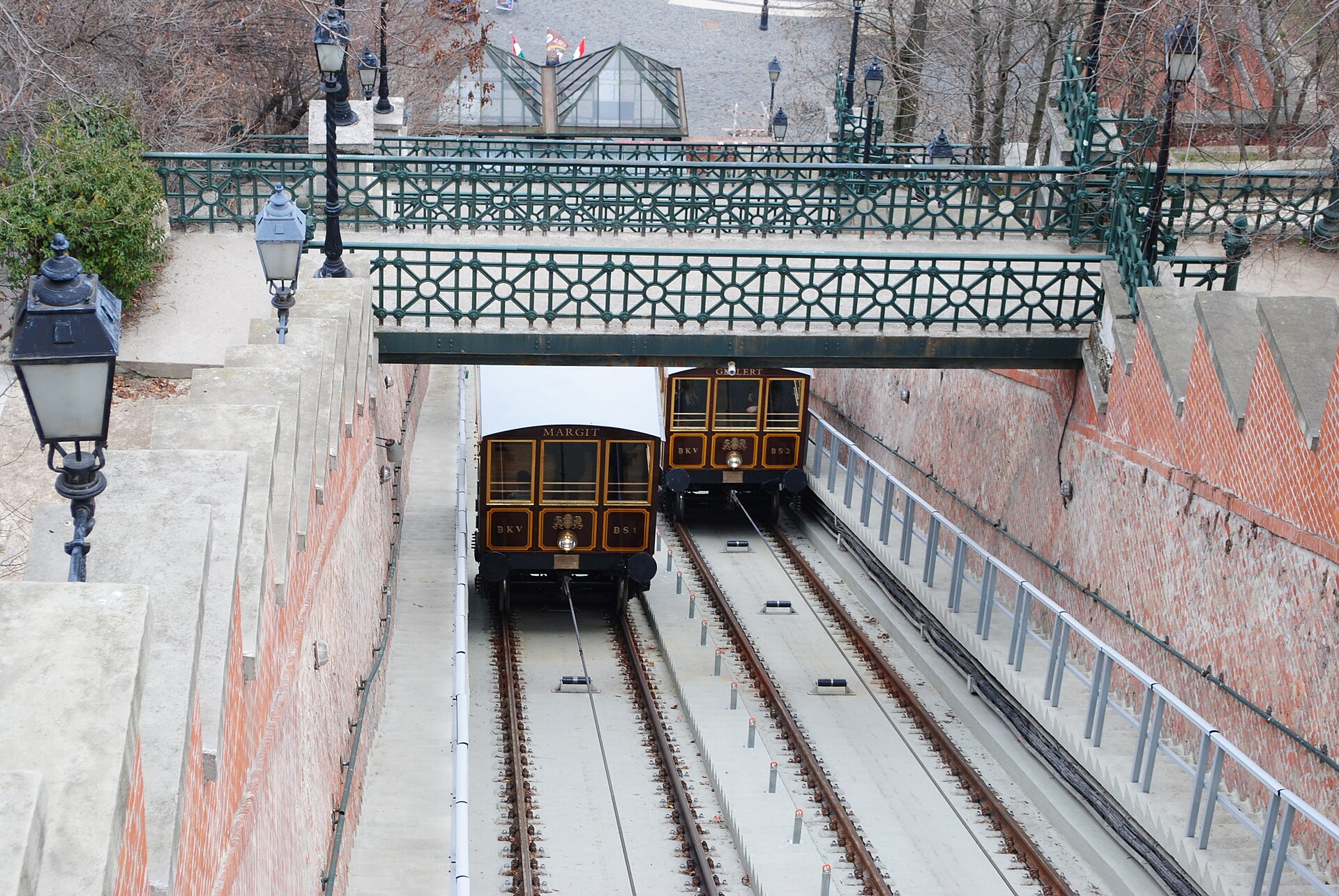
The Budavári Sikló runs from Clark Ádám tér, at the Buda end of the Chain Bridge, up to Szent György tér between the palace and the Sándor Palace. It’s a charming ride in restored wooden cars, and it’s also the priciest way up: in 2026 an adult one-way ticket cost 4,500 Ft (€11.25) and a return 5,500 Ft (€13.75), with children aged 3–14 paying 2,000 Ft (€5) one way. It runs daily from 08:00 to 22:00, with last tickets at 21:50, but closes on alternate Mondays for maintenance, so check the BKV site for closure dates. The queue at the bottom on a summer afternoon can be long. Our honest verdict: ride it once, downhill if you like, for the view of the Chain Bridge, and use the bus the rest of the time.
The buses
Buses 16, 16A and 116 climb the hill on ordinary public transport tickets, which makes them by far the cheapest way up: a single ticket is 500 Ft (€1.25), and travelcards are valid. The 16 runs from Deák Ferenc tér in Pest across the Chain Bridge to Clark Ádám tér and up into the old town; the 16A and 116 come up from Széll Kálmán tér, the big transport hub on the M2 metro. See our public transport guide for tickets.
On foot
Walking up is free, takes ten to fifteen minutes from most directions, and shows you parts of the hill that people riding up never see. Good routes are the steps from Batthyány tér up through Víziváros to the Fisherman’s Bastion; the path from Széll Kálmán tér up to the Vienna Gate; and the gardens and ramps of the Várkert Bazár on the river side below the palace, where there are also lifts and escalators part of the way. Wear shoes with grip: the cobbles are slippery in the wet.
By car
Don’t. Access to the old town by car is restricted, the few parking spaces are mostly for residents and permit holders, and the streets are narrow. Leave the car in Pest and take the bus. Our parking guide explains the options.
Víziváros: the Watertown
Víziváros is the strip of streets between the eastern slope of Castle Hill and the Danube, running north from Clark Ádám tér to Batthyány tér and beyond. In the Middle Ages it was where fishermen and craftsmen lived below the castle walls; today it’s a quiet, attractive residential neighbourhood of eighteenth- and nineteenth-century houses, steep stepped lanes and small churches, with Fő utca (“Main Street”) running along it parallel to the river.
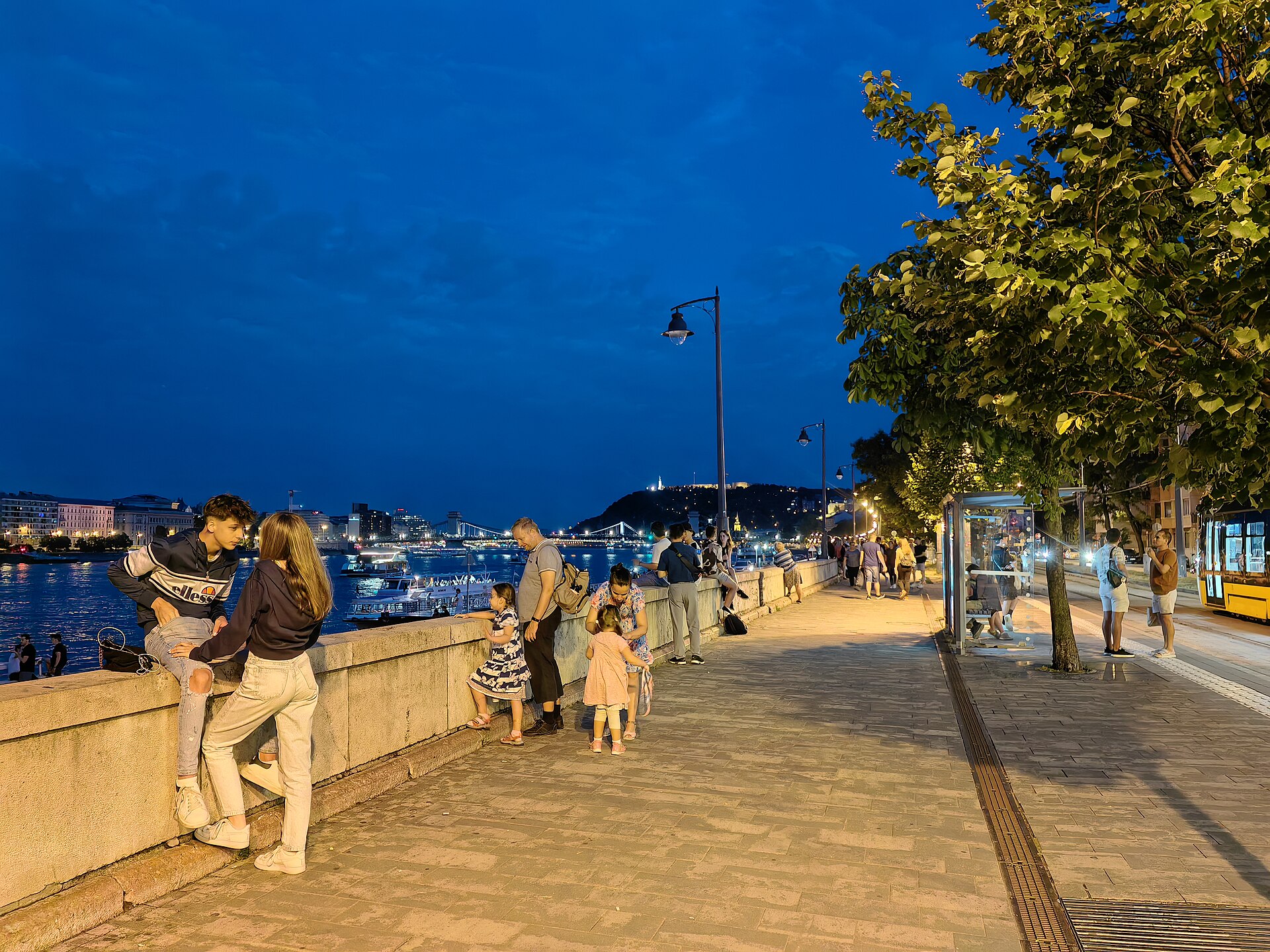
Batthyány tér is its centre: a square on the river with the twin towers of St Anne’s Church on one side and, across the water, a full-frontal view of the Parliament. It’s also a transport hub, with the M2 metro and the H5 suburban railway to Szentendre. Come here at dusk for the view; the Parliament lights up across the river and the embankment fills with people taking photographs. Our photography spots guide has more viewpoints like it.
Further north along Fő utca is the Király Baths, one of the Ottoman-era baths, which is closed indefinitely; don’t make the trip. Our Király Baths page tracks its status. For a bath in this part of Buda, go a little further north to Lukács, just over the district line.
Víziváros is the part of District I where you’d actually choose to live, and it’s also the best base in the district for visitors: close to the metro, the river and the hill, but with ordinary shops and prices. If you’re weighing it against Pest, our guide to which district to book compares it with the alternatives.
Tabán: the quarter that disappeared
Between the southern end of Castle Hill and Gellért Hill lies Tabán, which today is mostly a sloping park crossed by paths and the approach roads to the Elisabeth Bridge. It wasn’t always like this. For centuries Tabán was a crowded, ramshackle quarter of small houses, taverns and wine cellars, home to Serbs, Greeks and others, and much loved by writers and artists. In the 1930s the city cleared most of it for redevelopment that never fully happened, and the park is what was left.
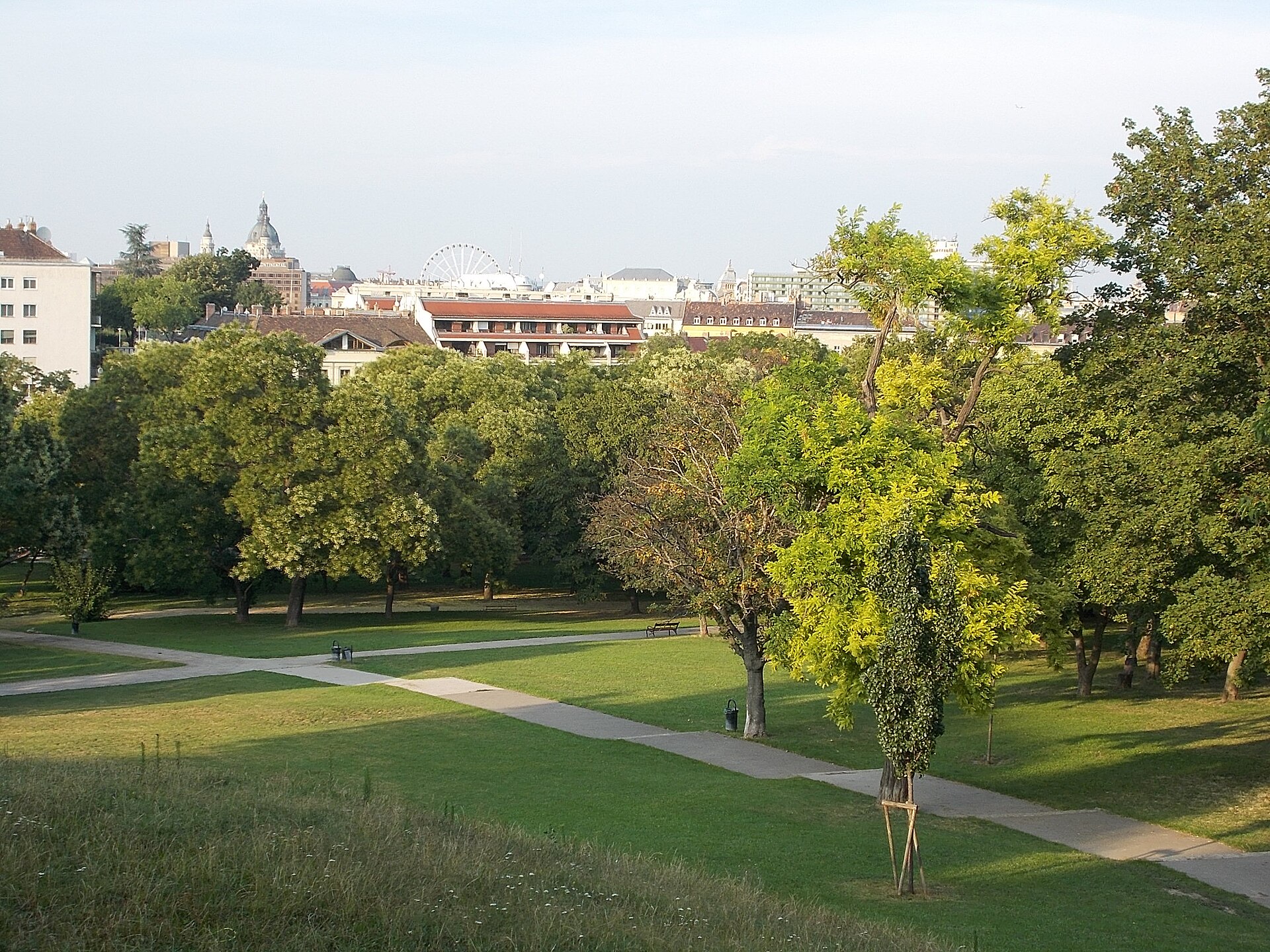
A few traces survive: the yellow baroque Tabán parish church at the foot of the hill, a handful of old houses along the edge of the park, and the street names. On a summer evening the park is full of locals with picnics and dogs; in winter it’s a good sledging slope when it snows. It’s also the easiest way to walk from the castle to the Rudas Baths and to the foot of Gellért Hill, whose northern slopes are part of District I.
Krisztinaváros and the west side
West of Castle Hill, Krisztinaváros is a large residential neighbourhood and one of the district’s least visited. It’s a pleasant, leafy, rather well-off residential area that grew up in the nineteenth century around the Christina Church, and it has nothing a tourist must see. That’s its appeal. The Vérmező, a long park below the western walls, is where the leaders of the Hungarian Jacobin conspiracy were executed in 1795, which gave it its name (the “Field of Blood”); today it’s a place for joggers, dog walkers and children.
At its northern edge is Déli pályaudvar, the Southern Railway Station, terminus for trains to Lake Balaton and the south-west. The station is open, but timetables have been changing as works on the line continue in phases into 2027, so check MÁV before you travel. The train stations guide explains what goes from where, and Lake Balaton from Budapest covers the main reason visitors use Déli.
Eating and drinking in District I
The honest truth about eating on Castle Hill is that most restaurants on the hilltop are aimed squarely at people who will never come back, and are priced accordingly. There are exceptions, but it pays to choose before you’re hungry.
- 21 Restaurant, at Fortuna utca 21, serves modern Hungarian food and is open daily from 11:30 to 23:00.
- Pierrot, at Fortuna utca 14, is open Wednesday to Sunday from 11:30 to 23:00 and closed on Mondays and Tuesdays.
- The Fisherman’s Bastion has its own café and bistro in the arcades, which you’re paying for the setting at.
The great loss of recent years is Ruszwurm, the tiny cake shop near Matthias Church, which had been a Castle Hill institution since 1827; it closed in August 2025 when the district council took back its premises after a long lease dispute. Some websites still list it, so check before you trek up for a slice of cake.
For everyday eating, go down the hill. Víziváros and the streets around Batthyány tér and Széll Kálmán tér have bakeries, lunch places and neighbourhood restaurants at ordinary Budapest prices, and Pest is only a bridge away. Our best restaurants in Budapest guide has more.
For drinking, District I is quiet. There’s no nightlife to speak of on the hill, and the bars below it are neighbourhood places. If you want a late night, cross the river: our nightlife guide starts in District VII.
When to come, and how long to give it
The old town is at its best early in the morning and in the evening. Between about 10:00 and 17:00, especially from spring to autumn, the stretch from the palace to the Fisherman’s Bastion is one of the busiest places in the city. Before nine, you’ll share it with residents and street sweepers; after dark, with a few couples and the occasional photographer. Sunset from the palace terraces or the Tóth Árpád promenade is wonderful, and our sunset guide has the best spots.
Give the hilltop half a day if you want to see the main sights without rushing, and a full day if you’re visiting the National Gallery or the Castle Museum properly. Add an hour or two to walk down through Víziváros or Tabán. The Budavári Borfesztivál, the Budapest Wine Festival, filled the palace courtyards and terraces in September 2026; see the wine festival guide.
A walk through the district
- Start at Széll Kálmán tér and walk up to the Vienna Gate.
- Wander south down Táncsics Mihály utca and Fortuna utca, then cross to Úri utca.
- Reach Szentháromság tér for Matthias Church and the Fisherman’s Bastion.
- Continue south past the Sándor Palace to the palace terraces.
- Walk down through the Várkert Bazár gardens, or take the Sikló down to Clark Ádám tér.
- Follow Fő utca north through Víziváros to Batthyány tér for the view of the Parliament.
It’s about two to three hours with stops. For guided options, see our walking tours guide.
Is the Castle District worth it?
Yes, without question, but on your own terms. The hilltop is one of the most beautiful places in central Europe, and seeing it in the quiet of early morning or after dark is one of the best things you can do in Budapest. Seen at midday in July, shuffling between tour groups and paying for the funicular, the bastion and an overpriced lunch, it can feel like a theme park.
So come early, take the bus, see the free terraces outside charging hours, eat down the hill, and spend an hour in Víziváros or Tabán, where the district is just a part of the city where people live. As a base, Víziváros is quiet and well connected; the hilltop itself is lovely for a night or two but dead after dark. For the other side of the river, our guides to the city’s best landmarks and free things to do pick up where this leaves off.
Frequently asked questions
What is the Castle District in Budapest?
It’s District I (Várkerület), the area around Castle Hill on the Buda side. It includes the old town on the hilltop, with Buda Castle, Matthias Church and the Fisherman’s Bastion, and the neighbourhoods below it: Víziváros, Tabán, Krisztinaváros and part of Gellért Hill.
How do I get to the Castle District?
Take bus 16 from Deák Ferenc tér or Clark Ádám tér, or the 16A or 116 from Széll Kálmán tér, on an ordinary ticket. The Sikló funicular from Clark Ádám tér is the scenic option, at 4,500 Ft one way for adults in 2026. You can also walk up from Batthyány tér or Széll Kálmán tér in ten to fifteen minutes.
Is the Castle District free to visit?
Walking around the old town, the palace terraces and the lower Fisherman’s Bastion terraces is free. You pay for the museums, Matthias Church, the upper level of the Fisherman’s Bastion during charging hours and the funicular.
How much time do you need in the Castle District?
Half a day covers the main sights at a comfortable pace. Allow a full day if you’re visiting the National Gallery or the Castle Museum, and an extra hour or two to walk down through Víziváros or Tabán.
Is the Castle District a good place to stay?
It’s lovely and very quiet in the evening, but expensive and a long way from restaurants and nightlife. Víziváros, below the hill, is a better-connected base. Our where to stay guide compares the options.
Can you drive into the Castle District?
Car access to the old town is restricted, and parking is mostly for residents and permit holders. Take the bus instead.
When is the best time to visit the Castle District?
Early morning or after dark, when the crowds have gone. The Fisherman’s Bastion’s upper level is free outside its charging hours, and the views are at their best at sunrise and sunset.
Photo credits
Táncsics Mihály utca in the Castle District (featured image): TancsicsUtcaThalerTamas by Thaler Tamas, CC BY-SA 4.0, via Wikimedia Commons.
Táncsics Mihály utca towards Bécsi kapu tér: Táncsics Mihály utca, Bécsi kapu tér felé nézve 2010-10-28 – panoramio (1) by 77csoda, CC BY-SA 3.0, via Wikimedia Commons.
The Sikló funicular: 2022-03 Budapest – Castle Hill Funicular (1) by Marek Mróz, CC BY-SA 4.0, via Wikimedia Commons.
The Danube embankment at Batthyány tér: Budapest, Batthyány tér, Duna-part by Random photos 1989, CC0, via Wikimedia Commons.
Tabán park: Tabán. Park. – Budapest District I by Globetrotter19, CC BY-SA 3.0, via Wikimedia Commons.