Budapest in February: Cold Air, Hot Water, No Queues
A planner for Budapest in February: the weather and lengthening days, the baths in the cold, the end of carnival and the Busójárás in Mohács, Valentine's weekend, a week-by-week calendar for 2027 and what it all costs.
In this guide
- February at a glance
- The weather, honestly
- Why February is good value, and the one weekend it isn’t
- Thermal baths in the cold
- Széchenyi
- Rudas
- Lukács
- The two you can’t visit
- Winter bathing tips
- Carnival season: farsang, doughnuts and the end of winter
- The Busójárás in Mohács
- Getting there from Budapest
- 25 February: remembering the victims of communism
- Indoor days: museums, music and coffee
- Museums
- Opera and concerts
- Coffee houses
- The Central Market Hall
- Outdoors, when the sun comes out
- February 2027, week by week
- 1–7 February: the last week of carnival
- 8–14 February: Shrove Tuesday, Ash Wednesday and Valentine’s
- 15–21 February: the quietest stretch
- 22–28 February: the first signs of spring
- Eating and drinking in February
- What February costs
- Day trips in February
- What to pack for February
- Is Budapest worth visiting in February?
- Practical tips
- Frequently asked questions
- Photo credits
This article contains advertising. Our booking links are routed through a partner that adds commission tracking automatically, so if you book through one we earn a commission from the provider, at no extra cost to you. It never affects what we recommend. Affiliate disclosure
There is a particular kind of February afternoon in Budapest when the sky is the colour of a dirty sheet, the wind off the Danube finds every gap in your coat, and the thought of sitting in water at 38 °C becomes almost unbearably attractive. Then you walk into the Széchenyi Baths, lower yourself into the big outdoor pool with the frost still on the railings, and the city makes sense again. Budapest in February is like that all month: cold outside, hot water and warm rooms within, and almost none of the queues that build up from spring onwards.
This guide covers what the month is really like and how to spend it well: the weather and the slowly lengthening days, where February saves you money and where it doesn’t, the baths, the end of carnival season and the masked Busójárás in Mohács, the day Hungary remembers the victims of communism, a week-by-week calendar for February 2027, costs and an honest verdict. Prices were checked in October and November 2026 and are mostly 2026 tariffs; treat them as the right order of magnitude, since Budapest’s baths and museums usually set new prices in the new year. For the whole year side by side, see Budapest month by month.
February at a glance
| What | February in Budapest |
|---|---|
| Temperature | Average daily high about 6 °C; average nightly lows below freezing (HungaroMet, 1991–2020) |
| Daylight | About 9½ hours on 1 February, nearly 11 by the 28th; sunset moves from about 16:45 to about 17:25 |
| Crowds | Thin all month, apart from Valentine’s weekend |
| Public holidays | None |
| Key dates in 2027 | Shrove Tuesday 9 February · Ash Wednesday 10 February · Valentine’s Day Sunday 14 February · Memorial Day for the Victims of Communism Thursday 25 February |
| Best for | Thermal baths, museums, coffee houses, opera and concerts, couples, travellers on a budget |
| Not for | River cruises on the open deck, long park days, anyone who wilts without sun |
The weather, honestly
February is still winter. HungaroMet’s 1991–2020 averages for Budapest put the typical daily high at just under 6 °C, a few degrees warmer than January, and the average overnight low below freezing. In practice that means mornings with frost on the parked cars, afternoons that feel tolerable in the sun and raw in the wind, and the odd spell of a week or so when the temperature doesn’t climb above zero at all. Snow comes some years and not others. When it does fall it rarely settles in the centre for long, though the Buda Hills can stay white for days after Pest has turned to slush.
The wind is what visitors tend to underestimate. The bridges and the riverside promenades are exposed, and the walk across the Chain Bridge that is a pleasure in May can be a grim ten minutes in February. Plan your outdoor sightseeing for the middle of the day, keep the river walks short, and have somewhere warm lined up for afterwards.
The good news is the light. On 1 February the sun sets at about a quarter to five; by the end of the month it’s nearly half past five, and you’ll notice the difference within a week or two of arriving. Sunrise moves the other way, from just after seven to around half past six. Nearly eleven hours of daylight by the 28th is enough for a full day’s sightseeing without the dusk-at-four feeling of December and January.

Why February is good value, and the one weekend it isn’t
For most of February, Budapest is a buyer’s market. The Christmas markets are long gone, the January sales are over and the spring city-break season hasn’t started, so hotels have rooms to fill. Outside the Valentine’s weekend, February rates are usually among the lowest of the year, and the gap between a central hotel and one a few metro stops out shrinks, which makes it a good month to stay somewhere you’d normally consider a stretch. Compare a few dates before you book; a Tuesday-to-Friday stay is often noticeably cheaper than the weekend.
The other saving is time. The sights that have queues for most of the year, the Parliament tours, the Fisherman’s Bastion terraces, the House of Terror on a weekend afternoon, the famous coffee houses, are at their quietest. The New York Café on the Grand Boulevard, which opens at 07:00 every day and closes at midnight Monday to Wednesday and 01:00 Thursday to Sunday, is a good example: in summer the line outside can be the length of the building, and on a weekday morning in February you can often walk straight in.
What you give up is obvious enough. The days are shorter than in spring, the parks are brown, the open-air terraces are shut or wrapped in plastic, and a sightseeing cruise means sitting behind glass. If your idea of Budapest is a long evening on a rooftop bar, come in June. If it’s a long soak, a gallery, a heavy lunch and an evening at the opera, February is hard to beat.
The exception is the weekend nearest 14 February. In 2027 Valentine’s Day is a Sunday, so the Friday and Saturday before it are when the romantic dinners, couples’ spa packages and river dinner cruises book up. If you’re coming for Valentine’s, book early; if you’re not, consider shifting your trip a week either way. Our romantic Budapest guide and the round-up of couples’ spas in Budapest are the places to start.
Thermal baths in the cold
This is what February is for. Sitting in an outdoor thermal pool with the air below freezing, steam rolling off the water and your shoulders the only part of you that feels the cold, is one of the great Budapest experiences, and it’s better in winter than in summer. Széchenyi, Rudas and Lukács stay open through the winter. Prices below are the operators’ 2026 tariffs; check each bath’s own site for the 2027 prices before you go.
Széchenyi
The big yellow neo-baroque complex in City Park is the one everyone pictures, and its outdoor pools are the reason to visit in winter. The warm outdoor pool runs at 36–38 °C, and the chess players are there in all weathers. In 2026 a day ticket with a locker cost 13,200 Ft (€33) Monday to Thursday and 14,800 Ft (€37) Friday to Sunday, with a cabin 1,000 Ft extra. The cheaper Good Morning ticket, for entry before 09:00, was 10,500 Ft (€26.25) on weekdays and 11,800 Ft (€29.50) at weekends, and an early start is the best way to get the outdoor pools at their steamiest and least crowded. Normal hours are 07:00–20:00 Monday to Thursday, 07:00–22:00 on Fridays and 08:00–20:00 at weekends; the ticket desks close an hour before closing. Two things to know: children under 14 aren’t admitted, and the Budapest Card gets you 20% off rather than free entry. The full rundown is in our Széchenyi Baths guide.
Rudas
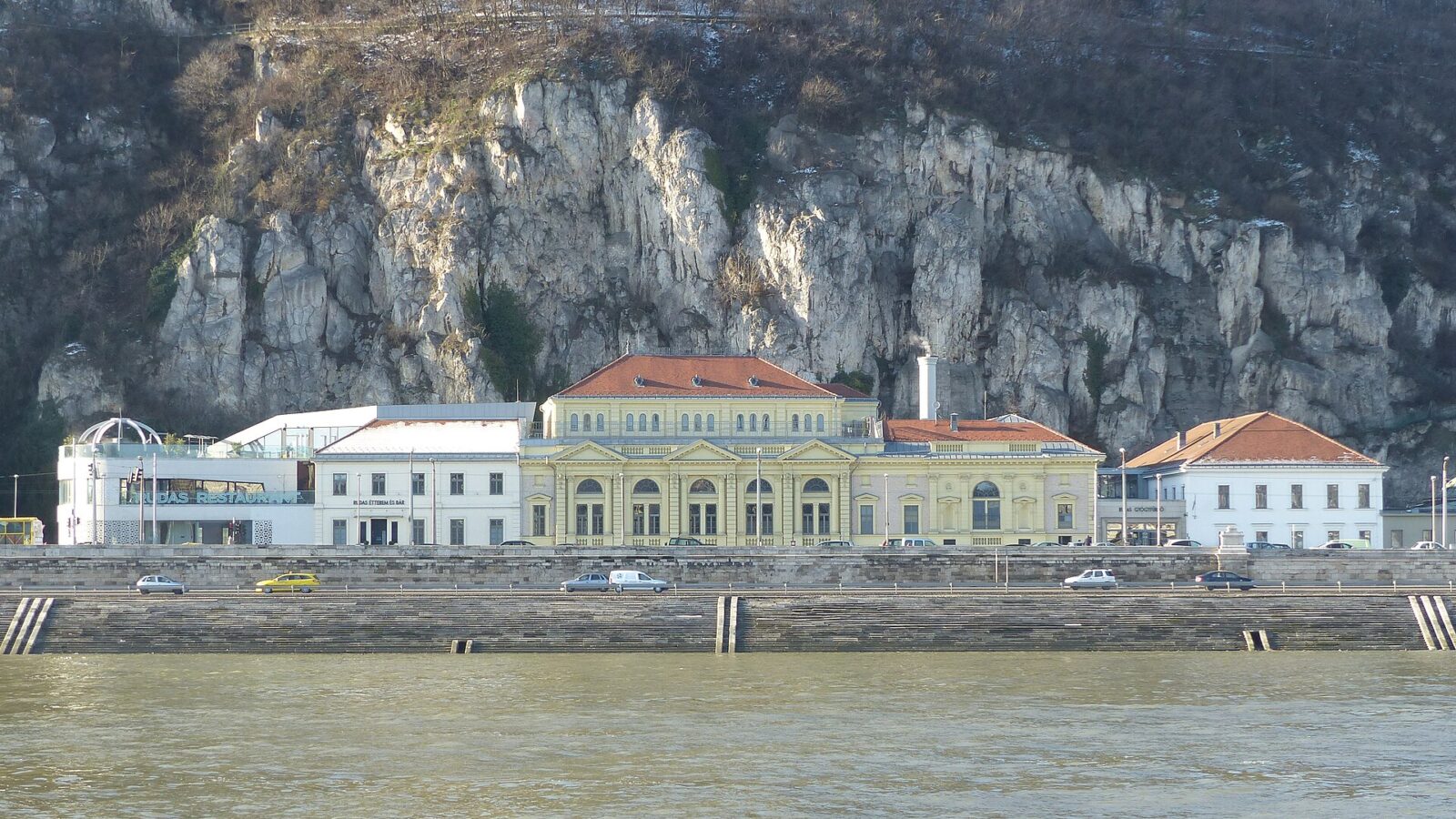
Rudas, at the Buda end of Elisabeth Bridge, has a sixteenth-century Turkish bath under an octagonal dome and a rooftop panorama pool that looks out over the Danube. On a February evening, with the bridges lit and the air cold enough to see your breath, that rooftop is the best seat in the city. Entry was 12,000 Ft (€30) Monday to Thursday and 15,000 Ft (€37.50) Friday to Sunday in 2026. It opens at 06:00 every day, closing at 22:00 on Mondays and 20:00 Tuesday to Sunday, and there’s night bathing from 22:00 to 03:00 on Friday and Saturday nights. Note that the Turkish section is women-only on Tuesdays and men-only on Wednesdays. More in our Rudas Baths guide.
Lukács
Lukács, in Buda near Margaret Bridge, is the locals’ bath: less theatrical, cheaper, and full of regulars who have been coming for decades. In 2026 entry cost 7,000 Ft (€17.50) Monday to Thursday and 8,000 Ft (€20) Friday to Sunday, and it’s open 07:00–19:00 daily, until 22:00 on Tuesdays. Budapest Card holders get in free, which makes it the one bath where the card really earns its keep. See our Lukács Baths guide.
The two you can’t visit
Older guidebooks and plenty of websites still send people to the Gellért and Király baths. Gellért has been closed for renovation since 1 October 2025, with reopening planned for 2028, and Király is closed indefinitely. If someone tries to sell you a Gellért ticket for February 2027, walk away. Our Gellért Baths page keeps track of the renovation, and the bath comparison will help you choose between the ones that are open.
Winter bathing tips
- Bring flip-flops. The walk from the changing rooms to the outdoor pool is short, and wet bare feet on frosty tiles is not a mistake you’ll make twice.
- Bring your own towel, or budget for hiring one where the bath offers it. Széchenyi doesn’t rent towels.
- Don’t wear a woolly hat into the water unless you like the look; do keep one handy for the walk afterwards, when your wet hair will freeze.
- Go early or late. Mid-afternoon at weekends is when the outdoor pools are busiest, even in February.
- Read our bath etiquette guide before your first visit. It’ll save you some confusion in the changing rooms.
Carnival season: farsang, doughnuts and the end of winter
February is the tail end of farsang, the Hungarian carnival season, which runs from Epiphany on 6 January to Ash Wednesday. In 2027 Ash Wednesday falls on 10 February, so carnival ends on Shrove Tuesday, 9 February, and the first ten days of the month are its last hurrah. These days it’s a quieter affair in the city than it once was: there are balls and masked parties, school carnivals and fancy-dress events for children, but no big street parade in Budapest itself.
What you will find everywhere is farsangi fánk, the carnival doughnut. The classic version is a light, yeasty round, fried so that a pale ribbon runs around its middle, dusted with icing sugar and served with apricot jam. Bakeries and cake shops sell them through the season, and plenty of Hungarian households still fry a batch at home on Shrove Tuesday. They’re best warm, and at their worst when they’ve sat in a display case since the morning, so buy them from somewhere busy.

The Busójárás in Mohács
The most spectacular carnival in Hungary isn’t in Budapest at all. In Mohács, a small town on the Danube in the far south of the country close to the Croatian border, the end of winter is chased away each February by the busók: men in sheepskin cloaks and carved wooden masks, many of them horned and painted red and black, who parade through the streets with rattles, cowbells and wooden clappers. The Busójárás is the town’s own festival, rooted in its Šokac community, and it is on UNESCO’s list of the intangible cultural heritage of humanity. It is loud, crowded, slightly anarchic and completely unlike anything you’ll see in the capital.
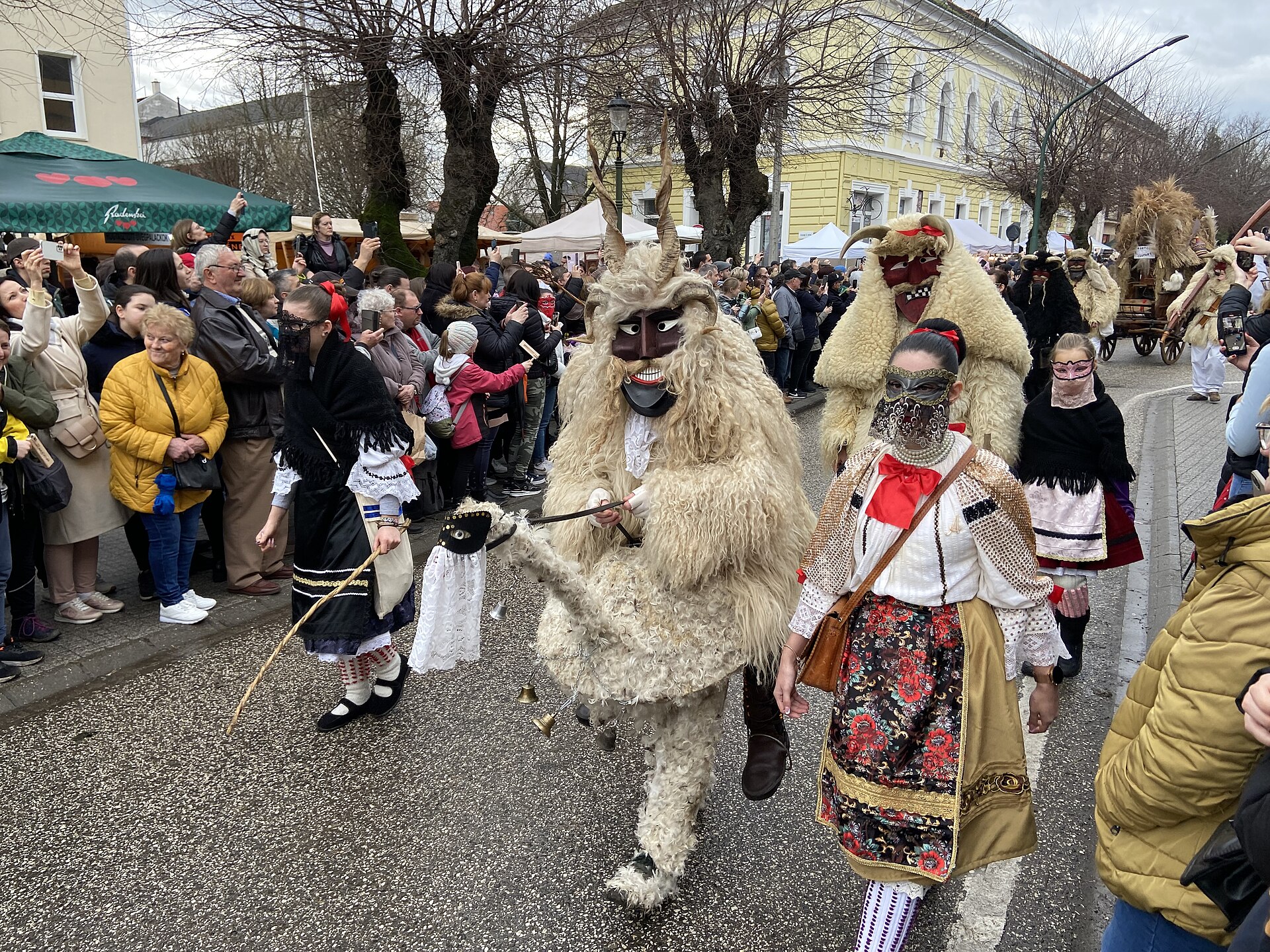
The festival runs over the days leading up to Ash Wednesday and traditionally ends on Shrove Tuesday, which would put it in the first ten days of February in 2027. The biggest crowds come on the weekend before Ash Wednesday: for the 2026 edition the national rail and bus company laid on extra services for that weekend. Check Mohács’s own tourism pages for the 2027 programme before you plan around a particular day.
Getting there from Budapest
Mohács is a long way for a day trip, but people do it. In 2026 Volán ran non-stop express coaches from Budapest to Mohács on the festival weekend, taking 2 hours 50 minutes, and there’s no direct train: you take the InterCity to Pécs, which runs every two hours, and change there for a connection of about an hour to Mohács. That’s close to six hours of travelling in a day, so if you can find a room in Mohács or Pécs, staying overnight makes for a far more relaxed visit. Rooms in Mohács are limited on the festival weekend, so book early. Check the MÁV and Volán timetables for 2027 before you set off.
Is it worth it? If you’re in Hungary on the right weekend and you like folk traditions, crowds and noise, absolutely: it’s one of the most remarkable things the country does. If you’re on a short Budapest break and the dates don’t line up, don’t contort your trip to fit it in.
25 February: remembering the victims of communism
Each year on 25 February Hungary observes its memorial day for the victims of the communist dictatorships. In 2027 it falls on a Thursday. It’s a sombre day rather than a holiday, with wreath-layings and commemorations, and it’s a natural day to visit the House of Terror on Andrássy út, the former headquarters of both the fascist Arrow Cross and the communist secret police, now a museum about the two regimes and their victims. The building, with its black frame and the word TERROR cut into the overhang, is hard to miss.
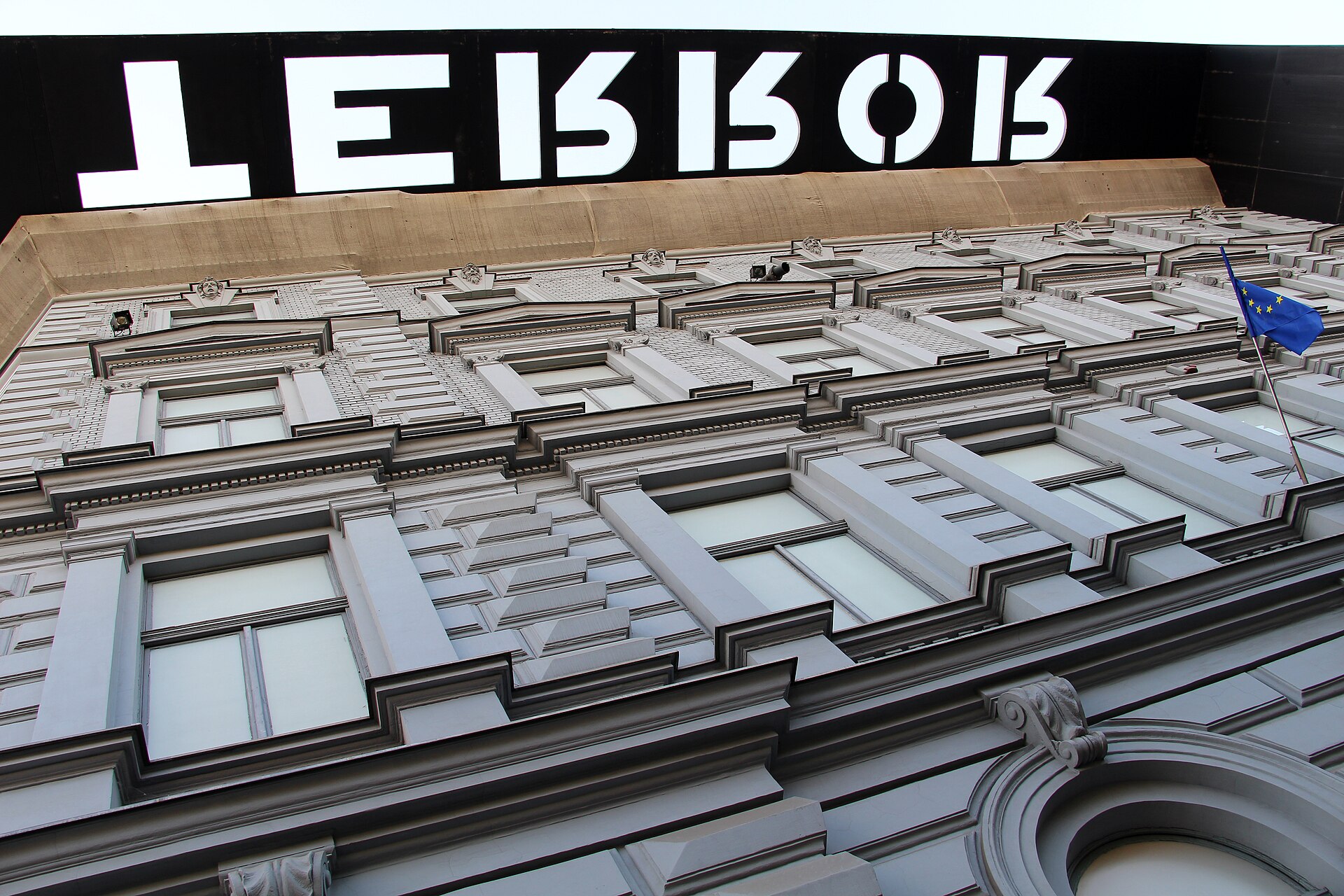
The museum is open Tuesday to Sunday from 10:00 to 18:00 (the cash desk closes at 17:30) and closed on Mondays. Tickets cost 4,000 Ft (€10), or 2,000 Ft (€5) reduced, and are sold only at the museum, so there’s no booking ahead. Take the M1 metro or the 4 or 6 tram. The exhibition is intense and very much a particular telling of the history, so it’s worth reading around it; our House of Terror guide covers it in detail, and communist Budapest puts it in context with the city’s other sites from the period.
Indoor days: museums, music and coffee
Budapest has more than enough to fill the coldest week. A few ideas for when the weather closes in:
Museums
February is the best month of the year to see the big museums without the crowds. The Museum of Fine Arts on Heroes’ Square, the Hungarian National Gallery in Buda Castle and the Hungarian National Museum are all good for a long afternoon. The Hospital in the Rock, a wartime hospital and later nuclear bunker in the caves under Castle Hill, is visited only on a guided tour; in English it costs €30 for adults, €22 for students and seniors and €15 for children, and under-sixes aren’t admitted. It’s underground, so the weather makes no difference. See our Hospital in the Rock guide and the wider guide to Budapest’s museums.
Opera and concerts
Winter is the heart of the concert and opera season. The Hungarian State Opera House on Andrássy út, which reopened in 2022 after a long restoration, is worth seeing for the building alone, and if you’re on a budget, standing-room tickets go on sale two hours before evening performances. Müpa, the arts centre by the Danube in south Pest, and the Liszt Academy, with its gilded Art Nouveau concert hall, round out the big three. Check opera.hu, mupa.hu and zeneakademia.hu for the February 2027 programmes. Our Hungarian State Opera House guide has the details on tours and tickets.
Coffee houses
The grand Budapest coffee house was made for days like these: high ceilings, chandeliers, a slice of Dobos torte and nowhere you need to be. The New York Café is the showiest, Gerbeaud on Vörösmarty tér the most famous, and there are quieter, more local places all over the city. Our coffee house guide sorts the grand from the good.
The Central Market Hall
The Central Market Hall on Fővám tér is a warm place to spend an hour on a cold morning, with paprika, salami and pickles on the ground floor and lángos and stuffed cabbage upstairs. It opens 06:00–18:00 Monday to Friday, 06:00–16:00 on Saturday and 10:00–16:00 on Sunday, and entry is free. See the Central Market Hall guide.
Outdoors, when the sun comes out
A bright, cold February day is something to make the most of. The views from Gellért Hill and the Fisherman’s Bastion are often at their sharpest in winter, when the air is clear and the trees are bare. Margaret Island is quiet and rather lovely in the frost. And the City Park Ice Rink, in front of Vajdahunyad Castle, is one of the city’s great winter sights.
The rink’s 2026/27 season opens on 20 November 2026. Last season it stayed open until 1 March, so February is usually well within the season, but the closing date depends on the weather and the operator, so check mujegpalya.hu before you go. The 2025/26 prices give you an idea of the cost: 3,500 Ft (€8.75) for an adult off-peak session and 4,500 Ft (€11.25) at peak times on Friday evenings and weekends, with skate hire 3,500 Ft (€8.75) plus a 2,000 Ft deposit. Last season’s off-peak weekday sessions ran 09:00–13:00 and 17:00–21:00; check mujegpalya.hu for this season’s times. Budapest Zoo, next door in City Park, is open every day in February from 09:00 to 16:00, with last entry at 15:00, if you have children who need running around.
February 2027, week by week
1–7 February: the last week of carnival
The month starts quietly. Carnival is coming to its climax, so expect doughnuts in every bakery and masked balls in the listings. This is a good week for value, and the Busójárás in Mohács traditionally falls in the days before Ash Wednesday. If you want to see it, check the programme and plan to head south early.
8–14 February: Shrove Tuesday, Ash Wednesday and Valentine’s
Shrove Tuesday on 9 February ends carnival and Ash Wednesday on the 10th begins Lent. Then the city turns to Valentine’s Day, which falls on Sunday 14 February. Expect the Friday and Saturday nights to be the busiest of the month for restaurants, river cruises and spa packages, and book ahead if you want any of them.
15–21 February: the quietest stretch
With Valentine’s out of the way, the middle of the month is about as quiet as Budapest gets. Hotel rates are low and the museums are empty. If you’re flexible, this is the week to aim for.
22–28 February: the first signs of spring
By the last week, sunset is approaching half past five and the first mild days can appear, though a late cold snap is just as likely. Thursday 25 February is the memorial day for the victims of communism. If you’re staying into March, our guide to Budapest in March picks up from here, with the national holiday on 15 March.
Eating and drinking in February
Hungarian food comes into its own in cold weather. This is the month for a bowl of goulash soup that is more meal than starter, for töltött káposzta (stuffed cabbage), for chicken paprikash with nokedli dumplings, and for anything made from mangalica, Hungary’s curly-coated pig, whose rich, fatty pork turns up on menus all over the city. Our guide to traditional Hungarian food explains what to order.
The Mangalica Festival has in past years filled Szabadság tér with pork, sausages and cabbage stews in the depths of winter. Check mangalicafesztival.hu for current dates and venue before planning around it.

To drink, February is the season for forralt bor, mulled wine, and for a glass of pálinka to warm up after a walk. Wine bars are cosy places to wait out a cold evening, and it’s a good month to try the heavier reds from Villány and Szekszárd. And if a doughnut isn’t enough, the cake shops are at their busiest and best.
What February costs
A sample of what you’ll spend, from the operators’ current price lists (mostly 2026 tariffs; prices usually rise a little in the new year):
| Item | Price |
|---|---|
| Single public transport ticket | 500 Ft (€1.25) |
| 24-hour travelcard | 2,750 Ft (€6.90) |
| 72-hour travelcard | 5,750 Ft (€14.40) |
| Széchenyi Baths, weekday day ticket with locker (2026) | 13,200 Ft (€33) |
| Rudas Baths, weekday entry (2026) | 12,000 Ft (€30) |
| Lukács Baths, weekday entry (2026) | 7,000 Ft (€17.50) |
| House of Terror | 4,000 Ft (€10) |
| Hospital in the Rock, English tour | €30 |
| City Park Ice Rink, adult off-peak session (2025/26) | 3,500 Ft (€8.75) |
| Budapest Zoo, adult | 5,900 Ft (€14.75) |
The euro conversions use 400 Ft to the euro and are rounded. With a 72-hour travelcard, a bath every other day and a museum or two, you can have a full February long weekend for a modest outlay before you count food and your room. Our Budapest on a budget guide goes into more detail, and the public transport guide explains which ticket to buy.
Day trips in February
Winter isn’t the best season for day trips, since many of the things that make the countryside appealing are shut or bleak, but a few work well.
- Szentendre, the riverside artists’ town north of the city, is about 40 minutes from Batthyány tér on the H5 suburban railway. Its galleries, museums and cafés are made for a grey day, and it’s far quieter than in summer. See our Szentendre day trip.
- Eger, with its baroque centre, castle and wine cellars, is a good winter day out if you like red wine. Our Eger day trip guide has the details.
- Mohács for the Busójárás, if the dates line up: a long day there and back, or better an overnight (see above).
What to pack for February
Pack as you would for January, with perhaps one layer less. You’ll want a warm, windproof coat, a hat, gloves and a scarf, and shoes with a good grip for the icy mornings and the cobbles on Castle Hill. Layers work best, since you’ll be going from cold streets into warm museums, cafés and trams all day. For the baths, pack a swimsuit, flip-flops and a towel. Our Budapest packing list has the full list.
Is Budapest worth visiting in February?
Yes, if you know what you’re coming for. February gives you the city’s best winter pleasures, the outdoor thermal pools in the cold, the museums, the coffee houses and the music, at low prices and without the crowds, and with the days lengthening noticeably as the month goes on. It’s an excellent month for couples (outside Valentine’s weekend, when it’s a good month for couples who booked early), for museum lovers and for anyone on a budget.
It’s not the month for a first visit if you’ve set your heart on long evenings by the river, on park picnics or on open-air bars. The city is grey a lot of the time, the wind is cold, and the parks are bare. For a similar trip with a bit more light, look at the end of March. For more ideas for the cold months as a whole, see Budapest in winter, and if you’re deciding between the two coldest months, Budapest in January makes the case for that month.
Practical tips
- Check opening hours before you go. Some smaller museums and attractions keep shorter winter hours, and many places close on Mondays.
- Book ahead for Valentine’s weekend: restaurants, dinner cruises and couples’ spa packages.
- Buy a travelcard. In the cold you’ll take the tram even for short hops, and the 24- or 72-hour cards save money and fumbling with tickets.
- Carry some cash. The House of Terror sells tickets only on site, and some small cafés and market stalls prefer cash.
- Keep an eye on the forecast. A sunny day is the one to spend on Castle Hill or the river; save the museums for the grey ones.
Frequently asked questions
Is February a good time to visit Budapest?
Yes, especially if you love thermal baths, museums and coffee houses and don’t mind the cold. It’s one of the quietest and cheapest months of the year, except for the Valentine’s weekend.
How cold is Budapest in February?
HungaroMet’s 1991–2020 averages put the typical daily high at just under 6 °C, with overnight lows below freezing. Cold snaps, when it stays below zero all day, happen most winters.
Does it snow in Budapest in February?
Sometimes. Snow is possible, but in the centre of the city it rarely settles for long. The Buda Hills hold it better.
Are the thermal baths open in February?
Yes. Széchenyi, Rudas and Lukács are open every day, and their outdoor pools are at their best in the cold. The Gellért and Király baths are closed.
When is the Busójárás in 2027?
The Busójárás in Mohács traditionally runs over the days leading up to Ash Wednesday, which is 10 February in 2027, so it should end on Shrove Tuesday, 9 February. Check Mohács’s own tourism pages for the 2027 programme.
Is Budapest expensive on Valentine’s Day?
The weekend around 14 February is the busiest of the month, and restaurants, river cruises and spa packages book up and charge more. In 2027 Valentine’s Day is a Sunday. Book early, or come a week before or after.
Is the ice rink open in February?
Usually. The City Park Ice Rink’s 2026/27 season opens on 20 November 2026, and last season ran until 1 March. The closing date depends on the weather, so check mujegpalya.hu before you go.
What should I wear in Budapest in February?
A warm, windproof coat, a hat, gloves and a scarf, plus shoes with a good grip. Wear layers you can take off indoors.
Photo credits
Rudas Baths below Gellért Hill (featured image): Rudas Fürdő by Elekes Andor, CC BY-SA 4.0, via Wikimedia Commons.
The Parliament over snowy rooftops: Hungarian Parliament Building over snowy rooftops at night, Budapest (2026) by Paul Colin Hennig firstdorsal.eu, CC BY-SA 4.0, via Wikimedia Commons.
Carnival doughnuts: Fánk by debreczeniemoke, CC BY 2.0, via Wikimedia Commons.
Busók at the Busójárás in Mohács: Busojaras festival2024 by Busojaras2024, CC0, via Wikimedia Commons.
The House of Terror: Budapest – Terror Háza Múzeum (37766885184) by Fred Romero from Paris, France, CC BY 2.0, via Wikimedia Commons.
Cabbage with pork knuckle at the Mangalica Festival: Mangalica fesztivál. Csülkös káposzta. – Lipótváros, 2016 Budapest by Globetrotter19, CC BY-SA 3.0, via Wikimedia Commons.