Óbuda and District III: Roman Ruins and Riverside Calm
District III beyond the ruins: Roman Aquincum and the amphitheatre among the flats, Fő tér and the estates behind it, the Római-part and Óbuda Island, where to eat, and how to get there on the HÉV.
In this guide
- Óbuda at a glance
- Three towns, then one city
- Aquincum: the Roman town
- Opening hours and tickets
- Roman ruins between the tower blocks
- The military amphitheatre
- The Baths Museum and the Hercules Villa
- Fő tér and old Óbuda
- The “Waiting” women
- The Vasarely Museum
- Two small museums
- Kiscell: the museum on the hill
- The estates: Óbuda’s other face
- The Római-part
- Óbuda Island
- Eating and drinking
- Getting there and around
- Óbuda through the year
- Should you stay in Óbuda?
- A half-day in Óbuda
- Is Óbuda worth it?
- Frequently asked questions
- Photo credits
This article contains advertising. Our booking links are routed through a partner that adds commission tracking automatically, so if you book through one we earn a commission from the provider, at no extra cost to you. It never affects what we recommend. Affiliate disclosure
On an ordinary weekday the Roman amphitheatre in southern Óbuda has more dog walkers than visitors. Its grassy arena lies below the level of the street, ringed by the stubs of stone walls and, beyond those, by apartment blocks. The Aquincum Museum likes to point out that the arena is bigger than the Colosseum’s in Rome, and somewhere between 10,000 and 13,000 spectators once sat on the earth banks around it. Nobody charges you to look. That’s Óbuda Budapest in miniature: one of the oldest parts of the city, wearing its history casually, with Roman ruins, a small-town square and the prefab estates of the socialist decades all within a short walk of each other.
This guide treats District III as a place to explore rather than somewhere to sleep. It covers the Roman town at Aquincum and the ruins scattered through the streets, Fő tér and what’s left of the old market town, the museums, the estates, the summer riverbank of the Római-part and Óbuda Island, where to eat, and how to get there. Opening hours and prices were checked in November 2026 against the museums’ and operators’ own sites; treat them as the right order of magnitude and confirm before you go, because several places here change their hours with the seasons. Our guide to all 23 Budapest districts sets Óbuda alongside the rest.
Óbuda at a glance
| What | District III |
|---|---|
| Official name | Óbuda-Békásmegyer |
| Where | The Buda bank of the Danube, north of the centre, from old Óbuda up to the city boundary beyond Békásmegyer |
| Area | 39.70 km², the third largest of the 23 districts |
| Population | 130,415 (2016), second only to Újbuda (District XI) |
| Neighbourhoods | Óbuda, Aquincum, Rómaifürdő, Csillaghegy and Békásmegyer along the river, hills to the west, and Óbuda Island in the Danube |
| Main sights | The Aquincum Museum and Archaeological Park, the military amphitheatre, Fő tér, the Vasarely and Kiscell museums, the Római-part |
| Getting there | H5 HÉV from Batthyány tér: 8 minutes to Szentlélek tér, 14 to Aquincum; tram 1 from Pest over Árpád Bridge; trams 17 and 19 up the Buda side |
| Best for | Roman history, a slower half-day, summer evenings by the river |
| Not for | Nightlife, or a first visit with only a weekend to spare |
Three towns, then one city
Óbuda means “Old Buda”, and the name is earned. Until 17 November 1873 it was a town in its own right: Buda on Castle Hill, Óbuda to its north and Pest across the river were separate places until they were merged into Budapest, a date the city now marks as Budapest Day.
Long before any of that, this was the Roman frontier. A legion was stationed here on the Danube, a sprawling military town grew up around its fortress, and a separate civilian town rose a little further north. By the early second century Aquincum was the capital of the province of Pannonia Inferior. An aqueduct carried water from the thermal springs at what is now Rómaifürdő, literally “Roman bath”, to the town and its bathhouses, which tells you how far back the city’s bathing habit goes. Our history of Budapest picks up the story from there.
Most of what you see above ground today is far younger. The old centre that survives around Fő tér is the small market town of the eighteenth and nineteenth centuries: low houses, courtyards, a manor house by Szentlélek tér and the taverns that made Óbuda somewhere city people came out to eat, drink and listen to music. Out in the river, a shipyard built and repaired steamers and gave the island its Hungarian name, Hajógyári-sziget, “Shipyard Island”.
The twentieth century was harder on it. In the socialist decades much of the old town was cleared for prefabricated housing estates, and wide roads were driven through what had been village streets. The handful of streets around Fő tér were kept, which is why the square now looks like a stage set with tower blocks peering over the rooftops. Understanding that layering, Roman, baroque-era village and concrete estate, is the key to enjoying Óbuda rather than wondering why you came.
Aquincum: the Roman town
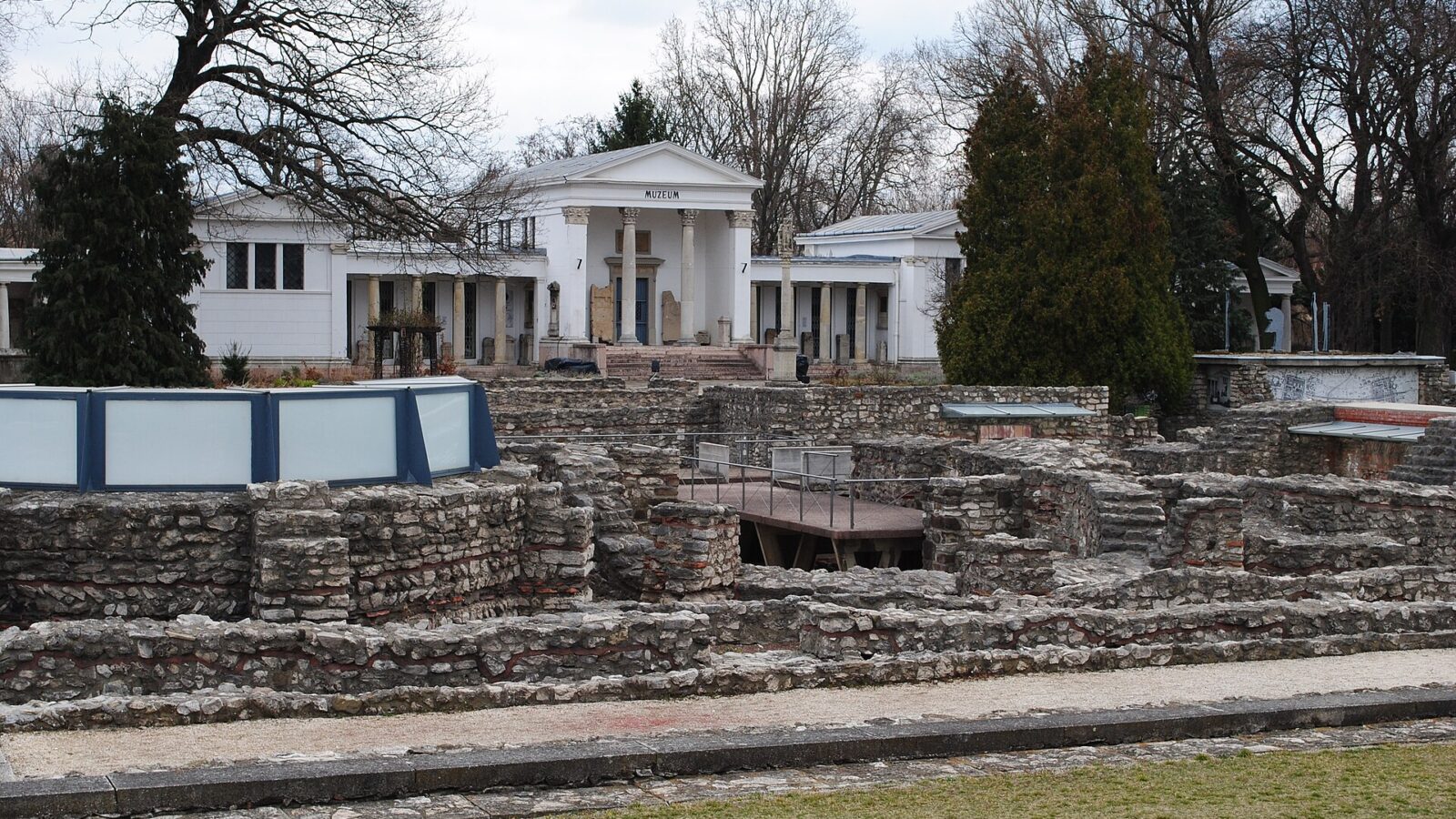
The Aquincum Museum and Archaeological Park, beside the Aquincum stop on the HÉV, is the reason most visitors come to Óbuda, and it deserves the trip. The open-air ruin park shows around a quarter of the civilian town, and the museum calls it one of the largest Roman archaeological parks in Hungary. What you walk through is mostly foundations: the stone footings of houses, shops, baths and shrines laid out along the old streets, with a reconstructed column or a rebuilt stretch of wall here and there to give you a sense of height.
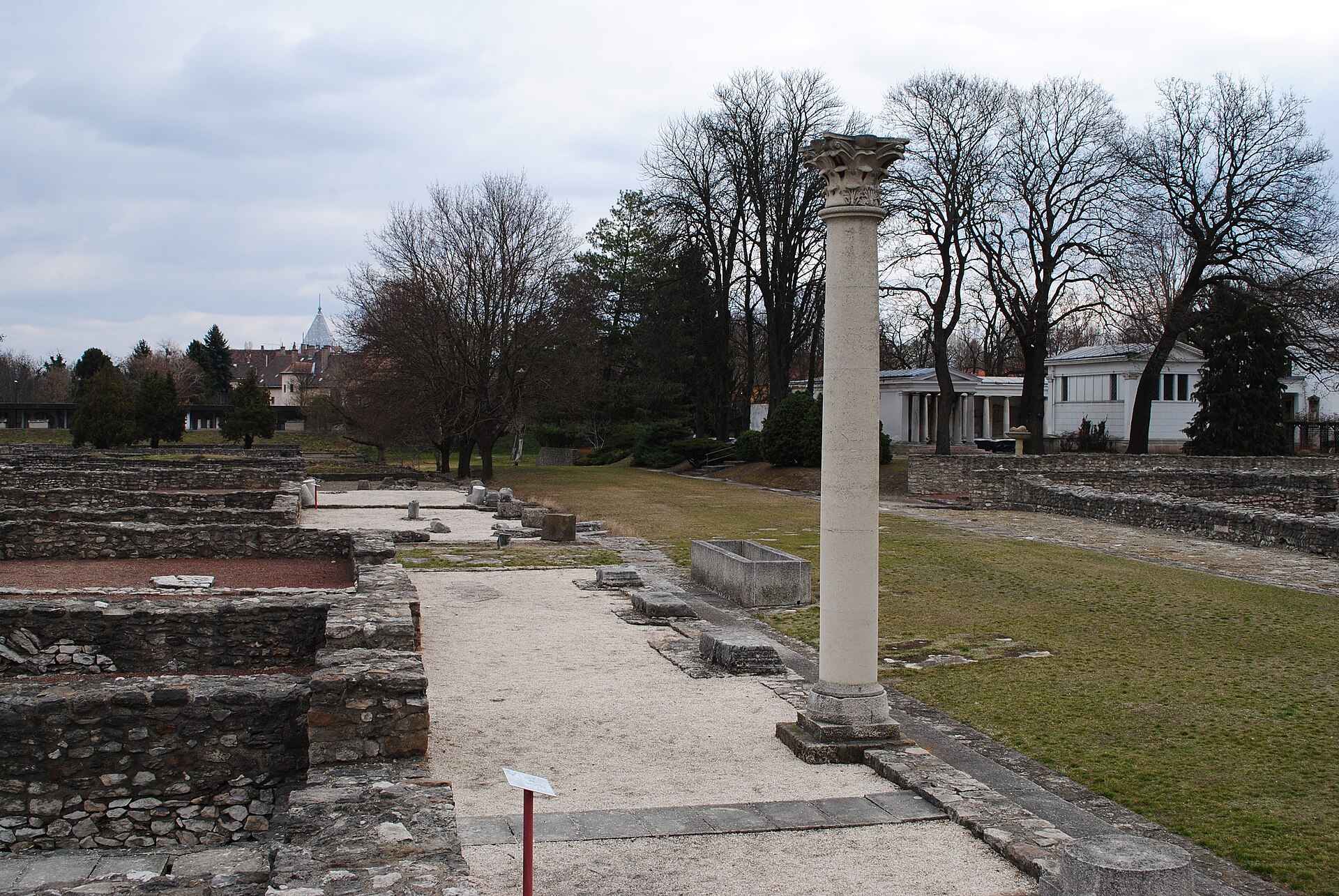
Give it time and a site map and it comes alive. You start to read the grid of streets, the shopfronts and the layout of the baths, and to picture the town as a working place rather than a field of rubble. Quiet weekday mornings are the best time; on a grey winter afternoon, with the light going by mid-afternoon, it can feel bleak.
The museum buildings fill in what the ruins can’t. The permanent displays include frescoes and mosaics from the governor’s palace on Óbuda Island, and “In the shadow of the Roman eagle”, a permanent exhibition on military life along the Danube frontier, opened in September 2023. Temporary shows change through the year, so check what’s on before you go.
Opening hours and tickets
- Winter (1 November–31 March): exhibitions and ruin park Tuesday to Sunday, 10:00–16:00, last entry 15:30. The park opens only when it’s dry and not slippery.
- Summer (1 April–31 October): exhibitions 10:00–18:00 and park 9:00–18:00, Tuesday to Sunday.
- Closed: Mondays, over Christmas and New Year, and for maintenance throughout January 2027; winter hours resume on Tuesday 2 February.
- Tickets: 3,000 HUF (about €8) for adults; 1,500 HUF for students, young people and pensioners from the EEA. The museum’s ticket page lists free entry with the Budapest Card.
The museum announced free entry for Budapest Day, 17 November 2026; check its site for any free days during your visit. If you hold a Budapest Card, Aquincum and the Kiscell Museum (below) are two of the better reasons to make the trip north while it’s valid.
Just by the HÉV stop is the smaller of Aquincum’s two amphitheatres, built for the civilian town outside its north wall. It takes a few minutes and costs nothing to look at, and it makes a good warm-up for the much bigger one further south.
Is it worth it? If Roman history interests you at all, yes, and it pairs naturally with Fő tér for an easy half-day. If it doesn’t, the park can feel like a lot of foundations; come in the warmer months, when it’s open longer, and spend more of your time in the museum. Our guide to Budapest’s museums has the rest of the city’s collections if you’d rather stay central.
Roman ruins between the tower blocks
The legion’s half of Roman Aquincum lay further south, under what is now the centre of Óbuda, and its remains turn up in unexpected places: under a road junction, between apartment blocks, and at the corner of Vöröskereszt utca and Miklós utca, where the ruins of a barracks and a shrine are on show.
The military amphitheatre
This is the big one, and the sight in Óbuda most visitors miss. It was laid out in a natural hollow that the legion may already have used as a training ground in the first century, then rebuilt in stone around AD 145, in the reign of Antoninus Pius, by the engineers of the Second Legion Adiutrix; a building inscription in the museum’s stone collection records the work. The outer walls measure about 132 by 108 metres and the arena 89.6 by 66.1 metres; the museum says the arena is larger than the Colosseum’s. The seating was on banked earth, with room for 10,000 to 13,000 spectators, and the arena had a shrine to the goddess Nemesis with inscribed altars.
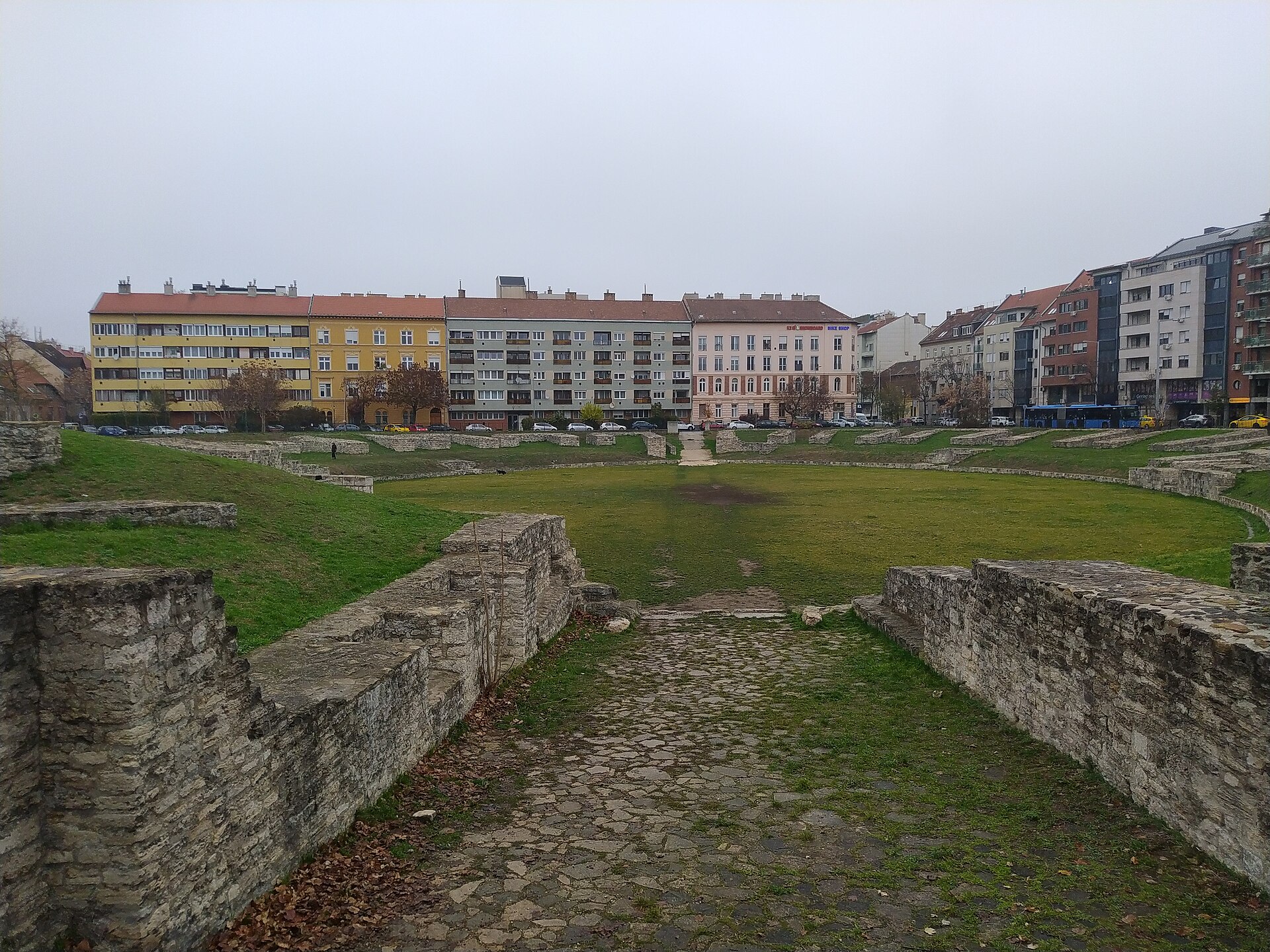
What’s left is a grassy oval below street level, the stone stubs of the walls and the two main gateways on its long axis. Stand at one end and the scale is obvious, and so is the oddity of the setting: a gladiatorial arena hemmed in by flats, parked cars and traffic noise. In another city it would have a visitor centre and a queue; here you’ll probably have it to yourself.
The Baths Museum and the Hercules Villa
Under Flórián tér, the big road junction at the heart of the estates, the Baths Museum preserves part of the legion’s great bathhouse; the first excavation at Aquincum, in 1778, uncovered its hall. The museum is temporarily closed to visitors, so check the Aquincum Museum’s site before making a special trip.
A little further north, on Meggyfa utca, the Hercules Villa was one of the luxurious houses of the military town’s wealthy quarter, richly decorated with mosaics and wall paintings; its owner probably belonged to the elite of the governor’s seat. It opens only from April to October, Tuesday to Sunday, for 1,000 HUF (about €2.70), and it isn’t covered by the Budapest Card. Outside April to October, then, Aquincum is the only Roman museum in Óbuda you can get into, and it closes for all of January 2027.
Fő tér and old Óbuda
Get off the HÉV at Szentlélek tér, eight minutes from Batthyány tér, and Fő tér, Óbuda’s main square, is right next to it. This is the best-preserved corner of the old town: a cobbled square of low, pastel-painted buildings around the old town hall, with restaurant terraces in the warm months and, on summer evenings, more locals than tourists.
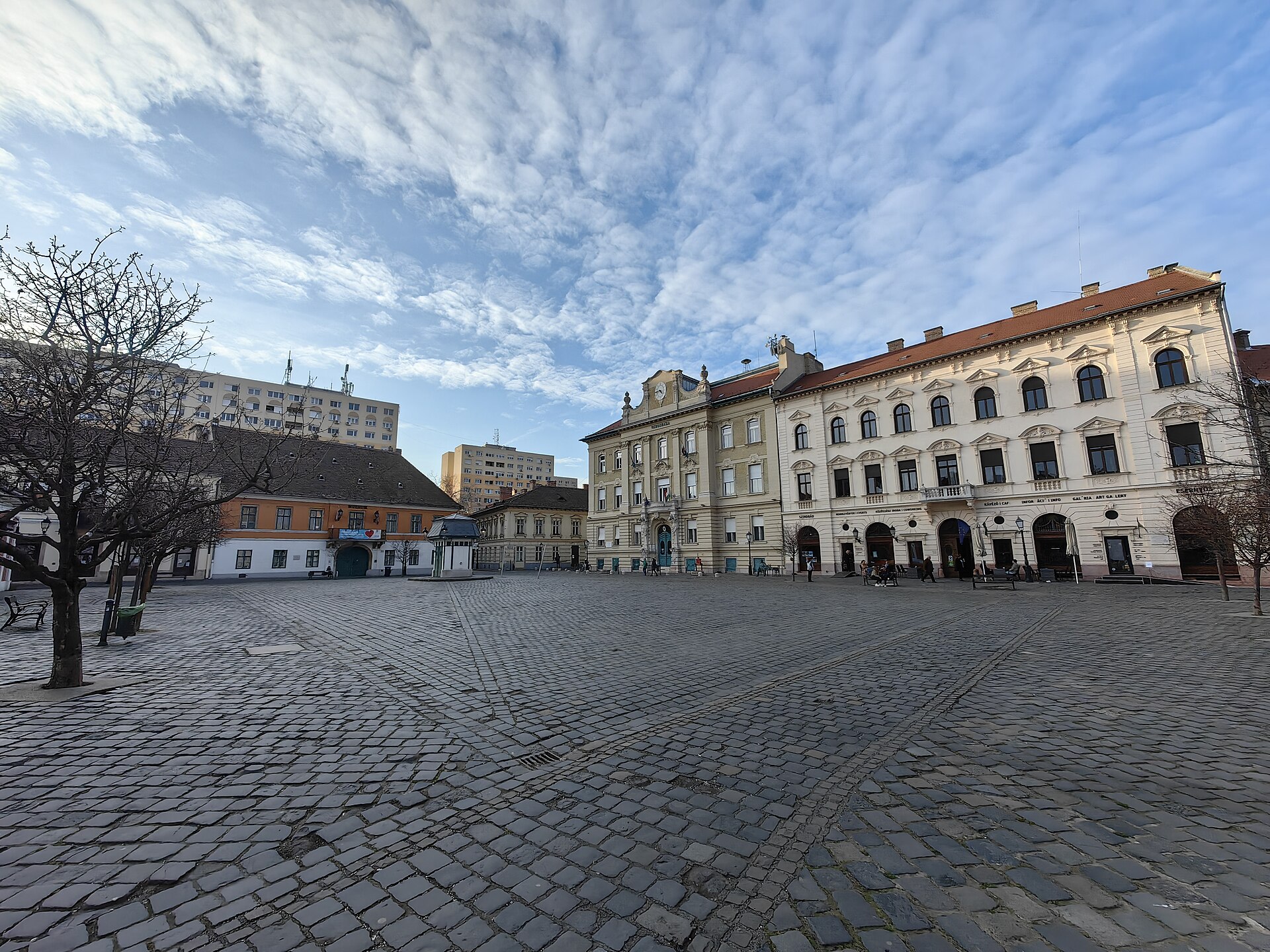
Look up and you see the other Óbuda straight away. The tower blocks of the estate rise just behind the rooftops, close enough to make the square feel like a film set built in somebody’s car park. Locals have long since stopped noticing; first-time visitors usually take the same photograph.
The “Waiting” women
Where the square meets Laktanya utca, Imre Varga’s much-photographed bronze Várakozók (“Waiting”) shows a group of women standing under umbrellas, as if for a bus or for the rain to stop. Varga, who also made the weeping-willow memorial behind the Dohány Street Synagogue, has a small museum of his own nearby, the Imre Varga Collection at Laktanya utca 7; check the collection’s own page for opening hours before you go.
The Vasarely Museum
On Szentlélek tér itself, the Vasarely Museum is devoted to Victor Vasarely, the Hungarian-born pioneer of Op Art, and it’s more fun than its reputation suggests: big canvases of bulging grids, shifting cubes and vibrating colour that play tricks on your eyes, plus temporary shows that change through the winter. It’s open Wednesday to Sunday, 10:00–18:00 (the ticket desk closes at 17:00), and a full ticket for the permanent collection and the current temporary exhibitions is 3,800 HUF (about €10), with half price for EEA visitors aged 6–26 and 62–70. The garden is free during opening hours. Note that it’s shut on both Monday and Tuesday.
Two small museums
The Óbuda Museum, the district’s local history museum, runs talks and exhibitions that lean heavily on the shipyard and the old town, and its programme is worth a look if you read Hungarian. The Kassák Museum, devoted to the avant-garde writer and artist Lajos Kassák, has announced reduced hours from January 2026: weekdays only, 10:00–16:30, with the permanent display free to visit; check the museum’s site for the current hours. Neither is a reason to come to Óbuda on its own, but both repay twenty minutes if you’re on the square anyway.
Kiscell: the museum on the hill
Uphill to the west of the old centre, the Kiscell Museum occupies a long, yellow building on the hillside above the rooftops of Óbuda. It’s one of the city’s lesser-known museums and it rarely feels busy, which is half its appeal: you can take your time over the collections and the building itself without a tour group at your elbow.
It’s open Tuesday to Sunday, 10:00–18:00. An adult ticket is 3,000 HUF (about €8), students pay 1,000 HUF and seniors aged 62–70 pay 1,500 HUF; the Budapest Card gets you in free. To get there, take tram 17 from Széll Kálmán tér or tram 19 or 41 from Batthyány tér to Szent Margit Kórház and walk for about ten minutes, or bus 165 from Kolosy tér to Remetehegyi út.
The estates: Óbuda’s other face
Most of District III’s people don’t live in the old town. They live in the prefab estates that went up around it and along the river to the north, and if you ride the HÉV past Szentlélek tér you’ll see them stop after stop: long slab blocks, wide roads, shopping centres and the tram lines that serve them.
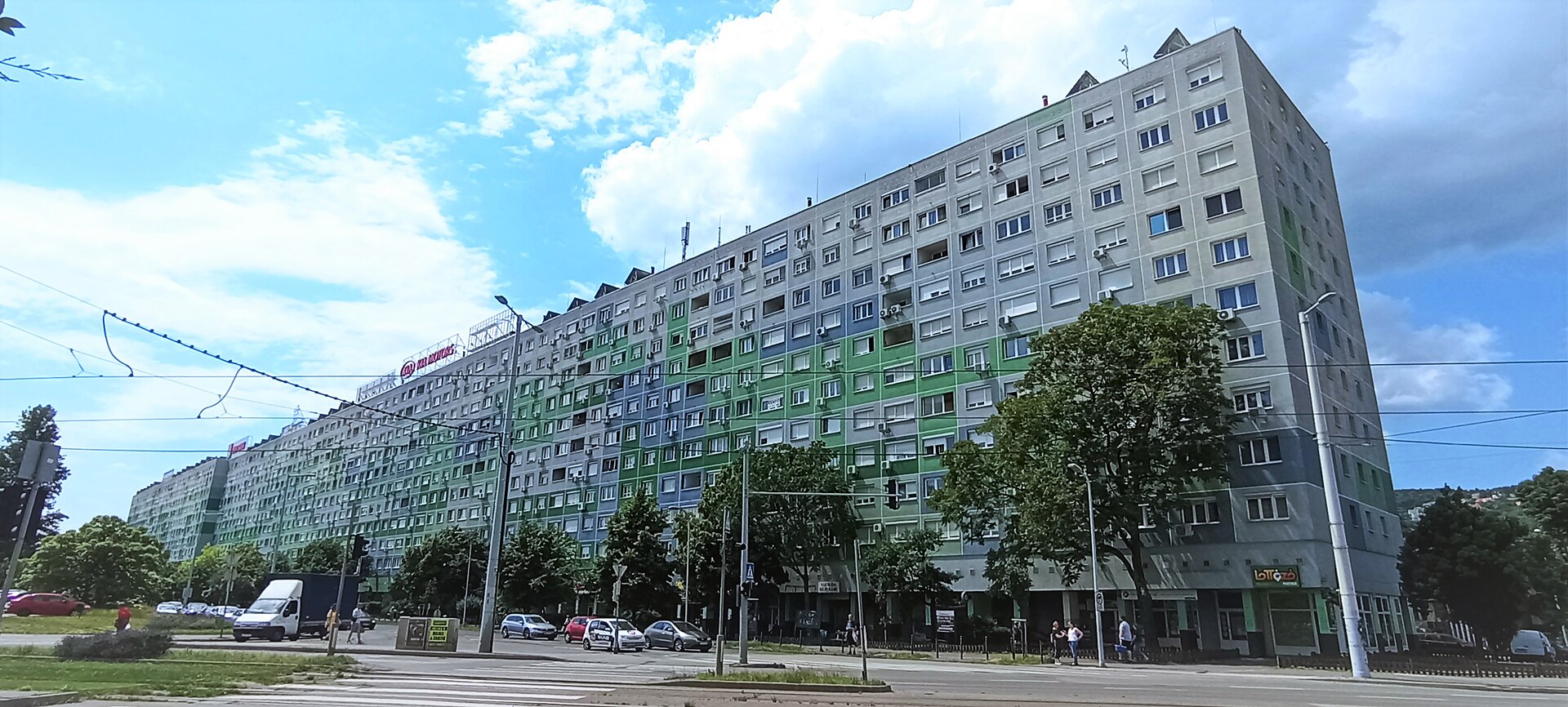
The Faluház is the one people point out, a single block so long that its name, “village house”, is only half a joke. Further north, Békásmegyer is a whole estate town of its own at the last HÉV stop inside the city, with its own market and centre. None of this is a sight in the usual sense, and you won’t find it in many guidebooks. But it’s how much of Budapest actually lives, and it explains the district far better than any museum. Our guide to communist-era Budapest has more on the panel estates and the period that built them.
The Római-part
North of Aquincum, the Buda bank of the Danube turns into a long, green, tree-shaded strip called the Római-part, the “Roman bank”. On a warm evening it’s where Budapest comes to pretend it’s at the seaside: boathouses and beer gardens with deckchairs on the gravel, wooden büfés frying fish and lángos, cyclists rolling north along the river path towards Szentendre, and families walking off dinner as the sun drops behind the Buda hills.
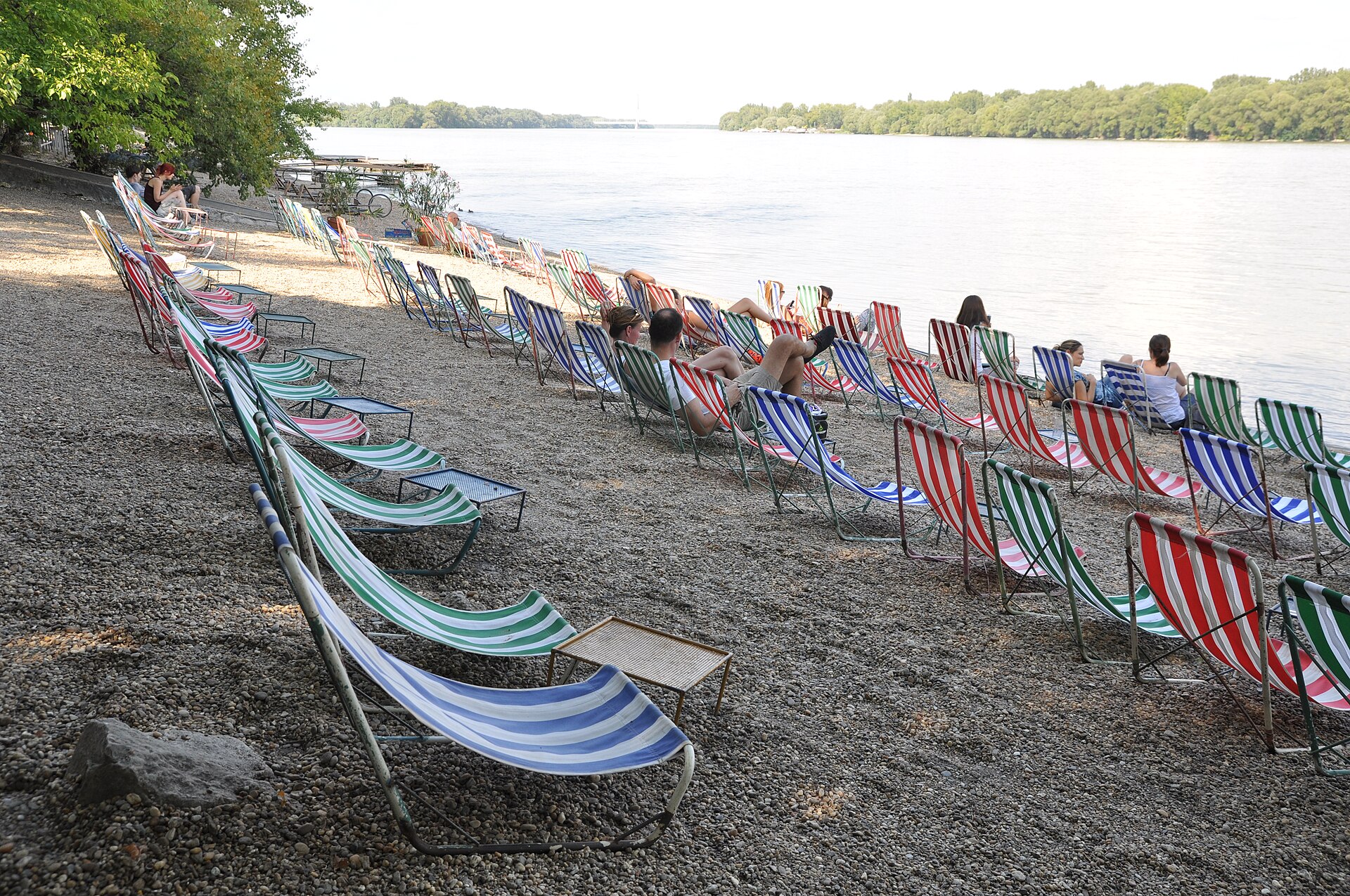
It’s very much a warm-weather place. Many of the büfés and beer gardens, the well-known Evezős Sörkert (the “rowing beer garden”) among them, open only for the warm months, and the Római Strand, the open-air pool a short walk inland, is a summer pool that closes outside the warm season. On a grey November afternoon you’ll share the path with joggers and dog walkers, which has its own charm, but don’t make a special trip for it in winter.
The quickest way there is the HÉV to Rómaifürdő, sixteen minutes from Batthyány tér, then a walk down towards the river. In summer it’s worth timing for the evening: it’s one of the best places in the city to watch the light go, and a long way from the crowds on the Pest embankment.
Óbuda Island
Óbuda Island, Óbudai-sziget or Hajógyári-sziget, lies in the Danube alongside the old town, and the Filatorigát stop on the HÉV, ten minutes from Batthyány tér, is the one for it. For a few days each August it becomes the Sziget festival, one of Europe’s biggest music and arts festivals, which runs on 10–14 August in 2027. For the rest of the year it’s a much quieter green space with the remnants of its industrial past.
There’s history underfoot here too. The palace of the Roman governors, a complex of about seven hectares, lies under the island; it was excavated and then reburied to protect it until it can be properly displayed, and its most important finds, including frescoes and mosaics, are on show at the Aquincum Museum.
Eating and drinking
Óbuda’s food reputation rests on its old taverns, and the best-known survivor is Kéhli Vendéglő on Mókus utca, which says it has kept the atmosphere of the old days for nearly 125 years and was once a regular haunt of the writer Gyula Krúdy. It’s still a family business, serves hearty, traditional Hungarian cooking, opens from noon every day and has live music every evening from 18:30 to 22:30. For more on the dishes to order, see our guide to traditional Hungarian food.
Beyond Kéhli, the pattern is simple. Fő tér and the streets around it have a handful of restaurants and cafés with terraces, good for a coffee or a long lunch after Aquincum. In summer, the Római-part büfés do fried fish, lángos and cold beer at plastic tables by the river, and that’s the meal most locals would steer you towards. The estates have the usual shopping-centre food courts and the odd neighbourhood bakery, which are fine for a quick bite between sights but not worth seeking out.
During the Advent market (below) Fő tér fills with stalls selling mulled wine and festive food, and it’s a more relaxed place to eat outdoors in December than the big markets in the centre.
Getting there and around
The H5 HÉV suburban railway is the easy way in. It starts at Batthyány tér, where it meets the M2 metro, and runs up the Buda bank with trains every 10 to 20 minutes. Scheduled times from Batthyány tér are roughly:
| HÉV stop | Minutes from Batthyány tér | For |
|---|---|---|
| Szentlélek tér | 8 | Fő tér, the Vasarely Museum, the Advent market |
| Filatorigát | 10 | Óbuda Island and Sziget |
| Aquincum | 14 | The Aquincum Museum and the civil amphitheatre |
| Rómaifürdő | 16 | The Római-part and the Római Strand |
| Csillaghegy | 18 | The Csillaghegy baths |
| Békásmegyer | 22 | The northern estates |
Ordinary Budapest tickets and travelcards are valid on the HÉV within the city boundary, which covers every stop in the table; if you carry on past Békásmegyer to Szentendre you need an extra ticket for the stretch outside the city. Our public transport guide explains the tickets, and the Szentendre day trip picks up where the line leaves the city.
From Pest, tram 1 crosses Árpád Bridge to Szentlélek tér and Flórián tér. On the Buda side, tram 17 runs up from Széll Kálmán tér and trams 19 and 41 from Batthyány tér, and buses 34 and 106 link Szentlélek tér with Aquincum. If you’re walking the length of Margaret Island, its northern tip lands you at Árpád Bridge, and from there it’s a short walk across into Óbuda.
Óbuda through the year
- Late November to Christmas: Advent in Óbuda fills Fő tér and Szentlélek tér from Friday 27 November to Wednesday 23 December 2026, opening at 16:30 on the first evening. Hours are 14:00–21:00 Monday to Thursday, 14:00–22:00 on Friday, 10:00–22:00 on Saturday and 10:00–21:00 on Sunday, and ice rinks on Fő tér and at the Békásmegyer market run from 27 November to 31 January. Our Christmas markets guide compares it with the big markets in the centre.
- January: the quietest month. Aquincum closes for maintenance for the whole of January 2027, so plan a winter Roman day for December or February.
- Winter days: the Csillaghegy baths, by the Csillaghegy HÉV stop, open daily from 06:00 to 20:00 (Wednesdays until 22:00; the wellness area from 10:00), a local alternative to the big tourist baths; check their site before you go, as hours change around holidays. Our guide to baths with kids covers it.
- Late spring to early autumn: the Római-part at its best, with the beer gardens and büfés open and the riverside path busy.
- August: Sziget week takes over Óbuda Island, and the HÉV fills up with festival-goers.
Should you stay in Óbuda?
For most first-time visitors, no. It’s quiet, green and well connected by HÉV and tram, but it’s a ride from the sights in the centre, the evenings are quiet and you’ll spend part of every day commuting. It makes more sense for a second or third trip, for a summer stay built around the river and cycling, or for Sziget week, when being close to the island is worth a lot. Our guide to which district to book compares Óbuda with the more central options, and where to stay in Budapest has the hotel picks.
A half-day in Óbuda
Óbuda works best as a half-day from the centre, and the day you choose matters: Aquincum is closed on Mondays and the Vasarely Museum on Mondays and Tuesdays, so Wednesday to Saturday is the best time to do the whole route.
- Take the HÉV from Batthyány tér to Szentlélek tér (8 minutes) and start at the Vasarely Museum, while you’re fresh enough for the optical tricks.
- Walk round Fő tér, find the “Waiting” women on the corner of Laktanya utca, and look back at the square framed by the tower blocks.
- Lunch at Kéhli on Mókus utca, or on one of the square’s terraces.
- Back on the HÉV to Aquincum (six minutes on from Szentlélek tér). Do the museum first, then the ruin park, and look at the civil amphitheatre on your way back to the platform. In winter, aim to arrive by 14:00, since everything closes at 16:00.
- Finish according to the season. In summer, carry on to Rómaifürdő and walk down to the Római-part for fried fish and the sunset. Between late November and Christmas, ride back to Szentlélek tér for the Advent market and a mulled wine.
With an extra hour, walk on to the military amphitheatre in southern Óbuda, the sight that surprises people most. Kiscell is better on a separate morning, combined with the Buda Hills or the Castle District to the south.
Is Óbuda worth it?
On a two- or three-day first visit, Óbuda is a nice extra rather than a must; the centre has more than enough to fill your time. On a longer trip, or if Roman history is your thing, it’s one of the most rewarding half-days in Budapest, precisely because it’s so unpolished: a Roman arena among the flats, a village square under the tower blocks, a riverbank that feels like a holiday. Come between late spring and early autumn for the full experience, or between late November and Christmas for the Advent market, and give it a miss in January, when Aquincum is shut.
Frequently asked questions
Is Óbuda part of Budapest?
Yes. Óbuda is the old core of District III, Óbuda-Békásmegyer, on the Buda side of the Danube north of the centre. It was a separate town until 17 November 1873, when it merged with Buda and Pest to form Budapest.
How do you get to Óbuda from the city centre?
Take the H5 HÉV from Batthyány tér: about 8 minutes to Szentlélek tér for Fő tér, and 14 minutes to Aquincum. From Pest, tram 1 crosses Árpád Bridge into Óbuda. Ordinary Budapest tickets and travelcards are valid within the city.
Is Aquincum open in winter?
Yes, from November to March the museum and ruin park are open Tuesday to Sunday, 10:00–16:00 (last entry 15:30), with the park open only in dry weather. It closes on Mondays, over Christmas and New Year, and for the whole of January 2027.
How much does Aquincum cost?
An adult ticket is 3,000 HUF (about €8), and EEA students, young people and pensioners pay 1,500 HUF. The museum lists free entry with the Budapest Card.
What is Óbuda known for?
The Roman town of Aquincum and its amphitheatres, the cobbled Fő tér and Imre Varga’s “Waiting” statue, the Vasarely Museum, the summer riverbank of the Római-part, and Óbuda Island, home of the Sziget festival.
Is Óbuda a good area to stay in?
It’s quiet, green and safe-feeling, with good HÉV and tram links, but it’s a ride from the main sights and has little nightlife. It suits repeat visitors, summer stays and Sziget-goers better than a first short trip.
When is the Óbuda Christmas market?
In 2026, Advent in Óbuda runs from 27 November to 23 December on Fő tér and Szentlélek tér, with ice rinks on Fő tér and at the Békásmegyer market until 31 January.
Photo credits
The Aquincum ruin park and museum (featured image): 2022-03 Budapest – Aquincum (12) by Marek Mróz, CC BY-SA 4.0, via Wikimedia Commons.
A column in the Aquincum ruin park: 2022-03 Budapest – Aquincum (10) by Marek Mróz, CC BY-SA 4.0, via Wikimedia Commons.
The military amphitheatre: Aquincum military amphitheatre 2025 November by Envagyokabela, CC BY-SA 4.0, via Wikimedia Commons.
Óbuda Fő tér: Budapest, Óbuda, Fő tér, 1 by Christo, CC0, via Wikimedia Commons.
The Faluház: Faluhaz1 by Vince, CC BY-SA 4.0, via Wikimedia Commons.
Deckchairs on the Római-part: Budapest, Római-part, 10 by Christo, CC BY-SA 4.0, via Wikimedia Commons.