District VI (Terézváros): Andrássy Avenue and Behind It
District VI beyond the avenue: Andrássy út and the M1 beneath it, Opera and Liszt Academy tours, the House of Terror, Budapest's Broadway, the quieter streets behind, and the 2026 short-let rules.
In this guide
- District VI at a glance
- The avenue and the grid behind it
- Andrássy út
- The M1, the line under the avenue
- The Hungarian State Opera
- The House of Terror
- The Liszt Academy and Liszt Ferenc tér
- Nagymező utca, Budapest’s Broadway
- Behind the avenue
- Nyugati station
- Eating and drinking
- Nightlife: District VI or District VII?
- Short-term lets: the 2026 rules
- Getting around
- Should you stay in District VI?
- A walk up Andrássy út
- Is District VI worth it?
- Frequently asked questions
- Photo credits
This article contains advertising. Our booking links are routed through a partner that adds commission tracking automatically, so if you book through one we earn a commission from the provider, at no extra cost to you. It never affects what we recommend. Affiliate disclosure
Come up the stairs of the M1 at Oktogon and you’re standing at the district’s crossroads. Trams 4 and 6 swing round the eight-sided square on the Grand Boulevard, Andrássy út runs off in both directions, down towards the Opera and up towards Heroes’ Square, and the side streets fill with people heading home who haven’t looked up at a facade in years. That’s District 6 Budapest, Terézváros: home to the city’s grandest avenue and, a street or two behind it, one of its most ordinary and likeable neighbourhoods.
This guide covers both halves: Andrássy út and the metro line beneath it, the Opera House, the House of Terror, the Liszt Academy and the theatres of Nagymező utca, and then the grid of apartment blocks, squares and market streets behind the avenue that most visitors never see. It also covers getting around, what the district’s 2026 short-let rules mean if you’re booking, and whether it’s worth staying here. Opening hours and prices were checked in November 2026 against the venues’ own sites; treat them as the right order of magnitude and confirm them before you go. For how District VI compares with its neighbours, see our guide to all 23 Budapest districts.
District VI at a glance
| What | District VI |
|---|---|
| Official name | Terézváros (Theresa Town, after Maria Theresa) |
| Area | 2.38 km², the second smallest of the 23 districts after District VII |
| Population | 38,504 (2016) |
| Neighbours | District V towards the river, District VII across Király utca, District XIII beyond Nyugati station |
| Main sights | Andrássy út, the Hungarian State Opera, the House of Terror, the Liszt Academy, Nagymező utca’s theatres and photography galleries, Nyugati station |
| Getting around | M1 under Andrássy út; M3 at Nyugati; trams 4 and 6 along Teréz körút |
| Best for | Culture, classical music, architecture, a central base with a lived-in feel |
| Not for | Private holiday apartments (short-term letting is barred from 2026), or anyone wanting the river on the doorstep |
The avenue and the grid behind it
Terézváros is named after the Habsburg empress Maria Theresa, like the other inner Pest districts that took their names from rulers, and it grew up north-east of the old town of Pest in the eighteenth and nineteenth centuries. Then, in the 1870s, Andrássy út was driven straight through it, a showpiece avenue of palaces, villas and shopfronts running out to the City Park.
The result is a district with two quite different personalities. Andrássy út is the formal one: wide, straight, tree-lined and lined with landmarks. Step one block off it in either direction and you’re in the other one, a dense grid of tall apartment blocks around inner courtyards, grand in places and shabby in others, with corner shops, small bars, a few theatres and the kind of street life you don’t get on a boulevard. Király utca forms the boundary with District VII, and the closer you get to it the busier the bars become. Walk the other way, towards Nyugati station and the streets beyond Teréz körút, and Terézváros turns quietly residential.
That split is the key to enjoying it. Most visitors see the avenue, ride the metro under it and leave. The district repays the extra half-hour it takes to wander behind it.
Andrássy út
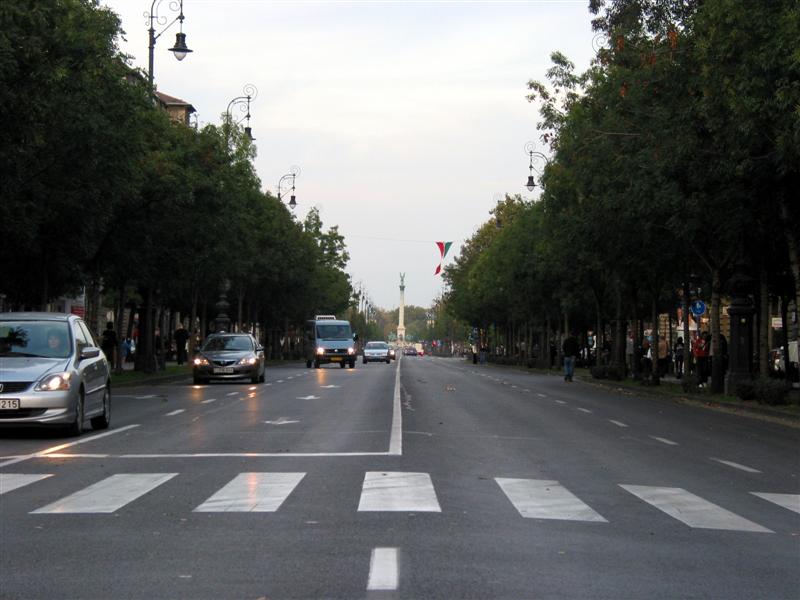
Andrássy út was inaugurated on 20 August 1876 and runs for about 2.3 km from the edge of the inner city to Heroes’ Square, the gateway to the City Park. Together with the M1 metro beneath it, the avenue is part of Budapest’s UNESCO World Heritage property, and it’s one of the few streets in the city that was planned as a single piece and still reads as one.
It changes character as it climbs. The lower stretch, from the inner city to Oktogon, is the busiest: apartment palaces with shops and cafés on the ground floor, the Opera House, and a run of international fashion boutiques. Past Oktogon, the avenue becomes greener and calmer, with the House of Terror at number 60. Beyond the Kodály körönd, the circus with its four curving corner buildings, the apartment blocks give way to detached villas set back behind front gardens, and the last few hundred metres to Heroes’ Square feel almost suburban.
Is it worth walking the whole length? Yes, once, ideally in the direction of Heroes’ Square, which gives you the monument as a goal and the M1 to take you back. It takes about half an hour without stops and closer to two hours if you go into the Opera or the House of Terror on the way. If your time is short, walk the lower stretch to Oktogon, where most of the interest is, and ride the rest.
The M1, the line under the avenue
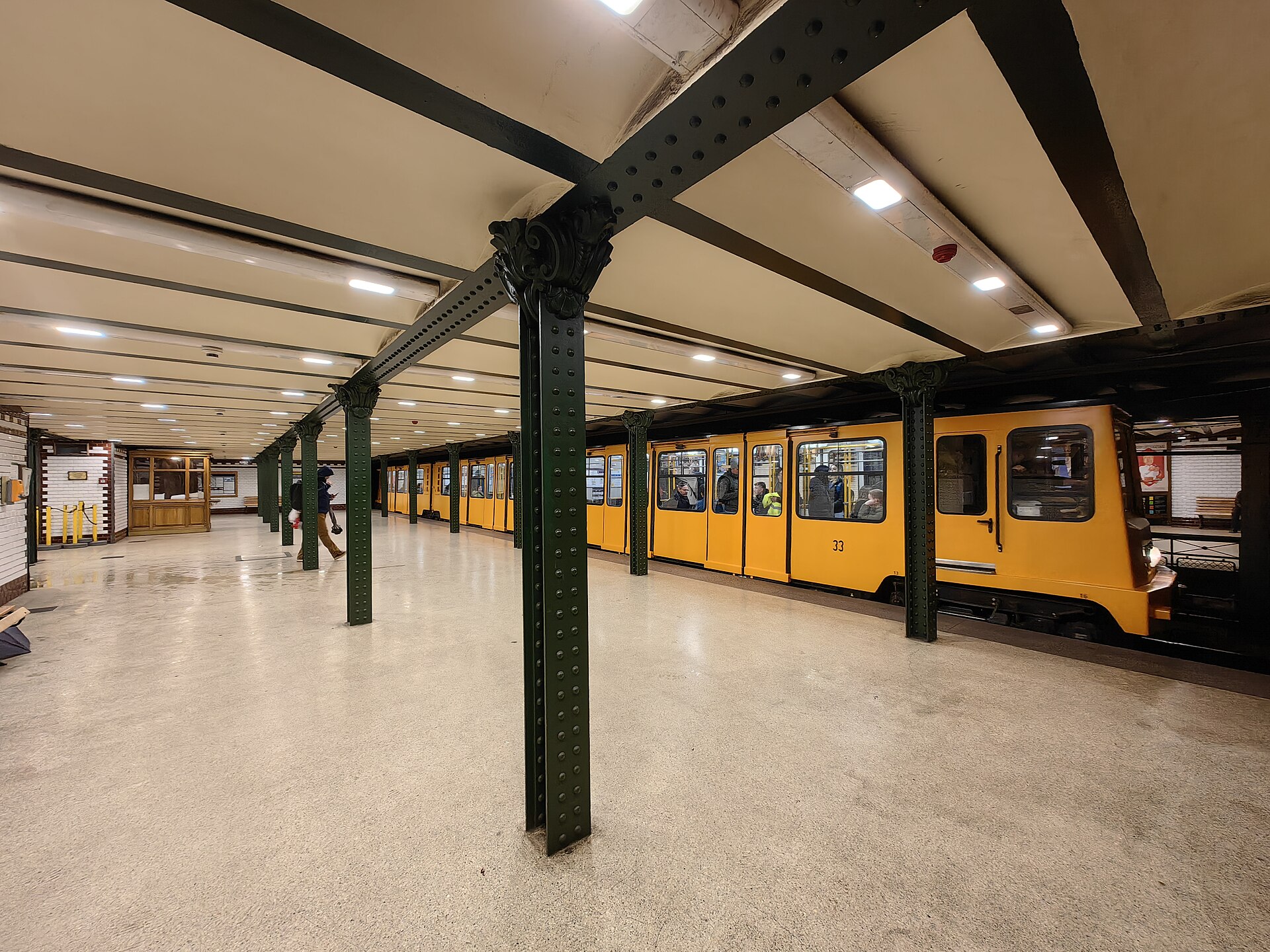
The M1, officially the Millennium Underground Railway, opened on 2 May 1896 for the celebrations of Hungary’s thousandth anniversary, and BKV, which runs it, describes it as the first underground railway on the European continent. Emperor Franz Joseph rode it on 8 May 1896 and let the company take his name. It runs just beneath Andrássy út, so the stations are a short flight of steps from the pavement, with the original tiled walls and ornate column capitals still to be seen; the line and its historic stations are part of the World Heritage listing.
For visitors it’s the obvious way to travel along the avenue, with stations at Opera, Oktogon, Vörösmarty utca, Kodály körönd and Bajza utca before Hősök tere for Heroes’ Square. Expect stairs: in May 2026 BKV still described accessibility improvements on the line as planned rather than done. Our metro guide covers tickets and the other three lines.
The Hungarian State Opera
Miklós Ybl’s neo-Renaissance opera house on the lower avenue opened on 27 September 1884, and after a long restoration it reopened on 12 March 2022. The work reduced the auditorium from about 1,200 seats to about 1,000 and added lifts for the audience. Even from the pavement it’s one of the handsomest buildings in the city, and inside it’s all marble, gilding and painted ceilings.
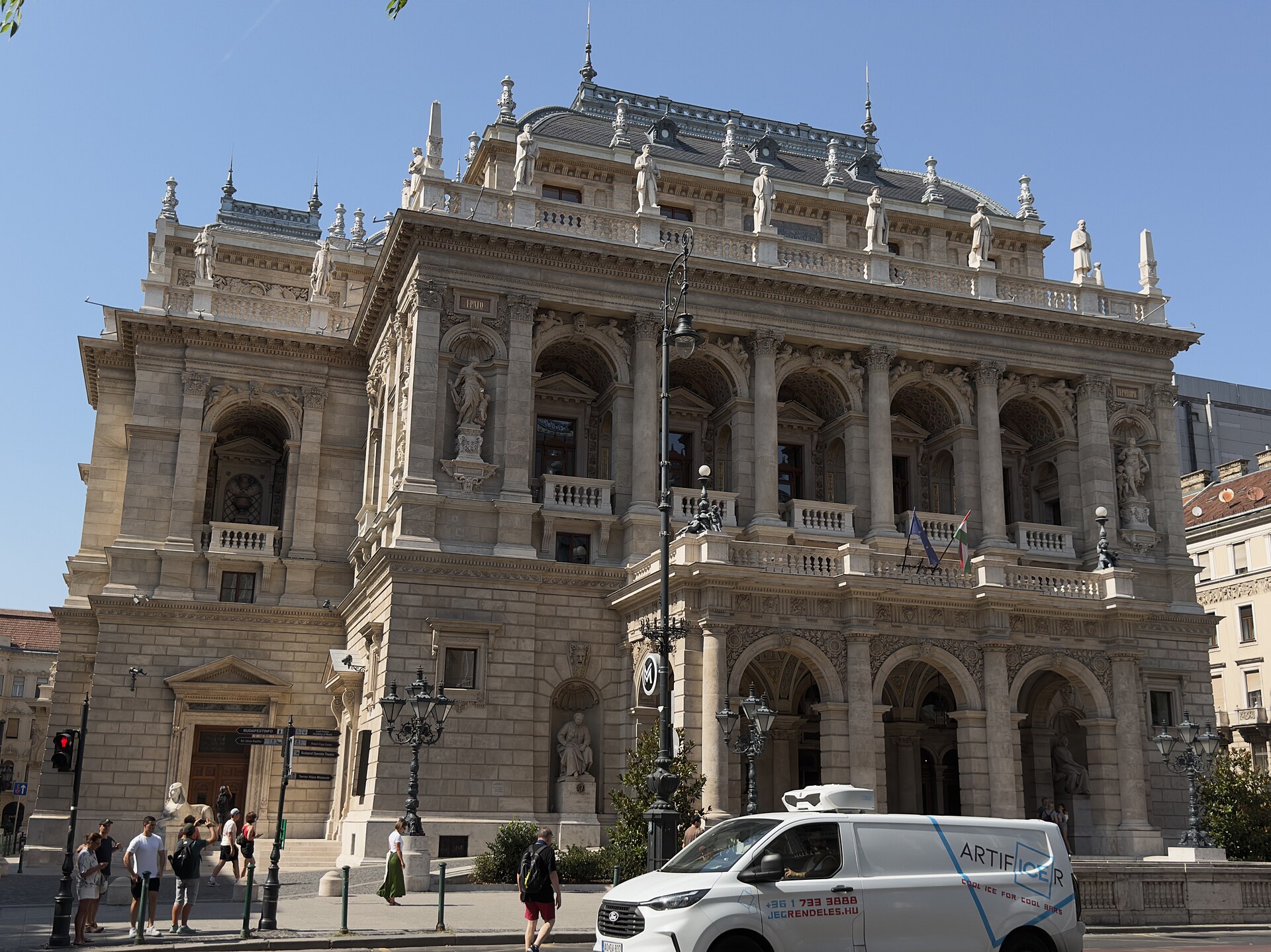
There are two ways in. The OperaTour runs in English for about an hour, daily at 13:30, 15:00 and 16:30, and ends with a short concert; it costs 12,000 HUF (about €33), tickets go on sale a week ahead at the box office or online, and there are no tours during performances. The other way is to see a performance. Standing tickets go on sale two hours before evening performances, and even a cheap seat gives you the building, the music and the audience together, which a tour can’t. If you can make the dates work, choose the performance. Our Opera House guide has more on the building and how to book.
The House of Terror
At Andrássy út 60, the House of Terror occupies the building where Hungary’s fascist Arrow Cross and then the communist state security police held and tortured prisoners, and it’s now a museum to both regimes and their victims. The black frame around its roof, with TERROR cut out of it, throws the word in shadow across the facade on sunny days.
It’s open Tuesday to Sunday from 10:00 to 18:00 (the cash desk closes at 17:30), and closed on Mondays. Tickets are 4,000 HUF (about €11) for adults and 2,000 HUF reduced, sold only at the museum, with no online sales. The exhibition is theatrical rather than scholarly, with dramatic staging, music and video, and it can be overwhelming; the basement cells are the part people remember. Our House of Terror guide explains what to expect and how to pace it.
The Liszt Academy and Liszt Ferenc tér
A short walk off the avenue, the Liszt Academy of Music is the district’s other great building, and for many music lovers the reason to come to Budapest at all. Its Art Nouveau interior was refurbished by 2013, with the main concert hall restored to the way it was built in 1907: gilded, glowing and a thrilling place to hear music. See our guide to Budapest Art Nouveau for the style and where else to find it.
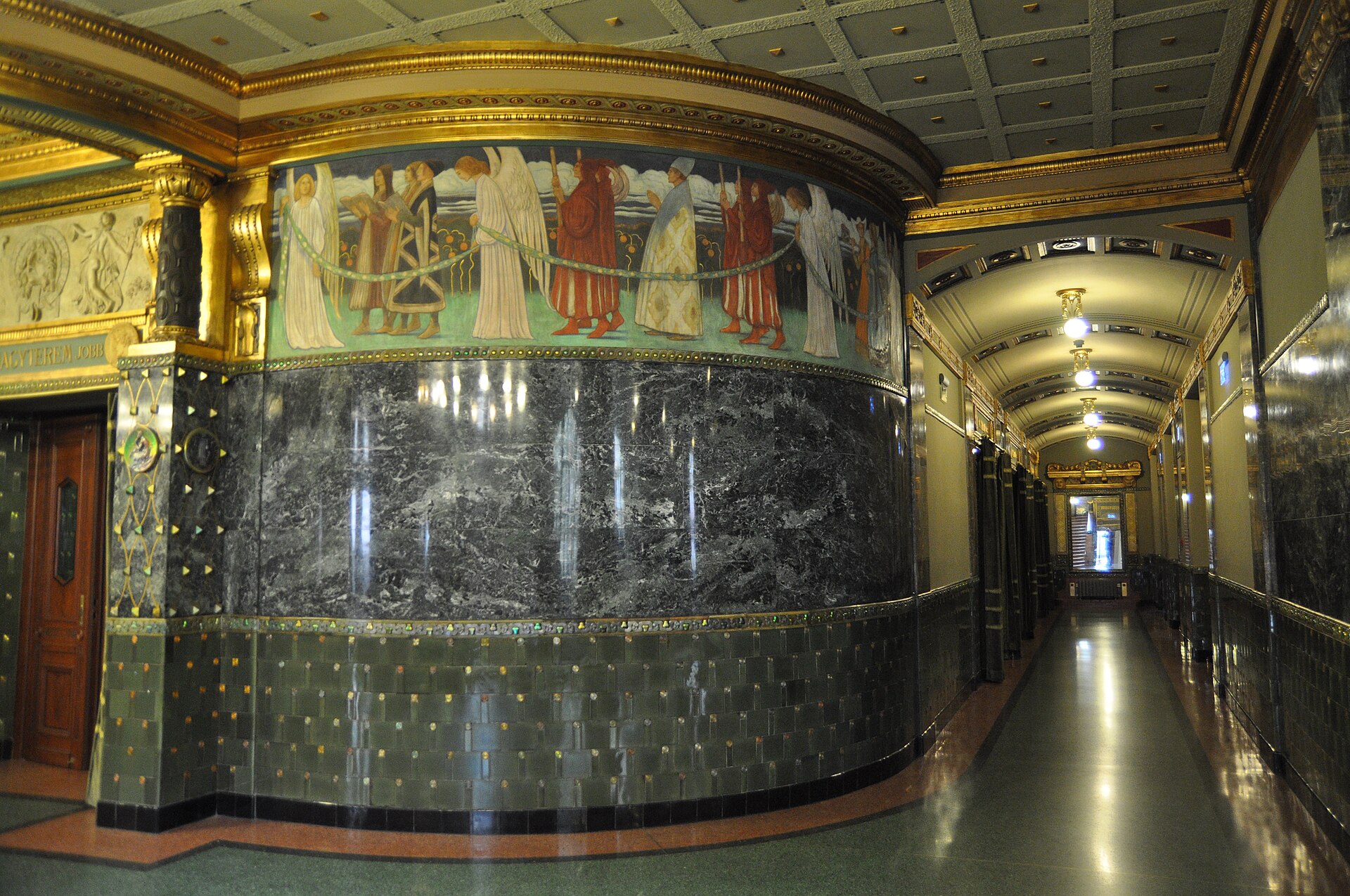
The best way to see it is from a seat at a concert; the programme runs through the season. Otherwise, guided tours last about 50 minutes, run in Hungarian and English and end with a short concert by students. A tour with a foreign-language guide costs 6,700 HUF (about €18), or 4,100 HUF with a Hungarian guide. English tours run on set dates rather than daily (one was scheduled for 21 November 2026 at 16:30, for example), so check the Academy’s tour page before planning around one.
Liszt Ferenc tér, the long, tree-shaded square between the Academy and Andrássy út, is lined with café and restaurant terraces. It’s a pleasant place for a drink before a concert, lively on summer evenings and pricier than the streets around it, and it’s the kind of square where you’re paying partly for the setting. Back on the avenue, the Liszt Ferenc Memorial Museum, in the Old Academy of Music, holds concerts on Saturday mornings at 11:00; check its own site for current hours and prices.
Nagymező utca, Budapest’s Broadway
Nagymező utca, running across Andrássy út between the Opera and Oktogon, calls itself Budapest’s Broadway, and in the evening it earns the name. The Budapest Operetta Theatre, the Thália and the Radnóti are all here, and the bars and restaurants around them fill up before and after performances.
By day it’s the street for photography. The Robert Capa Contemporary Photography Center at Nagymező utca 8 is open Tuesday to Friday from 13:00 to 18:00 and at weekends from 10:00 to 18:00 (closed Mondays); a full combined ticket is 7,000 HUF (about €19), with student and senior tickets at 4,500 HUF, and its 8F Gallery is free to visit daily from 9:00 to 19:00. Its current show, METAMORPHOSIS, runs until 17 January 2027. Further along the street, the Mai Manó House, the Hungarian House of Photography, puts on exhibitions too; check maimano.hu for what’s on and when it’s open.
Behind the avenue
The streets between Andrássy út and Teréz körút, and between the boulevard and Nyugati station, are where Terézváros lives. It’s a grid of tall apartment houses with heavy wooden gates and inner courtyards, corner bakeries and shops, and small squares that act as the neighbourhood’s back gardens.
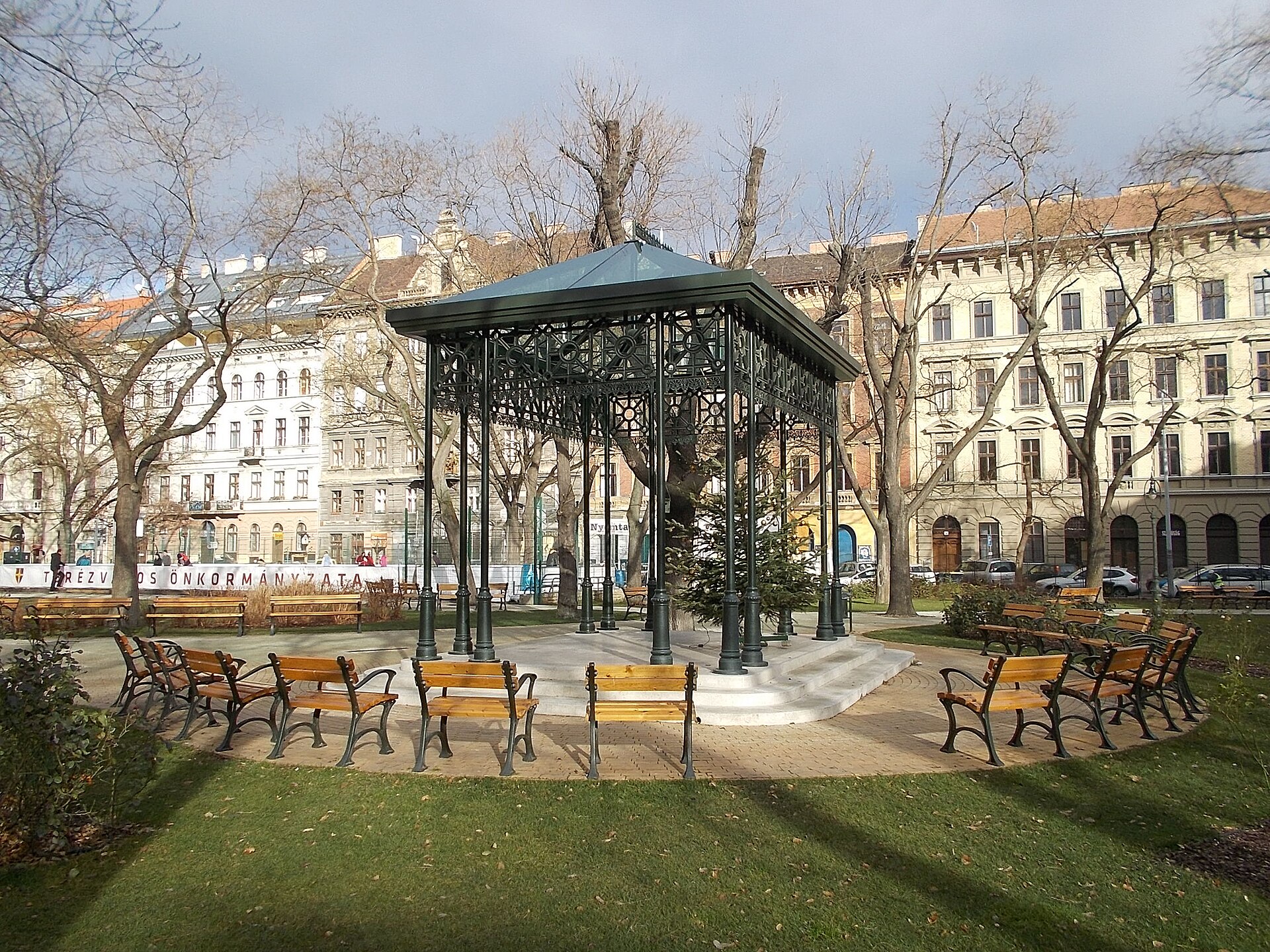
Hunyadi tér is the best of them: a small park with a cast-iron bandstand and benches, a block from the avenue and a world away from it. Its old market hall went into a long interior renovation in 2025, with traders moved to a temporary market alongside, so check whether the hall has reopened before you go looking for it. Even without the hall, the square is a good place to see how the district actually works on a weekday morning.
Teréz körút, the district’s stretch of the Grand Boulevard, is busy, noisy and practical, with trams 4 and 6, shops, fast food and a steady flow of people between Oktogon and Nyugati. It isn’t pretty, but it’s the spine of everyday life here. Further north, beyond the boulevard, the streets towards Podmaniczky utca and the railway lands are quieter still and almost entirely residential.
Nyugati station
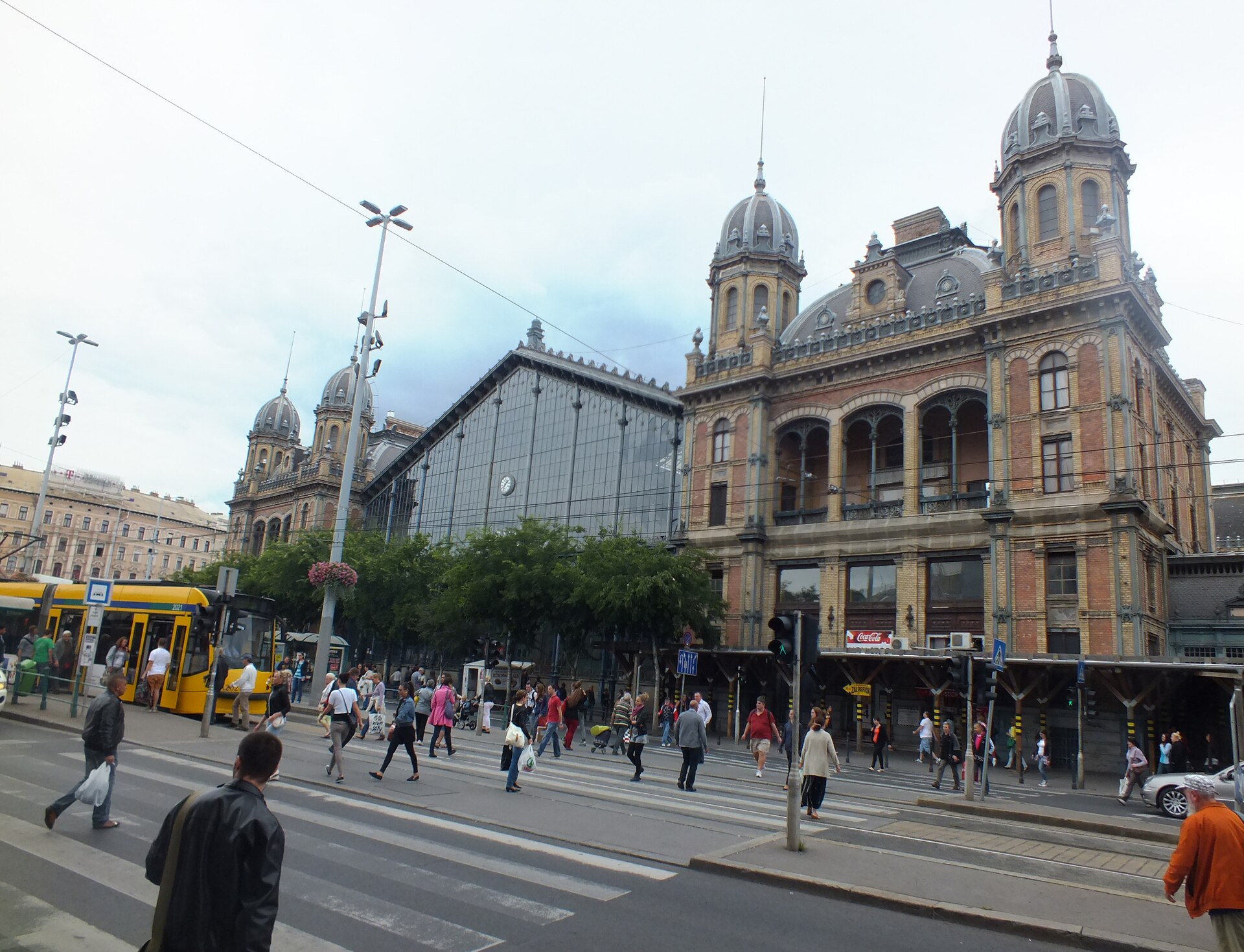
The district’s northern edge is Nyugati station, the Western Railway Station, which opened in 1877. Its iron-and-glass train shed is often credited to Gustave Eiffel, but MÁV, the Hungarian railway company, credits the design to the Austrian August de Serres, with Eiffel’s office coordinating the work and Théophile Seyrig designing the iron structure. It’s still a working terminus, and the facade, with the shed glazed between two ornate brick-and-stone wings, is worth a look even if you aren’t catching a train.
Next door, the WestEnd City Center shopping mall (Váci út 1–3, in the same 1062 postcode) is useful for practical errands and wet afternoons. The M3 metro stops at Nyugati, and our guide to Budapest’s train stations explains which trains leave from where.
Eating and drinking
District VI has three distinct places to eat, and knowing which you’re in saves money and disappointment.
- The lower avenue and around the Opera: grand cafés, hotel bars and smart restaurants, aimed at visitors and the theatre crowd. Fine for a special occasion; you pay for the address.
- Liszt Ferenc tér and Nagymező utca: terraces, cocktail bars and pre-theatre menus. Lively and convenient, but terrace prices on the square tend to be higher than in the back streets.
- The back streets: the best value. Lunchtime menus, bakeries, small bistros and the odd old-fashioned eatery serving set daily dishes, mostly for the people who live and work here. Walk a block or two off the avenue before you choose.
Coffee is a district speciality. Andrássy út has some grand old cafés, and several of the city’s best-known coffee houses are a short walk away; our guide to Budapest’s coffee houses rounds them up, and our best restaurants in Budapest covers the wider dining scene.
Nightlife: District VI or District VII?
The two districts meet at Király utca, and their nightlife meets there too. District VI’s evenings are mostly about the theatres, the Opera and the Liszt Academy, with bars on Liszt Ferenc tér and Nagymező utca and a busier strip close to the District VII border. Cross Király utca and you’re in the ruin-bar quarter, louder and open later.
In practice, plenty of people sleep in VI and go out in VII, which works well: you’re a short walk from the bars and far enough away to get some sleep. Our guide to District VII covers the party district by night and day, and the Budapest nightlife guide has the rest of the city.
Short-term lets: the 2026 rules
If you’re thinking of renting an apartment here, read this first. After a local vote, Terézváros cut the number of days a private home may be let short-term to zero a year from 1 January 2026, and in November 2025 Hungary’s supreme court, the Kúria, ruled the district’s decree lawful; fines have since been issued to people who broke the ban. Hotels, guesthouses and registered community accommodation aren’t affected by it.
For visitors the practical upshot is simple: in District VI, book a hotel, guesthouse or hostel rather than a private holiday apartment, and treat any listing that offers one with suspicion. Our guide to Airbnb in Budapest explains the rules district by district and where you can still book an apartment legally.
Getting around
- M1: under Andrássy út, from the inner city to Heroes’ Square and the City Park. The quickest way along the avenue.
- M3: stops at Nyugati, for the north–south route through the centre.
- Trams 4 and 6: along Teréz körút, through Oktogon and Nyugati, and on round the Grand Boulevard in both directions. The 6 normally runs through the night, though replacement buses sometimes take over for track works.
- On foot: the whole district is walkable. From the Opera to Oktogon takes under ten minutes; Heroes’ Square is about half an hour’s walk from the Opera.
Our public transport guide explains tickets and passes, and the tram guide covers the 4 and 6.
Should you stay in District VI?
For a lot of visitors it’s the best compromise in the city: central, walkable, well connected, handsome, and calmer than District VII while being only a few minutes from its bars. The catch in 2026 is the short-let rule, so you’ll be choosing between hotels, guesthouses and hostels rather than apartments. Rooms near the Opera and on the lower avenue usually cost more; the back streets towards Nyugati and the upper avenue are quieter. Our guide to which district to book compares it with the alternatives, and where to stay in Budapest has the hotel picks.
A walk up Andrássy út
This route takes a relaxed half-day and works on any day but Monday, when the House of Terror is closed.
- Start at the Opera (M1 Opera). Take the 13:30 OperaTour if you’ve booked it, or just look at the facade and the foyer.
- Cross to Nagymező utca, Budapest’s Broadway, and check what’s on at the Capa Center or the Mai Manó House.
- Cut through to Liszt Ferenc tér for a coffee on the terraces and a look at the Liszt Academy’s facade at the far end.
- Back on the avenue at Oktogon, carry on up to the House of Terror at number 60. Allow at least an hour and a half inside.
- Walk on past the Kodály körönd and into the villa stretch, where the avenue goes quiet under the trees.
- Finish at Heroes’ Square, then either explore the City Park or ride the M1 back to the centre.
With an extra hour, detour from Oktogon to Hunyadi tér and the streets behind the avenue, which show you the district the tour buses miss. For the start of the walk, our guide to District V covers the inner city at the avenue’s lower end.
Is District VI worth it?
Yes, and not only for the headline sights. The Opera, the Liszt Academy and the House of Terror would each justify a visit, and Andrássy út is one of the great walks of central Europe. But the district’s real pleasure is how quickly it turns from grand to ordinary: a block from the boulevard you’re among bakeries, courtyards and people walking dogs. Give it a half-day for the avenue and an hour or two more for the streets behind it, and if you can, come back in the evening for a concert or a show. Skip the terrace dinners on the most famous corners, and don’t expect to rent an apartment here.
Frequently asked questions
What is District 6 in Budapest known for?
District VI, Terézváros, is known for Andrássy út and the M1 metro beneath it, the Hungarian State Opera, the House of Terror, the Liszt Academy concert hall, the theatres of Nagymező utca and Nyugati station.
Is District 6 a good place to stay in Budapest?
Yes, for most visitors: it’s central, walkable and calmer than District VII. Since 1 January 2026, though, private homes can’t be let short-term, so stay in a hotel, guesthouse or hostel rather than a holiday apartment.
What is the difference between District 6 and District 7?
Király utca divides them. District VI is the more polished of the two, with Andrássy út, the Opera and the concert halls; District VII is the old Jewish quarter and the ruin-bar district, louder and busier at night.
Is Andrássy út worth walking?
Yes. It’s about 2.3 km from the inner city to Heroes’ Square, around half an hour without stops. If you’re short of time, walk the lower stretch from the Opera to Oktogon and take the M1 the rest of the way.
Can you tour the Budapest Opera House?
Yes. The OperaTour runs in English daily at 13:30, 15:00 and 16:30, lasts about an hour, ends with a short concert and costs 12,000 HUF. There are no tours during performances, so book ahead.
Can you rent an Airbnb in District 6?
Not legally in a private home. Terézváros cut short-term letting of private homes to zero days a year from 1 January 2026; hotels, guesthouses and registered community accommodation are unaffected.
Is the House of Terror worth it?
For most visitors, yes, as long as you know it’s dramatic and theatrical rather than a quiet history museum. Allow at least an hour and a half; it’s closed on Mondays and adult tickets are 4,000 HUF.
Photo credits
Andrássy út towards Heroes’ Square (featured image): Andrassy-ut-budapest by Andreas Poeschek , fotografikus.hu, CC BY-SA 2.0 at, via Wikimedia Commons.
The M1 at Oktogon: Budapest, M1 metró, Oktogon, 16 by Random photos 1989, CC BY-SA 4.0, via Wikimedia Commons.
The Hungarian State Opera House: Hungarian State Opera House Budapest 2026 by Mike is Michi, CC BY-SA 4.0, via Wikimedia Commons.
The Liszt Academy foyer: Budapest, Zeneakadémia, 15 by Christo, CC BY-SA 4.0, via Wikimedia Commons.
The Hunyadi tér bandstand: Hunyadi Square Bandstand, 2016 Terezvaros by Globetrotter19, CC BY-SA 3.0, via Wikimedia Commons.
Nyugati station: Budapest-Nyugati by Orrling, CC BY-SA 3.0, via Wikimedia Commons.